
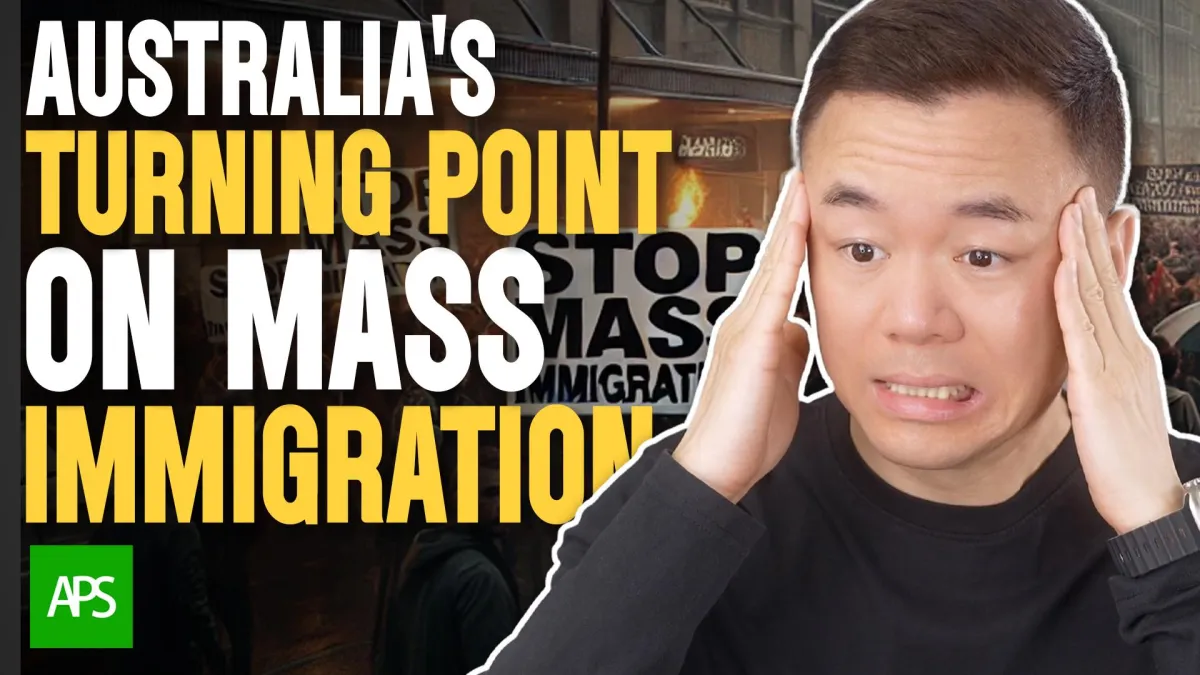
Why Australians Want Chinese and Indians Out? Housing Crisis | EP112
I honestly didn’t expect this. I thought the nationwide anti-immigration rallies at the end of August would come and go—just a one-off protest. But not long after, an even larger national anti-immigration march broke out again. Tens of thousands of Australians took to the streets holding signs: “End Mass Immigration,” “Immigrants are about to replace Australians.” Some flyers even target the Indian community, claiming that over the next five years more Indians will come to Australia than the total number of Greeks and Italians who arrived in an entire century. Chinese people walking down the street could be shouted at “Go back to China.” by strangers at any time. And it’s not just Australians—many Australian Chinese have also joined the anti-immigration march.


Some Australians say being anti-immigration isn’t racism; others are blunt about it and openly throw out white-supremacist ideas.
Soaring house prices, rising living costs, fewer job opportunities, and cultural erosion have become the reasons many Australians vent their anger at migrants. Anti-immigration sentiment across the country has been completely ignited. A nationwide anti-immigration wave has begun.
How did a democratic nation that prides itself on cultural inclusiveness and welcoming migrants become a vanguard of anti-immigration—especially against Chinese and Indian migrants? With Australia like this, do you still want to come?
Opinion on Immigration Flipped
Many people don’t understand—where does the anger inside Australians come from? In 2025, the Lowy Institute ran a social survey with a single question: “Regarding Australia’s current immigration policy, do you think the annual number of migrants is too high, too low, or about right?” A striking 53%—more than half—said the intake is too high. That tells us the anti-immigration sentiment has passed a tipping point. It can’t be held down anymore; it’s become mainstream thinking across Australia.


Over the past decade, the number of people born in China who migrated to live in Australia rose from 430,000 to 660,000—up 51%. It hasn’t grown as fast as the Indian-born population, but by country ranking, Chinese migrants still sit in the top three. Hostility toward Chinese people peaked during the pandemic. After that, as China’s economy slowed and India gathered strength, Australia leaned toward India, signed multiple bilateral trade deals, and gradually shifted its focus to the Indian community.

In 2014, 410,000 Indian-born migrants were living in Australia. By then, Indians had already gained a foothold—growing in influence, but still seen as manageable. By 2019, that number jumped to 660,000. At the 2021 census, the Indian-born population officially surpassed the Chinese-born, becoming the largest overseas-born group after the British. By 2023, the Indian-born community reached 845,000, and rose again to 916,000 by mid-2024—more than 3.4% of Australia’s population. In just ten years, the Indian community more than doubled, becoming the fastest-growing migrant group nationwide.

This explosive growth didn’t happen by accident. Australian universities actively recruited Indian students. Businesses looked for skilled tech and healthcare workers. The government viewed Indian migration as an economic booster to offset the drag of an ageing population. Before Australia reopened its borders in 2022, Australians broadly welcomed the energy that Indian migrants brought.
A Turning Point in Immigration Sentiment
On the last weekend of August 2025 and the second weekend of October, the “March for Australia” organised rallies across the country. From Sydney’s CBD to the streets of Perth and Hobart, demonstrators called for an end to mass immigration. Banners and chants targeted Indians in particular. Some participants were linked to neo-Nazi and white-supremacist groups. Counter-protesters got together quickly and marched at the same time, and police reported violent clashes in several cities. Government leaders called the rallies racist—anti-immigration gatherings don’t belong in Australia; these aren’t Australian values. Yet polls show more than half the public is against current immigration levels. The Prime Minister of course says Australia is inclusive and welcomes migrants, but the angry crowds and anti-immigration slogans have been seen around the world and shaken the confidence of people considering to move here. The message is that Australia no longer welcomes migrants. Is Australians’ anger really because there are too many migrants? Or is there something deeper?
1.House Prices Soaring
The first problem triggered by rapid population growth—and the first layer of the backlash against migrants—is skyrocketing house prices. From 2013 to 2024, Sydney’s median property price jumped by more than 90%, from a bit over $600,000 to $1.18 million. In some suburbs of Sydney the surge topped 150%, with prices rising even faster after the pandemic. Brisbane, Perth, Adelaide—even Darwin—have been booming. Rents in Melbourne have hit record highs. Public hospitals are under mounting pressure, wait times are longer, and emergency rooms are packed. What about transport? City commuter systems are overloaded; train delays are up and crowds keep growing, especially in Sydney and Melbourne’s morning peak. Strikes hit the rail network from time to time, bringing services to a standstill for days. Even childcare centres, parks, and supermarkets are jammed—running beyond capacity. Why? More properties were built nearby, more people have moved in, but the infrastructure hasn’t kept up. Demand for housing keeps climbing year after year, while supply is severely short. Economists keep saying the real problems are interest rates, strict land-use rules, and construction bottlenecks—slow approvals and labour shortages—these are what push prices higher. But more Australians are turning migrants into the target, and the surge in Indian migration has been seized on as “evidence” by anti-immigration voices. Listen to what the protesters are saying.
The mismatch between population growth and housing supply is directly driving up both prices and rents.
If you have any questions about property investment, please book a free 15-minute discovery call on our website. If you want a team offering one-stop service to help you build a property investment portfolio, achieve financial freedom and retire early, join our VISION Membership by booking a 30-minute obligation-free discovery session to start with. Or to keep it simple, our data-driven buyer's agency service can help. We buy and manage properties for our clients anywhere in Australia. Links to the service are in the description below.
2.Severe Employment Pressures
Many local Australians feel the workplace has become noticeably more competitive. Job growth is slowing, yet more people are looking for work. New migrants enter the labour market and compete alongside locals for interviews, trial roles, and promotions. For those already “stuck in place” at work, the moment a company announces a hiring freeze or headcount cuts, that sense of being squeezed expands fast: the opportunities ahead haven’t increased, but the rivals behind you are multiplying.
When the queue for a job stretches longer and the number of résumés for the same role doubles, it’s natural that many point the finger at migrants, believing “outsiders” have raised the bar. Even if the real causes are more complex, emotionally that instinctive reaction forms first. Once people feel threatened, they slip into a defensive posture—anxious about losing the job they have, fearful there’ll be no openings in future—and then channel frustration and hostility toward a visible minority. The more often this chain of emotions is triggered, the more it accumulates and hardens into confrontation. It’s not hard to see why some locals choose to march and voice an “anti-immigration” demand.
And that’s in a scenario where jobs still exist. What if there aren’t jobs? Last month Australia’s unemployment rate jumped to 4.5%, a four-year high. In that environment, anti-immigration voices can only grow louder.


3.The Cost of Living Surge
Housing and jobs are surface symptoms. Ultimately, both flow into one issue: the cost of living. Why has Australia turned against immigration? Because life for locals is getting tougher. Protesters repeat the same line—“We can’t afford it!” They’re talking about bidding wars for rentals, being priced out of the suburbs where they grew up. New migrants are taking up Australia’s resources, leaving locals with less. It’s hard not to feel heavy hearing that, isn’t it? A typical family of three in Sydney now easily spends over $5,000 a month. Electricity, groceries, rent—everything is climbing. Who wouldn’t be anxious?
But reality is more complicated. Migration brings additional labour, entrepreneurialship, and more tax revenue; multiple studies also show that over the long run, immigration lifts overall wages. The problem is, that understanding hasn’t “landed” with the public. When a family budget is squeezed by rent, school fees, and all the extras, what people get is the pain of being pressed.
After the pandemic, the rebound in migrant numbers collided with a slowdown in homebuilding. The national rental vacancy rate fell below 1%. On the supply side, the brakes were on; on the demand side, the accelerator was floored. The outcome: rising rents, dwindling available listings, and public services under strain across the board.
4.Fear of Cultural Invasion
Beyond economics, there’s a deeper fear: cultural invasion. More and more Indian grocery stores, Hindu temples, and Diwali celebrations. Streets that used to be quiet now blast Indian music every evening, and a pile of Indian festivals has appeared out of nowhere. In many Australians’ eyes, this isn’t cultural integration—it’s a signal of “cultural invasion.” Lively videos on social media of Indian weddings or cricket celebrations are twisted into “proof” that India is taking over Australia. A flyer compares the number of Indians arriving in five years with Greeks and Italians over an entire century, warning that Australians will be replaced. Every line carries a whiff of conspiracy.
As the Indian community grows, Indian Australians are stepping onto the political stage. The two major parties are scrambling to win Indian-Australian voters. Some Australians, without evidence, accuse migrants of potentially shifting elections and steering policy in Australia. When this suspicion stacks on top of economic unease, people will reduce every complex issue to a single slogan: “Stop mass immigration.”
Why aren’t Australians afraid of a cultural invasion from Chinese people? Because at most the Chinese celebrate Lunar New Year, and it’s not even unique to China alone. The one thing that’s really seen as “Chinese culture” with the widest impact—the bit that changes local communities—is probably the aunties doing plaza dancing. But even that cultural intensity can’t compare with India’s.
Australians’ views of Indians and Chinese have been completely different at different times. Another Lowy Institute survey in 2025 measured how welcome other countries are in Australia. New Zealand ranked the highest at 85, followed by Japan at 76. India’s favourability fell sharply after the pandemic, from 65 down to 51 now. China’s favourability dropped to a freezing 32 during the period of bilateral friction in the pandemic. Back then, one in three Chinese people in Australia experienced racial discrimination. This happens every day in Australia. In recent years favourability toward China has edged up to 37, but the situation hasn’t improved much. The tall poppy gets cut—now it’s India’s turn. India and China sit near the bottom of the rankings, only slightly better than Russia and North Korea. This explains why today’s anti-immigration wave is aimed at Indian and Chinese migrants—because there are so many of them.


Values and Reality
In response to the two waves of large-scale anti-immigration rallies, Australia’s official stance was swift and clear: “Cultural diversity is Australia’s core strength.” Police stepped up protection for temples and community centres. Both major parties issued a joint statement emphasising the value of migrant cultures. Canberra reaffirmed migration targets and made it clear that extremists won’t dictate policy. The Indian government asked Australia to ensure the safety of Indian citizens. Despite the protests, diplomatic and economic ties between the two countries remain stable. And Australia’s relationship with China has also eased somewhat in recent years—at least business has more or less returned to normal.
Australians aren’t only concerned about immigration; they’re also asking what kind of country Australia will become. Whenever the economy is weak, living standards fall, jobs are hard to find, and lifestyles and culture are forced to change, immigrats get the blame. These all become reasons to oppose immigration. If the anti-immigration sentiment keeps rising, the government really could make major policy shifts—if it doesn’t, it may not win the next election. History offers too many examples showing that when a society suffers a deep sense of defeat, minority groups become the targets for venting.
The phenomenon of mass immigration in a short time, rising rents, and rising house prices is playing out across the major countries of the world. From the United States to Europe, populist often pin economic problems on migrants. But Australia’s anti-immigration wave only represents part of the country. Chinese and Indian restaurants are thriving; cricket brings fans of different backgrounds together; Chinese- and Indian-origin entrepreneurs are advancing on the frontiers of innovation. Friendships, marriages, and business weave cultures together—no protest can tear that apart. A significant share of Australians support diversity, and they recognise the contribution that students, professionals, and families make to the economy. The real question is whether the country has prepared for the scale of migration. Are housing, healthcare, and transport expanding fast enough to welcome newcomers without pushing locals aside? When infrastructure lags and policy fails, frustration just keeps piling up, and law-abiding migrants become the “easiest targets.” Yet migrants arrive in Australia through legal pathways, looking for the chance to change their lives that Australia offers.
Many Australians believe that as long as immigration stops, everything will get better. So under what conditions would Australia no longer need migrants? When Australia can train enough experts in every field on their own, manage the economy well, raise living standards, and there is a strong Prime Minister appearing—one who won’t be morally blackmailed. Look at what this member of the European Parliament from Poland (Dominik Tarczynski) says.
Nothing shown in that video is something Australia can achieve right now. Will Australia move in that direction? I don’t think it’s possible in the short to medium term. As long as mining, agriculture, and education exports still dominate, Australia will continue to have relatively generous social welfare. Compared with countries that send migrants, the pressure to survive here is certainly lower, so there’s naturally less drive to overhaul the system and push hard for income. As long as this logic holds, Australia will need migrants. And Australia’s house prices will continue to have the momentum to rise.
Watch the video version of the blog on YouTube.
15 Minutes Free Consultation (Limited-Time Free Offer)
If you have any questions about Australian real estate, we invite you to use our 15 Minutes Free Consultation service. Once you have filled in the form, a professional property investment strategist will be in touch with you. They will assess your needs and provide fundamental advice. This service is designed to help answer general property-related queries. BOOK NOW.
VISION Membership
Our Flagship Service: VISION Membership. Your One-Stop Property Investment Manager – Build a Tailored Portfolio and Achieve Financial Freedom
Whether you're an employee, a professional, a business owner or even a new migrant, everyone has a financial goal for the future. The VISION Membership is designed to solve all the pain points in your Australian property investment journey through one single, comprehensive service.
By analysing your current financial situation and long-term goals, we'll tailor a property investment plan just for you. Our team will match you with the ideal mortgage structure, tax strategies, wealth planning, and legal support, empowering you to go further, faster, and smarter on your path to financial freedom.
VISION Membership is perfect for busy individuals who want a professional team to create, expand and manage their Australian investment portfolio. If you're looking for a dedicated team, including real estate investment experts, mortgage brokers, accountants, financial planners, and property solicitors, VISION Membership is your ideal solution.
Start with an obligation-free 30-minute discovery session on Zoom. BOOK NOW.
VISION Buyer’s Agent
No time for inspections? Tired of dealing with pushy selling agents? Unsure how much to offer or feeling nervous about auctions? Worried about buying the wrong property? If any of these sound like you, AusPropertyStrategy's Australia-wide VISION Buyer's Agent Service is here to help.
We provide end-to-end support to help you build an optimised property portfolio and achieve your financial goals—whether you're investing interstate, refinancing, or planning post-settlement leasing or resale. Our services cover everything from suburb research and property selection, to price negotiation, auction bidding, and post-settlement support.
Start with an obligation-free 30-minute discovery session on Zoom. BOOK NOW.
real estate australia,real estate investing,australian property,australian housing market,australian economy,australian property investment,australian property market,buying property,australian real estate,mortgage brokers brisbane,first home buyer,Australian Real Estate,Australian Real Estate Investment,Australian Property Investment,Real Estate Investment,Property Investment,Property Investment Australia,Passive Income,Positive Cash Flow,Australia Real Estate Investing,Australian Real Estate Investors,Australian Property Investors,Vision Wealth Mentors,Vision Real Estate Investors Australia,financial freedom, freedom through property investment,real estate investors,property investment,passive income,positive cash flow,real estate course,real estate courses,real estate training,australian property market,property investment brisbane,property investment sydney,melbourne property market,investing in brisbane,investing in melbourne,how to invest in property,buying properties,start investing in property,property investment strategy,how to buy investment property,property investing tips,best suburbs to invest in sydney,locations real estate,prime location,property growth by suburb,capital growth suburbs


