

Why 0% Might Be the Most Dangerous Number in Australian Property|APS155
The Australian property market just went flat. Fifteen months of consecutive growth, and in May 2026, it all stopped. Zero percent. Not a crash, not a boom, just nothing. And that might be the scariest number of all, because what usually follows flat is down.
Sydney and Melbourne have already tipped over. They’re officially in a downturn cycle. The three mid-tier capitals are still climbing, but they’ve taken their foot off the gas. And new foreign capital restrictions have shut down one of the biggest pipelines of overseas money flowing into Australian property.
Now, a lot of people are looking at these numbers and saying the party’s over. And I get it. But here’s what most of them are missing: the Australian property market is not one market. It’s a collection of completely different markets, and they’re all moving in different directions. If you treat them like they’re the same thing, you will make the wrong call every time.
So what actually happened in May, what does it mean for what’s coming, and in a market like this, should you be selling, waiting, or buying in?
May Property Market Stalls
Straight to the numbers. In May 2026, the national property market came in at exactly 0% growth, bringing 15 months of consecutive gains to a dead stop. Annualised growth rate is still 8.8%, and with rental yields on top, total returns come in at 12.5%. National median price: $940,000.
But a whole pile of bad news hit at once. Three rate hikes in a row. The Penthouse Syndicate lending fraud case spooked the big four banks and major funds into tightening loan scrutiny, which slowed approvals, pushed down approval rates, and shrank loan amounts. The Iran conflict pushed inflation higher. Then you’ve got the CGT reform and the abolition of negative gearing on top of all that. For property investors, it’s been a painful stretch. Owner-occupiers still want to buy, but getting finance approved right now is very tough, and transaction volumes have dropped as a result.
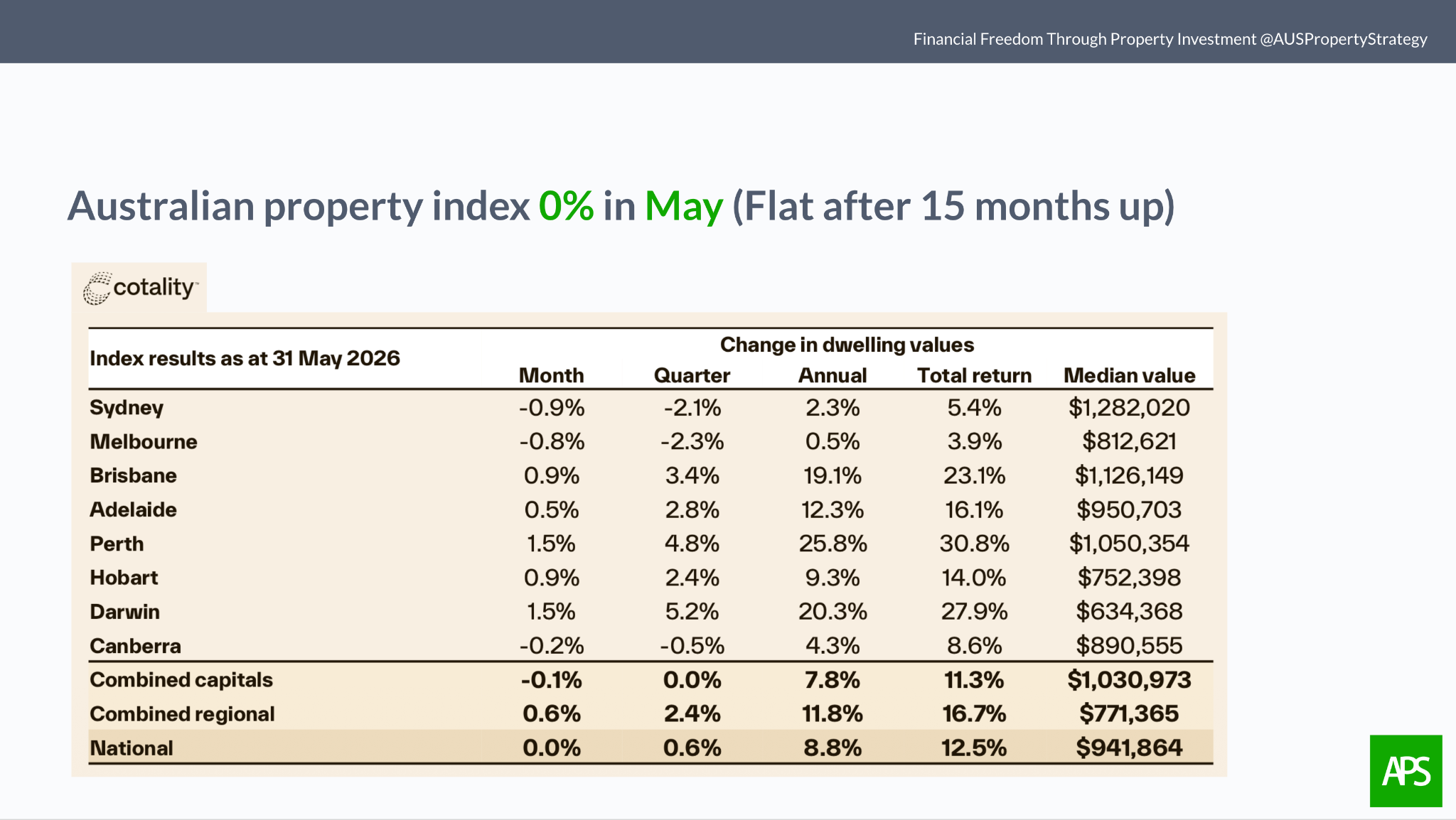
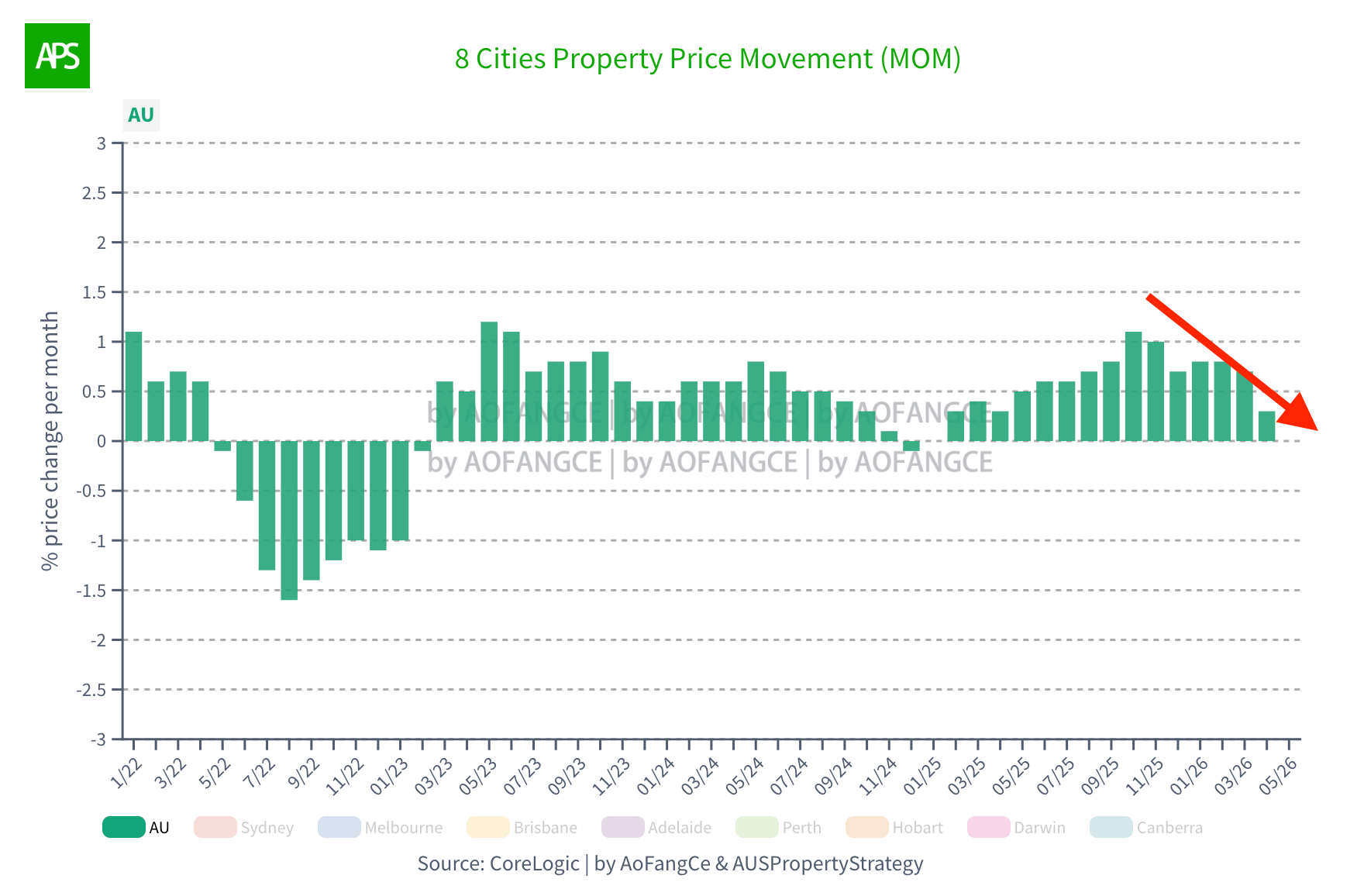
If this trend continues, the national average should start falling when the June data lands. How far and how long? Nobody knows. History says it could last three months or stretch to eight. What I can say is that the national property cycle has entered the back half of this run.
Now, I’m talking about the national average, which mixes everything across all eight capital cities into one number. When you pull the cities apart, the story changes completely.
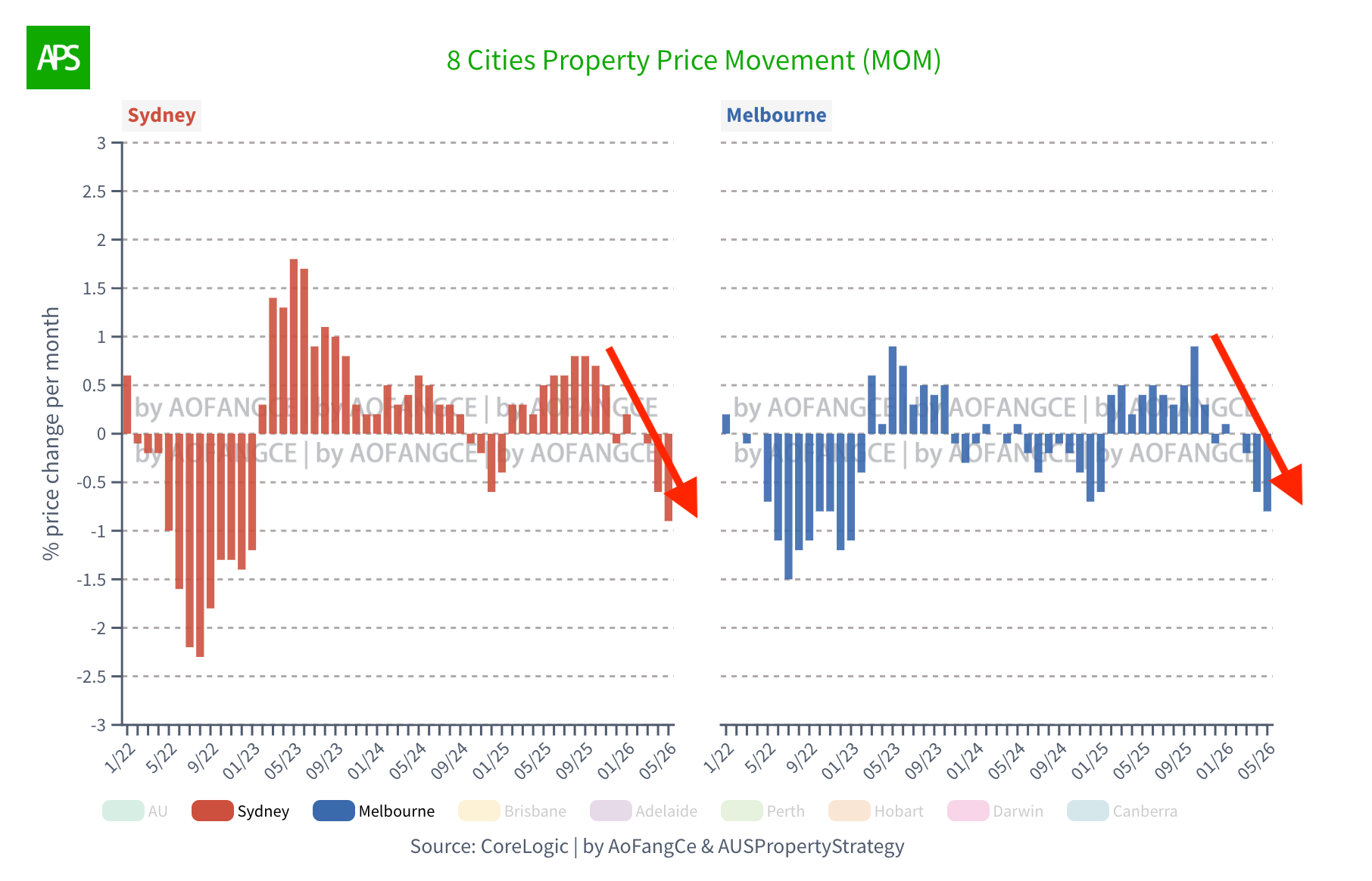
Sydney dropped 0.9% in May, picking up speed on the way down. That blows past the 0.5% threshold, which means it’s officially in a downturn. The auction clearance rate has fallen off a cliff, and hitting 50% on a Saturday now counts as a good week. Melbourne isn’t much better, down 0.8%. Melbourne has basically been treading water for over three years and slowly sinking since January 2023. If you bought an investment property there over the past three years, your returns have been well behind other capital cities.
Here’s something I’ve watched play out over those years. A small number of Melbourne investors purchased in Perth and Brisbane, but the vast majority stayed out. Melbourne investors stick with Melbourne. The ones who did look interstate were chasing lower median prices. Now, with Melbourne property market still soft, even fewer are heading to those cities, because another pattern has taken over: Melbourne investors will only buy where prices are lower than Melbourne’s. That’s why so many ended up in regional areas or Tasmania. A big chunk of Hobart’s price growth has been driven by Melbourne money. But now that Hobart has climbed too, a lot of Melbourne investors have started looking overseas.
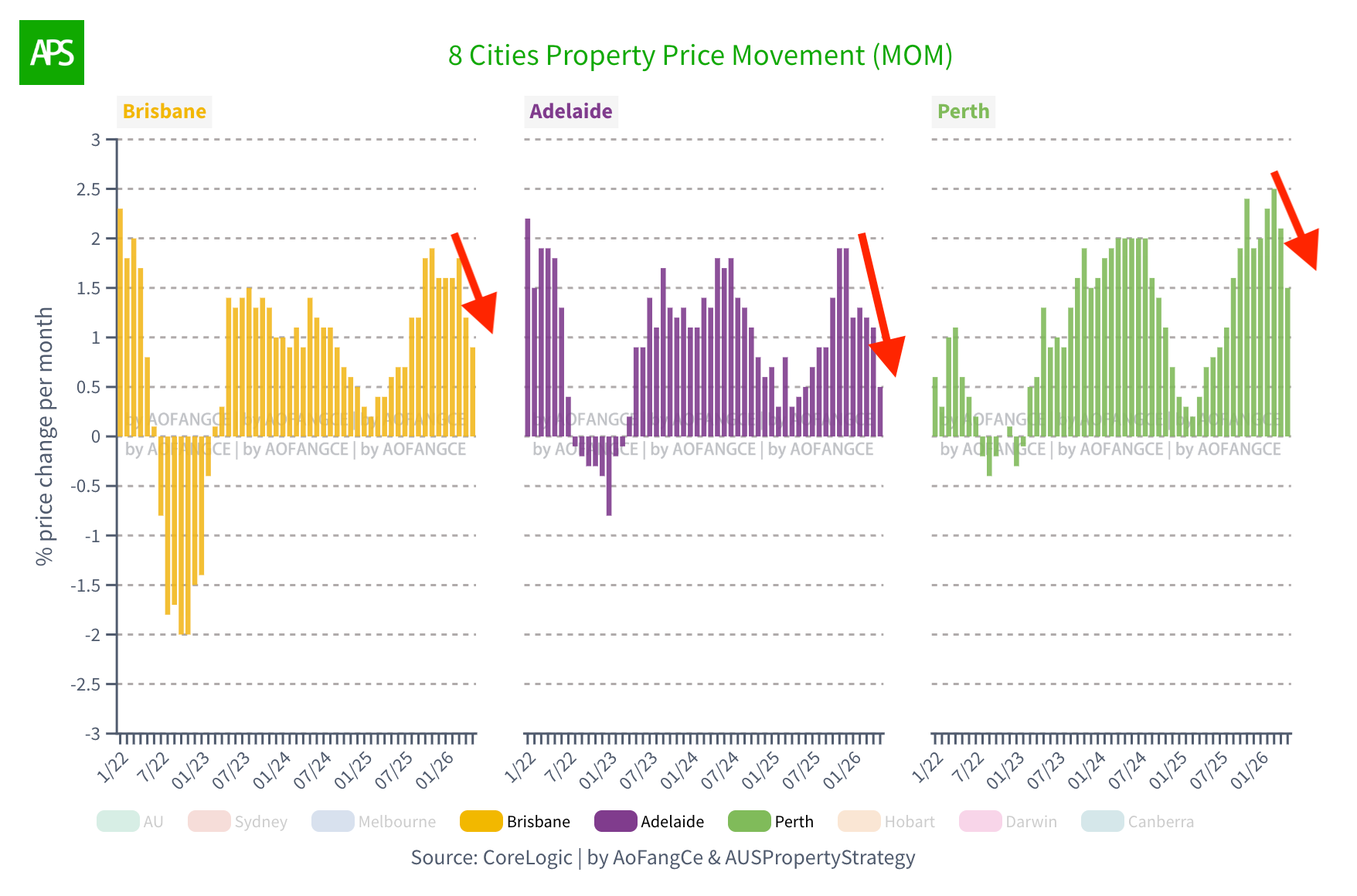
Now let’s talk about the mid-tier cities, because this is where the picture turns around. Brisbane, Adelaide, and Perth have all been rising continuously for more than three years. Growth rates picked up speed through March, which was the peak, and have been easing since. Brisbane gained 0.9% in May, still solidly in an upswing. Adelaide was up 0.5%, moving into consolidation. Perth climbed 1.5%, slower than before, but still the fastest-growing capital in the country.
So why are some cities going up while others are going down? It comes down to the fundamentals. Under the same rate-hike conditions, service and finance-heavy economies like Sydney and Melbourne are extremely sensitive to interest rates. Resource-driven cities like Perth, and diversified economies like Brisbane, handle higher rates much better. When buyers outnumber available homes, rate hikes alone simply can’t turn the price trend around. That’s what the numbers tell us.
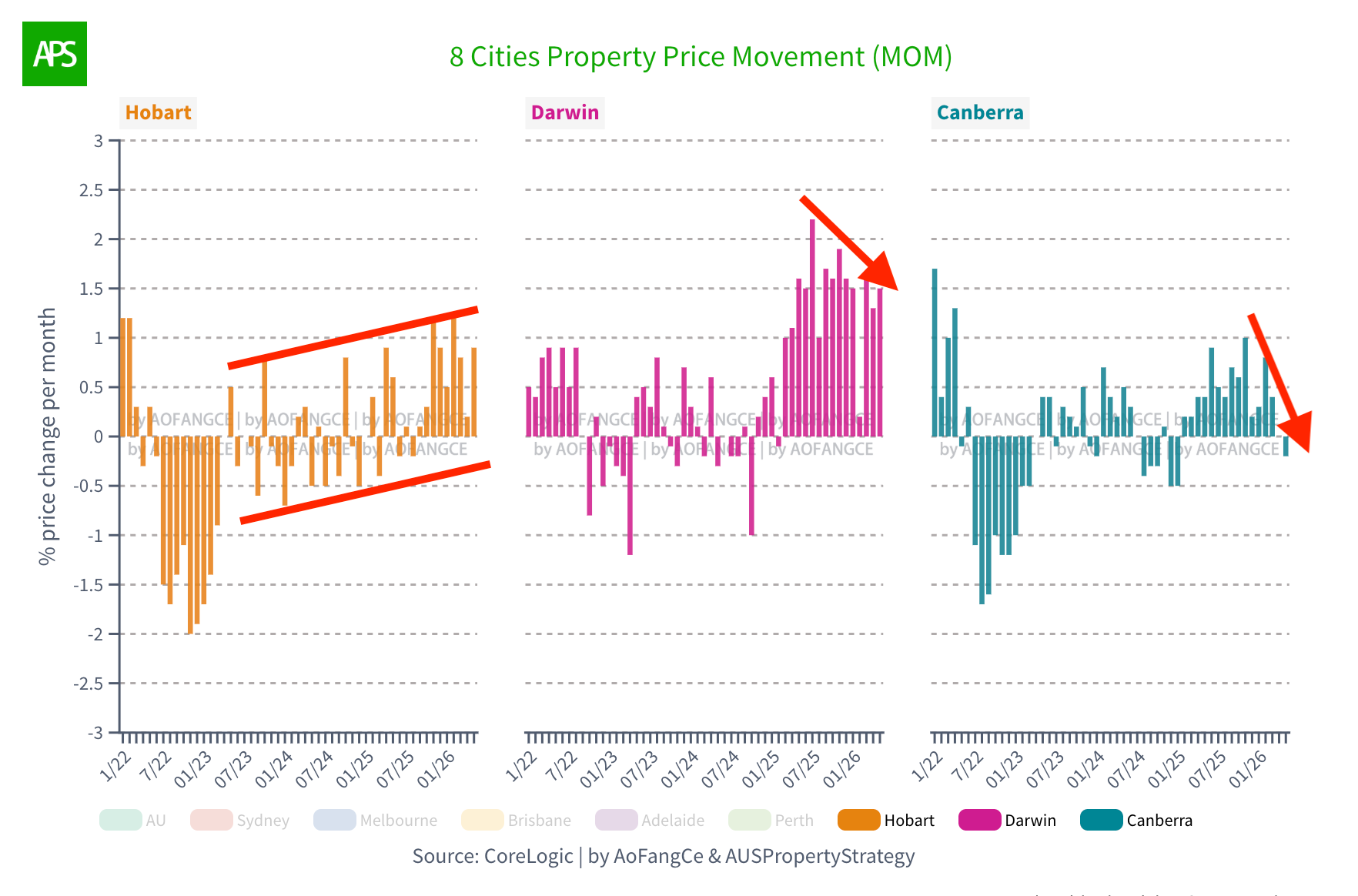
The three smaller capitals were a mixed bag in May. Hobart kept up its choppy upward trend, gaining 0.9%. Darwin was up 1.5%. Canberra eased into a flat phase, slipping 0.2%. Hobart is the least affected by the big-picture headwinds because the buyer mix is different: mostly retirees, with a smaller investor share than other cities.
So that’s the monthly snapshot. But if you want to see the real trend underneath the noise, look at the 90-day moving average. Stretching the window to a full quarter smooths out the jumps and makes the direction much clearer. And the data is very clear: major cities are in a downturn, mid-tier cities are rising but slowing.
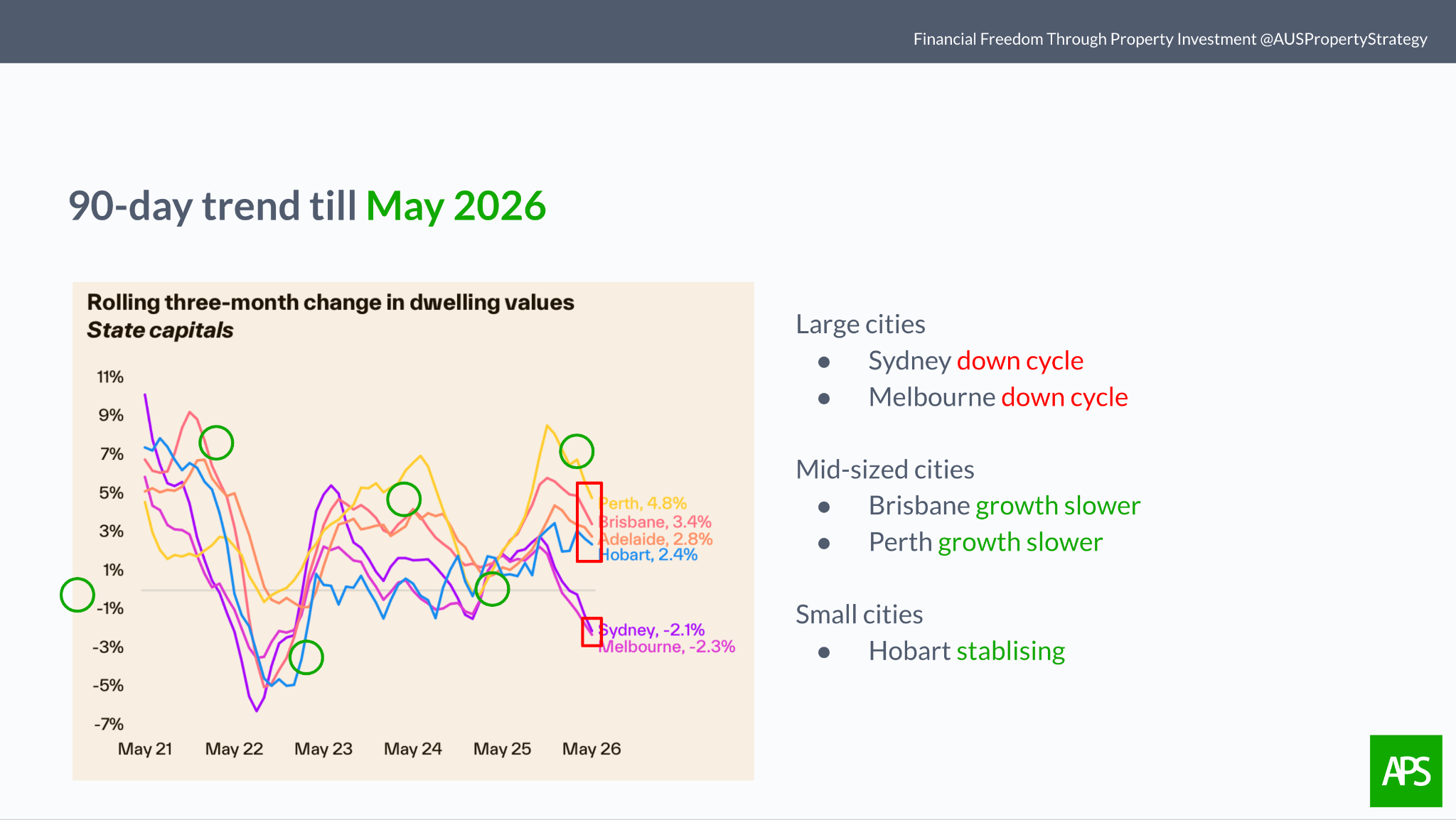
Sydney’s turning point could come by year-end or early next March. Melbourne’s turnaround depends heavily on politics, specifically whether Labour gets voted out. If the Coalition wins, conditions should improve. If One Nation ends up in power, and that’s a low-probability scenario, the outlook gets messy fast. The mid-tier cities are all still in an upswing, but the momentum is fading.
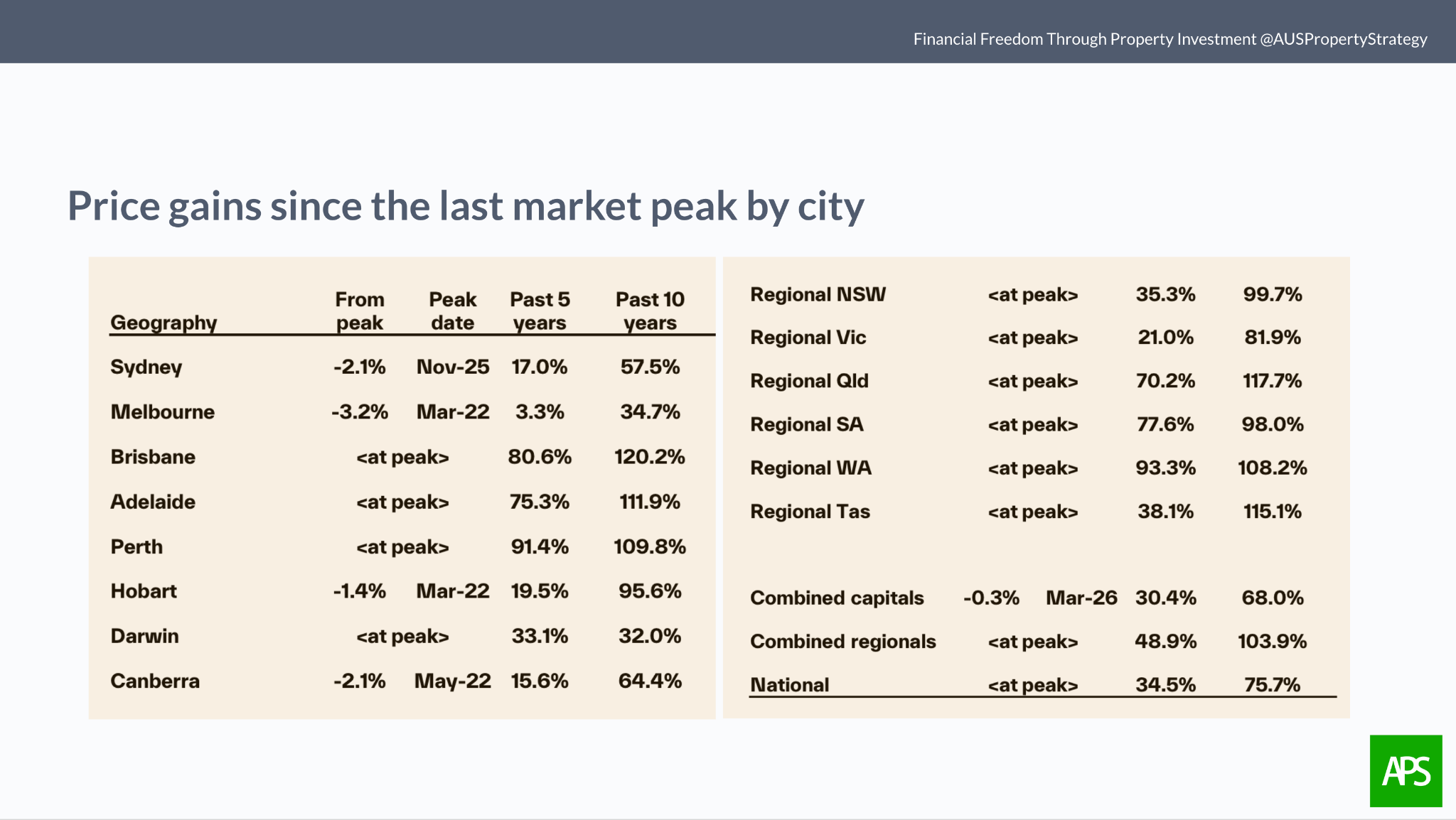
Right now, Brisbane, Adelaide, Perth, and Darwin are all at fresh all-time highs. Melbourne sits 3.2% below its March 2022 peak. Sydney is 2.1% below its November 2025 high. If you’re looking at Sydney or Melbourne over the next twelve months, make a move carefully. But here’s the thing. If you’ve got strong nerves, enough cash flow to ride it out, and a genuine long-term view, buying in a falling market is actually the best. You pay less, you get more to choose from, and you negotiate harder. The catch? Buying against the market like that takes a certain temperament. Most people don’t have it. They always chase prices up and freeze when they come down. That’s human nature, and there’s no shame in it.
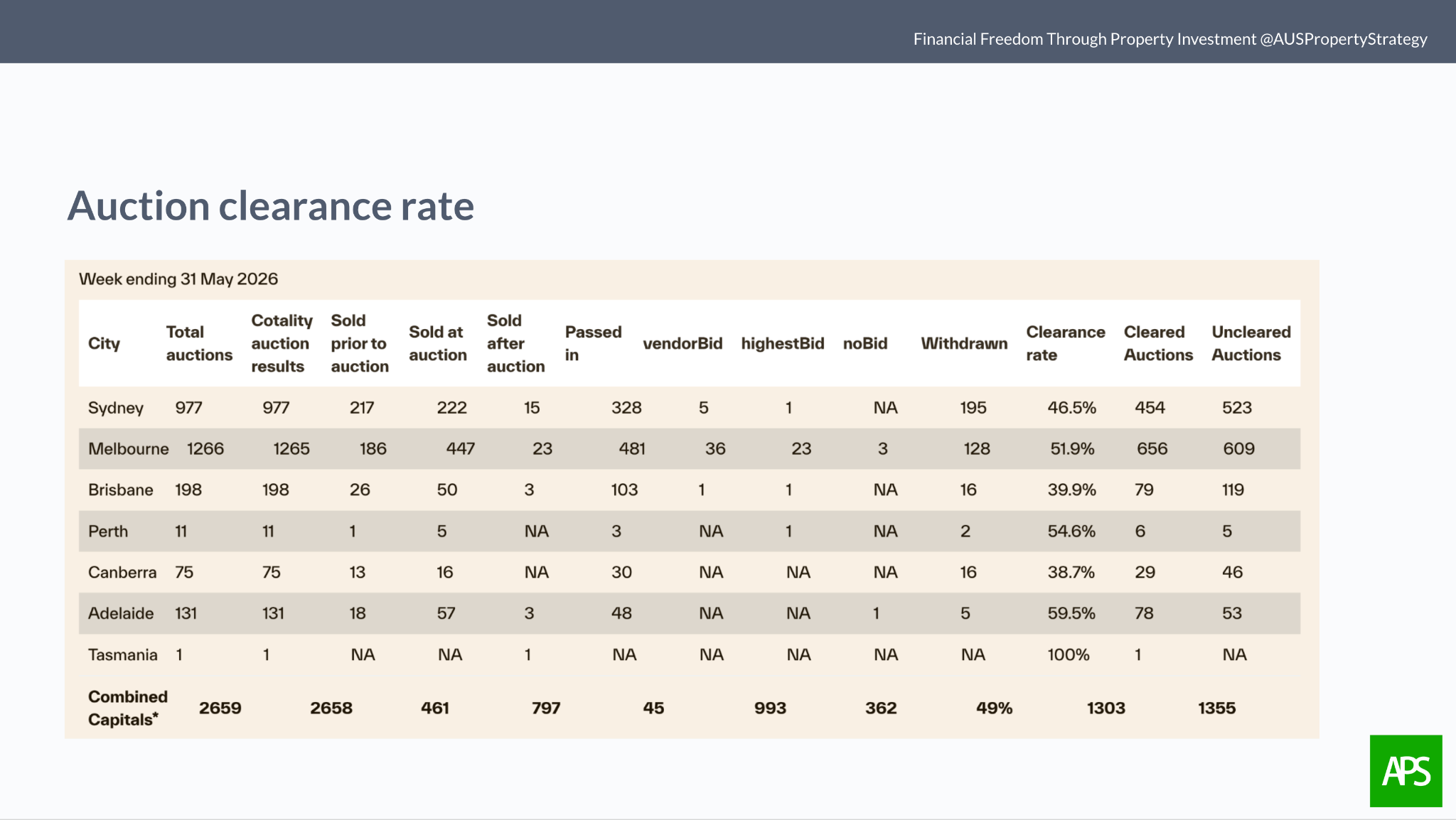
By the end of May, the national auction clearance rate dropped below 50% for the first time since the pandemic, landing at 49%. That is a clear weak-market signal. Sydney and Melbourne are at 46% and 52%, firmly in buyer’s market territory. Brisbane sits around 40%, also low, but prices are still going up. What that tells us is fewer sellers are listing, and buyers have become much pickier. If you don’t have to sell right now, you’re holding out for the right price. And that’s exactly what’s putting a floor under this market.
So when you put it all together, the gap between markets has actually narrowed. Think of it as a K-shaped market. The upper arm is the mid-tier cities, still climbing but losing steam. The lower arm is the major cities, rate-sensitive and falling faster. Two different markets, two different strategies required. That is the key point here.
Look, the headwinds are real. Price-to-income ratios are at all-time highs. In plain English, houses have never been this expensive compared to what people actually earn. Wages aren’t keeping up with inflation, so your real spending power is shrinking. The Middle East conflict and cost-of-living pressure keep grinding away at consumer confidence. Energy prices are eating into household budgets. But there is a floor. Supply is tight, so a sharp correction has very little room to take hold. The labour market is stable, so mortgage holders aren’t being forced into fire sales. Construction costs are still high, limiting new supply. And government regulations mean land supply won’t suddenly flood the market. I’m not saying the market won’t pull back. I am saying the probability of a full-on crash is close to zero. This isn’t doom and gloom, it’s the data talking.
Want to know exactly where you stand and what your next property move should be? Book a VISION Blueprint Session — in 45 minutes, you'll walk away with a personalised Property Investment Blueprint built around your numbers, your goals, and your timeline. And if you want ongoing support from a team that handles everything from strategy to settlement, VISION Gold Membership is your next step. Link in the description below.
May Economic Snapshot
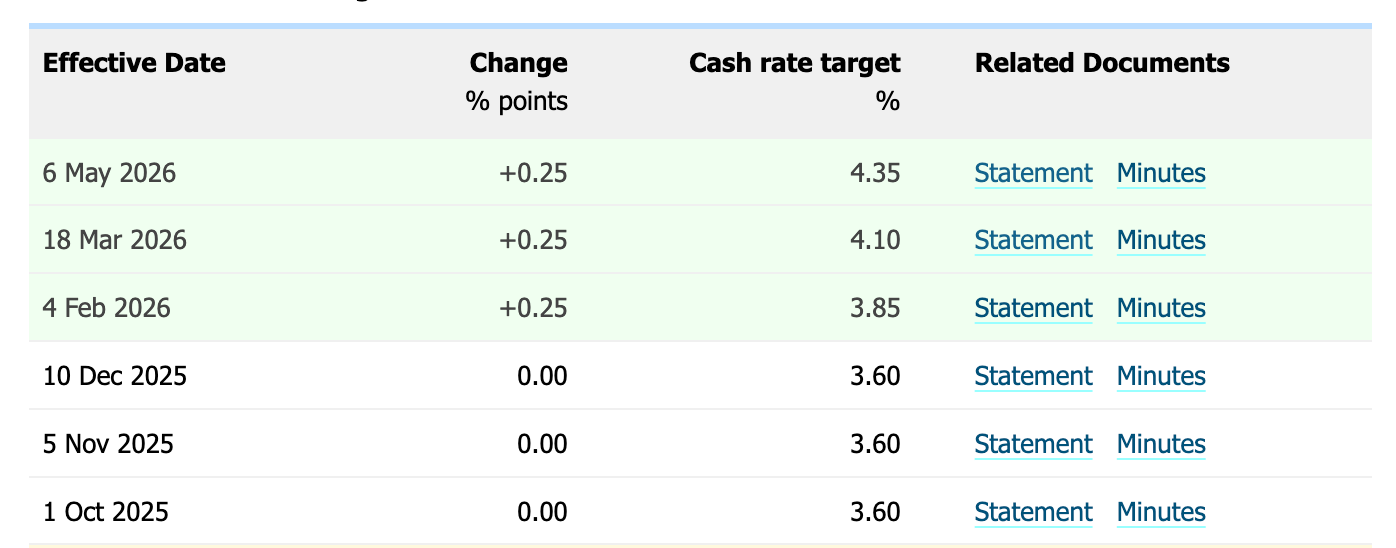
Now let’s talk about the economy, because rates and inflation are the engine behind everything we just covered. On 6 May, the RBA hiked again to 4.35%, the third consecutive increase. Financial markets are pricing in one more in August, to 4.6%, then rates holding through to September 2027.
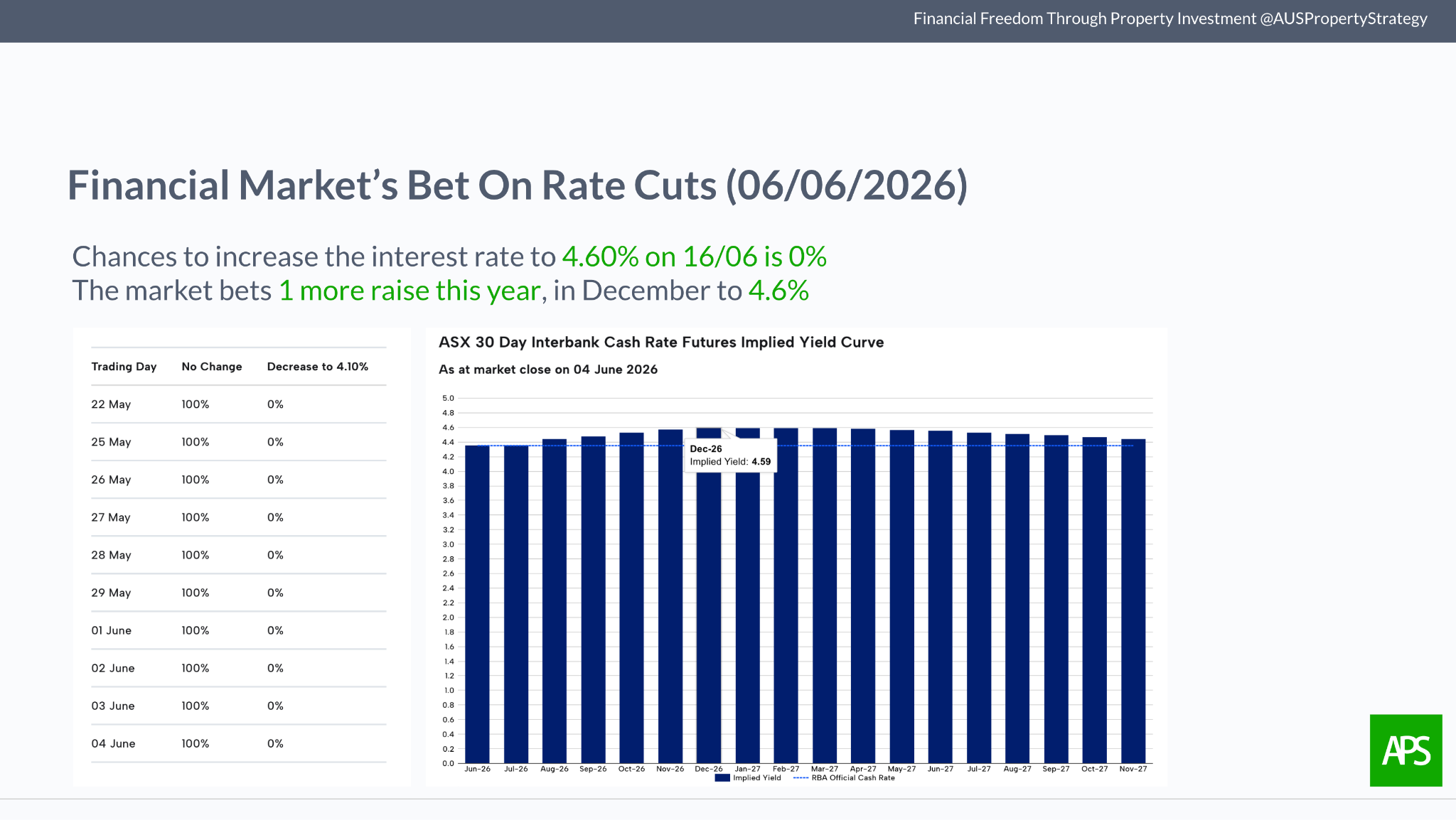
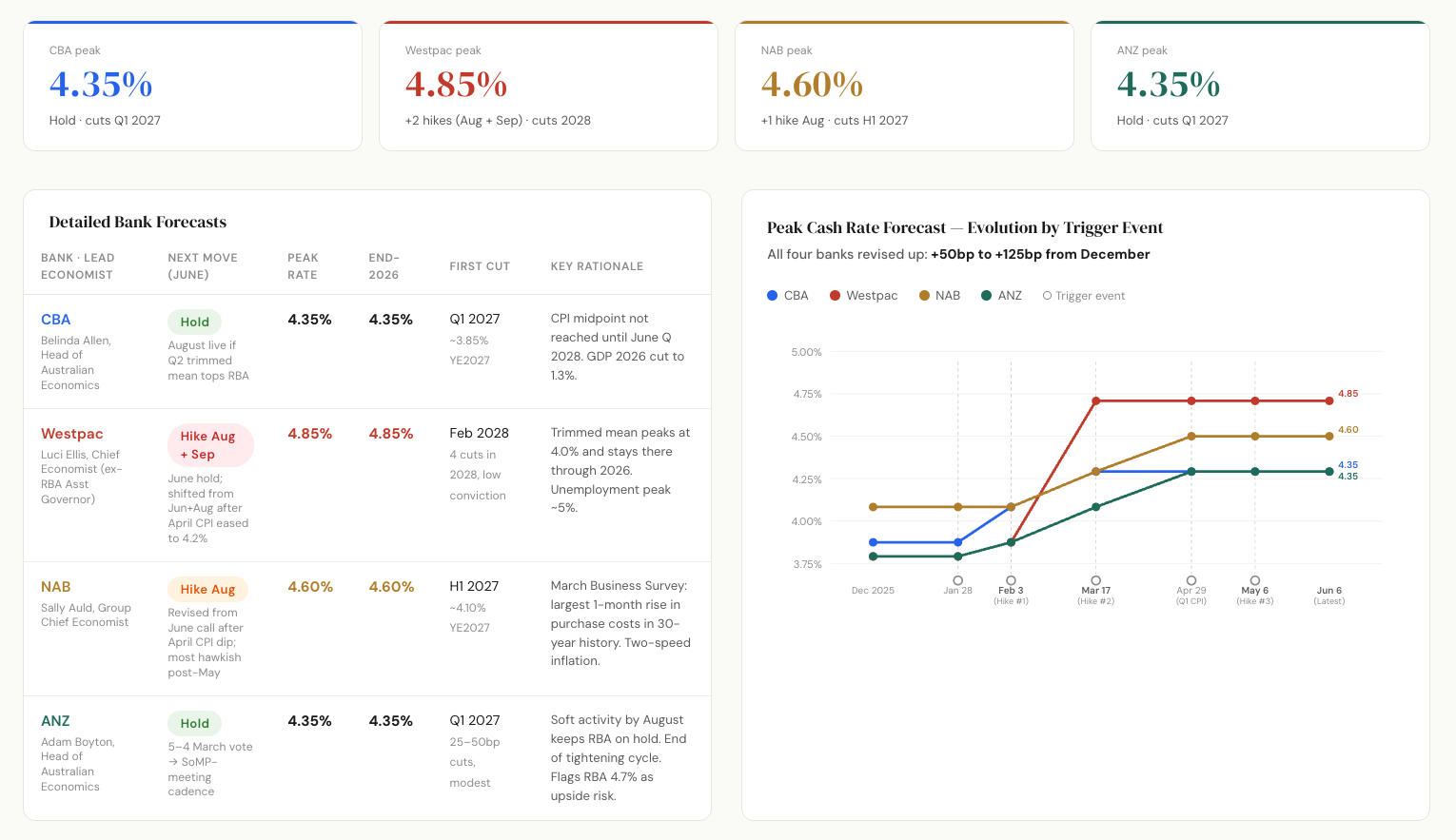
The big four banks can’t agree on what comes next. CBA and ANZ think 4.35% is the ceiling. NAB says 4.6%. Westpac is the most aggressive, calling for hikes in both August and September, pushing rates to 4.85%. Bank forecasts change every month, so treat them like weather reports, not promises. I follow the financial markets, because those are real-money bets. Bank economists are offering opinions. One of these is putting their money where their mouth is, and the other isn’t.
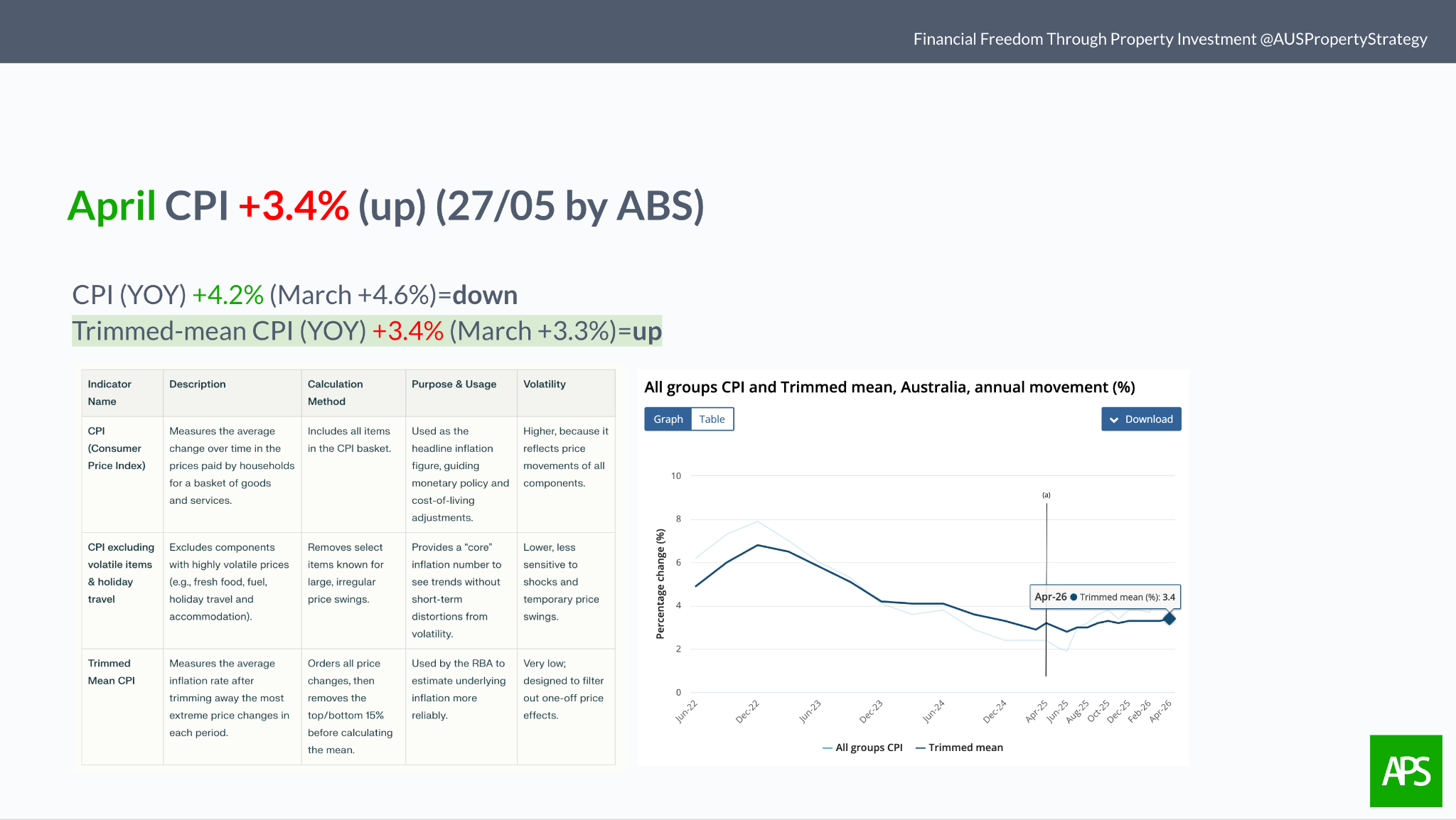
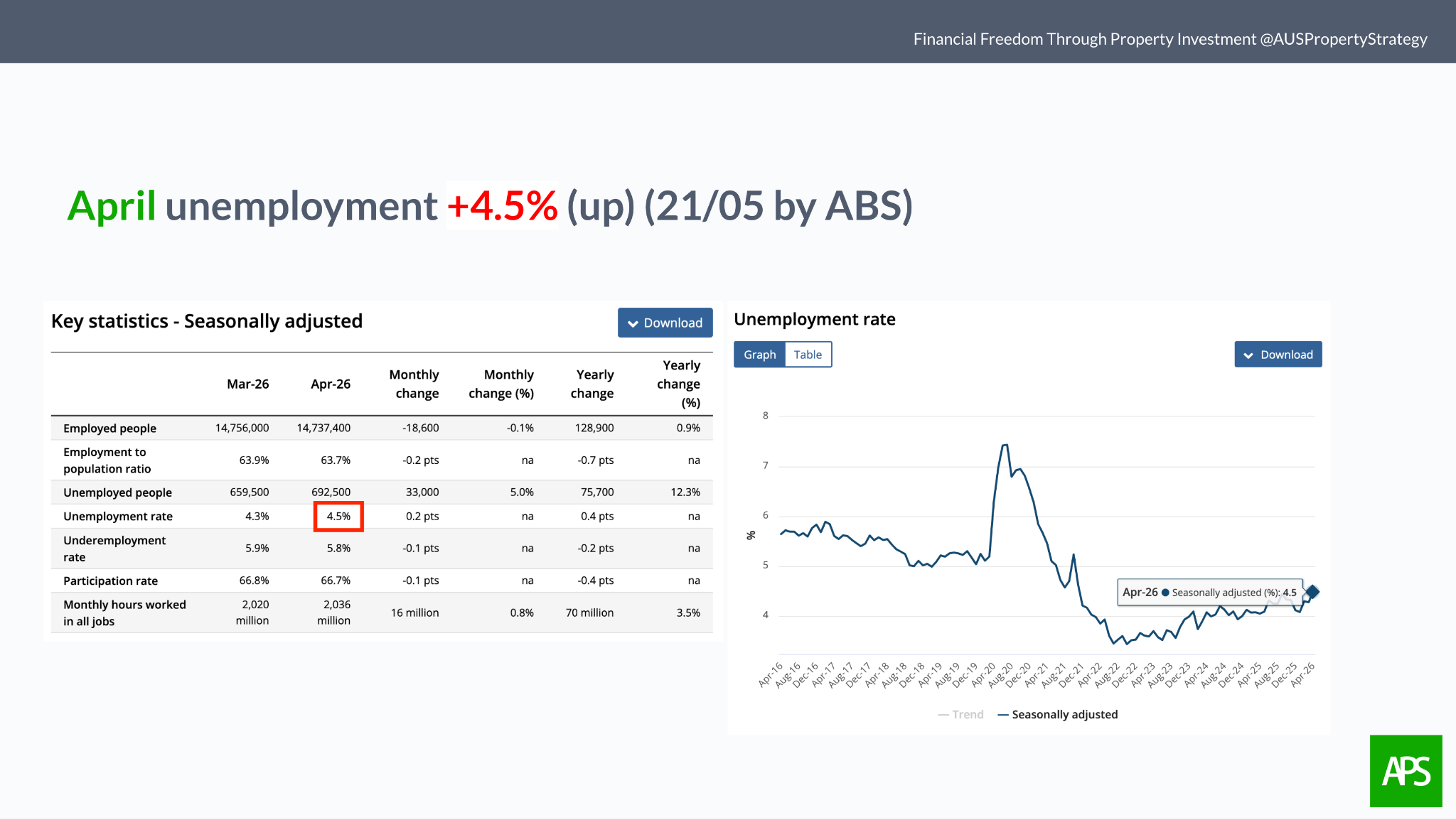
April’s core inflation came in at 3.4%, ticking slightly higher. This is the second month of data since the conflict began, and it factors in higher oil prices and broader cost pressures. But it’s not the inflation blowout some commentators warned about. Unemployment went up to 4.5%. Put those two together, and most analysts expect the RBA to hold in June, and I agree. After that, it depends on the incoming data. I’ll keep you posted.
How to Take Action
Right, we’ve covered the market and the economy. Now here’s the part that actually matters for your back pocket.
A lot of people have lost confidence in Australian property. I understand why. But zoom out, and the picture changes completely. This chart uses Cotality data showing the national property market’s annual price change over the past 40 years. In those 40 years, prices dropped in just six of them, only 15%. And the total gains in the up years absolutely dwarf the losses in the down years. Every single downturn was followed by multiple years of consecutive growth.
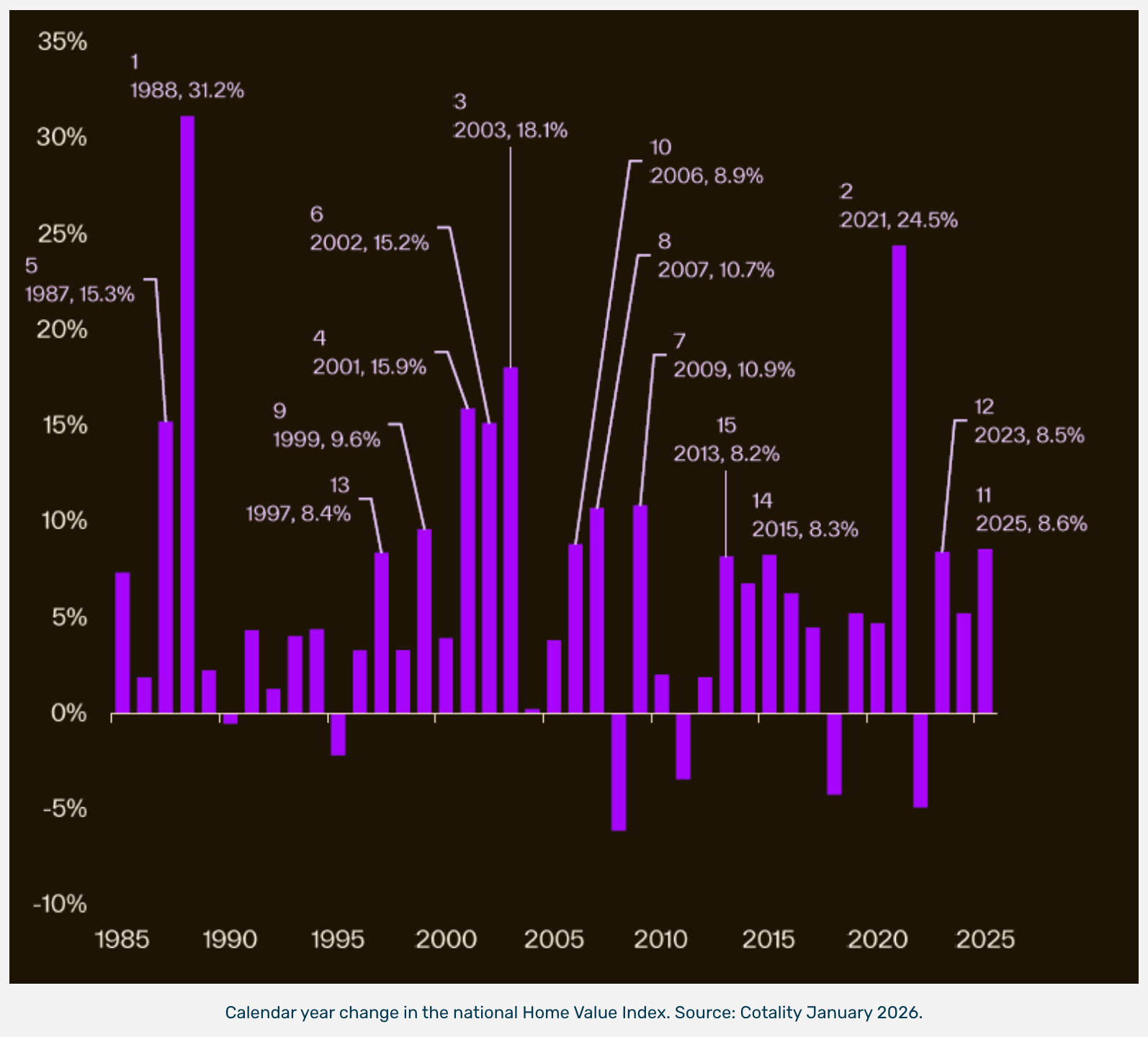
So what does that tell you? If you buy the right property and hold for the long term, even if your timing is off, it barely changes the final result. That’s the idea behind our APS 541 Rule: 50% is about location, 40% is about how long you hold, and only 10% is about when you buy. Instead of gambling on picking the bottom or chasing prices on the way up, focus on the fundamentals and let time do the heavy lifting.
Action Framework
So here’s where we land. May 2026 is a headwind month, but the long-term foundations are still intact. Prices will wobble in the short term. The long-term trend hasn’t changed. Here are two things to take away.
First, stress-test your borrowing at 4.85%. Don’t plan around 4.6%. Use the worst case to check your cash flow. If you can handle 4.85%, you’ve earned the right to keep building your portfolio. If you’re a first-home buyer and you can manage the repayments, now is actually a good time to move. By the time you’ve done your homework and found the right place, the market may have come down a touch further, and the timing lines up.
Second, follow the supply gap when picking a city. Perth and Brisbane are still worth getting into. Melbourne is a medium-to-long-term play, but it needs patience, because nobody knows when the turnaround starts. Sydney’s window could open from late this year through to next March.
War, rate hikes, tax reform, elections. There are more moving parts right now than in any year I can remember. Tracking all of that on your own, you’ll catch some of it and miss the rest. That’s what our VISION Gold Membership is built for. Full planning, data-driven selection, loan to settlement, end to end. Australia-wide, and we only work on the buyer’s side. Click the link below and book a free 30-minute discovery session. Half an hour, and you’ll know exactly what your next move is.
Watch the video version of the blog on YouTube.
15 Minutes Free Consultation (Limited-Time Free Offer)
If you have any questions about Australian real estate, we invite you to use our 15 Minutes Free Consultation service. Once you have filled in the form, a professional property investment strategist will be in touch with you. They will assess your needs and provide fundamental advice. This service is designed to help answer general property-related queries. BOOK NOW.
VISION Membership
Our Flagship Service: VISION Membership. Your One-Stop Property Investment Manager – Build a Tailored Portfolio and Achieve Financial Freedom
Whether you're an employee, a professional, a business owner or even a new migrant, everyone has a financial goal for the future. The VISION Membership is designed to solve all the pain points in your Australian property investment journey through one single, comprehensive service.
By analysing your current financial situation and long-term goals, we'll tailor a property investment plan just for you. Our team will match you with the ideal mortgage structure, tax strategies, wealth planning, and legal support, empowering you to go further, faster, and smarter on your path to financial freedom.
VISION Membership is perfect for busy individuals who want a professional team to create, expand and manage their Australian investment portfolio. If you're looking for a dedicated team, including real estate investment experts, mortgage brokers, accountants, financial planners, and property solicitors, VISION Membership is your ideal solution.
Start with an obligation-free 30-minute discovery session on Zoom. BOOK NOW.
VISION Buyer’s Agent
No time for inspections? Tired of dealing with pushy selling agents? Unsure how much to offer or feeling nervous about auctions? Worried about buying the wrong property? If any of these sound like you, AusPropertyStrategy's Australia-wide VISION Buyer's Agent Service is here to help.
We provide end-to-end support to help you build an optimised property portfolio and achieve your financial goals—whether you're investing interstate, refinancing, or planning post-settlement leasing or resale. Our services cover everything from suburb research and property selection, to price negotiation, auction bidding, and post-settlement support.
Start with an obligation-free 30-minute discovery session on Zoom. BOOK NOW.
real estate australia,real estate investing,australian property,australian housing market,australian economy,australian property investment,australian property market,buying property,australian real estate,mortgage brokers brisbane,first home buyer,Australian Real Estate,Australian Real Estate Investment,Australian Property Investment,Real Estate Investment,Property Investment,Property Investment Australia,Passive Income,Positive Cash Flow,Australia Real Estate Investing,Australian Real Estate Investors,Australian Property Investors,Vision Wealth Mentors,Vision Real Estate Investors Australia,financial freedom, freedom through property investment,real estate investors,property investment,passive income,positive cash flow,real estate course,real estate courses,real estate training,australian property market,property investment brisbane,property investment sydney,melbourne property market,investing in brisbane,investing in melbourne,how to invest in property,buying properties,start investing in property,property investment strategy,how to buy investment property,property investing tips,best suburbs to invest in sydney,locations real estate,prime location,property growth by suburb,capital growth suburbs


