
Sydney Down 6%, Perth Up 13% — SQM Rewrites the Fate of 8 Australian Cities |APS137
Four months ago, SQM Research put out its annual report. National prices set to rise 6% to 10%. Perth at 16%. Brisbane at 15%. Even Sydney and Melbourne were supposed to pick up 3 to 5 points. And the mood back then? Rates are coming down; buy now, or you’ll miss it.
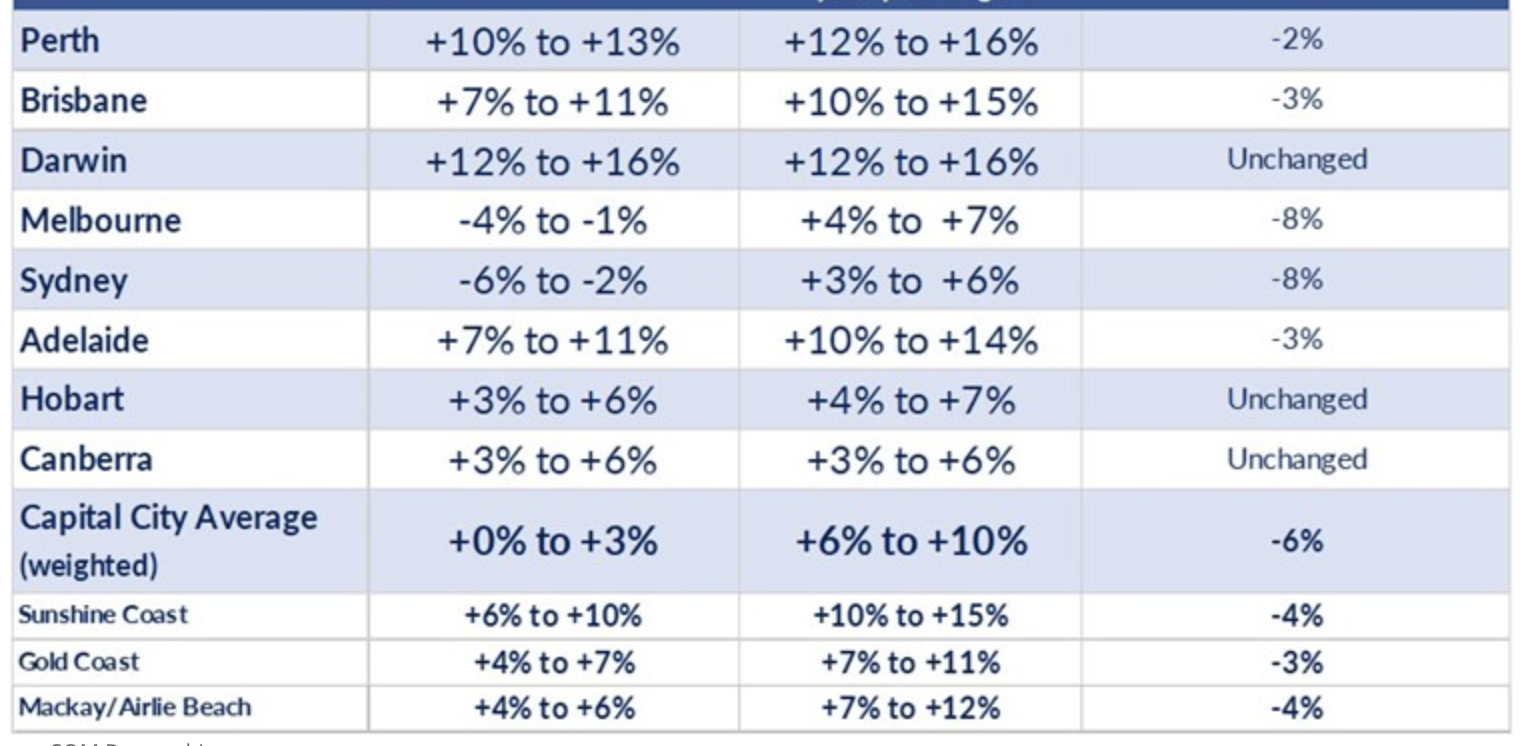
Four months later. Same firm. Same guy. Out comes the revised edition. National growth? Zero to 3%. Sydney? Down as much as 6%.
But here’s what nobody’s talking about. Buried in that same report, one city barely got touched. Still up 12% to 16%. Same rate hikes. Same Middle East war. So how come those cities aren’t falling? That answer tells you exactly where your money should go right now.
The Forecast Reversal
Let me run through the updated numbers quickly.
Perth — the prediction was originally 12% to 16%, and has since been revised to 10% to 13%. Brisbane — 10% to 15% becomes 7% to 11%. Adelaide — 10% to 14% becomes 7% to 11%. Darwin — 12% to 16%. Didn’t change much. So far, you might be thinking, " Alright, just minor trims, no big deal. Then you get to the other cities. And the picture changes completely.
Sydney. Originally up 3% to 6%. Now? Down 2% to 6%. Melbourne. Originally up 4% to 7%. Now? Down 1% to 4%. Hobart and Canberra, 3% to 6% — small adjustments.
The national weighted average? Slashed from 6–10% down to 0 to 3%. This isn’t fine-tuning. SQM tore up its entire 2026 story and started from scratch.
Why? Because three things blew up at once.
First — war in the Middle East. The Strait of Hormuz got blocked, and oil prices shot through the roof. Now you might think oil has nothing to do with property. It has everything to do with it. PVC pipes, asphalt, waterproofing, insulation, the diesel that trucks your building materials around — all of it comes from oil. When oil moves, construction costs move. When construction costs move, CPI moves. Oil isn’t a petrol station problem. It eats into almost every part of the cost to build a home.
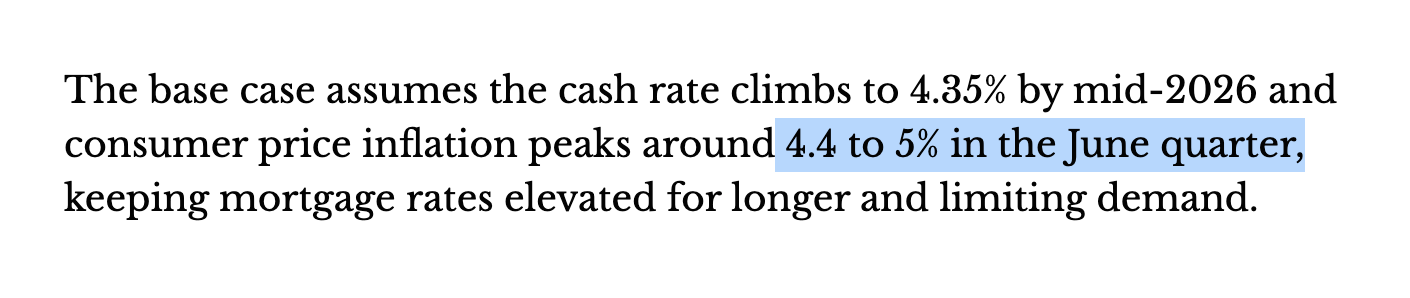
Second — inflation simply won’t come down. The latest ABS numbers show January CPI at 3.8% year-on-year. Core inflation ticked up from 3.3% to 3.4%. The RBA’s target? 2% to 3%. Four years of fighting and we still haven’t even touched the target band. SQM’s revised assumption is even more aggressive — June quarter inflation could hit 4.4%, possibly 5%. That doesn’t mean inflation is holding steady. It might actually be speeding up.
Third — and this is the one that really stings. The RBA completely reversed course. Last year, they cut three times to 3.6%. Everyone thought the good times were rolling — cutting cycle, officially underway. Then February this year? Straight back up to 3.85%. March 17th, another 25 basis points to 4.1%. Back-to-back hikes.
SQM’s original base case had one to two cuts in the second half. Now? Rates heading to 4.35%. The whole direction flipped. Four months ago we talked about how many cuts. Now we’re talking about how far rates go up. This isn’t SQM changing its mind for fun — the world changed on them. Oil up, inflation up, rates up, forecast cut in half. Four dominoes falling in four months.
Now, everything I’ve covered so far is big-picture stuff. But the next part is where it hits you personally — right in the wallet.
Your Wallet Just Shrunk
Rates went from 3.6% to 4.1%. Half a per cent. Doesn’t sound like much, right? Let me break it down.
On a $600,000 loan over 25 years, every 25-basis-point hike adds about $90 a month. Two hikes back to back — that’s $181 extra every month. About $2,100 a year. In plain English, that’s roughly one month of groceries for a family.
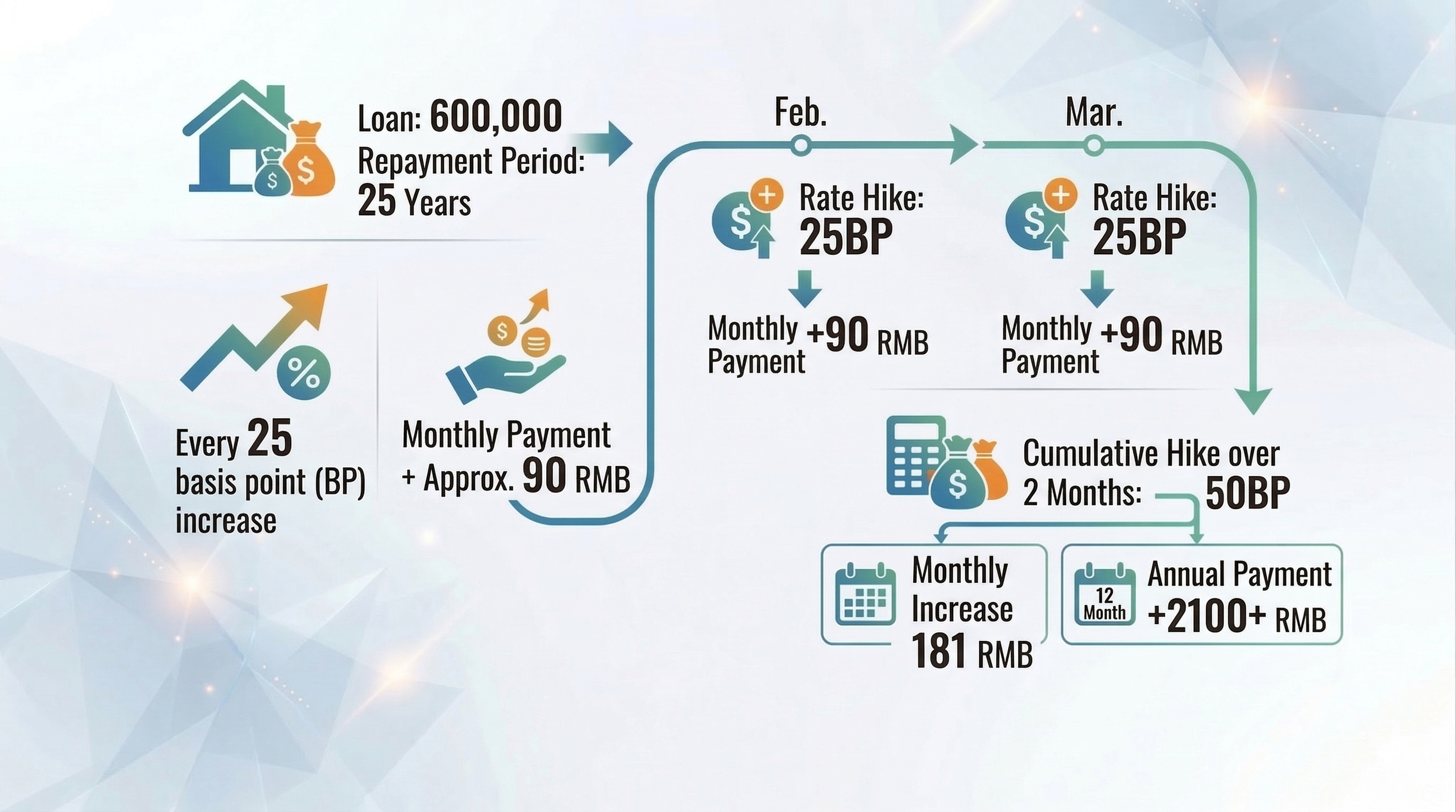
ANZ and NAB both came out yesterday saying another hike in May is likely, pushing rates to 4.35%. If that lands — three hikes in a row — you’re shelling out $270 more per month. Over $3,200 a year. Every dollar you saved from last year’s cuts? Gone. Handed straight back. You thought it was a gift. Turns out the money barely had time to get warm before it was taken away.
Honestly, a few hundred dollars extra on the mortgage — most people can grit their teeth and get through it. But the number that really got me was a different one. Borrowing power.
Someone on the average salary of $105,000 a year — just from February’s hike alone, the bank’s lending limit dropped $12,000. Two hikes combined? Down $24,000. And this isn’t a forecast. It’s already in effect.
Your income didn’t change by a cent. But the bank will lend you less. You think you’ve been saving up to get into the market? You’re not getting closer to the door. You’re drifting further away. And here’s the kicker — this hits harder than a price drop. If prices fall, you might still afford to buy. If your borrowing power shrinks, you don’t even get a seat at the table.
At the press conference, the Governor said something that should concern everyone — “We don’t want a recession. But if inflation doesn’t come down, we may have to face that consequence.” CBA chief economist Belinda Allen was even more direct — the vote was 5 to 4, and the debate wasn’t about whether to hike. It was about when. The direction was never in question.
This time last year, I thought the cutting cycle had started. I said so on this channel. I’ll be straight with you — that call was wrong. The Middle East fire burned everyone’s script. That kind of shock went beyond what most people saw coming.
OK. I know all of that sounds alarming. And it should. But if you’re watching this right now, you’re already ahead of most people who have no idea this is happening. Because the most useful part of today’s video is coming up next — same rate hikes, same inflation, so why are some cities still climbing 13% while others are tanking 6%? That gap isn’t luck. It’s structure. Let me show you.
If you have any questions about property investment, please book a free discovery call on our website. If you want a team offering one-stop service to help you build a property investment portfolio, achieve financial freedom and retire early, join our VISION Gold Membership starting with a 30-minute discovery session. Or to keep it simple, our data-driven buyer's agency service can help. We buy and manage properties for our clients anywhere in Australia. If you have an international view, talk to us about the UAE VISION Gold Membership. We help you invest in the UAE property market, plan your tax residency, reduce your taxes to almost 0 and handle CRS/AML auditing. Links to the service are in the description below.
The Divergence Map
2026 isn’t all boom and it isn’t all bust. It’s half fire, half ice. SQM’s national figure of 0 to 3%? That “average” tells you nothing useful. You mix fire and ice together and the thermometer reads “mild.” But would you seriously buy a property based on that?
Let me break this down using the AusPropertyStrategy Golden 11 framework — rates, population, supply, policy and more. Different cities score completely differently across these dimensions. That’s why their fates are worlds apart.
Start with the worst. Sydney. Forecast swung from +3–6% to −2–6%. Deepest projected fall in the country. Why? Sydney’s economy is built on financial services. When rates go up, finance takes the first hit — layoffs, team cuts, bonuses gone. That pain ripples from the CBD right across the city.
But when you dig deeper, there’s another layer. Sydney has the highest prices in Australia. And the more expensive the home, the more sensitive it is to rate hikes. People buying at $1.5 or $1.8 million are borrowing right up to their limit. Two hikes just wiped $24,000 off their capacity. For a $600,000 Perth property, barely a scratch. For $1.8 million in Sydney? That buyer goes from “barely enough” to “not enough.” High-leverage buyers get squeezed out first. And Sydney is where they’re packed tightest.
Melbourne — from +4–7% to −1–4%. But Melbourne carries an extra burden that Sydney doesn’t. Victorian government debt. Net debt as a share of GSP was about 5.5% in 2019. By 2024? 22%. Quadrupled in five years. How do you pay that off? Taxes. Land tax went up. Windfall Gains Tax arrived. If you own investment property in Victoria, you’ve felt this — you’re not being hurt by the market. You’re being hurt by the government. That’s how confidence dies.
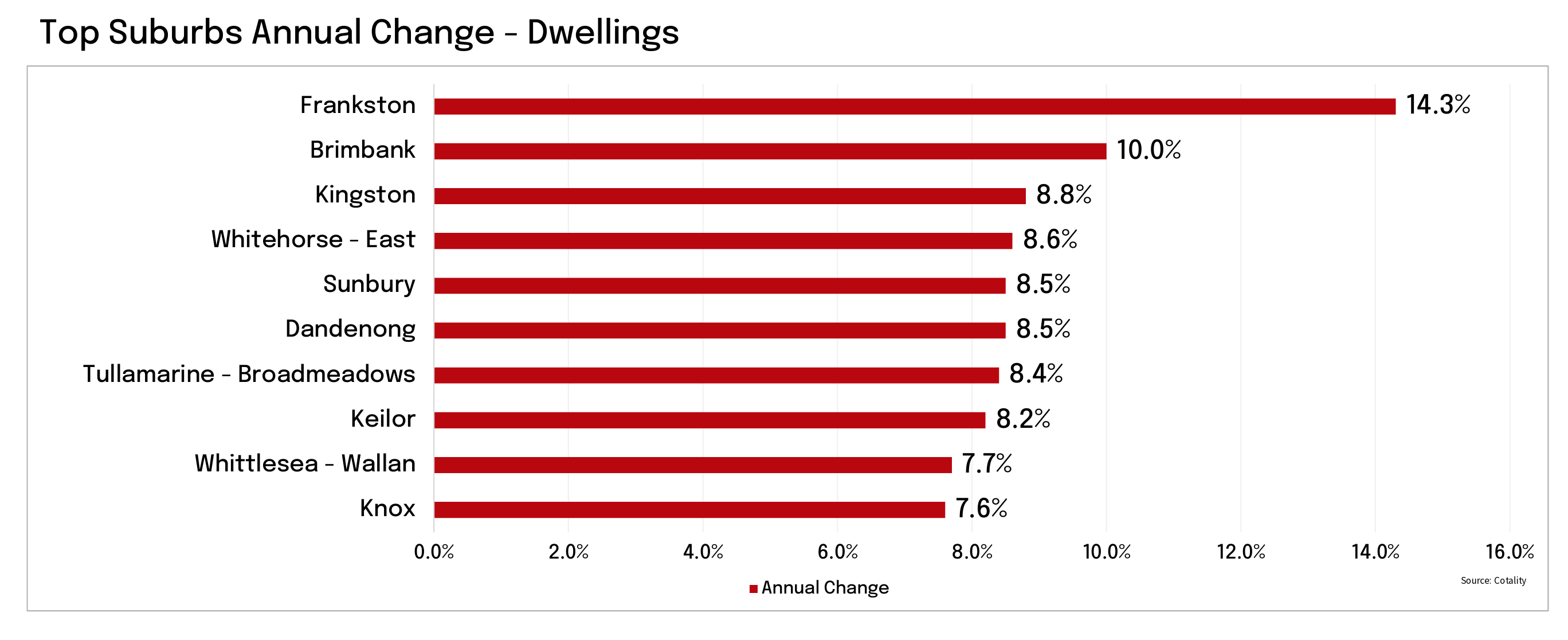
But not all of Melbourne is falling. Frankston — up 14.3% year-on-year. Brimbank up 10%. Tullamarine up 8.4%. Inner-city premium dropping, outer suburbs climbing. Divergence inside the divergence.
Now for the cities holding their ground — and this is really the part that matters most.
Perth. Only trimmed from +12–16% to +10–13%. Why so tough? Supply simply can’t keep up. Population growth at 2.3%, fastest in Australia, vacancy rates rock-bottom, rents still climbing. Resource economy, iron ore strong, mining jobs stable. And here’s the key — Western Australia is the only state in the country where government debt is actually going down. Net debt as a share of GSP dropped from roughly 9–10% in 2020 to 6.7% by 2025.
Look at the contrast. On one side, Victoria’s debt quadrupled, and the government is taxing investors out the door. On the other, Western Australia’s debt is shrinking, the government has money, and it doesn’t need to reach into your pocket. Where does investor confidence flow? That’s a no-brainer.
Brisbane. Revised from 10–15% to 7–11%. Prices up 86% in five years. Some people say it’s peaked. Has it? Look at vacancy rates. Under 1%. When’s the last time you saw a “peaked” market where you can’t even find a rental? If people can’t rent, demand is nowhere near satisfied.
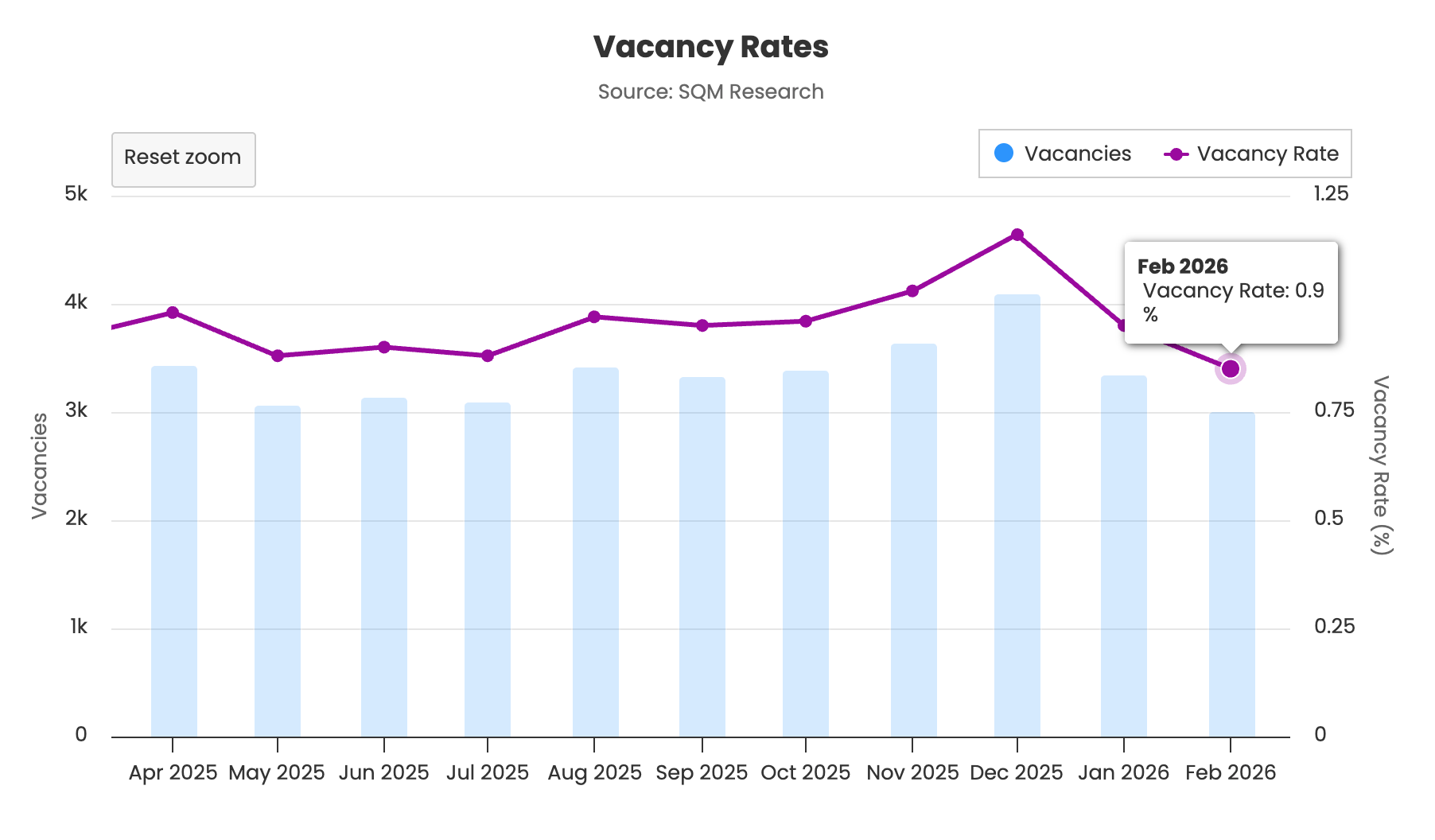
Both cities share the same story — people coming in, housing not keeping up, money flowing in. Rate hikes can slow them down. But they can’t stop them.
Quick run through the rest. Adelaide 7–11%, solid. Darwin 12–16%, untouched. Hobart and Canberra 3–6%, minor.
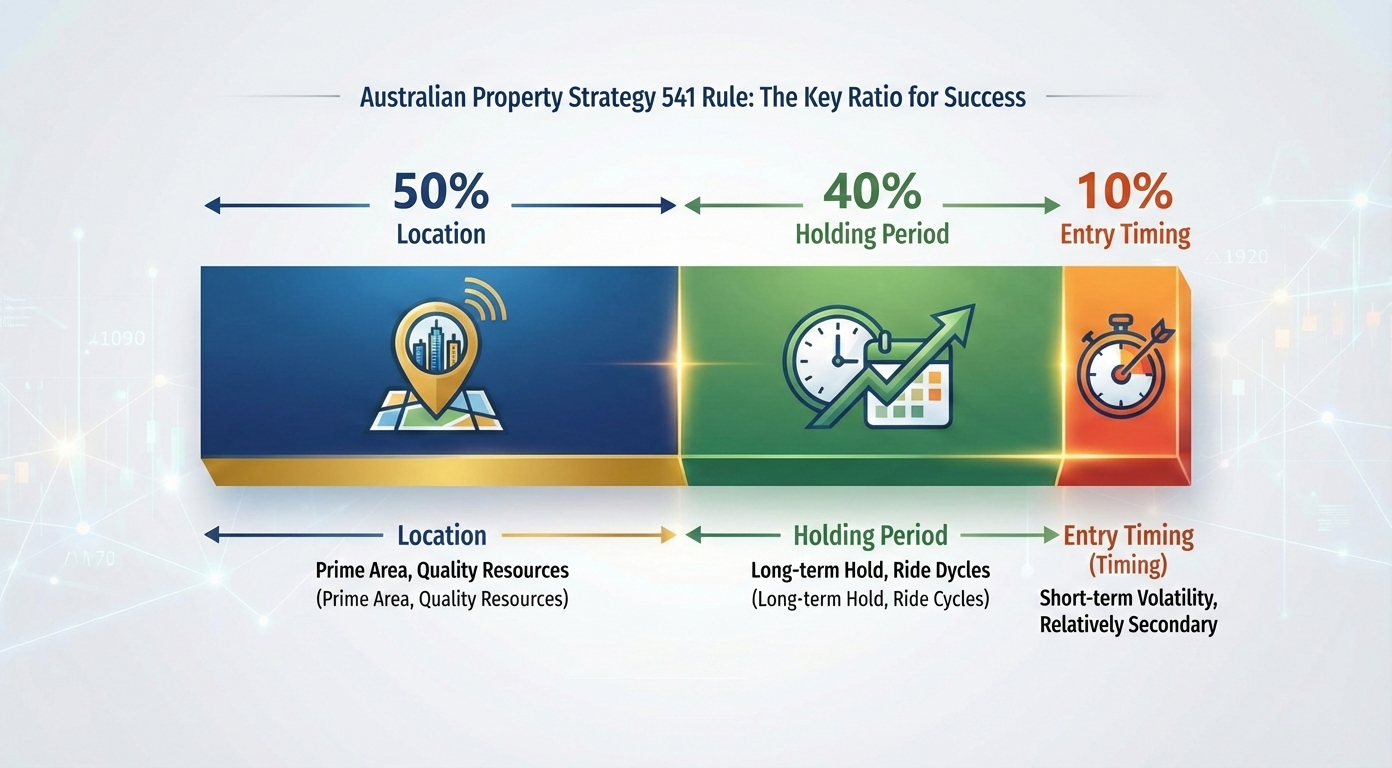
I always talk about the 5-4-1 rule at AusPropertyStrategy — 50% of your success comes from location, 40% from how long you hold, only 10% from when you buy. Stressing about how many more hikes are coming — that’s the 10%. Picking the right city — that’s the 50%. Get your priorities straight.
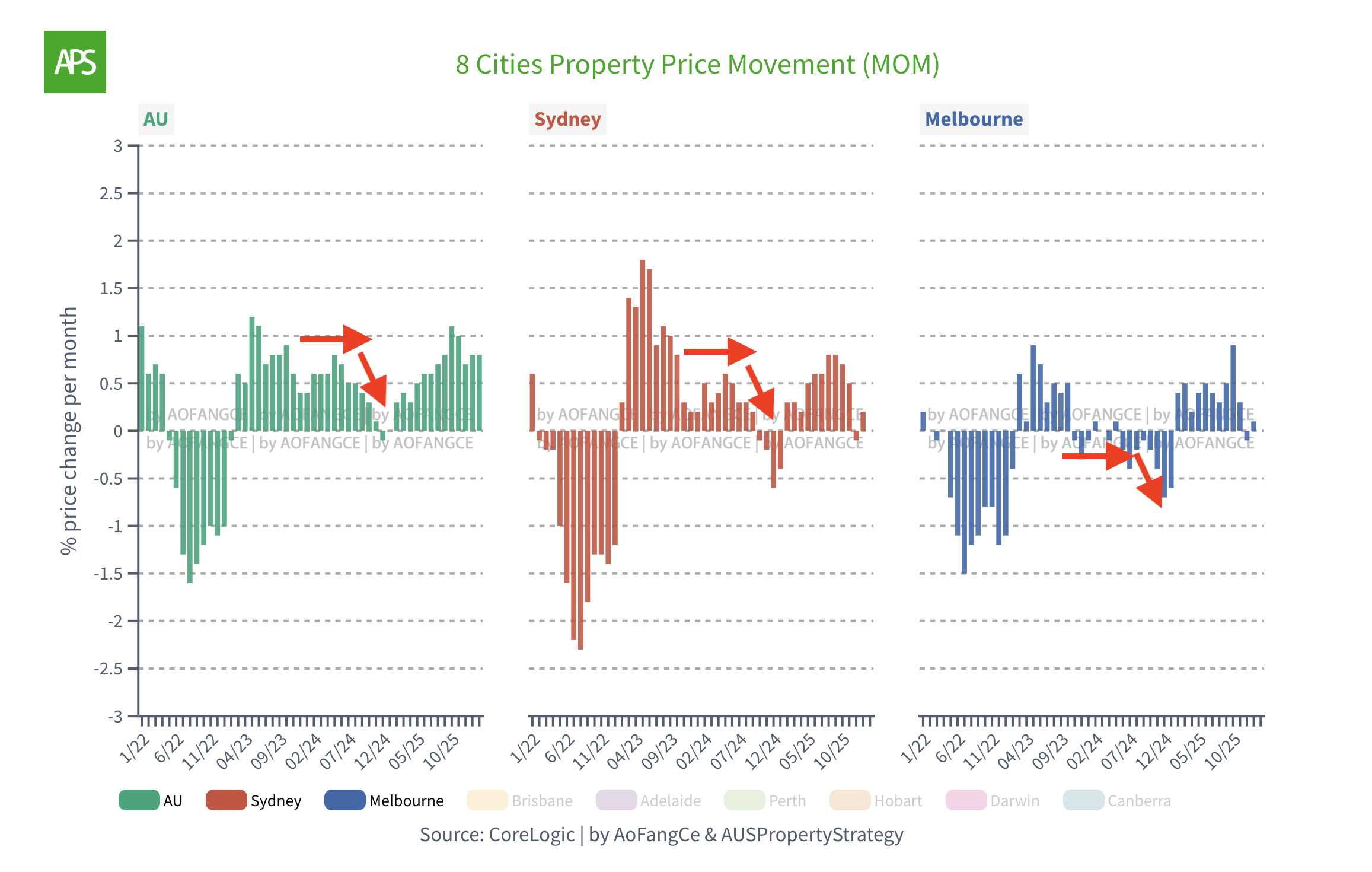
Now that’s SQM’s analysis. My personal take? Sydney and Melbourne will likely trade sideways this year, with possible small dips in individual months. Perth, Brisbane, Adelaide — I’m bullish. Darwin also positive, but the pace should slow noticeably, with potential monthly dips.
One more thing. Last time rates peaked at 4.35%, they held from December 2023 through February 2025. During that stretch, prices didn’t slow down straight away — momentum carried for six to eight months before any real deceleration. After February’s cut, prices started picking up again. Across that full 14-month stretch, Brisbane, Adelaide, and Perth posted positive growth every single month. Will the pattern repeat? Only time will tell. But I’d say the odds are pretty high.
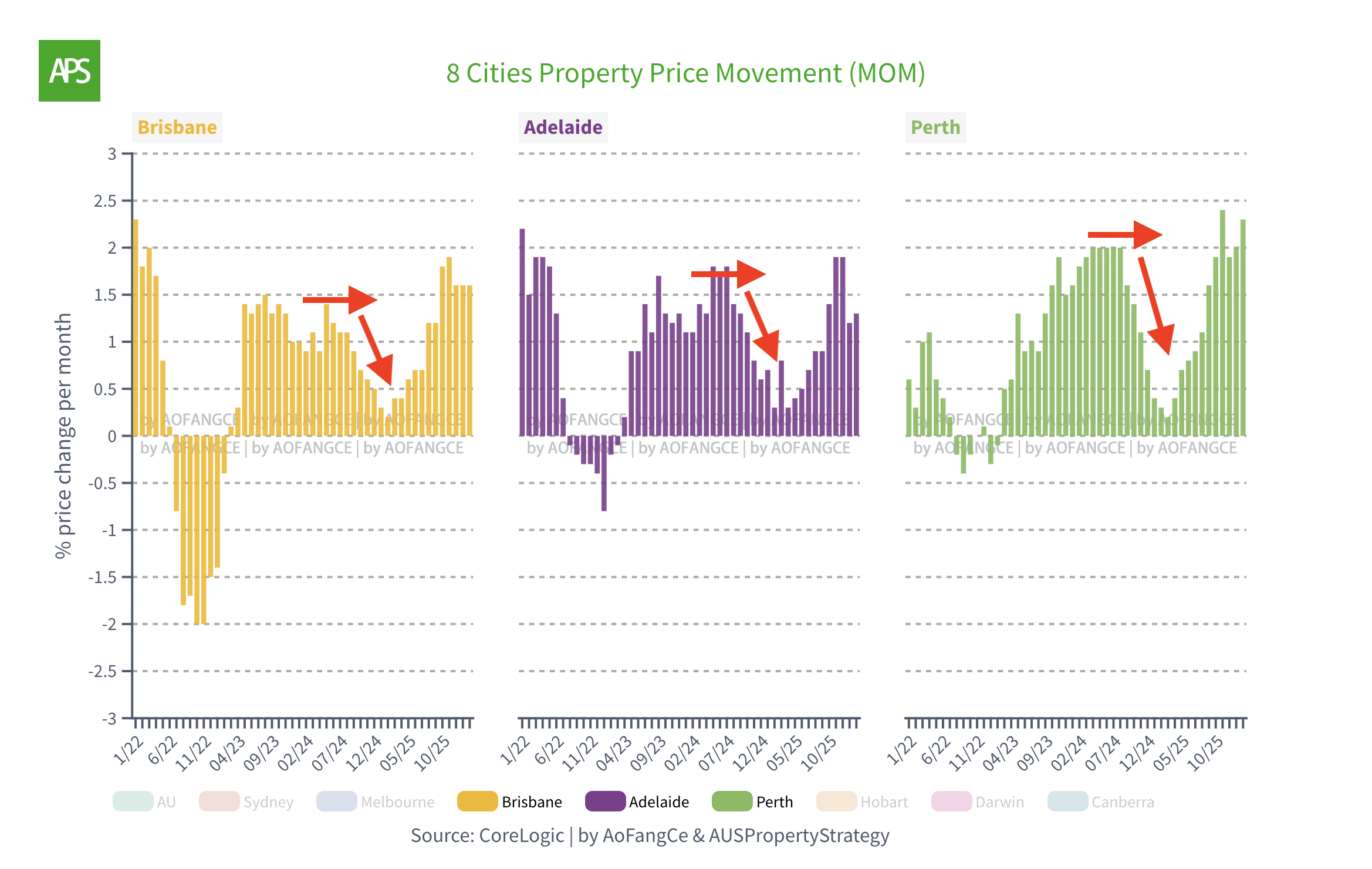
So the map is clear. But the real question is — where are you standing right now? And what’s your next move?
What You Should Do Now
Rates are at 4.1%. Very likely hitting 4.35% by May. If you’ve been sitting on the sidelines waiting for the “perfect moment” — here’s the hard truth. What you actually waited for isn’t a cheaper house. It’s less borrowing power. You’re sitting still while your purchasing power quietly shrinks. Waiting is a cost. It just never shows up on a bill.
But panic is just as dangerous as doing nothing. Don’t hear the word “recession” and assume the sky is falling. Let me walk you my opinions on 3 situations.
If you already own in Sydney or Melbourne — don’t panic-sell. Australian property moves up and down in the short term but rises over the long term. That hasn’t changed. But do this right now — go check your loan structure. Has your fixed rate rolled off? Can your cash flow handle another hike in May? If the numbers feel tight, call your bank today. A 10-minute phone call could save you real money on your rate. If you’re holding in Perth or Brisbane where prices are still climbing, just hold steady.
Getting ready to buy your first place? The timing isn’t as bad as you think. SQM’s “−6%” is the extreme scenario — it could end up being just −2%, or even flat. The key isn’t timing, it’s location. Australia isn’t one single market. It’s 8 markets. Maybe 80. Find something affordable in Perth or Brisbane with tight supply and low vacancy, and your experience will be a completely different story compared to Sydney. The VISION all-weather approach — all of Australia, all types, all cycles — boils down to this: spread the risk. Don’t put all your eggs in one basket. It sounds old. But in this market, it could save you.
Looking to expand your portfolio? This is when you need to be more disciplined, not less. Sydney and Melbourne are cooling — but flip that around. When they cool, that’s the exact window when capital flows toward other cities. Property cycles across Australia’s 8 states and territories have never moved in sync — some cooling, some accelerating, some just starting to recover. Don’t follow the panic. Use the mismatch to rebalance. One city’s tide going out is often the signal that another city’s tide is coming in. That’s the core of what “all cycles” means in the VISION framework.
On top of that, check your ownership structure — personal, company, trust, SMSF. Different structures have very different tax efficiency when rates are rising. The right structure could mean tens of thousands more in after-tax cash flow at year-end. Wrong structure, and even a great city gets eaten alive by interest and tax. That’s a hidden cost most people completely miss.
One last thing. No matter how high rates go, there’s one number that isn’t changing — ABS data shows FY2024–25 net overseas migration at 306,000. That’s 27% above pre-pandemic averages. People are coming. Housing isn’t keeping up. The RBA can hike all it wants — it can’t build houses.
Choose the right city. Use the right structure. Control your leverage. At the end of the day, this market isn’t about who buys the most. It’s about who buys right.
Watch the video version of the blog on YouTube.
15 Minutes Free Consultation (Limited-Time Free Offer)
If you have any questions about Australian real estate, we invite you to use our 15 Minutes Free Consultation service. Once you have filled in the form, a professional property investment strategist will be in touch with you. They will assess your needs and provide fundamental advice. This service is designed to help answer general property-related queries. BOOK NOW.
VISION Membership
Our Flagship Service: VISION Membership. Your One-Stop Property Investment Manager – Build a Tailored Portfolio and Achieve Financial Freedom
Whether you're an employee, a professional, a business owner or even a new migrant, everyone has a financial goal for the future. The VISION Membership is designed to solve all the pain points in your Australian property investment journey through one single, comprehensive service.
By analysing your current financial situation and long-term goals, we'll tailor a property investment plan just for you. Our team will match you with the ideal mortgage structure, tax strategies, wealth planning, and legal support, empowering you to go further, faster, and smarter on your path to financial freedom.
VISION Membership is perfect for busy individuals who want a professional team to create, expand and manage their Australian investment portfolio. If you're looking for a dedicated team, including real estate investment experts, mortgage brokers, accountants, financial planners, and property solicitors, VISION Membership is your ideal solution.
Start with an obligation-free 30-minute discovery session on Zoom. BOOK NOW.
VISION Buyer’s Agent
No time for inspections? Tired of dealing with pushy selling agents? Unsure how much to offer or feeling nervous about auctions? Worried about buying the wrong property? If any of these sound like you, AusPropertyStrategy's Australia-wide VISION Buyer's Agent Service is here to help.
We provide end-to-end support to help you build an optimised property portfolio and achieve your financial goals—whether you're investing interstate, refinancing, or planning post-settlement leasing or resale. Our services cover everything from suburb research and property selection, to price negotiation, auction bidding, and post-settlement support.
Start with an obligation-free 30-minute discovery session on Zoom. BOOK NOW.
real estate australia,real estate investing,australian property,australian housing market,australian economy,australian property investment,australian property market,buying property,australian real estate,mortgage brokers brisbane,first home buyer,Australian Real Estate,Australian Real Estate Investment,Australian Property Investment,Real Estate Investment,Property Investment,Property Investment Australia,Passive Income,Positive Cash Flow,Australia Real Estate Investing,Australian Real Estate Investors,Australian Property Investors,Vision Wealth Mentors,Vision Real Estate Investors Australia,financial freedom, freedom through property investment,real estate investors,property investment,passive income,positive cash flow,real estate course,real estate courses,real estate training,australian property market,property investment brisbane,property investment sydney,melbourne property market,investing in brisbane,investing in melbourne,how to invest in property,buying properties,start investing in property,property investment strategy,how to buy investment property,property investing tips,best suburbs to invest in sydney,locations real estate,prime location,property growth by suburb,capital growth suburbs


