

Senate Report Drops: CGT Discount Cut to 25%? Your Property Could Cost $60K More|APS138
On March 17, the Australian Senate released a report that sent shockwaves through the investment community. The CGT discount — your Capital Gains Tax Discount, the one that’s been quietly making property investors richer for 25 years — is now officially on the chopping block. And this time, it’s not the Greens making noise. Labour — the same party that took a “slash the CGT discount” platform to the 2019 election and got hammered — now has two of its own senators who’ve signed this report. That’s a public admission: the CGT system is broken. Then Treasurer Jim Chalmers, speaking in Melbourne two days later, practically tipped his hand. His words: “I’ll give my colleagues a whole bunch of options when it comes to tax reform.” Let me translate — the food’s on the table. They’re just picking up the fork.
Now, I’m not saying reform is guaranteed. I’m saying the risk of a major CGT change is higher right now than at any point in the last 25 years. So how did we get here? What did this report say? Which of the six reform paths is most likely to become law? Whichever they pick points directly to your investment property.
One Cut, 25 Years Ago
To understand why this report matters, we need to go back to 1999. Before that year, when you sold an investment property at a profit, you paid tax on an inflation-adjusted gain — hold for 10 years, and you’d only get taxed on what you actually made after stripping out inflation. Fair enough. But the Howard government decided the maths was too messy. So in 1999, John Howard made one clean cut — doesn’t matter how long you held it, doesn’t matter what inflation did, if you owned it for more than 12 months, you’d only pay tax on half the profit. Simple. And it changed the entire game.
Here’s what happened next. From 2000 to 2025, Australian residential property went up 6.4% per year on average. Before 2000? Just 4.2%. That’s over 50% faster. Now ask yourself — how much did your wages go up over that same period?
Then investors figured out the perfect closed loop — while holding, use negative gearing to write off losses against your salary. When selling, only pay tax on half the profit. Winning on both ends. The Australia Institute put it brilliantly in their Senate submission — “If negative gearing is the firewood fuelling the housing crisis, the CGT discount is the bucket of petrol poured on top.”
Over 25 years, investors piled in while owner-occupiers fell behind. Finally, in November 2025, the Senate set up a special committee to dig into the CGT discount. Ninety-seven submissions, three hearings, former RBA governors and Treasury secretaries all gave opinions. On March 17 this year, the report dropped. But here’s the thing — this report isn’t legislation. What it does is hand the knife to whoever’s writing the May budget.
Now that we’ve got the history sorted, here comes the real story — what did this report actually find? Four core findings. Every single one cuts deep.
Four Cuts That Draw Blood
Number one: you pay more tax going to work than someone cashing in on investment properties. Former Treasury Secretary Ken Henry laid it out at the hearing — “Investment property under Australian tax law has essentially become a tool for sheltering labour income.” You’re a teacher, an engineer, a nurse — every dollar you earn gets taxed in full. But an investor who pockets $500,000 selling a house only pays tax on $250,000.

Number two — I checked this figure twice because I thought I’d misread it. Over the past five years, 92% of investor housing loans flowed into second-hand properties. Only 8% went toward new builds. Owner-occupiers? 20% went to new construction. Investor money isn’t building homes — it’s bidding up prices on what already exists. That single number tears apart the “investors boost housing supply” story. And your investment property — house or unit — almost certainly sits in that 92%. You didn’t do anything wrong. But the government now sees this as problem number one.
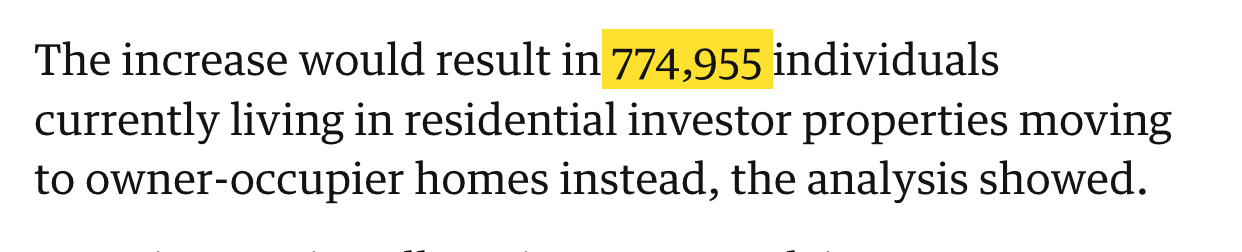
Number three: investors get a tax break on both ends; first home buyers get nothing. While you hold, negative gearing cuts your tax bill. When you sell, the CGT discount cuts it again. So what does a first-home buyer bring to a bidding war against that? Former NSW Treasury economist Michael Warlters found that scrapping both concessions could help an additional 770,000 renters afford to buy.
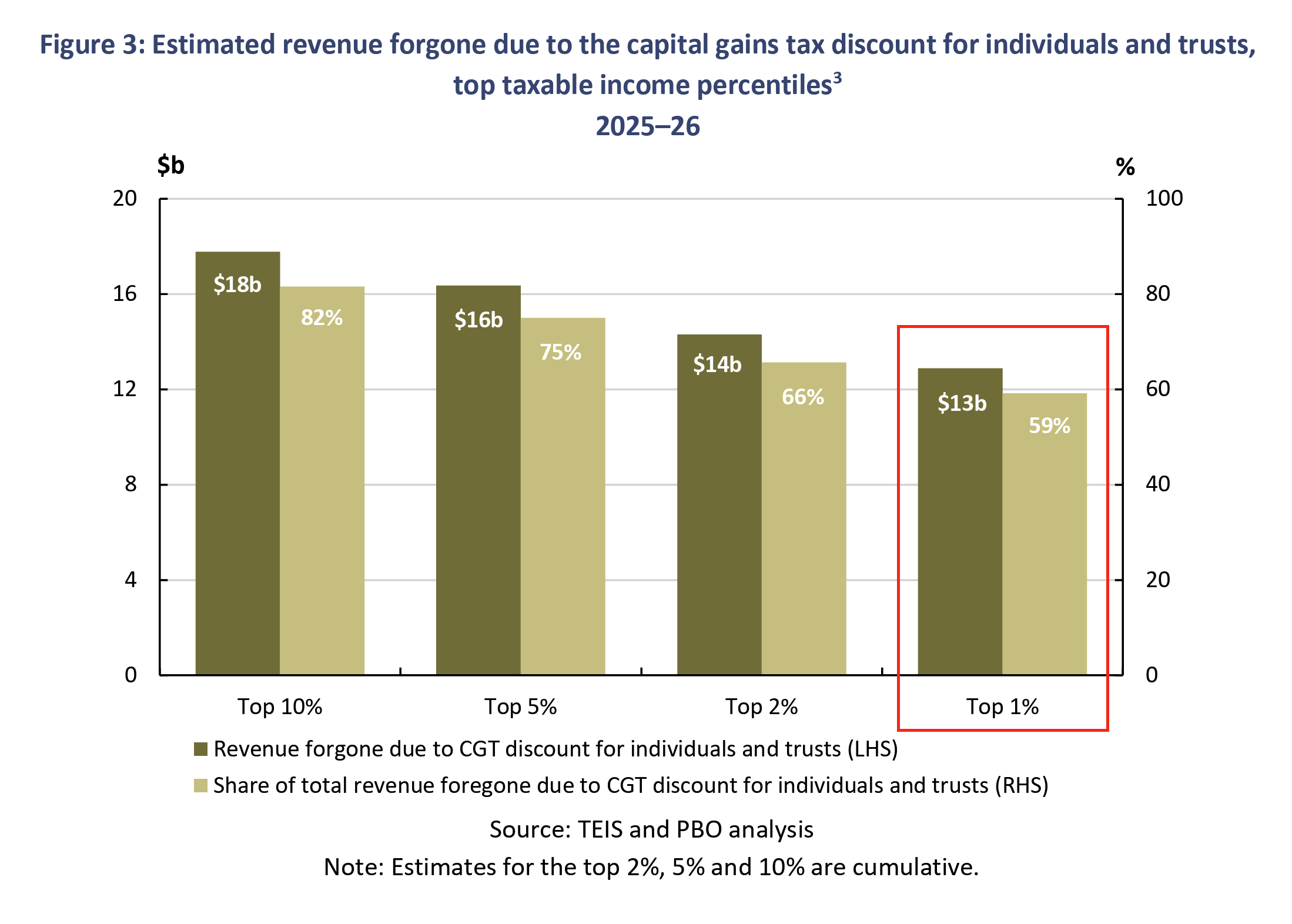
Number four: $250 billion in tax concessions over the next decade — and who actually benefits from it? The top 1% of earners took 59% of the gains. 75% went to people over 50. Under 35? Just 4%. The Parliamentary Budget Office puts the 10-year cost at $247 billion. The report’s conclusion was blunt: “intergenerational inequality.” In plain English, young people’s taxes are propping up the people who need it the least. That matters.
Four findings. The data’s all there. But knowing there’s a problem isn’t enough — you need to know how they plan to fix it. The report laid out six paths, and each leads straight to your tax bill.
If you have any questions about property investment, please book a free discovery call on our website. If you want a team offering one-stop service to help you build a property investment portfolio, achieve financial freedom and retire early, join our VISION Gold Membership starting with a 30-minute discovery session. Or to keep it simple, our data-driven buyer's agency service can help. We buy and manage properties for our clients anywhere in Australia. If you have an international view, talk to us about the UAE VISION Gold Membership. We help you invest in the UAE property market, plan your tax residency, reduce your taxes to almost 0 and handle CRS/AML auditing. Links to the service are in the description below.
Six Paths, One Tax Bill
I’m not going to walk you through the whole document — let me break down the two paths most likely to actually happen, and run through the rest quickly.
The CGT discount reform options, from most aggressive to most gentle: 1. Scrap it entirely. 2. Return to inflation indexation. 3. Cut to 25%. 4. Cut to 30–40%. 5. Treat residential differently — keep the discount only for new builds. 6. And running through every option is one huge debate — grandfathering. Anything bought before a cut-off date stays under the old rules.
The most mainstream option is cutting the discount to 25%. The Grattan Institute’s logic is straightforward — since 1999, property prices have climbed 6.4% a year on average, and investors typically use 80% leverage, giving roughly 25% annualised returns on their cash invested. Meanwhile, inflation has averaged just 2.9%. A 50% discount to “compensate” for 2.9% inflation? Wildly generous. A 25% discount is much closer to what the numbers justify.
Let me put that in real dollars. Say you bought for $800,000 in 2020, now worth $1.3 million — a $500,000 gain. Under today’s rules, halve it — $250,000 taxable. At 37%, you pay about $92,500. Drop the discount to 25% — $375,000 becomes taxable, roughly $138,700 in taxes. That’s about $46,000 more. At 45%? Around $56,000 more. So an extra $50,000 or so on a half-million gain — significant, but not catastrophic.
But that’s still the mild version. This next one is what I think you should really be paying attention to.
Here’s my personal take — Independent Senator David Pocock’s differential approach is the option I believe comes closest to what the government will go with. From July 1, 2026, any second-hand investment property bought after that date gets zero CGT discount. Properties bought before stay protected under grandfathering. New builds keep a 25% CGT discount if held for at least three years. Negative gearing gets tightened too — gone from the second investment property onwards.
Why does this work? It channels investor money into new construction and blocks speculation on existing homes. Politically more moderate than the Greens, but concrete enough to deliver a real result. What does it mean for you? If you already own and grandfathering applies, you’re safe for now. But buy another second-hand investment property after that date? Full tax on the gain. No discount. The rules.
Former Treasury Secretary Ken Henry said he doesn’t like grandfathering — the lock-in effect makes investors cling to properties, and liquidity dries up. But scrapping it entirely is politically dead on arrival. The most likely outcome is a clear line in the sand — buy after a certain date, new rules apply. Everything before that stays as it was.
Right, six paths covered. But which one gets picked isn’t up to economists — it comes down to politics. Who’s backing it, who’s fighting it, and do the objections hold up? You can’t read the direction without understanding that.
Everyone Shows Their Hand
The pro-reform camp is broad: ACOSS, Oxfam, ACTU, the Grattan Institute, the e61 Institute, and even the Business Council of Australia backs reform to some degree. Over 70% of submissions supported either abolishing or reforming the CGT discount. This isn’t a fringe position — it’s becoming mainstream.
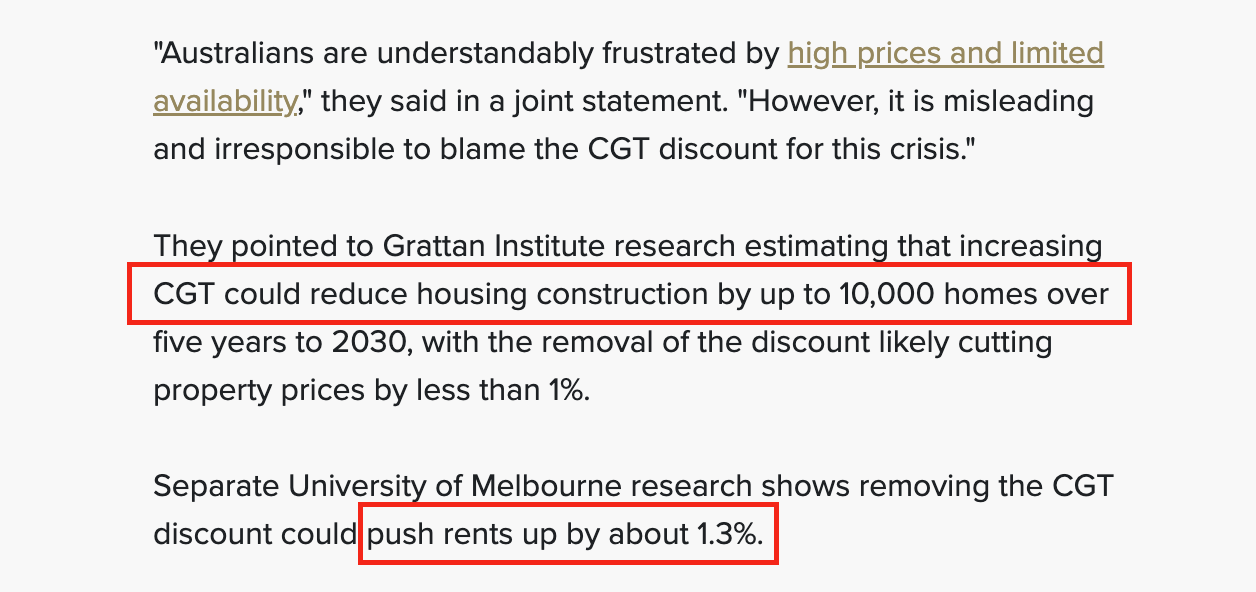
On the other side? The Coalition is the loudest — their argument boils down to: “Housing is a supply problem, not an investor problem.” Senator Andrew Bragg called the report “shallow and cruel.” They point to modelling suggesting higher CGT could cut new supply by 10,000 dwellings over five years. University of Melbourne research says removing the discount might push rents up 1.3%. The HIA and REIA are also opposed — though they’ve got obvious skin in the game.
All the cards are on the table. Now the big question — can this actually get through Parliament?
Can It Pass?
The House of Representatives? Labour holds a clear majority. Not an issue. The Senate is where the real fight happens. The Coalition is firmly against, so the government needs the Greens. The Greens’ position has always been “don’t go halfway” — but as long as the reform has genuine teeth, chair Nick McKim will most likely vote yes. Add David Pocock and independent Allegra Spender, and the numbers look solid. The timing lines up too — commentators are calling this Labour’s best window for tax reform in decades. They’ve got the seats, and the next election is still far off.
My read: the chance of nothing changing is slim. The question is how deep the cut goes and what the transition looks like. Most likely — discount drops to 25–30%, with some form of grandfathering. Full abolition? Unlikely. Zero change? Also unlikely.
We’ve covered a lot of ground. Now we get to the question that actually counts — if this goes through, what does it mean for your money?
What It Actually Means for You
First — prices. Will they crash? I don’t think so. Academic evidence points to a 1% to 4.7% price impac
t — growth slows, it doesn’t collapse. The Victoria case backs that up. Supply shortages and population growth still hold the floor. But growth will ease. Good news if you’re buying a home. For investors, it depends on how you respond. The key is working out which group you fall into.
If you already own investment properties and you’re holding long-term, grandfathering should protect you in the short run. But if negative gearing changes at the same time, you need to redo your cash flow numbers.
If you’re thinking about getting in, it depends on what you’re buying. A home to live in? This doesn’t touch you, buy when you’re ready. New build or house-and-land? Same — buy now, the impact is smaller. Second-hand investment property, and you think policy will shift? Buy before May 12. If nothing changes, you’ve lost nothing. If it does, you locked in at the better rate.
If you personally own multiple properties — and negative gearing shifts so losses can only offset other investment income, or deductions get cut from the second property onwards — your holding costs jump. So pause. Sort out your tax structure and entity setup before you do anything else.
If you hold through a trust or SMSF — and trust CGT reform comes through alongside this — that’s where the biggest hit lands. Get your holding structure sorted first, then make investment decisions. A full entity structure review is something you can start with us right now.
If you’re an overseas investor, non-residents don’t get the CGT discount anyway, so the direct impact is small. But pair this with AML Tranche 2 and CRS 2.0, and the environment is tightening. Unless you have reasons beyond investment returns, it might be worth waiting.
So what should you do right now? Four things. First, don’t panic-sell — the fine print isn’t out yet, and selling now could mean selling at the worst possible moment. Second, sit down with your accountant and work through what different scenarios do to your tax position. Third, keep your eyes on May 12 — I’ll have a full breakdown ready the moment it drops. Fourth, pay attention to every detail — how far the discount drops, when it takes effect, whether grandfathering exists, and whether negative gearing changes — because every detail will change your numbers.
You might think — can’t I just sit tight and wait? No. “Doing nothing” is still a choice, and it could be the most expensive one you make. The key is figuring out exactly where you stand before you make any moves. This CGT reform is actually a good moment for every investor to step back and take a hard look at their portfolio and strategy.
This is potentially the biggest shift in Australia’s tax system in 25 years. Getting your head around it and preparing — that’s your homework right now. Look, policies change, and rules change. But the people who’ve done their homework don’t fear change.
If the thing holding you back is “I don’t know where I stand — defence or attack?” — don’t go on gut feeling. What we do inside VISION Gold Membership is pull all the moving parts together — rates, supply and demand, policy, tax — and turn them into a plan we can execute for you. Check the details in the description. May 12 is coming, and I’ll have a full breakdown the moment it drops. If you know anyone with investment property who needs to see this before that date, share this video with them now.
Watch the video version of the blog on YouTube.
15 Minutes Free Consultation (Limited-Time Free Offer)
If you have any questions about Australian real estate, we invite you to use our 15 Minutes Free Consultation service. Once you have filled in the form, a professional property investment strategist will be in touch with you. They will assess your needs and provide fundamental advice. This service is designed to help answer general property-related queries. BOOK NOW.
VISION Membership
Our Flagship Service: VISION Membership. Your One-Stop Property Investment Manager – Build a Tailored Portfolio and Achieve Financial Freedom
Whether you're an employee, a professional, a business owner or even a new migrant, everyone has a financial goal for the future. The VISION Membership is designed to solve all the pain points in your Australian property investment journey through one single, comprehensive service.
By analysing your current financial situation and long-term goals, we'll tailor a property investment plan just for you. Our team will match you with the ideal mortgage structure, tax strategies, wealth planning, and legal support, empowering you to go further, faster, and smarter on your path to financial freedom.
VISION Membership is perfect for busy individuals who want a professional team to create, expand and manage their Australian investment portfolio. If you're looking for a dedicated team, including real estate investment experts, mortgage brokers, accountants, financial planners, and property solicitors, VISION Membership is your ideal solution.
Start with an obligation-free 30-minute discovery session on Zoom. BOOK NOW.
VISION Buyer’s Agent
No time for inspections? Tired of dealing with pushy selling agents? Unsure how much to offer or feeling nervous about auctions? Worried about buying the wrong property? If any of these sound like you, AusPropertyStrategy's Australia-wide VISION Buyer's Agent Service is here to help.
We provide end-to-end support to help you build an optimised property portfolio and achieve your financial goals—whether you're investing interstate, refinancing, or planning post-settlement leasing or resale. Our services cover everything from suburb research and property selection, to price negotiation, auction bidding, and post-settlement support.
Start with an obligation-free 30-minute discovery session on Zoom. BOOK NOW.
real estate australia,real estate investing,australian property,australian housing market,australian economy,australian property investment,australian property market,buying property,australian real estate,mortgage brokers brisbane,first home buyer,Australian Real Estate,Australian Real Estate Investment,Australian Property Investment,Real Estate Investment,Property Investment,Property Investment Australia,Passive Income,Positive Cash Flow,Australia Real Estate Investing,Australian Real Estate Investors,Australian Property Investors,Vision Wealth Mentors,Vision Real Estate Investors Australia,financial freedom, freedom through property investment,real estate investors,property investment,passive income,positive cash flow,real estate course,real estate courses,real estate training,australian property market,property investment brisbane,property investment sydney,melbourne property market,investing in brisbane,investing in melbourne,how to invest in property,buying properties,start investing in property,property investment strategy,how to buy investment property,property investing tips,best suburbs to invest in sydney,locations real estate,prime location,property growth by suburb,capital growth suburbs


