
The Secret Fuel Behind Australia’s “Impossible” Housing Boom | APS142
Inflation hits 17%. Interest rates double. Oil prices go up four times over. What happens to Australian property prices? Most people would say crash. But the real answer? They doubled. I’m not making that up. That’s what actually happened in Australia in 1973.
Now, oil has shot past 110 US dollars. The RBA has hiked twice in a row to 4.10%. A lot of people are saying this time prices can’t hold up. But there’s one number that’s been quietly propping up prices from behind the scenes. Banks won’t bring it up. The media won’t touch it. Because the truth is too confronting. I know that sounds like a big claim. But I’ve got three pieces of evidence that tell the whole story. You watch, you decide.
The Banks Keep Changing Their Minds
CBA and Westpac just put out their 2026 property forecasts, and the two look nothing alike. CBA says Perth is up 15% this year, Brisbane up 12%, clear frontrunners. Sydney? Only 2%. Melbourne even worse, just 1%. Now look at Westpac. They’re also calling 5% nationally, but the rankings are completely different. Melbourne at 4%, jumping ahead of Sydney at 3%. Brisbane only 7%, Perth only 8%.
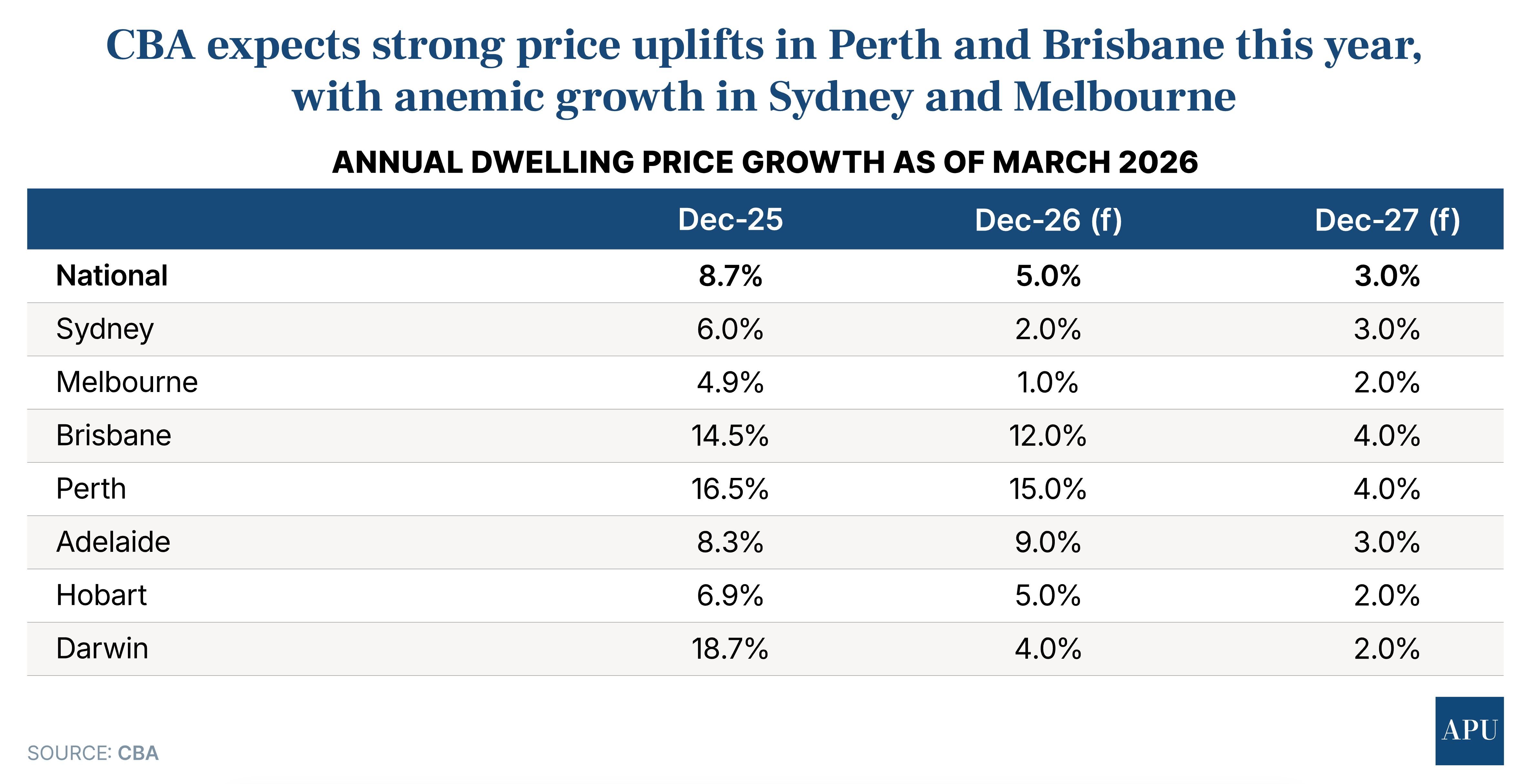
So for Perth, one says 15%, the other 8%. Nearly double the gap. Adelaide is the same story, 9% versus 6%. Same market, same data, completely different pictures. You call that a forecast? Honestly, it looks more like a coin toss to me.
Here’s how I see it. Don’t take either one too seriously. Six months ago their own numbers were way higher. Westpac had the national forecast at 9% in August 2025, now slashed to 5%. CBA dropped from 7% to 5%. ANZ from 5.8% to 4.8%. They keep moving the goalposts. The reason? The rate direction flipped. Last year they were talking about cuts to 3.60%. This year, two hikes back up to 4.10%. CBA’s forecast also bakes in possible CGT (Capital Gains Tax) reform from the May federal budget, which could drag 2027 growth down further.
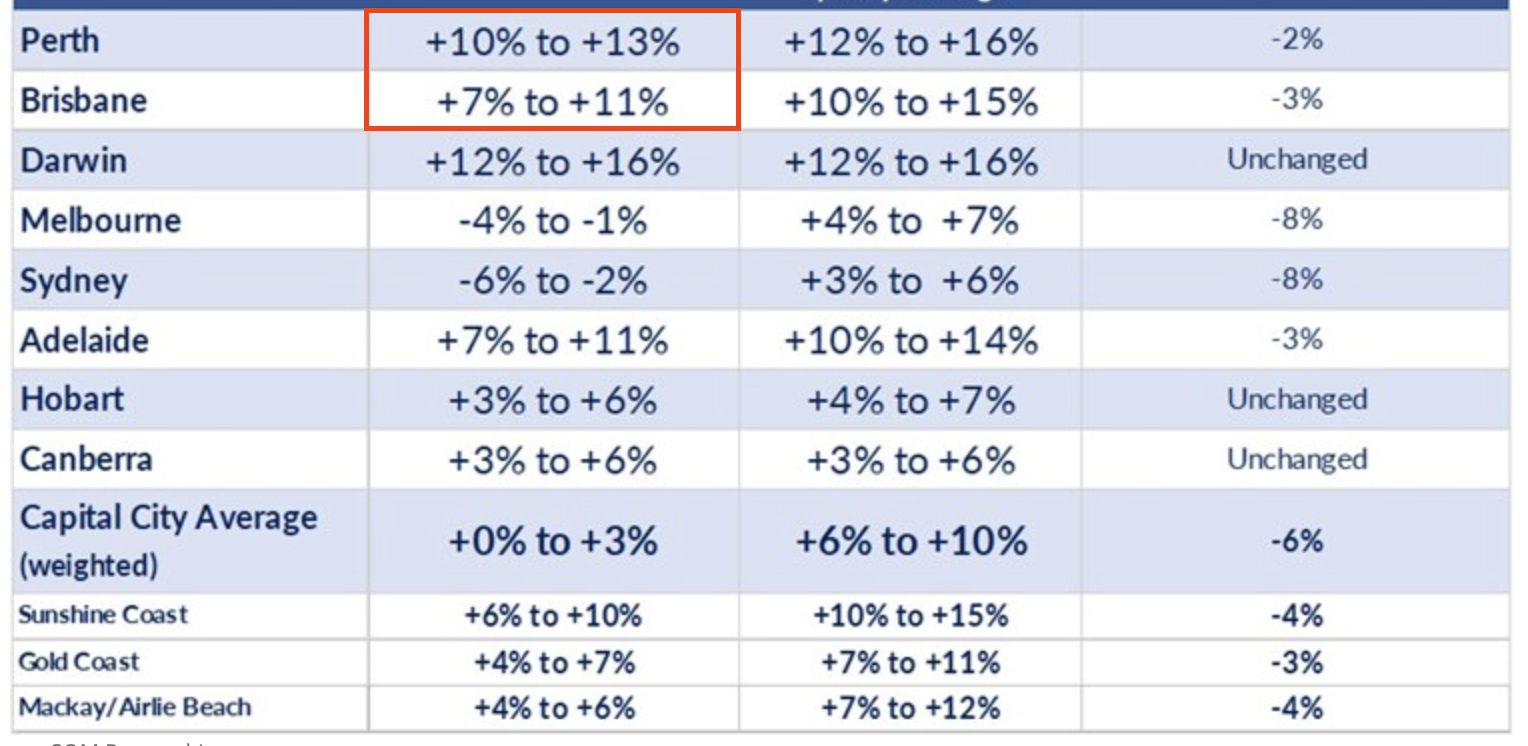
Now here’s the thing. The big four are fighting over how much prices will go up, but on one point they all agree: not a single bank is calling for negative growth in any capital city for the full year. There are voices far more bearish, though. SQM Research predicts Sydney and Melbourne could actually fall across 2026. But even SQM has Brisbane and Perth growing between 7% and 13%. “Divergence.” That is the word for 2026.
So forecasts tell you “how much.” But they don’t tell you “why.” The answer is hiding in the population numbers. And once you see it, Sydney’s 2% will make a lot more sense.
People Are Leaving, but the Money Isn’t
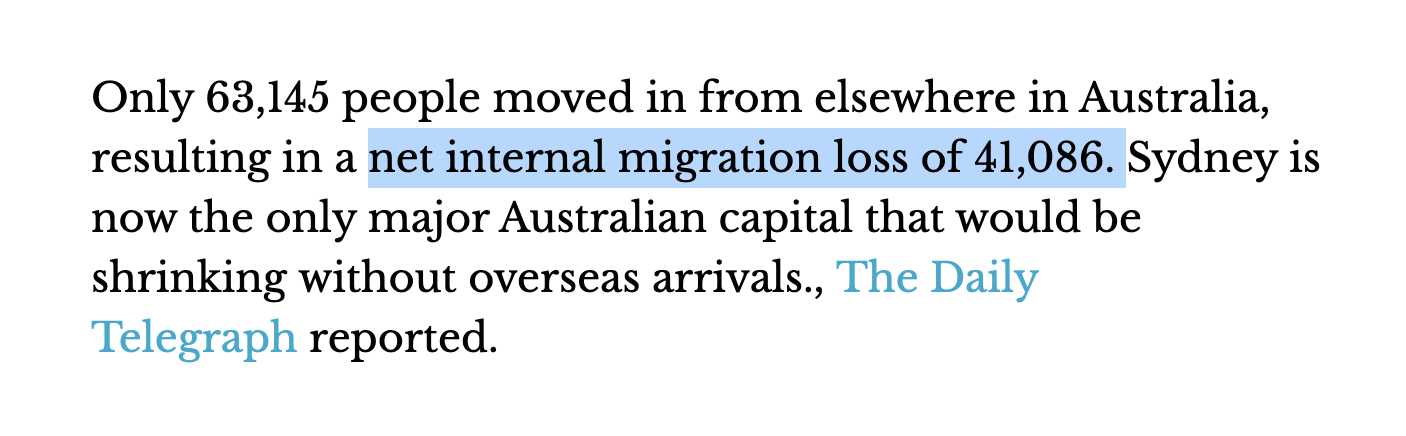
Sydney is bleeding people. I don’t say that lightly. The ABS (Australian Bureau of Statistics) put it in black and white. In the 2023-24 financial year, Greater Sydney had a net loss of 41,086 people.
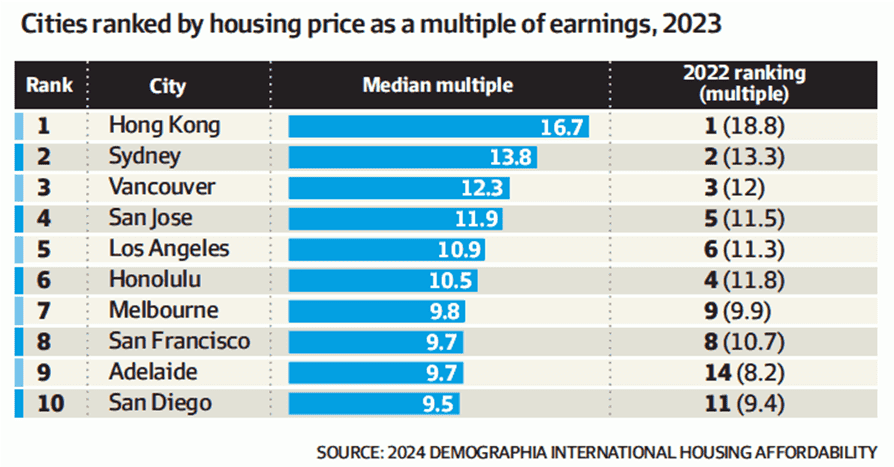
Why? Cost. Demographia’s global housing affordability report gave Sydney a price-to-income ratio of 13.8, making it the second most unaffordable city on Earth, barely behind Hong Kong. The NSW Productivity Commission has a number that stings even more: between 2016 and 2021, 70,000 people aged 30 to 40 left Sydney, and only 35,000 came back. “Sydney is becoming a city without grandchildren.” Let that sink in.
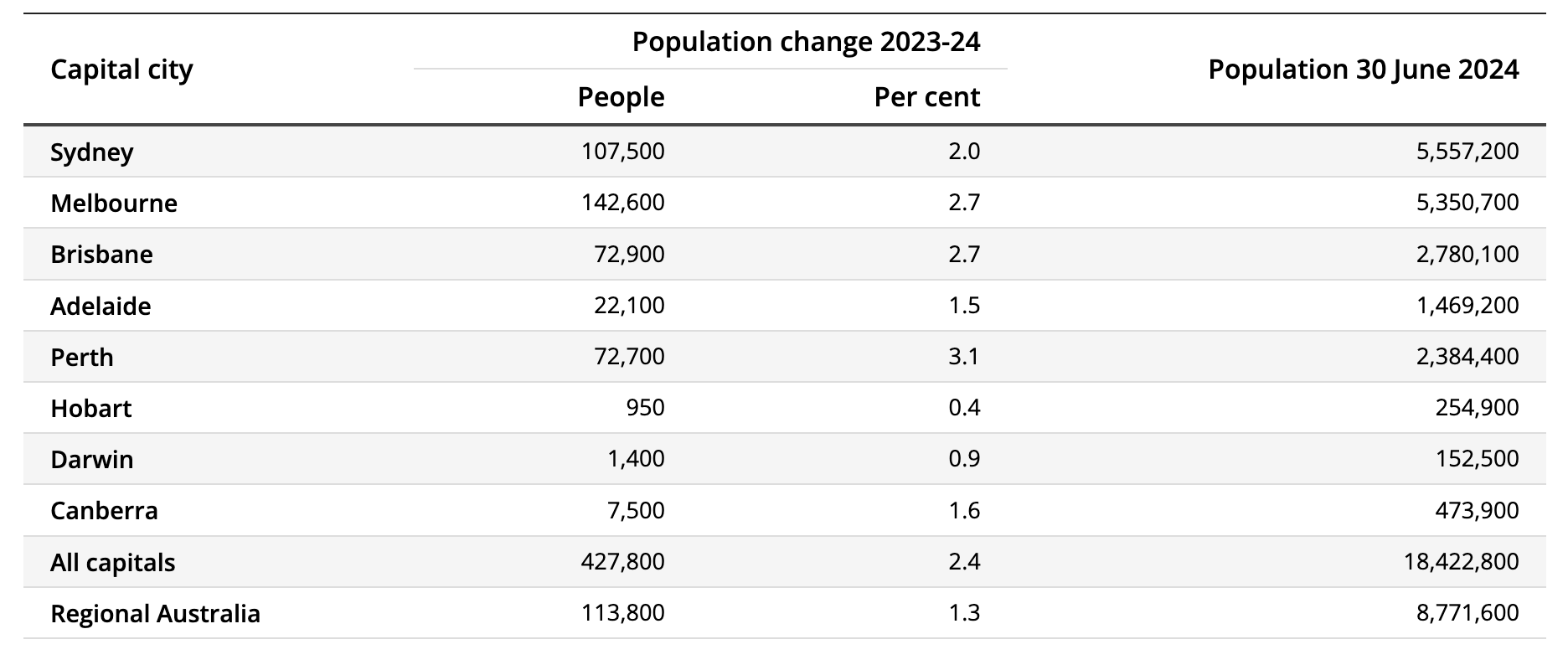
Now you might think, everyone’s leaving, so prices should drop. Not that simple. The ones leaving are young people who can’t afford to buy. The ones coming in? Overseas migrants with money. In 2023-24, Sydney’s net overseas migration alone topped 120,000. Property prices come down to who’s buying, not who’s walking away. And the money is still walking in. Perth is growing at 3.1%, fastest in the country. Brisbane and Melbourne both at 2.7%. Sydney dead last at 2.0%.
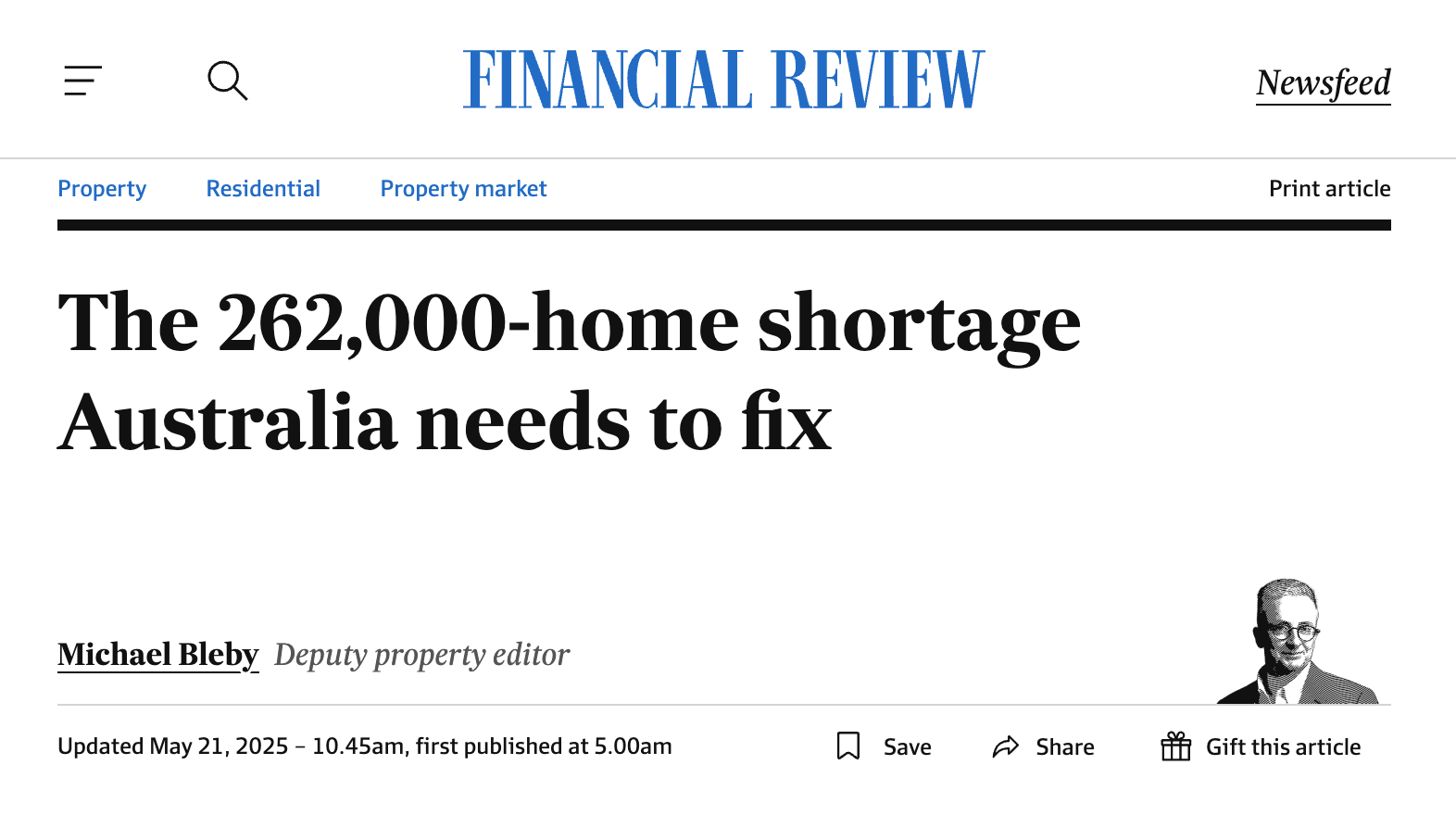
NHSAC (National Housing Supply and Affordability Council) figures show only 177,000 homes were finished nationally in 2024. The Housing Accord target? 240,000. A gap of over 60,000 in one year, with a five-year shortfall projected at 260,000. More people pouring in, not enough homes being built. That hole isn’t getting plugged soon.
So now you can see the demand side clearly. People are flowing out of Sydney, but total demand keeps growing and supply can’t keep up. That’s only half the picture, though. Something just happened on the supply side that’s taken the whole situation to a completely different level.
It’s Getting Too Expensive to Build
On March 24th, suppliers to building materials giant Reece suddenly announced across-the-board price hikes on piping. PVC up 27%. PE pipes up 36%. PP pipes up 31%. The reason? Oil prices.
The Strait of Hormuz got shut down. Twenty per cent of the world’s oil shipping capacity was wiped out. Plastic raw materials come from petroleum, so when the upstream supply breaks, everything downstream goes up in flames.
And here’s what most people miss. Even before this oil shock, construction costs had already gone up sharply. ABS data shows residential building materials are up close to 38% since COVID. Master Builders Australia puts it higher, factoring in labour, and the total cost of building a home is 47% above pre-pandemic levels. That’s climbing faster than Sydney rents. Sometimes I think I should’ve bought a warehouse full of PVC pipes back in 2020. It might’ve been a better return than property.
So what does this boil down to? Construction cost is the floor under property prices. When flour gets more expensive, bread doesn’t get cheaper. New homes cost more to build, fewer get built, and the ones already standing become more valuable. And there’s one rule in Australian construction history that has never been broken: the nominal cost of building has never come down. Not once. Ever. It’s a one-way street. Anyone hoping construction prices will fall once inflation eases can stop dreaming.
Right, so now you know two things. Demand side, population is surging. Supply side, costs have locked in the price floor. That alone is serious. But there’s an even bigger force pushing the property prices higher. Banks don’t bring it up, the media doesn’t cover it, and when you see the data, you’ll understand why.
Want to know exactly where you stand and what your next property move should be? Book a VISION Blueprint Session — in 45 minutes, you'll walk away with a personalised Property Investment Blueprint built around your numbers, your goals, and your timeline. And if you want ongoing support from a team that handles everything from strategy to settlement, VISION Gold Membership is your next step. Link in the description below.
How Much Have You Already Lost?
M3. This might be the most important word in today’s video. M3 is the broad money supply, basically the total amount of money floating around the economy. RBA data shows that in early 2020, Australia’s M3 sat at about 2.2 trillion dollars. By February 2026? 3.4 trillion. Six years. Up 55%.
When I first pulled that number, I checked it twice because I thought something had to be wrong. Let me put 55% in perspective for you. If you had a million dollars six years ago, what that money can buy today is worth roughly 650,000. Your money didn’t shrink. Money itself became worth less. And that is the part that should worry you.
So where did all this money come from? Mainly quantitative easing (QE) between 2020 and 2022. The RBA printed money to buy bonds, and the federal government pumped hundreds of billions into fiscal stimulus. In those two years, M3 grew by roughly 650 billion. There’s over 50% more money in the system than six years ago. And it’s still growing. In 2025, M3 went up about 7.2% year on year, more than double GDP growth and nearly double wage growth.
Think about what that looks like. GDP grows 2% to 3% a year. Your wages grow 3% to 4%. But the money supply is expanding at over 7%. More money chasing fewer hard assets. If you own property, your wealth is growing. If you don’t? The purchasing power of your cash is being eaten into at 7% every single year. And nobody sends you a bill for it. It just vanishes.
Look at the maths. Property up 5%, purchasing power down 7%, wait one year and you’ve fallen behind by 12 points. A 500,000 dollar home you don’t buy this year could be 520,000 to 530,000 next year. This isn’t a textbook exercise. This is real money disappearing from your pocket while you sleep.
We’ve always talked about a concept at AusPropertyStrategy called VISION All-Weather Investing. One of its core ideas: when money keeps expanding, holding cash is the single biggest risk you can take. Our 541 Rule says 50% comes down to location, 40% to holding period, 10% to timing. Timing is only 10%, but so many people pour 100% of their energy into waiting for the “perfect moment.” And while they wait, their purchasing power evaporates.
So at this point you’ve seen three forces: population growth, construction costs locked in, and money being printed faster than the economy can grow. But you might still have one question. What if oil keeps going up, rates keep climbing, and the economy tips into recession? Fifty years ago, someone asked the exact same question.
The 1973 Playbook Is Playing Out Again
October 1973. OPEC (Organisation of the Petroleum Exporting Countries) announced an oil embargo. Crude went from 2.90 US dollars a barrel to 11.65. Four times over.
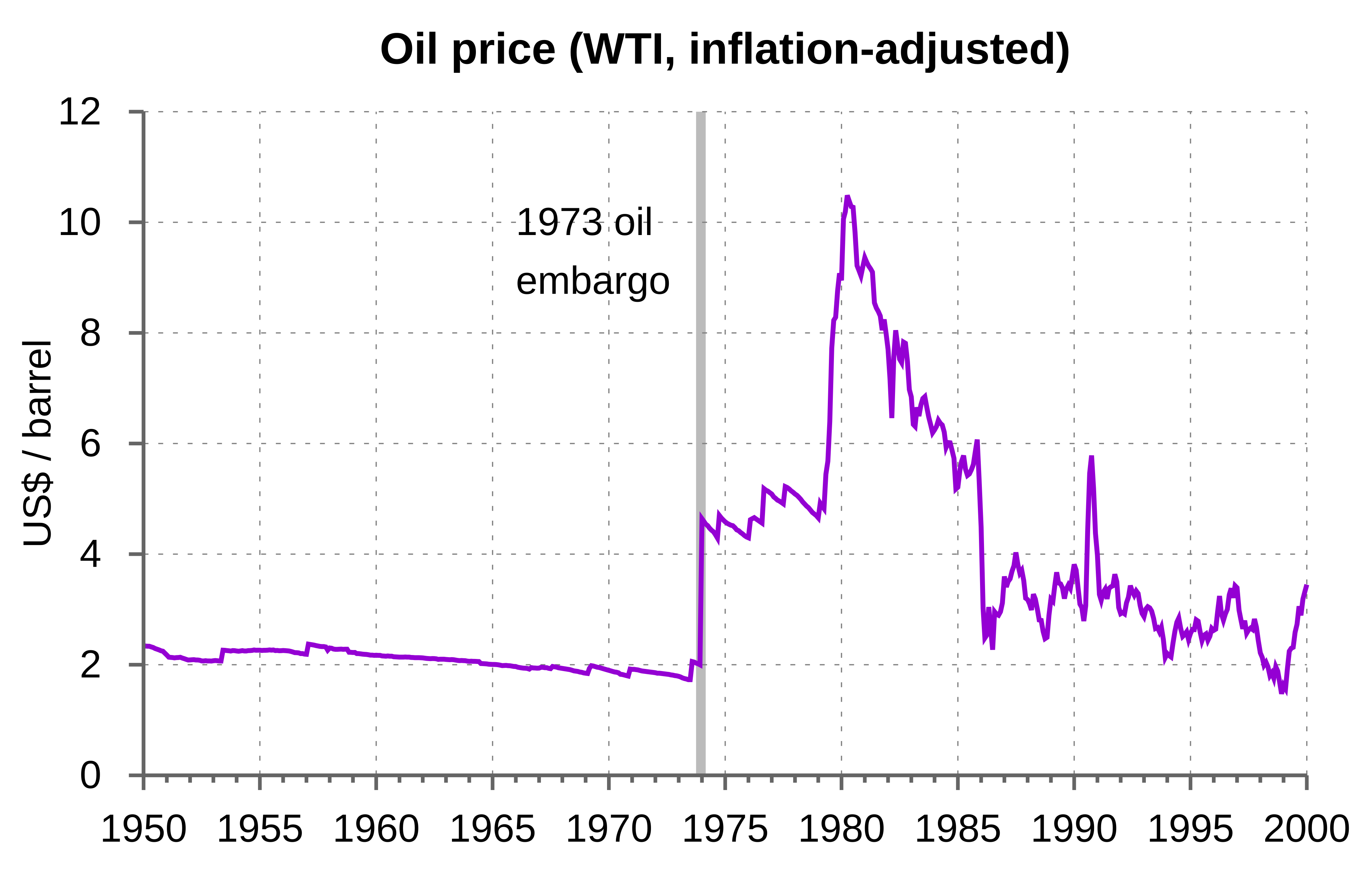
What happened in Australia? Inflation spiked to 17.7%. Mortgage rates doubled from 5.88% to 10.38%, more than double where we are now at 4.10%. If YouTube had existed back then, every thumbnail would’ve been screaming “property is about to crash” and “sell everything now.”
So what actually happened? Sydney’s median house price was 18,700 dollars in 1970. By 1976 it hit 36,800. Close to doubling in six years. Then the 1979 Iranian Revolution hit, Australia tipped into recession, unemployment shot up. Sydney property price went from 34,300 to 68,850. Five years, doubled again.
Now you might say, you can’t compare 50 years ago to today. Fair point. The 1970s had no APRA (Australian Prudential Regulation Authority) controls, no LVR caps, and hardly any variable-rate loans. Rates today have a much tighter grip on the market.
But here’s the part most people miss. Research from Macquarie University academics Abelson and Chung found that between 1974 and 1979, Sydney’s real purchasing power index for housing dropped from 68.0 to 62.8. On paper, your house was going up in value. But factor in inflation, and your actual purchasing power fell by about 8%. Even when prices were “booming,” the real value was quietly shrinking.
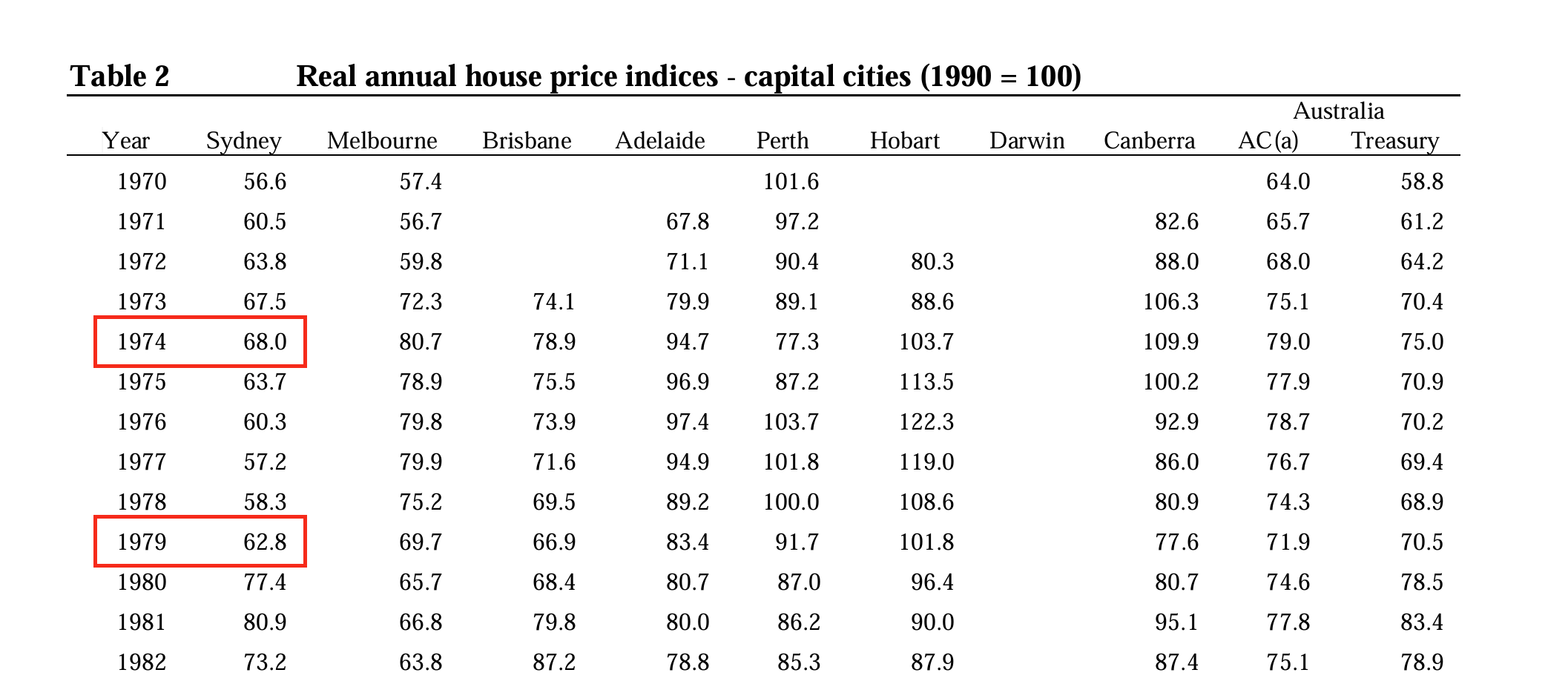
And that is the question that matters. It was never “will prices go up.” In an inflationary environment, nominal prices almost always go up. The real question is: can you outrun inflation?
History gives you two answers. First, nominal prices don’t crash. Every crisis in the last 50 years, oil shocks, the GFC, COVID, nominal prices came back and kept climbing. No exceptions. Second, going up on paper doesn’t mean you’re making money. If you can’t beat inflation, you’re going backwards. The people who waited for a “crash” through the 1970s watched their purchasing power get chewed up. The ones who bought in 1973 while everyone called them crazy? By the 1980s, their assets had multiplied several times over.
The ones who came out ahead have always been the ones who moved in the right location, at the right phase of the cycle. That’s what our Golden 11 Rules are built for. Not gut feeling. A system that checks the boxes: monetary conditions, population trends, supply bottlenecks, policy direction, rate cycles. When all of those line up, that’s your signal to move.
So, Where Does This Leave Us?
I don’t think Australian property prices are going to crash. But the split between cities has already kicked in. Sydney and Melbourne will see limited growth, and they’ll probably fail to keep pace with inflation. Where are the real opportunities? Areas with diversified economies, sustained population growth, and vacancy rates below 3%. But you can’t just pick any regional market and hope for the best. If the local economy runs on one industry, if people are leaving, if the infrastructure isn’t keeping up, stay away no matter how cheap it looks. Short term, prices go up and down. Long term, they keep climbing, but only if you pick the right location and the right strategy.
At the end of the day, this isn’t about whether prices will crash. It’s about how much longer you can afford to sit there watching your purchasing power shrink while the cost of getting in keeps going up.
Everything I just went through, M3 trends, construction costs, historical cycles, you don’t figure this out from one video. Our team tracks this monthly and updates quarterly. If you want to know which city, which suburb, what price range, whether to buy new or established, detached or townhouse, VISION Gold Membership is built for that. Data-driven selection, lending, accounting, legal, settlement, full service, one stop. 100% on the buyer’s side. Link is below.
Watch the video version of the blog on YouTube.
15 Minutes Free Consultation (Limited-Time Free Offer)
If you have any questions about Australian real estate, we invite you to use our 15 Minutes Free Consultation service. Once you have filled in the form, a professional property investment strategist will be in touch with you. They will assess your needs and provide fundamental advice. This service is designed to help answer general property-related queries. BOOK NOW.
VISION Membership
Our Flagship Service: VISION Membership. Your One-Stop Property Investment Manager – Build a Tailored Portfolio and Achieve Financial Freedom
Whether you're an employee, a professional, a business owner or even a new migrant, everyone has a financial goal for the future. The VISION Membership is designed to solve all the pain points in your Australian property investment journey through one single, comprehensive service.
By analysing your current financial situation and long-term goals, we'll tailor a property investment plan just for you. Our team will match you with the ideal mortgage structure, tax strategies, wealth planning, and legal support, empowering you to go further, faster, and smarter on your path to financial freedom.
VISION Membership is perfect for busy individuals who want a professional team to create, expand and manage their Australian investment portfolio. If you're looking for a dedicated team, including real estate investment experts, mortgage brokers, accountants, financial planners, and property solicitors, VISION Membership is your ideal solution.
Start with an obligation-free 30-minute discovery session on Zoom. BOOK NOW.
VISION Buyer’s Agent
No time for inspections? Tired of dealing with pushy selling agents? Unsure how much to offer or feeling nervous about auctions? Worried about buying the wrong property? If any of these sound like you, AusPropertyStrategy's Australia-wide VISION Buyer's Agent Service is here to help.
We provide end-to-end support to help you build an optimised property portfolio and achieve your financial goals—whether you're investing interstate, refinancing, or planning post-settlement leasing or resale. Our services cover everything from suburb research and property selection, to price negotiation, auction bidding, and post-settlement support.
Start with an obligation-free 30-minute discovery session on Zoom. BOOK NOW.
real estate australia,real estate investing,australian property,australian housing market,australian economy,australian property investment,australian property market,buying property,australian real estate,mortgage brokers brisbane,first home buyer,Australian Real Estate,Australian Real Estate Investment,Australian Property Investment,Real Estate Investment,Property Investment,Property Investment Australia,Passive Income,Positive Cash Flow,Australia Real Estate Investing,Australian Real Estate Investors,Australian Property Investors,Vision Wealth Mentors,Vision Real Estate Investors Australia,financial freedom, freedom through property investment,real estate investors,property investment,passive income,positive cash flow,real estate course,real estate courses,real estate training,australian property market,property investment brisbane,property investment sydney,melbourne property market,investing in brisbane,investing in melbourne,how to invest in property,buying properties,start investing in property,property investment strategy,how to buy investment property,property investing tips,best suburbs to invest in sydney,locations real estate,prime location,property growth by suburb,capital growth suburbs


