

Rate Hikes Return to Australia. At Least 3 More Hikes. Worst Is Yet To Come | APS174
Last weekend, RBA Governor Michele Bullock sat in front of Parliament and said: the upside risks to inflation are now materialising. Then she went even further: “The Middle East conflict has made us poorer, but we can’t just let inflation run.” That kind of language, in that setting, is extremely rare. And it tells you one thing: the RBA has made up its mind to restart the rate hike cycle. The moment she finished, market pricing for a September 29 hike jumped above 80%. Reuters had it at 93%. All four major banks now forecast at least one more hike this year, and some economists are calling for rates above 5%, which means at least three more hikes. So why is inflation so stubborn? If rates keep going up, what happens to the property market? And I’m going to break down a pattern in Australian property that’s held for 75 years and has never been broken. Once you understand it, you’ll know what to do next.
How many hikes are coming?
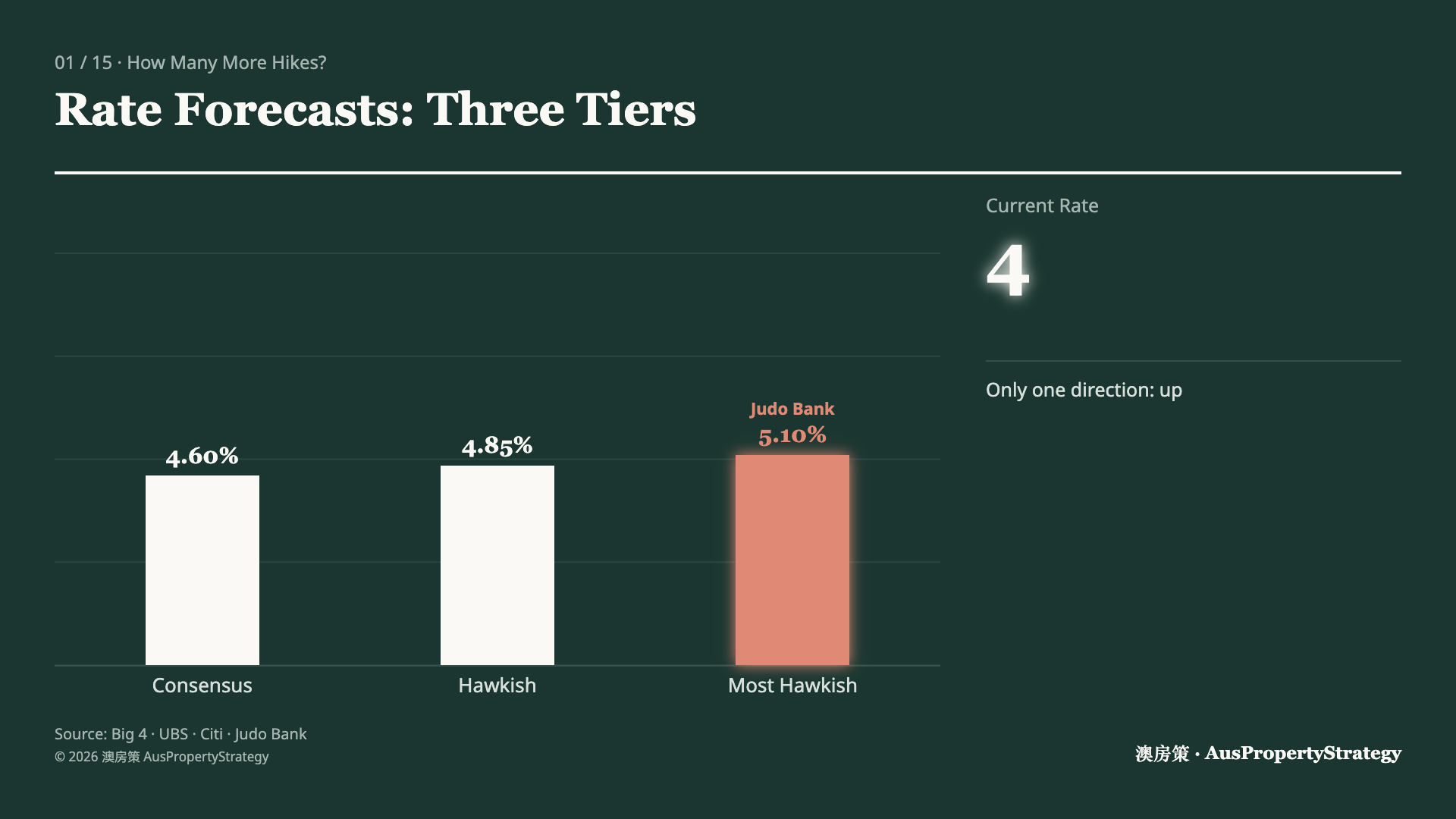
How many hikes are coming this cycle, and how high do rates go? Let’s start with what the big four banks are saying. NAB was the first to bet on a September 29 hike. Westpac was more dramatic: on September 8, they changed their forecast from “no more hikes” to 1 hike in “November.” Then Bullock testified on the 18th, and Westpac changed their call again, pulling it forward to September. A major bank’s chief economist changing their forecast twice in ten days tells you the situation is moving faster than their models can keep up with. CBA and ANZ lean toward November. But all four agree on at least one more hike to 4.60%. On that, there’s no disagreement.
Before Bullock's testimony, markets had priced in a September hike at around 70% to 75%. By the time she finished, that number shot past 80%. The direction is clear: the majority of money is betting the RBA moves in September.
And then there are the bigger calls. UBS is forecasting two more hikes to 4.85%, because surging oil could push Q3 headline inflation to 3.8%. Citi is also calling for 4.85% and says the first cut won’t come until Q4 2027. Citi flagged something called the “two-speed economy”: property prices falling on one side, AI investment booming on the other. Those two forces offset each other and push inflation higher, which means the RBA can’t find an excuse to stop hiking even if it wanted to.
The most extreme call comes from Judo Bank: at least three more hikes, taking rates above 5%. Yahoo Finance ran the headline with “minimum level,” meaning 5% is the floor, not the ceiling. The logic is straightforward: 4.35% didn’t control inflation in 2026, so why would it work in 2027? If rates get pushed above 5%, Australians are looking at the kind of pain they went through in the late 1980s.
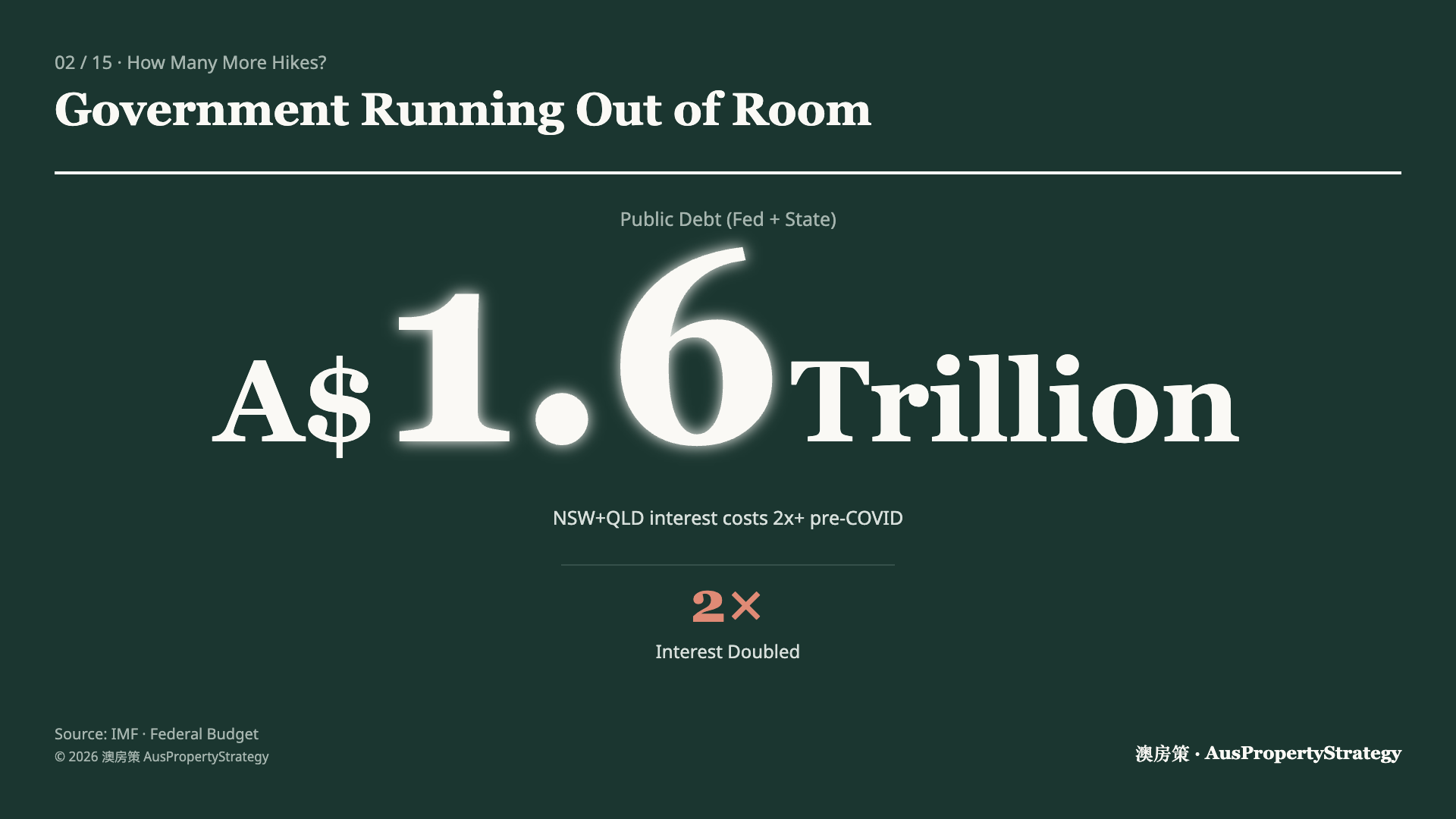
And pay attention to what the IMF is warning. Government spending is too high, so demand won’t come down. If demand won’t come down, inflation can’t be tamed. Then the RBA keeps hiking. Every extra dollar the government spends is another reason for the RBA to raise rates. Australia’s public debt sits at around $1.6 trillion. Interest payments in New South Wales and Queensland alone have more than doubled since before the pandemic. The government itself is getting crushed by interest costs. In the past, when prices dropped, the government stepped in with stimulus. This time, it’s short on cash. So the chances of fiscal support propping up the market are lower than usual.
The forecasts range from 4.60% to 5.1%. The numbers differ, but they all point the same way. So what are all these institutions actually seeing? Why has almost everyone landed on the same side?
Three forces behind inflation
There are three forces driving inflation higher. RBA Deputy Governor Andrew Hauser went on ABC’s 7.30 and named them: the Middle East crisis, the global AI-driven investment boom, and weakening supply-side capacity in Australia.
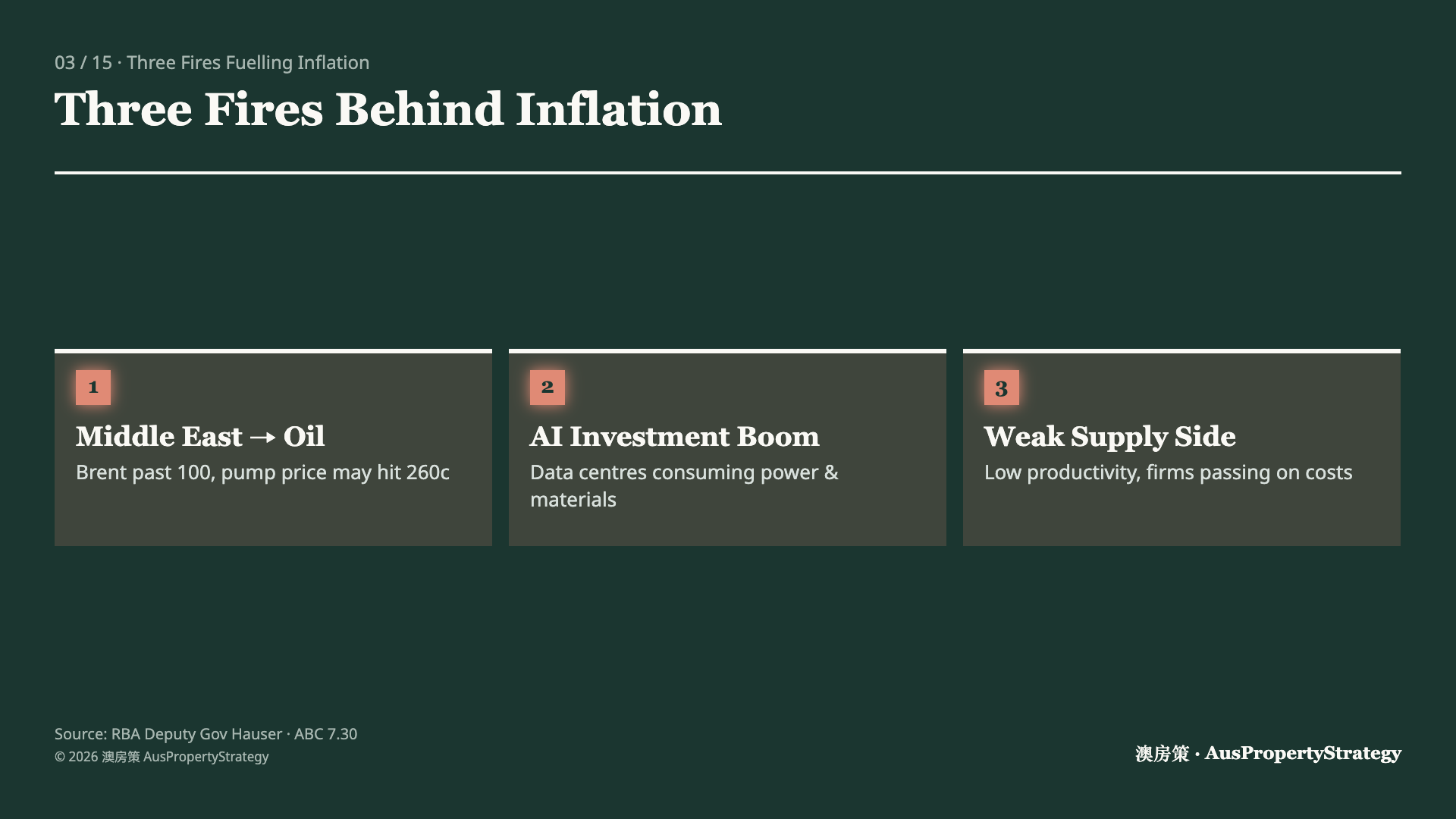
Start with oil. Brent crude climbed back above $100 in early September and now sits around $104. CBA estimates that if Middle East shipping routes stay disrupted, Brent could spike to $150. The national average for 91-octane is around 225 cents per litre. If Brent hits $120 and the Australian dollar weakens, 91-octane could push past 260 cents. This isn’t speculation: in March, at the peak of the conflict, NRMA recorded prices touching 257.8 cents, and back then, the fuel excise was still halved. On August 3, the full excise came back, adding 32 cents per litre on the spot. Even at the same crude price, you’re paying more at the pump today, and that feeds straight into inflation.
Second, AI. The Deputy Governor came back from the US and called the scale of AI and tech investment “impressive.” Data centres worldwide are eating up electricity, building materials, and capital. All of that investment eventually turns into demand, which adds to inflationary pressure.
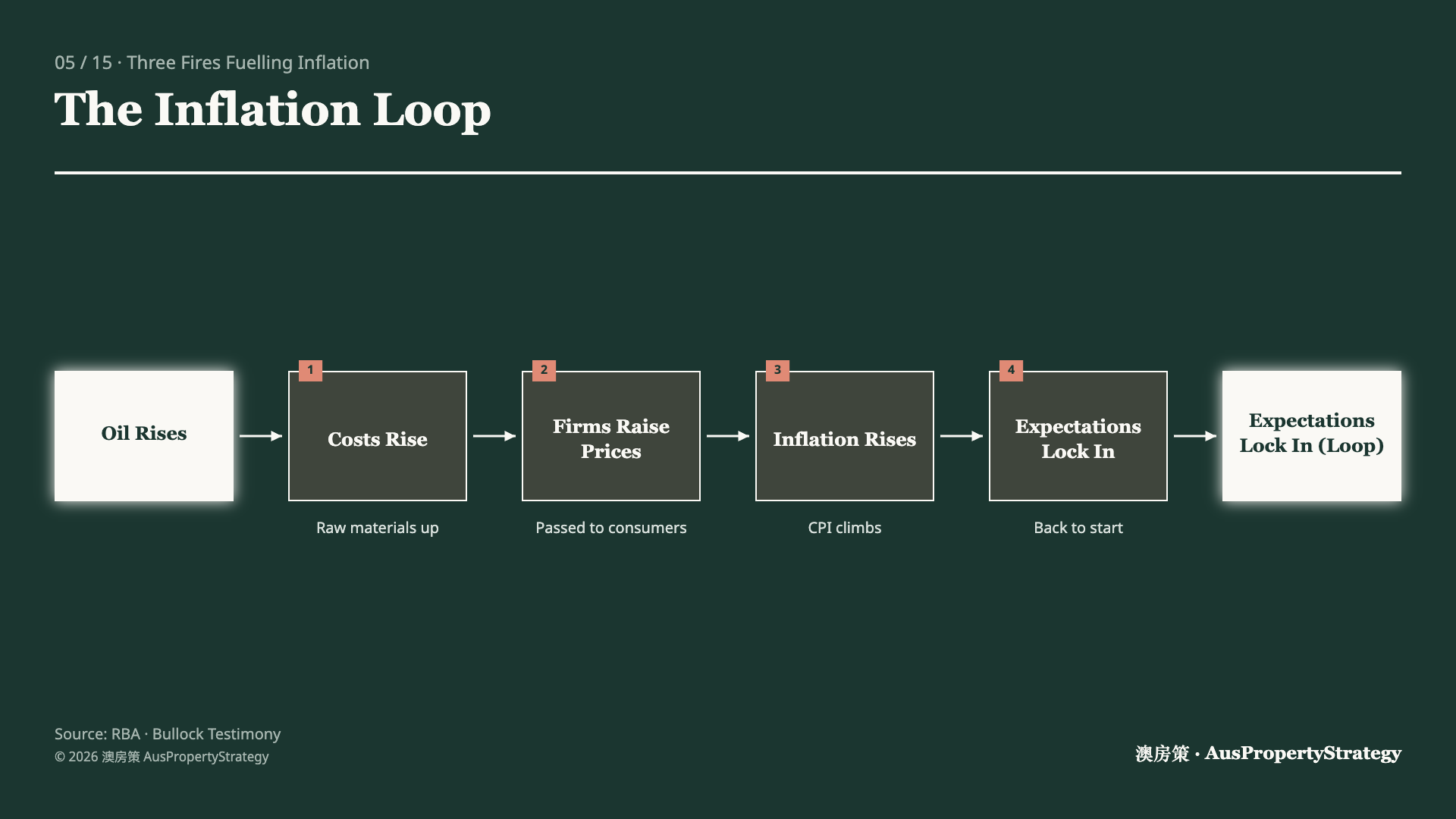
Third, and this is the most fundamental one: the supply side is getting weaker. Productivity is too low and the economy can’t lift its output. Businesses are choosing to pass costs straight through to prices because they can’t produce more. The RBA doesn’t think this is temporary. And that’s the dangerous part. Price increases are no longer one-off events. They’re feeding on themselves. Oil pushes up costs, costs push up prices, prices drive inflation higher. That’s the feedback loop the RBA fears most.
All three forces are making inflation burn hotter, so rates have to go up. And here’s the question everyone wants answered: if rates keep rising, how far do property prices fall?
How far do prices fall?
Property prices are already falling across the board. Cotality’s August data: the national market is down 3.6% from its March peak, median price $912,885. Sydney is down 7.1% from peak, Melbourne down 6.8%. 93% of capital city suburbs saw prices fall this winter. Sales volumes dropped 15.5% year-on-year, and auction clearance rates have been below 50% for over ten weeks.
It’s a buyer’s market right now, and that’s not up for debate. But does the RBA care?
The Governor told Parliament: “Property prices are still 50% higher than early 2020. The decline isn’t that large.” The message is clear: yes, prices have come down, but that’s not a reason to stop hiking. The RBA’s job is to crush inflation. Property prices are just caught in the crossfire.
So what are the forecasts saying? HSBC put out the most specific number: a 13% peak-to-trough decline nationally, which would be the biggest correction in 30 years. CBA looked at what negative gearing and CGT discount reform would do to prices, with a base case of a 3% drop and a worst case of 5.5%. Macquarie revised their forecast from a 5% drop to 10%.
The forecasts range from 5% to 13%.But the exact number isn't what matters. If you look at the track record, none of these banks and economists have ever been spot on. What really matters is this: in 75 years of Australian property history, how has every single downturn actually ended? Can we find the trigger for this turning point somewhere in that history?
Before we keep going — if anything in today's video has you thinking about your own situation, there are two ways to get real answers. A free 15-minute call with one of our property investment strategists — bring your questions, get a straight answer, no strings. Or if you want the full done-for-you path — strategy, lending, property selection, portfolio, tax structure, wealth planning, all of it — book a free 30-minute Discovery Session and see how VISION Gold Membership actually works. Both links are in the description. Alright, let's get back to it.
History is on your side
History is on your side. This is the most important part of today’s video.
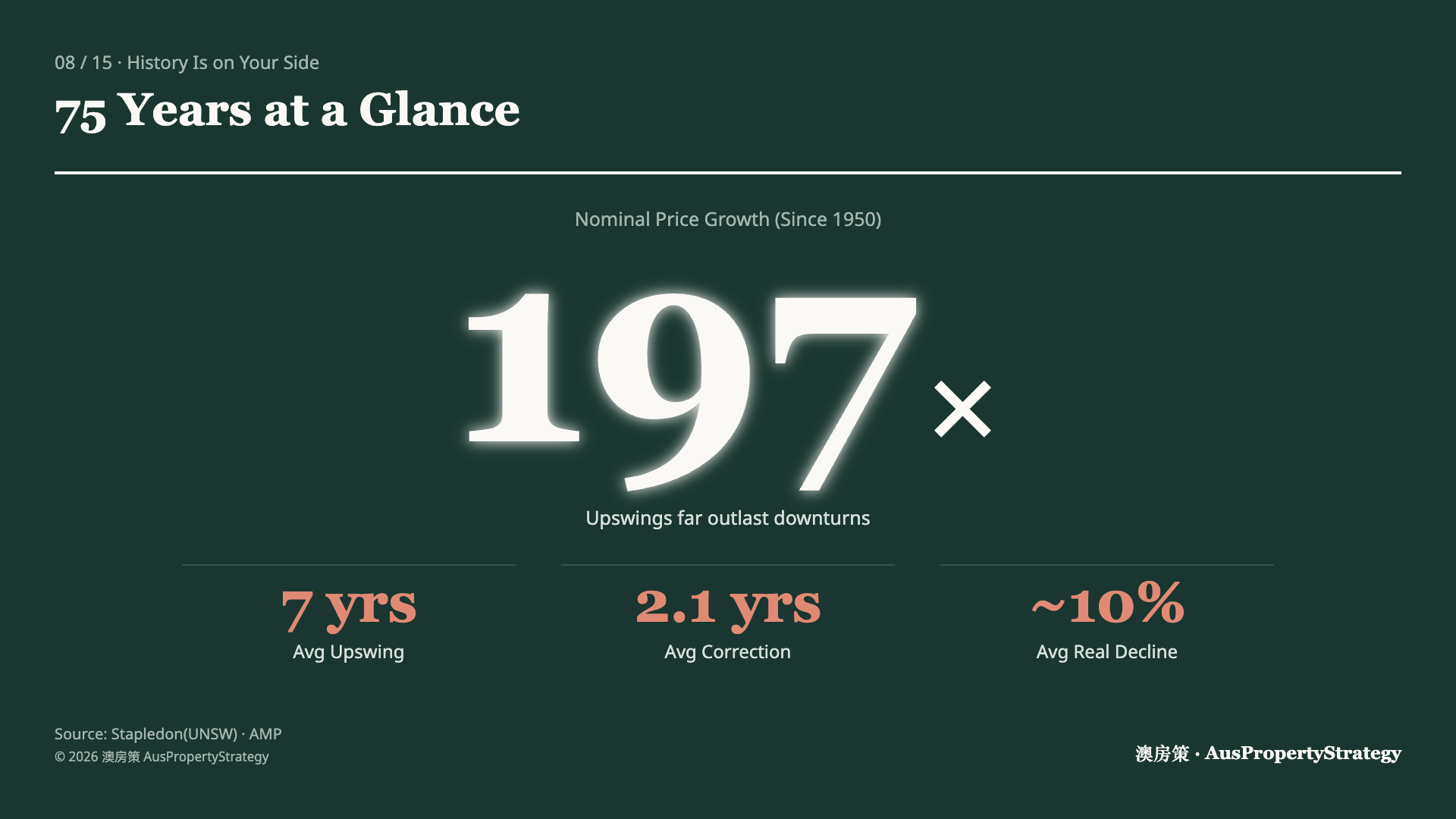
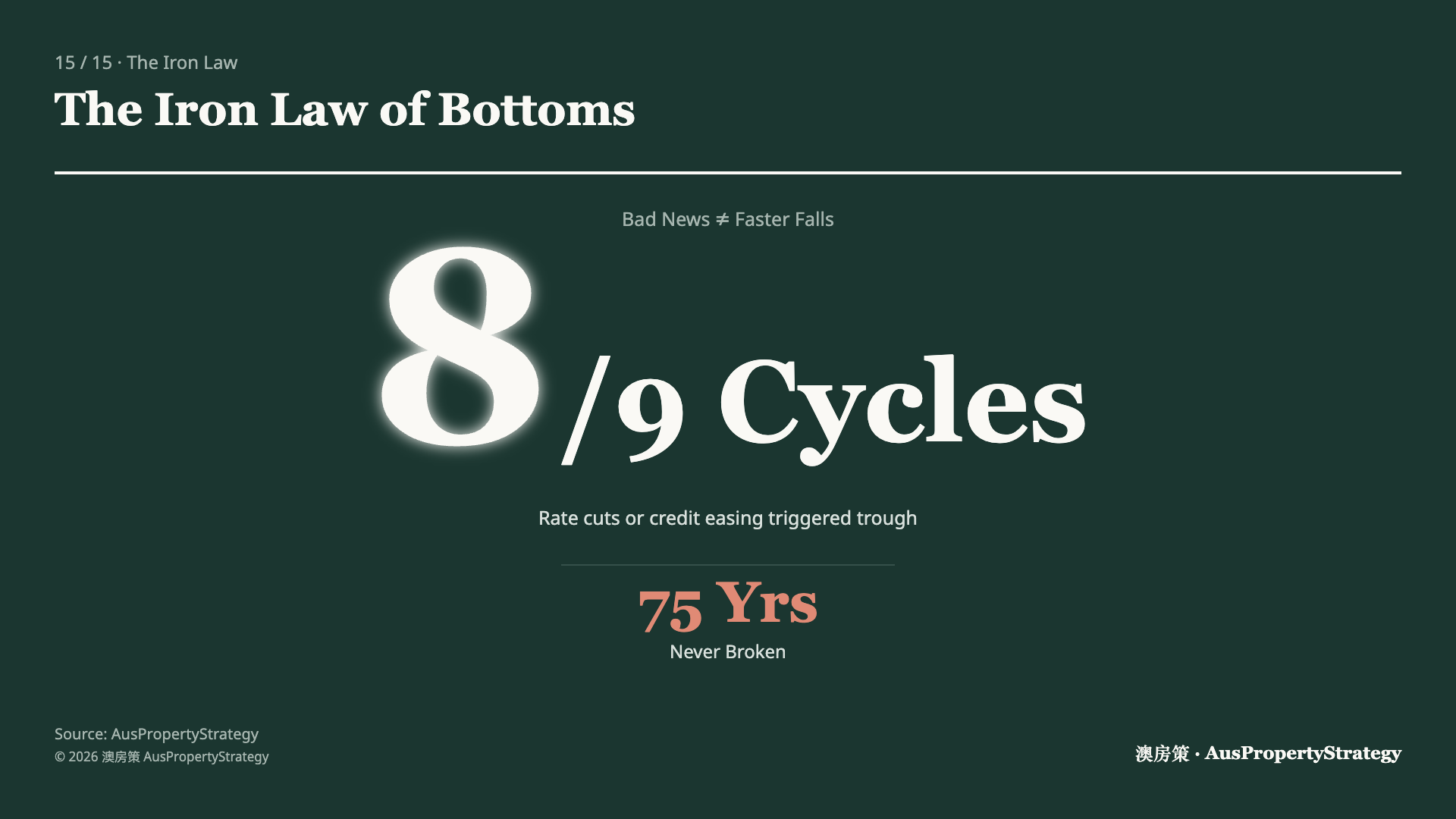
I went through every piece of Australian property price data going back to 1950. 75 years, 9 downturns, 8 upswings. The average upswing lasted 7 years. The average downturn lasted just 2.1 years, with an average real decline of about 10%. In nominal terms, prices have risen roughly 197 times since 1950. The time spent going up has far outweighed the time going down. Property in this country has never been a long-term loser. But the pattern is what matters most. Let me walk you through a few cycles.
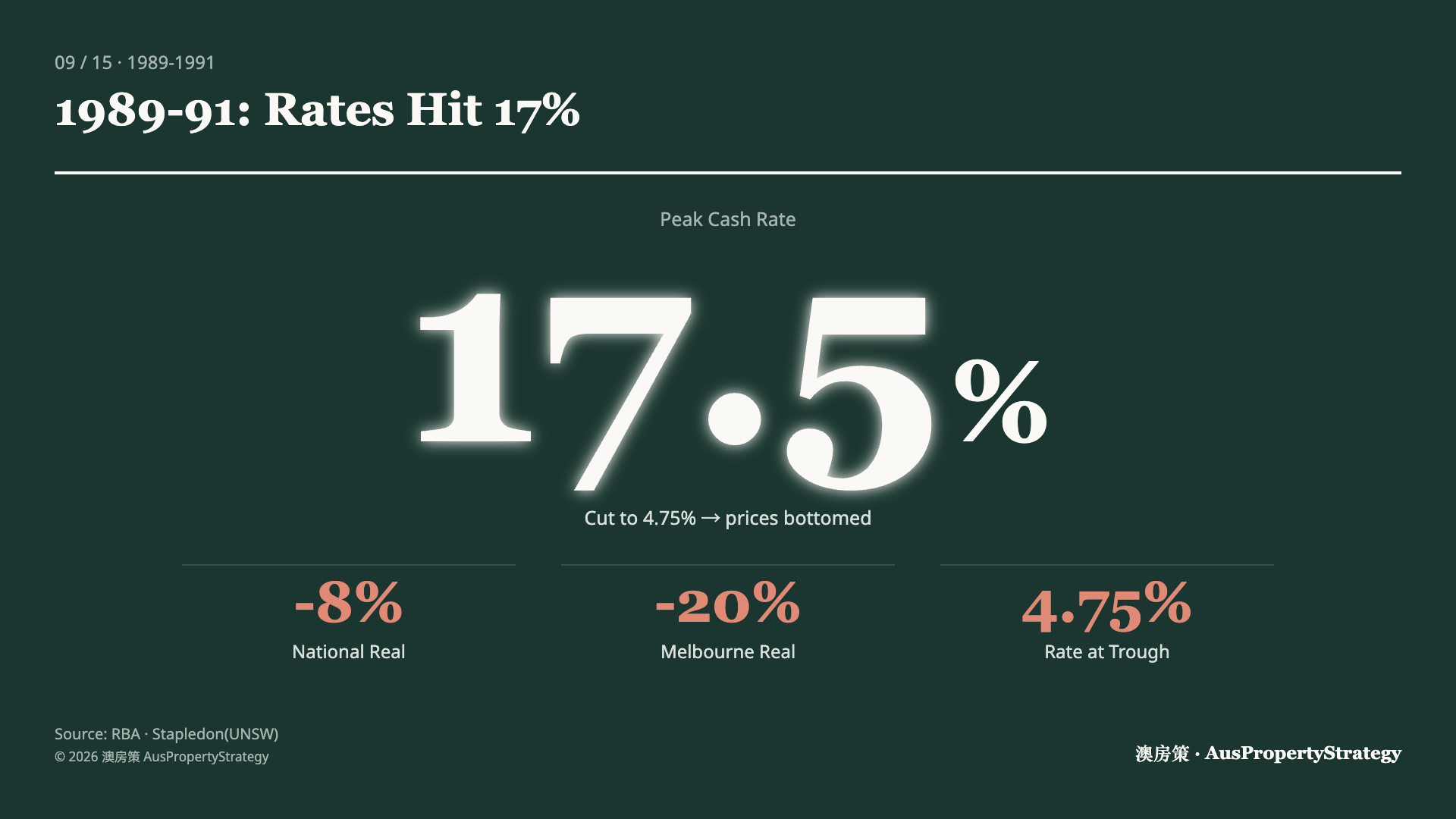
1989 to 1991. Mortgage rates were pushed to 17%. National prices fell 8% in real terms, and Melbourne fell 20%. How did it end? The RBA cut from 17.5% all the way down to 4.75%. When rate cuts came, the bottom came with them.
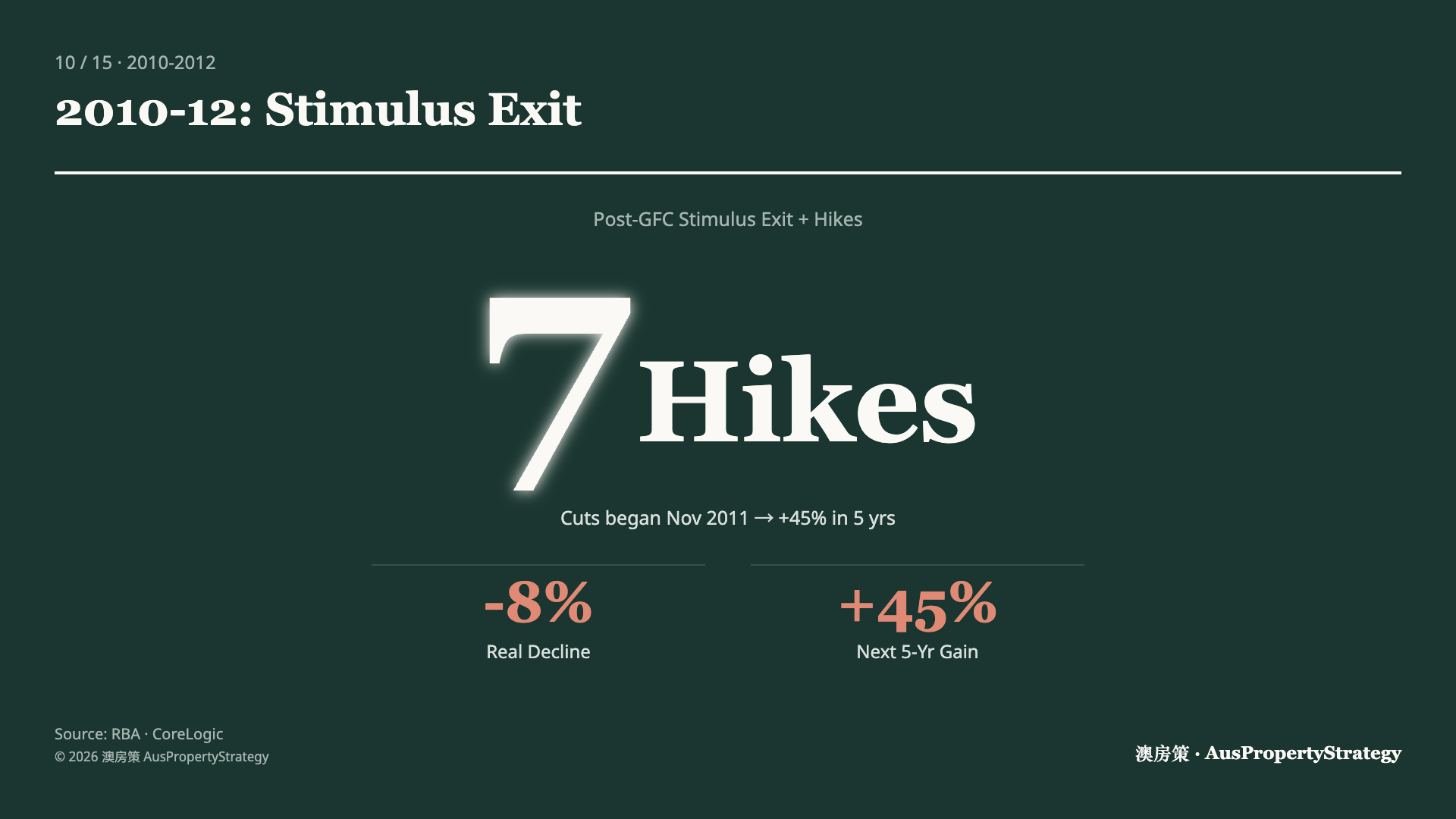
2010 to 2012. Stimulus was pulled and seven hikes followed. Real prices fell 8%. The cutting cycle started in November 2011, and over the next five years, prices rose 45%.
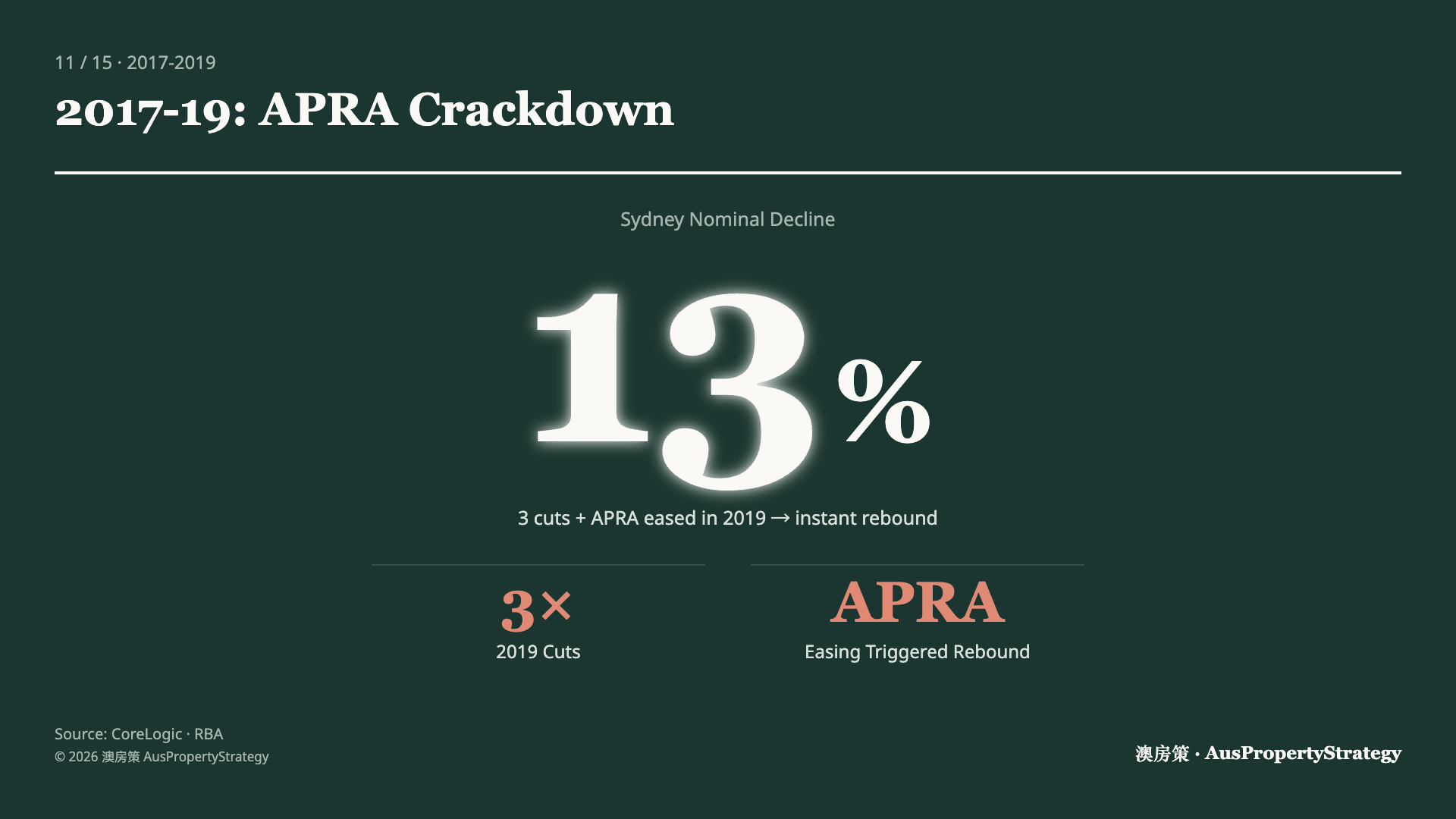
2017 to 2019. APRA tightened macroprudential controls, and Sydney fell 13%. Three rate cuts in mid-2019 plus APRA loosening the rules, and the market bounced straight back.
2022 to 2023. The RBA hiked 13 times in 18 months, from 0.1% to 4.35%. National prices fell 9.1%, the deepest decline on record. But the market bottomed in February 2023, a full two years before the first rate cut. Why? Net overseas migration hit 538,000 in 2022-23, the highest on record, and supply was constrained. Migration replaced rate cuts as the force that put a floor under prices.
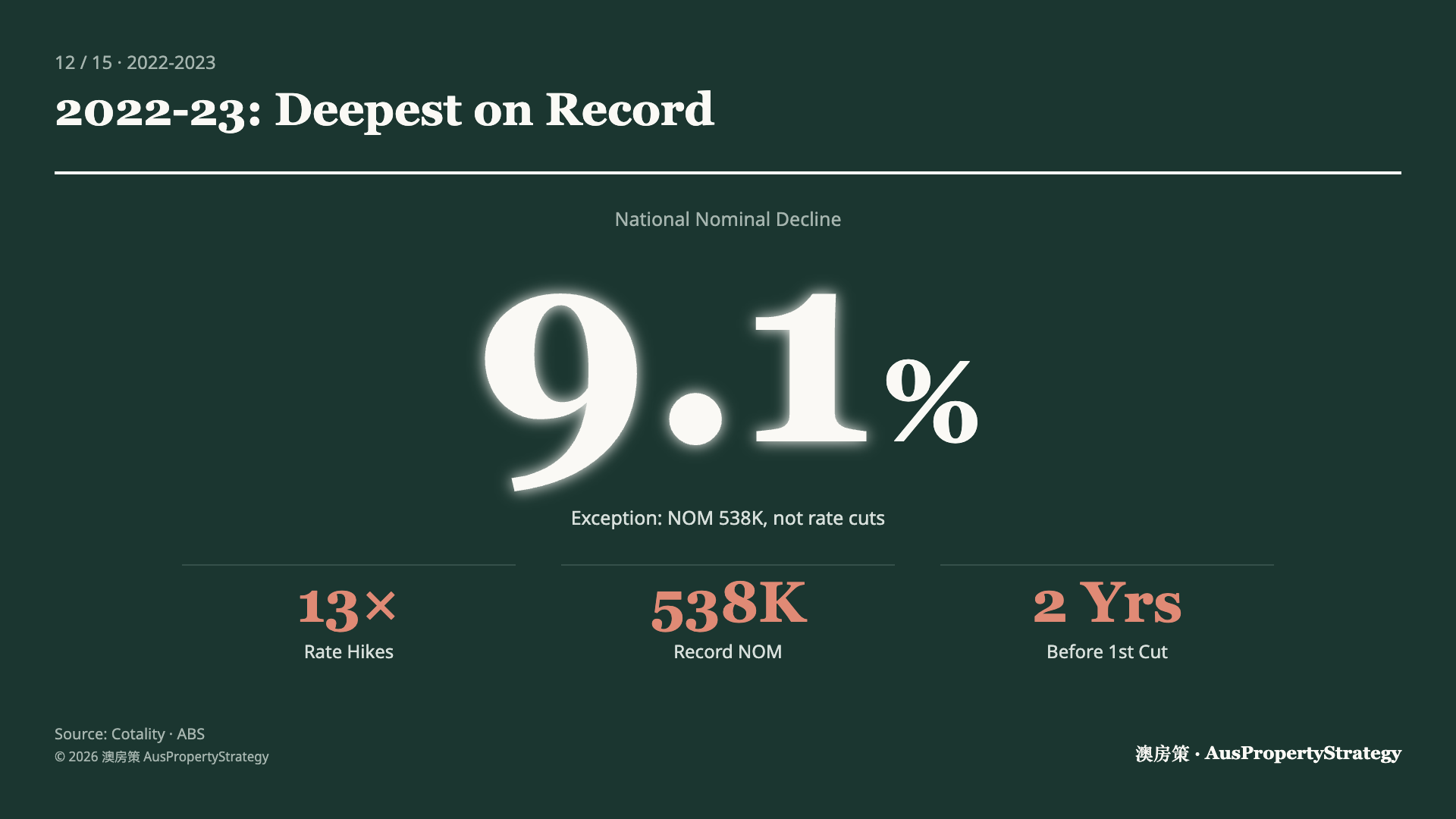
Across 9 downturns, at least 8 bottomed because of rate cuts, credit loosening, or government stimulus. The only exception was 2023, driven by record migration. So what about this time?
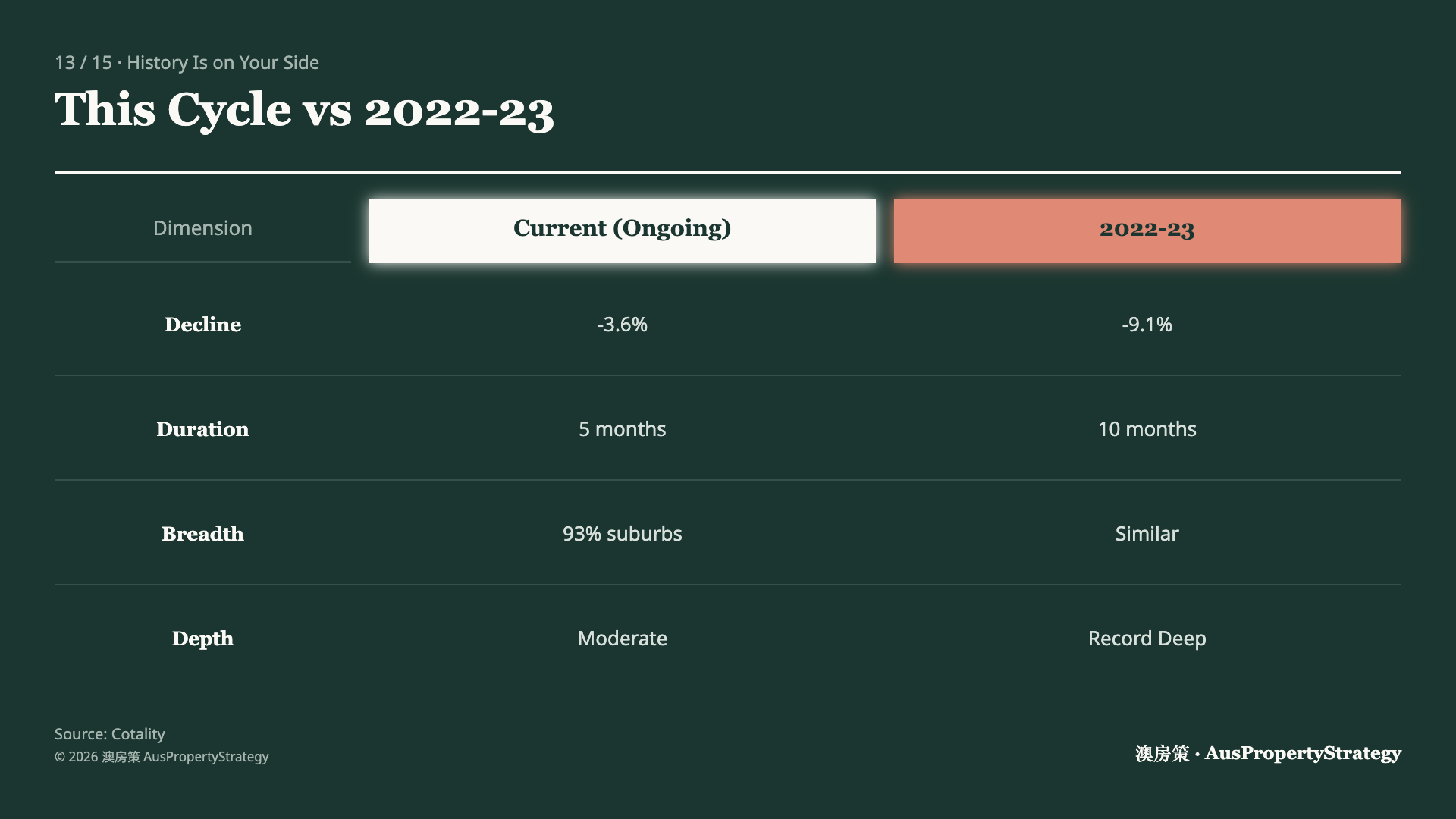
The current decline is 3.6% over 5 months. Compare that to the 2022-23 downturn of 9.1% over 10 months. We’re nowhere near the deepest on record.
Here’s what makes this cycle different from every previous one. Immigration is tightening. Net overseas migration for 2024-25 has already dropped to 306,000, well below the 500,000-plus of the previous two years. Recent reports suggest migration will be capped at around 220,000 over the next two years. On top of that, the May 2026 federal budget removed negative gearing on existing properties. That’s the first time in 75 years the federal government has tightened investor incentives while the market was already weakening.
Some will point to government subsidies. In the past, first-home buyer grants were rolled out to rescue the market or to stimulate growth during recessions. In 2008, Kevin Rudd doubled the grant to $14,000 during the GFC. In 2020, a $25,000 new build grant came in during the pandemic. Other times, stimulus showed up around elections to win votes. But the next federal election is not happening until May 2028. Before then, the only way we see fiscal stimulus for housing is when Australia enters a recession.
So the forces that support the property market have changed. This time, the floor won’t come from an immigration surge, and it probably won’t come from government stimulus first. The floor comes when rates genuinely peak and rate cuts begin.
Will tighter immigration break the economy? Look at Canada. In October 2024, they cut migration hard and the economy did contract in the short term. But the latest Q2 data tells a different story. GDP grew at an annualised 3.3%. Productivity changed from negative to positive at 1%. Employment improved for three straight months. After the initial pain, the economic picture is already improving.
Where is the bottom?
OK so let’s bring it back to Australia. When does the bottom come? There are three signals to watch.
First, the interest rate turning point. Westpac forecasts rate cuts starting in August 2027, with rates at 4.10% by year-end. If the 75-year pattern holds, the period before cuts begin is the window where property prices find their floor.
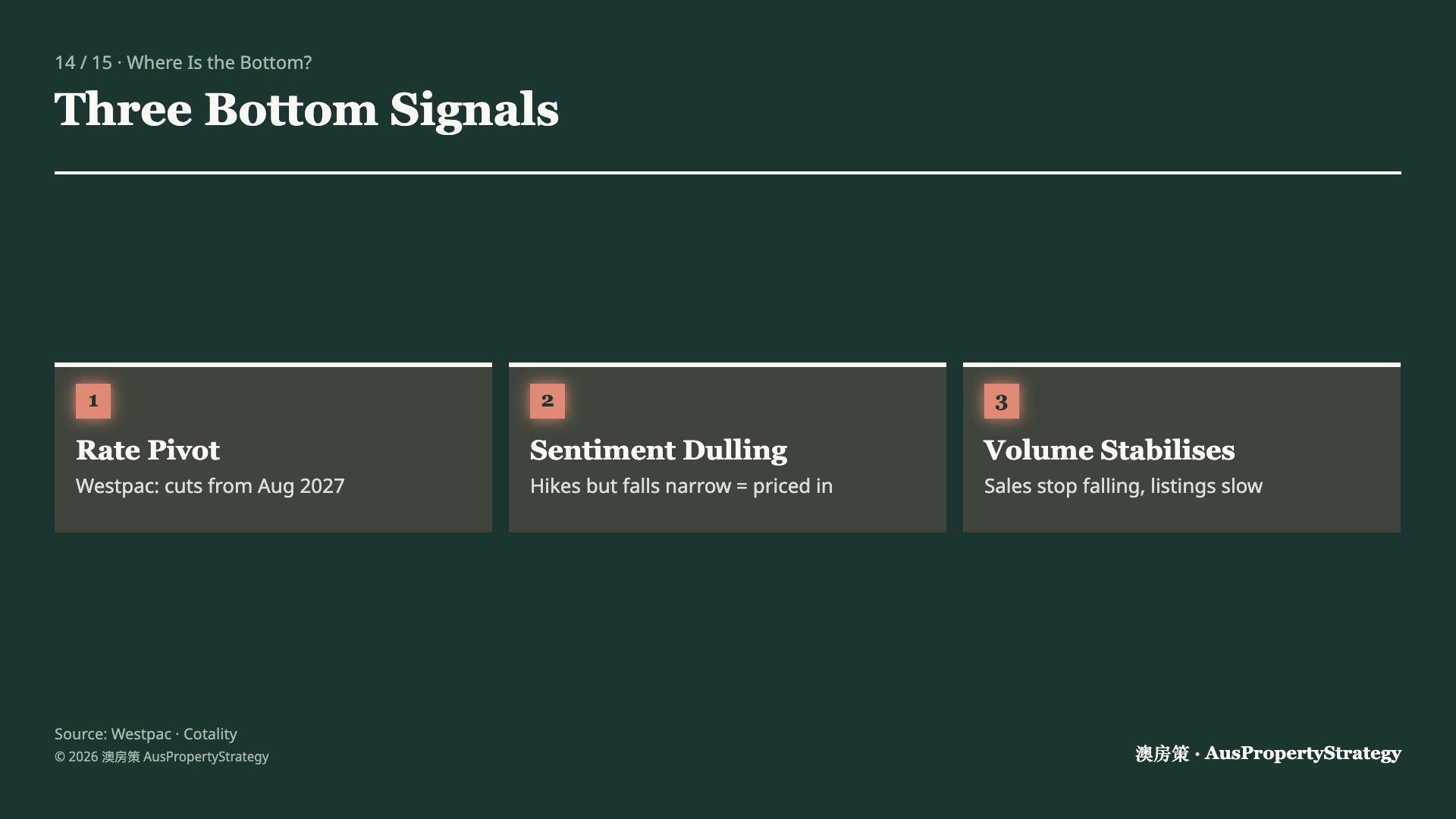
Second, the market starts to go numb to bad news. The RBA hikes again, but the monthly price decline actually narrows. In August, prices fell 0.9%, down from July’s revised 1.2%. There’s a hint of that happening, but we need a few more months of data to confirm it.
Third, volume stabilises while prices stop falling. Sales are still down 15.5% year-on-year and listings are up 24%, so things are still getting worse. When sales volumes stop shrinking and listing growth slows down, it means buyers and sellers are recalibrating their expectations.
I don’t like predicting exact numbers, but I believe in cycles. This pattern hasn’t been broken in 75 years. Rates will peak, and then they’ll come down. Rate cuts will come, and prices will stabilise. The period in between is the hardest to sit through, but that’s exactly why most people get scared out of the market.
In our VISION all-weather framework, we say this: in any cycle, what you need isn’t the ability to pick the bottom. It’s a framework. A framework tells you when to defend, when to attack, and when to hold your position. When the market reaches the point where more bad news can’t push prices down faster, that’s when the recovery begins.
The conclusion is simple. The rate hike cycle isn’t over. Three forces are driving inflation, and in the short term, it’s not coming down. Prices are already in a correction, with forecasts ranging from 5% to 13%. But 75 years of history tells you this: every darkest moment has been the start of the countdown to the next upswing.
If you want to figure out whether your loan structure has room to improve in the current rate environment, or how to stress-test your portfolio, checking data on your own isn’t enough. You need a system that helps you make different decisions at different points in the cycle. That’s what our VISION Gold membership does: rates, supply and demand, rents, and policy, updated every week and built into a decision framework. If you’re serious about taking action, check the link below this video.
Watch the video version of the blog on YouTube.
15 Minutes Free Consultation (Limited-Time Free Offer)
If you have any questions about Australian real estate, we invite you to use our 15 Minutes Free Consultation service. Once you have filled in the form, a professional property investment strategist will be in touch with you. They will assess your needs and provide fundamental advice. This service is designed to help answer general property-related queries. BOOK NOW.
VISION Membership
Our Flagship Service: VISION Membership. Your One-Stop Property Investment Manager – Build a Tailored Portfolio and Achieve Financial Freedom
Whether you're an employee, a professional, a business owner or even a new migrant, everyone has a financial goal for the future. The VISION Membership is designed to solve all the pain points in your Australian property investment journey through one single, comprehensive service.
By analysing your current financial situation and long-term goals, we'll tailor a property investment plan just for you. Our team will match you with the ideal mortgage structure, tax strategies, wealth planning, and legal support, empowering you to go further, faster, and smarter on your path to financial freedom.
VISION Membership is perfect for busy individuals who want a professional team to create, expand and manage their Australian investment portfolio. If you're looking for a dedicated team, including real estate investment experts, mortgage brokers, accountants, financial planners, and property solicitors, VISION Membership is your ideal solution.
Start with an obligation-free 30-minute discovery session on Zoom. BOOK NOW.
VISION Buyer’s Agent
No time for inspections? Tired of dealing with pushy selling agents? Unsure how much to offer or feeling nervous about auctions? Worried about buying the wrong property? If any of these sound like you, AusPropertyStrategy's Australia-wide VISION Buyer's Agent Service is here to help.
We provide end-to-end support to help you build an optimised property portfolio and achieve your financial goals—whether you're investing interstate, refinancing, or planning post-settlement leasing or resale. Our services cover everything from suburb research and property selection, to price negotiation, auction bidding, and post-settlement support.
Start with an obligation-free 30-minute discovery session on Zoom. BOOK NOW.
real estate australia,real estate investing,australian property,australian housing market,australian economy,australian property investment,australian property market,buying property,australian real estate,mortgage brokers brisbane,first home buyer,Australian Real Estate,Australian Real Estate Investment,Australian Property Investment,Real Estate Investment,Property Investment,Property Investment Australia,Passive Income,Positive Cash Flow,Australia Real Estate Investing,Australian Real Estate Investors,Australian Property Investors,Vision Wealth Mentors,Vision Real Estate Investors Australia,financial freedom, freedom through property investment,real estate investors,property investment,passive income,positive cash flow,real estate course,real estate courses,real estate training,australian property market,property investment brisbane,property investment sydney,melbourne property market,investing in brisbane,investing in melbourne,how to invest in property,buying properties,start investing in property,property investment strategy,how to buy investment property,property investing tips,best suburbs to invest in sydney,locations real estate,prime location,property growth by suburb,capital growth suburbs


