

NUCLEAR Immigration Bomb – Your Property’s DOOM or BOOM - (It’s Worse than you think) | APS146
Something massive just happened in Australia. Opposition Leader Angus Taylor dropped a nuclear-grade immigration plan, with former Prime Minister John Howard standing right behind him to back it. It’s called the Australian Values Immigration Plan: nine proposals, three pillars, one unmistakable declaration.
Now you might think this is just another politician doing what politicians do. But this time it’s different. If this goes through, the 5% First Home Guarantee for non-citizens gets killed and migration numbers get slashed. So here’s the question everyone should be asking: if Australia hits zero net migration for a decade, does your property go up or down?
Most people say down. A lot of commentators say down. But when KPMG Chief Economist Brendan Rynne ran the model, the result left everyone speechless. If you care about how immigration policy shapes the property market, stay with me on this one, because the data says the opposite of what you’d expect.
9 Bullets Loaded
Taylor’s speech was dressed up as “three pillars”: Australian values first, shutting the door on migration abuse, and drawing a hard line against extremism. Sounds great on paper. Let me put it in plain English for you. He laid out nine specific proposals.
Number one, and this is the big one: the Australian Values Statement. Right now, it’s just a box you tick when you apply for a visa. Under this plan, it becomes a legally binding visa condition. Break it, and your visa gets cancelled. That includes permanent residents.
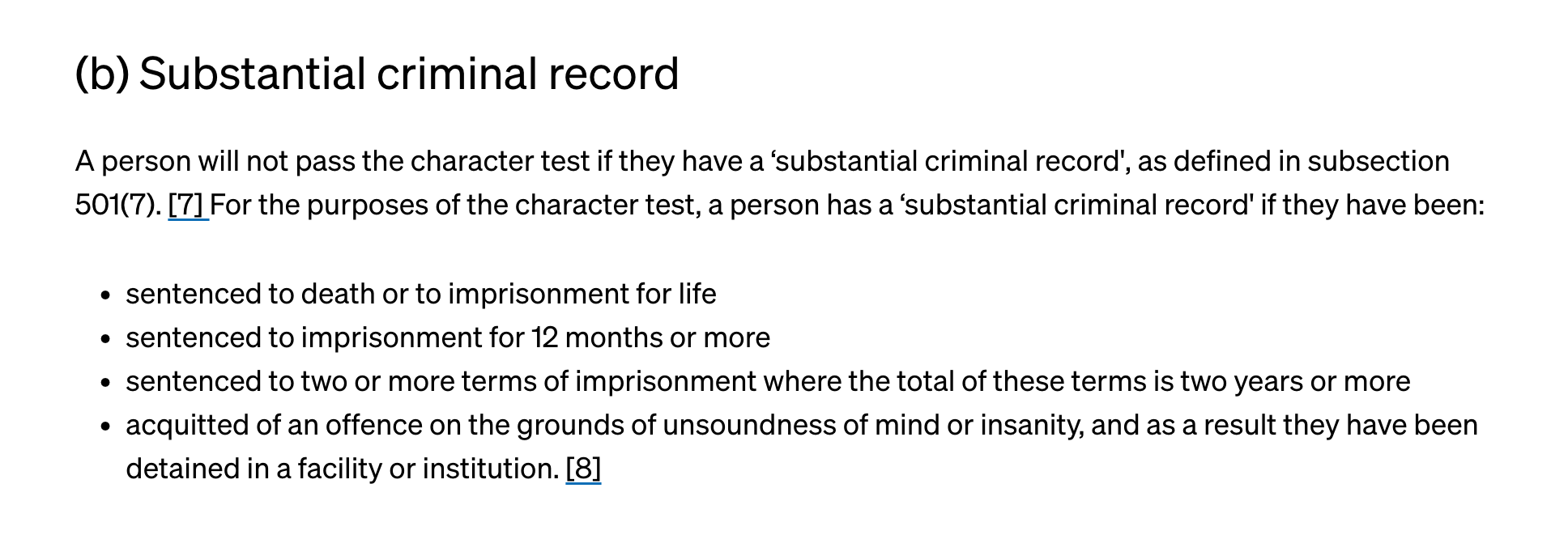
Number two: expanding the Character Test. This means that someone who’s held a PR for 20 years could still be deported. We already have Section 501 of the Migration Act for criminal deportations, but Taylor wants to stretch that to cover speech as well, not just crime. I’ll come back to this, because it’s where things get really uncomfortable.
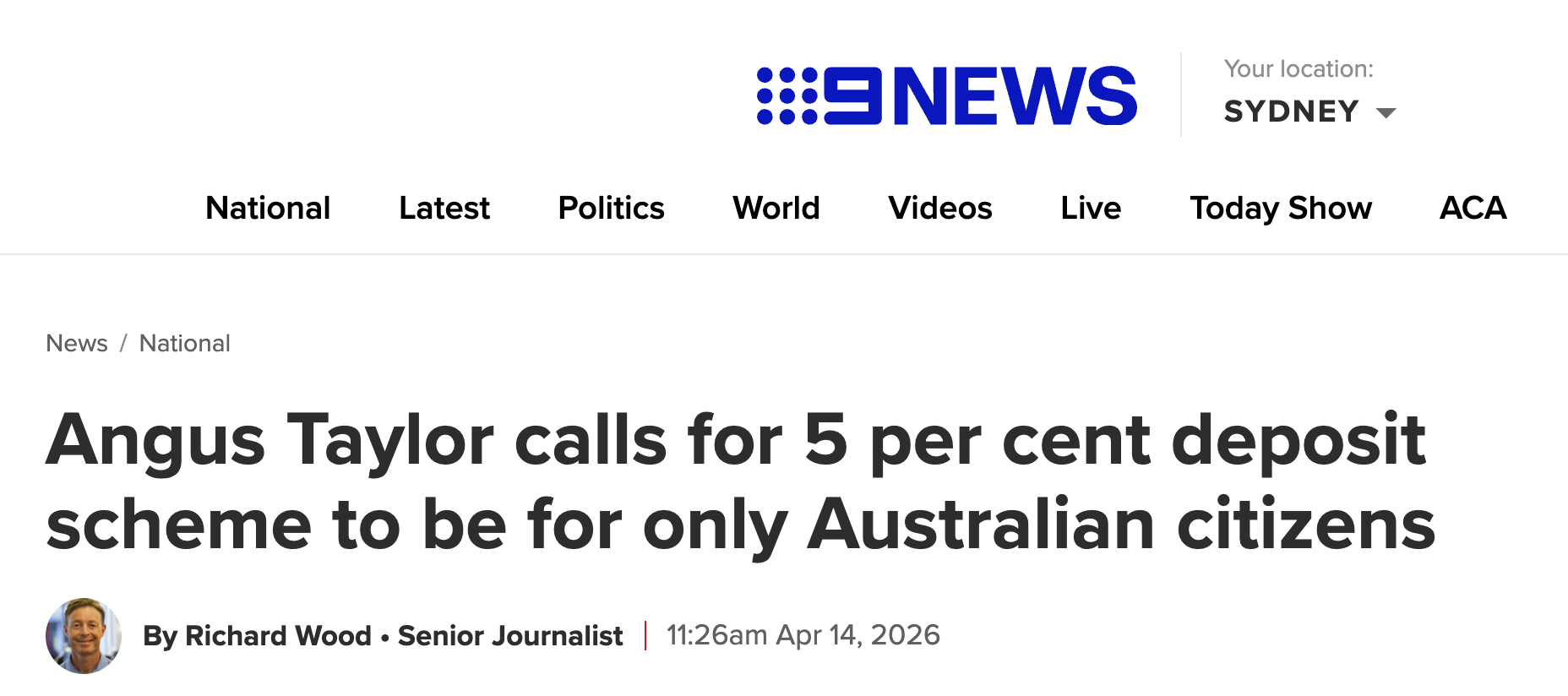
Number three hits your pocket directly: closing the 5% First Home Guarantee to non-citizens. Taylor says around 50,000 non-citizens have used this scheme already. If that door shuts, a lot of first-home buyers will need to completely rethink their deposit strategy.
The remaining six in quick fire: mandatory social media screening for visa applicants, a “safe countries” list, a review of the 1,700 Gaza visa holders, a dedicated taskforce targeting 65,000 unlawful non-citizens, bringing back Temporary Protection Visas, and beefed-up security screening.
Here’s the line that stuck with me. Taylor himself said, “This is the first wave. Specific quotas are still to come.” In other words, these nine proposals are just the trailer. The main feature hasn’t even started.
So why now? Why did he play this card at this exact moment?
4 Cards and 9 Days of Silence
Taylor had four cards in his hand. Let me turn them over.
Card one: Bondi Beach. On December 14, 2025, a terror attack in Sydney killed 15 people, inspired by an extremist group. The attackers were a father, 50, Indian-born and a long-term permanent resident, and his son, 24, an Australian citizen. Would Taylor’s social media screening have stopped it? No. The son was a citizen. The father had held PR for years. Even if screening existed when they first arrived, it couldn’t have flagged something that happened decades later. Taylor never addressed that gap.
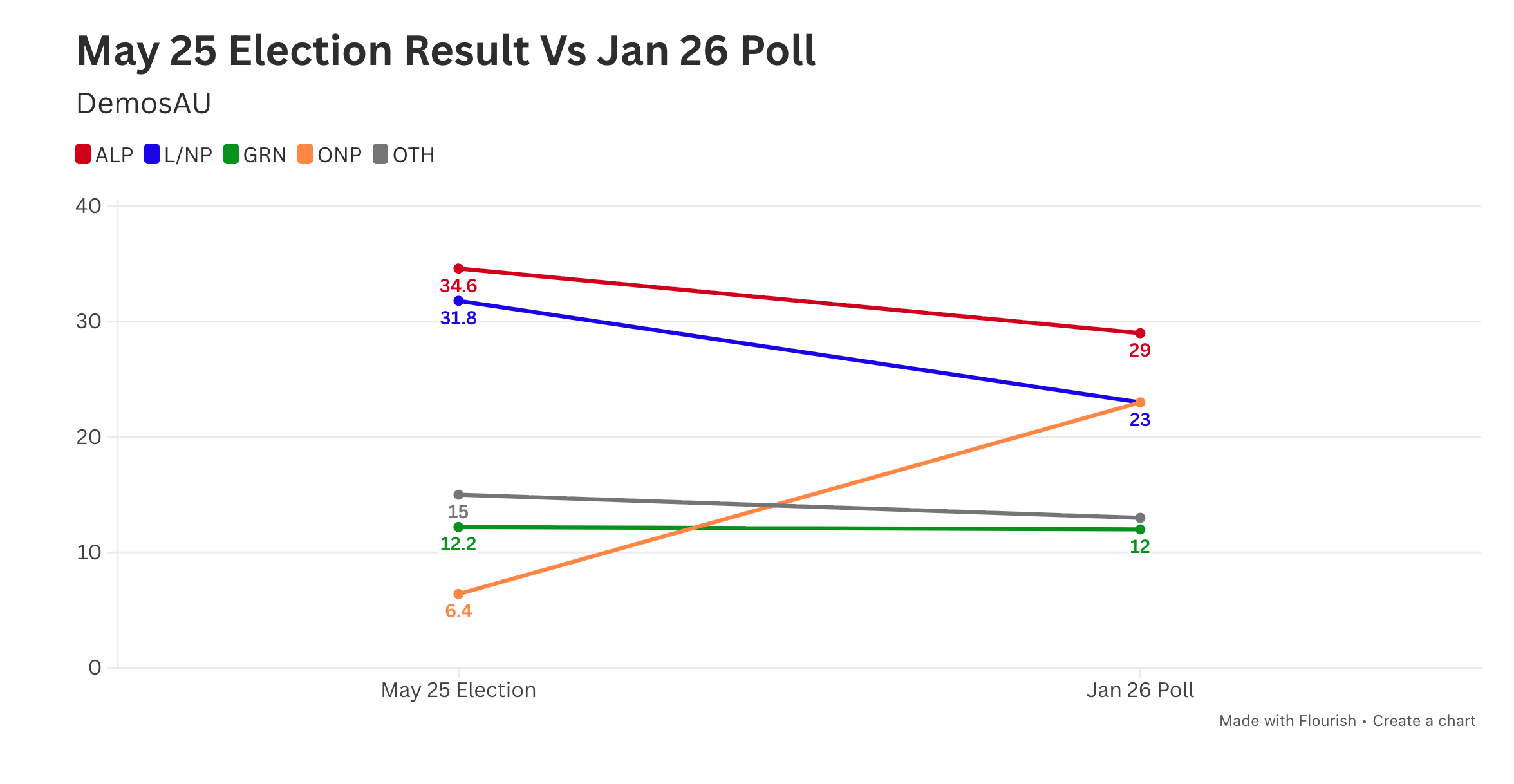
Card two: the rise of One Nation. A January 2026 DemosAU poll showed Labour at 29%, One Nation at 23%, and the Coalition at 23%, the first time One Nation pulled level with the Coalition. By February, Newspoll had them peaking at 27%. Right-wing votes were being eaten alive, and if Taylor didn’t move to claw them back, they’d be gone.
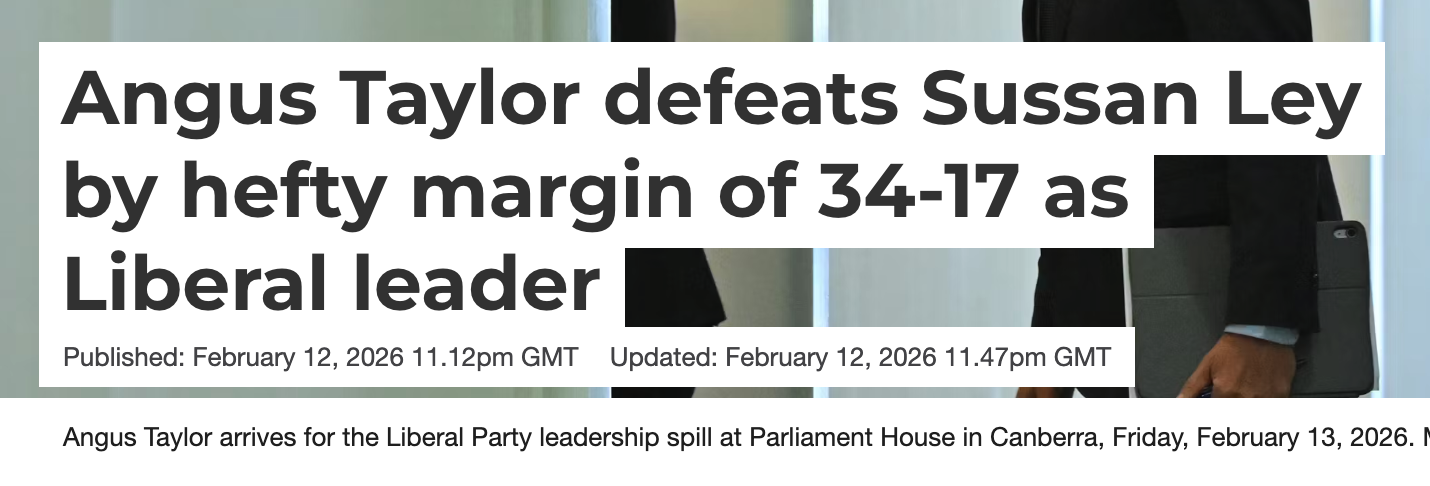
Card three: the leadership change. On February 13, Taylor knocked off Sussan Ley 34 to 17 and took the top job.
Card four: the extremist cleric deportation. On April 1, Labour Home Affairs Minister Tony Burke used his existing ministerial powers to deport a Bangladeshi extremist preacher.
Line those four cards up, and the timing stops looking like a coincidence.
But what happened after the speech was even more telling. Home Affairs Minister Burke fired back straight away, calling it a pitch to One Nation voters. Former PM Paul Keating called it racist. Greens Senator David Shoebridge said this was bringing back elements of the White Australia Policy. I want to be clear: “W
Now what really got my attention was the business response. BCA, ACCI, AiG: nine days, zero public comment. The business lobby was still trying to figure out which way to jump.
And the polls told their own story. Newspoll gave Taylor a net approval of negative 13. Resolve gave him positive 15. Same person, 28-point gap. That’s not a rounding error. That’s a country tearing down the middle.
So that’s the political layer, but it’s only the surface. Now, let me take you deeper into how these proposals actually work, because Taylor’s “new ideas” have all been done before.
Old Wine in New Bottles
The social media screening is where it gets really interesting. Taylor didn’t name any specific platforms, but he said he wanted to copy the Trump-style approach, making the American system the reference point. The US visa form DS-160 already lists major platforms in a dropdown. From December 2025, H-1B, student, and exchange visitor applicants face mandatory social media checks, and by March 2026 that expanded to fiancé visas, religious worker visas, and over a dozen other categories.
But here’s the thing: the screening isn’t about which platform you use. It’s about what you’ve posted. The US State Department puts it plainly: the goal is to identify applicants hostile towards the country’s citizens, culture, government, or founding principles.
And Taylor said something that tells you exactly where the line gets drawn: “People from liberal democracies are more likely to share Australian values than those from countries run by fundamentalists, extremists, and dictators.” That sentence is a risk map disguised as an opinion.
So where exactly does the line fall? That’s the single biggest point of controversy in this whole framework, and the honest answer is nobody knows yet.
Want to know exactly where you stand and what your next property move should be? Book a VISION Blueprint Session — in 45 minutes, you'll walk away with a personalised Property Investment Blueprint built around your numbers, your goals, and your timeline. And if you want ongoing support from a team that handles everything from strategy to settlement, VISION Gold Membership is your next step. Link in the description below.
Who Gets Hit
Everyone’s asking the same question: who does this actually affect? Let me break it down.
Start with nationality. Applicants from established democracies face the least friction, while those from authoritarian regimes or active conflict zones face the most, and everyone in between gets varying degrees of extra scrutiny.
Then there’s ideology, and this is the real target of Taylor’s policy. It’s not about where you come from. It’s about what you’ve said publicly. Supporting terrorist organisations, praising dictators, inciting hatred: those are hard red lines regardless of your passport.
Religion is tricky. Taylor didn’t name any faith specifically, but critics have pointed out that in practice, these measures will fall disproportionately on Muslim communities.
Wealth plays a role too. High-net-worth visa pathways are the least affected because those applicants can afford the compliance. Middle and lower income applicants feel the biggest squeeze. Money doesn’t buy you immunity, but it buys you the ability to sort things out.
English proficiency is straightforward. If you’re at IELTS 6.5 and above, the pressure is minimal. Between 5.5 and 6.0, student pathways still work but the PR track gets harder. Below 4.5, a lot of doors close entirely.
And , ranked from least to most impacted: investor, skilled independent, employer-sponsored, student and graduate, partner, parent, and humanitarian. The refugee pathway takes the biggest hit of all.
All right, the politics and the policy mechanics are done. Now let’s get to what you actually care about: what does all of this mean for Australian property prices? And I’ll tell you now, the answer is probably the opposite of what your gut is telling you.
What This Means for Property
When people hear “fewer migrants,” the gut reaction is always the same: housing prices will fall, right?
The data tells a completely different story. KPMG Chief Economist Brendan Rynne modelled this out: if you wiped out all migration for a decade, by the mid-2030s house prices would actually be 2.3% higher than the baseline scenario. Let that sink in for a second.
Why? Because cutting migration doesn’t just cut demand. It cuts supply too. Fewer construction workers means fewer homes get built, and supply shrinks faster than demand. So the widely held belief that less migration means cheaper houses is dead wrong.
First time I saw that number, I didn’t buy it. So I dug into Rynne’s methodology, checked it against the NHSAC reports and ABS construction workforce data, and the logic holds up.
So if Taylor’s plan actually goes through, how does the market move? I see four pathways.
First, the rental market. Over the next 6 to 18 months, higher barriers on student and graduate visas will take some heat out of rental demand and rents might ease briefly. But 3 to 5 years out, construction worker shortages get worse, new supply slows down, and rents climb right back up.
Second, the owner-occupier market actually works in favour of first home buyers because there's less competition in the $700,000 to $1 million bracket. But the mid-range upgrade market loses steam because fewer skilled migrants are coming in, meaning fewer people are trading up into those homes.
Third, the investment market. In the short term, you’ll see a front-running effect, with investors rushing to buy while the window is still open. But over the medium- to longer-term, the traditional migration-to-homeownership timeline stretches out, and return cycles slow down.
And fourth, the one most people miss entirely: construction. Australia’s building industry runs on migrant labour. Tighten employer-sponsored pathways, and the worker shortage gets worse, new housing starts drop, and supply crumbles. When supply crumbles, existing property prices go up, which is the exact opposite of what everyone expects.
Regionally, the picture splits. Brisbane, Perth, and Adelaide hold up better because they’re driven more by domestic demand. CBD apartment markets that lean heavily on international buyers and students face the clearest downside.
So all the data is on the table. What should you take away from this?
Fewer migrants don’t equal lower prices. KPMG’s model is clear: the supply side takes a bigger hit than the demand side. You can’t make good decisions based on bad assumptions.
Spread your investments across states to hedge against single-market risk. Using our 541 framework, the 50% weighting on location matters more now than ever. Perth, Brisbane, and Adelaide still have tailwinds while Sydney and Melbourne are adjusting. Don’t put all your eggs in one basket, and within each basket, hold assets at different points in the cycle. That’s the VISION all-weather investing philosophy.
Watch the video version of the blog on YouTube.
15 Minutes Free Consultation (Limited-Time Free Offer)
If you have any questions about Australian real estate, we invite you to use our 15 Minutes Free Consultation service. Once you have filled in the form, a professional property investment strategist will be in touch with you. They will assess your needs and provide fundamental advice. This service is designed to help answer general property-related queries. BOOK NOW.
VISION Membership
Our Flagship Service: VISION Membership. Your One-Stop Property Investment Manager – Build a Tailored Portfolio and Achieve Financial Freedom
Whether you're an employee, a professional, a business owner or even a new migrant, everyone has a financial goal for the future. The VISION Membership is designed to solve all the pain points in your Australian property investment journey through one single, comprehensive service.
By analysing your current financial situation and long-term goals, we'll tailor a property investment plan just for you. Our team will match you with the ideal mortgage structure, tax strategies, wealth planning, and legal support, empowering you to go further, faster, and smarter on your path to financial freedom.
VISION Membership is perfect for busy individuals who want a professional team to create, expand and manage their Australian investment portfolio. If you're looking for a dedicated team, including real estate investment experts, mortgage brokers, accountants, financial planners, and property solicitors, VISION Membership is your ideal solution.
Start with an obligation-free 30-minute discovery session on Zoom. BOOK NOW.
VISION Buyer’s Agent
No time for inspections? Tired of dealing with pushy selling agents? Unsure how much to offer or feeling nervous about auctions? Worried about buying the wrong property? If any of these sound like you, AusPropertyStrategy's Australia-wide VISION Buyer's Agent Service is here to help.
We provide end-to-end support to help you build an optimised property portfolio and achieve your financial goals—whether you're investing interstate, refinancing, or planning post-settlement leasing or resale. Our services cover everything from suburb research and property selection, to price negotiation, auction bidding, and post-settlement support.
Start with an obligation-free 30-minute discovery session on Zoom. BOOK NOW.
real estate australia,real estate investing,australian property,australian housing market,australian economy,australian property investment,australian property market,buying property,australian real estate,mortgage brokers brisbane,first home buyer,Australian Real Estate,Australian Real Estate Investment,Australian Property Investment,Real Estate Investment,Property Investment,Property Investment Australia,Passive Income,Positive Cash Flow,Australia Real Estate Investing,Australian Real Estate Investors,Australian Property Investors,Vision Wealth Mentors,Vision Real Estate Investors Australia,financial freedom, freedom through property investment,real estate investors,property investment,passive income,positive cash flow,real estate course,real estate courses,real estate training,australian property market,property investment brisbane,property investment sydney,melbourne property market,investing in brisbane,investing in melbourne,how to invest in property,buying properties,start investing in property,property investment strategy,how to buy investment property,property investing tips,best suburbs to invest in sydney,locations real estate,prime location,property growth by suburb,capital growth suburbs


