
Melbourne World #1 City SHOCK: 630K Crimes Hit 9-Year HIGH – Investor Warning! |APS145
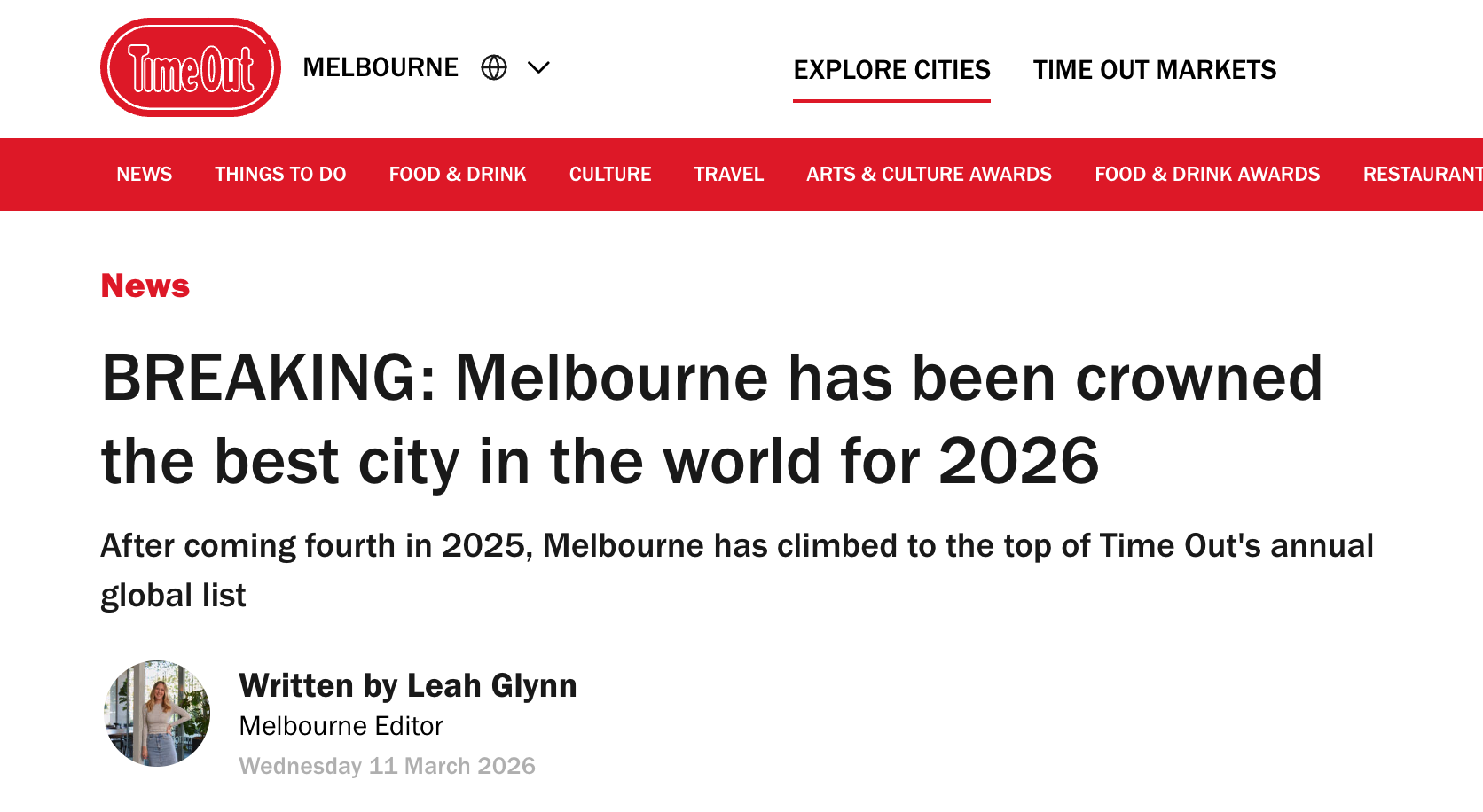
Melbourne. The world’s most livable city. Number one. That’s what Time Out magazine declared in March 2026. Melbourne’s mayor Nicholas Reece jumped on LinkedIn with three trophy emojis. Property agents, education consultants, migration agents, they all lost their minds. “Most liveable city! Growth is locked in! Come study, migrate, buy property!” And in the exact same month, Victoria’s Crime Statistics Agency released its latest numbers. 630,000 criminal incidents. The highest crime rate in nine years. On one hand, number one in the world. On the other, the worst in nearly a decade. You put those two things side by side and tell me that doesn’t feel a little surreal.
Today I’m pulling this apart. What these rankings actually measure, what they leave out, who’s making money off them, and the standard you should really be using to judge a city as an investor. That standard has nothing to do with “liveability” scores. There’s a full supply chain running behind this, from government to agents to education providers, and the person left in the dark at the end of it is the one making decisions based on that ranking. That’s you. I’m going to peel back every layer today, and I’ll also give you my take on whether your money actually belongs in Melbourne from an investment return perspective.
What the Rankings Actually Measure
So let’s start with the rankings. It’s not just Time Out. At least seven international rankings put Melbourne near the top. The EIU Global Liveability Index has it fourth. QS Best Student Cities, fifth. Oxford Economics, sixth. Mercer Quality of Living, twentieth. Sounds impressive. But here’s something you probably don’t know. The EIU index, the one that gets quoted the most by agents, was originally designed to calculate “hardship allowances” for employees posted overseas by multinational companies. Put simply, it measures how convenient life is for a foreigner sent to a city by their employer. You’re the person planning to put down roots, buy a house, raise kids, and carry a mortgage for thirty years. That index was never built for you. And that tells you how the people pushing these rankings have been swapping one thing for another right in front of you.
The EIU tests stability, healthcare, education, and those are fine. But it doesn’t test property prices at all. It doesn’t test cost of living. It doesn’t track which direction crime is heading. It cares whether your city has a good hospital, but it doesn’t care whether you’re safe on the way there. 54% of Melbourne residents say cost of living is their biggest source of stress, and the ranking just ignores the single most critical metric.
Now Time Out? 24,000 people filled in a survey. Good coffee? Points. Cool street art? Points. Nice bar scene? Points. Whether you feel safe walking home at night? Not their problem. Whether the government has any money left for infrastructure? Not their problem either. You’re making life decisions based on a coffee rating. I find that pretty hard to take seriously.
The methodology is flawed, and maybe you can accept that. But what really got me was this: who’s using these rankings, and what are they making from them?
Who’s Cashing In on the Rankings
The moment a ranking drops, a whole profit chain kicks into gear.
First layer: government. Melbourne City Council spent millions on its “Only in the City” marketing campaign. Business Victoria put out a guider on the same day the ranking was released, literally teaching businesses how to use it in their advertising. Live in Melbourne, the state’s official migration portal, features “Move to one of the world’s most liveable cities” on its homepage. Study Melbourne, the education promotion platform, uses the EIU ranking as a badge with the tagline “A welcoming and safe city.” From local council to state government, from the business department to immigration to education marketing, the entire official system is using “most liveable” as a billboard. Victoria has over 258,000 international students. That’s a multi-billion dollar industry, and the ranking is its advertising.
Second layer: property agents, especially buyer’s agents who only operate in Melbourne. Knight Frank calls Melbourne, Australia, “the strongest long-term growth city.” CBRE says the “liveability reputation supports a thriving commercial property market.” The logic is neat: liveable means people move here, people move here means prices go up, so buy now. But what they’ll never tell you is that Melbourne’s residential house prices currently rank sixth among capital cities. Lower than Brisbane. Lower than Perth. Even Adelaide’s median price has overtaken Melbourne's.
Third layer: migration and education agents. The word “liveable” has become a universal sales pitch, used in every scenario. But while the rankings were being quoted everywhere, in August 2025, the Chinese Consulate-General in Melbourne issued a safety advisory across its jurisdiction telling people to “reduce going out at night,” “increase safety awareness,” and “avoid direct confrontation.” On one side, the consulate is telling people to watch their backs. On the other side, agents are telling you it’s the most livable city on Earth. I’ll let you work out who’s telling the truth.
So the methodology is flawed, and the profit chain is pushing the narrative. But that’s still just “what other people are saying.” Now let’s look at the data. All official sources, nothing I’ve made up. And this part doesn’t just affect Victoria’s long-term direction. It affects your wallet.
The Data Tears the Mask Off
Every number that follows comes from the Victorian Crime Statistics Agency, Cotality (formerly CoreLogic), and the Property Council of Australia.
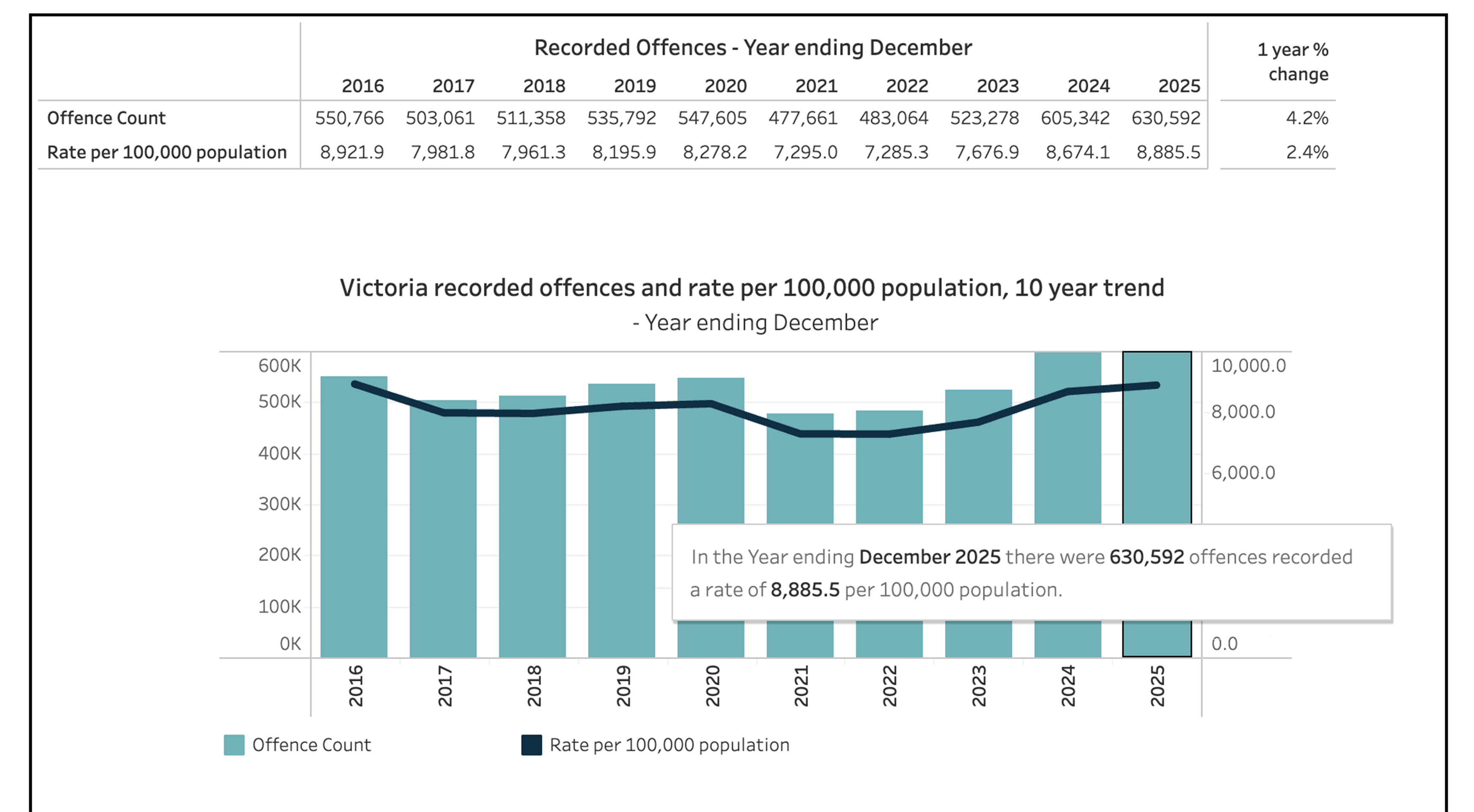
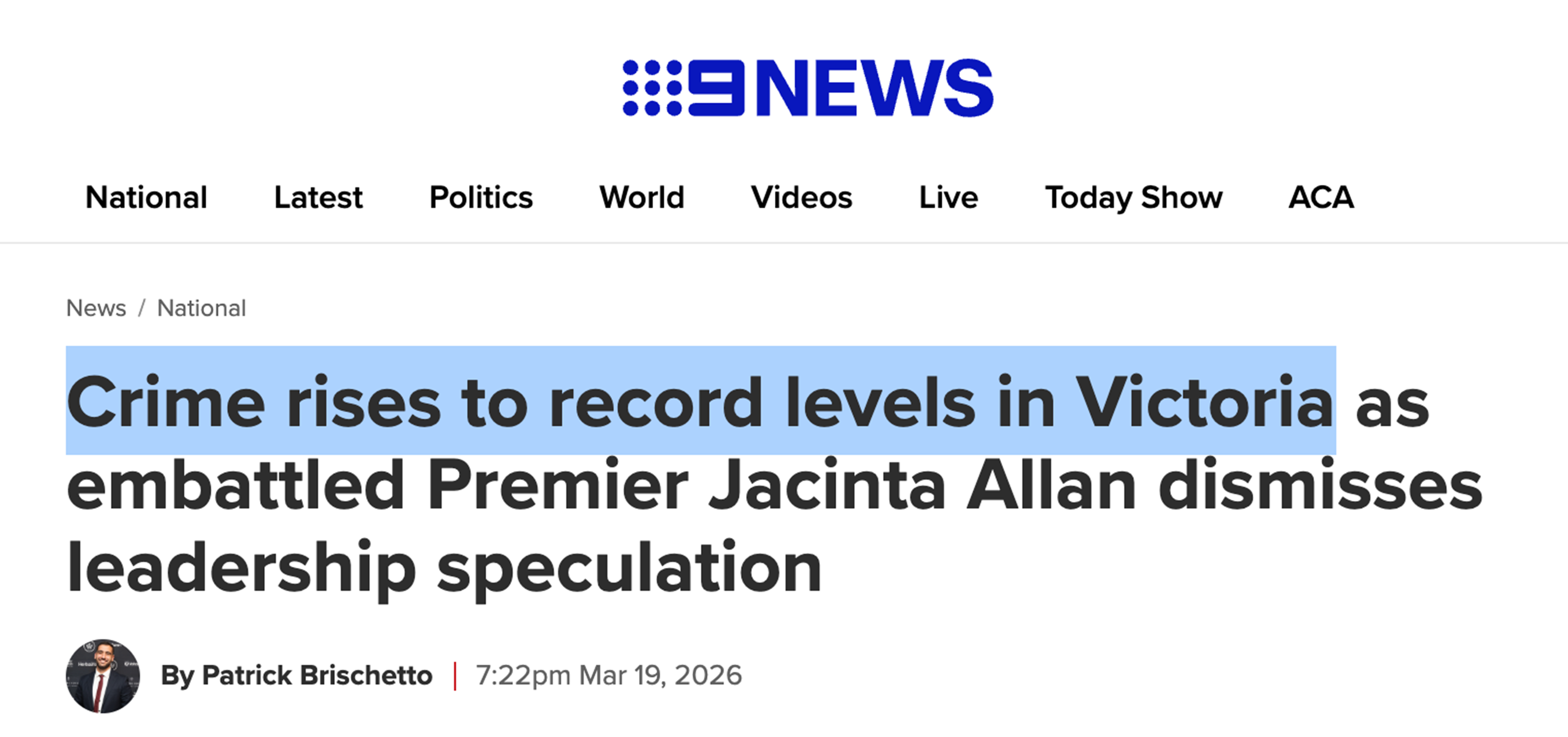
Start with crime. In 2025, Victoria recorded 630,000 criminal incidents. The crime rate hit 8,885.5 per 100,000 people, the highest in nine years. And this isn’t petty theft. Youth crime reached 25,275 incidents, the highest since electronic records began in 1993. To put that in perspective, 63% of robberies, more than half of all carjackings, and over half of home invasion robberies were committed by minors. Police seized 17,400 knives and machetes across the year, another record. The government had to classify machetes as prohibited weapons in 2025.
In September 2025, in Melbourne’s western suburb of Cobblebank, two boys, one twelve and one fifteen, were walking home after playing basketball. They were attacked with machetes by a group and didn’t make it home. In 2023, Melbourne CBD saw at least ten robberies in two weeks, with most victims being Chinese international students. SBS Chinese ran the headline: “Don’t wear or carry luxury items.” That’s the sense of safety the “world’s most liveable city” is offering you.
You might say every big city has crime. Fair enough. Let’s compare directly. Numbeo safety index: Canberra 73.6, Sydney 66.1, Brisbane 62.5, Perth 58.2, and Melbourne at 55.8. Dead last among capital cities.
Before you say “you’re just here to bash Melbourne,” hold on. Crime is just the first layer. The next part hits your wallet even harder.
Now look at the economic engine. Melbourne CBD’s office vacancy rate sits at 19%, the highest in Australia and the highest since 1997. Before the pandemic, it was 3.7%. One in five offices is sitting empty. So what does that mean for you? If you bought an investment property near the CBD expecting rental income, the workers aren’t coming in anymore. Where are your tenants coming from? The restaurants, cafes, and retail shops around you are watching their customer base shrink. Under the 21 Golden Rules, “rental vacancy rate” and “stable cash flow” are hard indicators. When a city’s economic engine is stalling, what’s holding up your rental return?
Victoria: The Debt State
The Victorian government has been going from bad to worse with its policy decisions. It has burned through Melbourne’s tax revenue and racked up a mountain of debt.
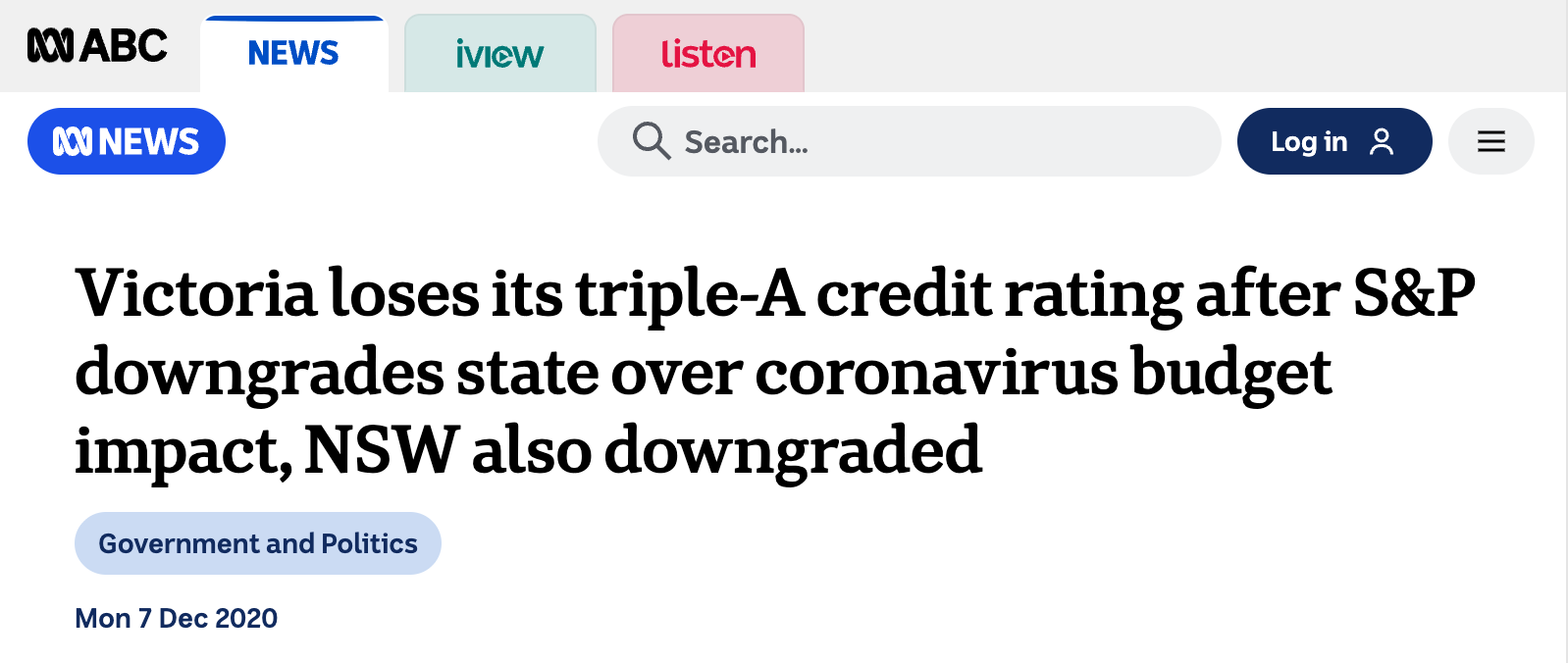
The numbers tell the story. Victoria’s net debt is projected to reach $187 billion by 2028, climbing to $194 billion by 2029, or $235 billion using a broader measure. Since Labour took power in 2014, Victoria’s debt has grown 415%, while the economy grew just 29% over the same period. The state’s credit rating is AA, the lowest of any Australian state. It was downgraded from AAA in 2020 and has never recovered. S&P, Moody’s, and Fitch have all warned that another downgrade could be coming. And the IMF went even further. In its 2025 Article IV report, it explicitly stated that “the federal government may need to bail out highly indebted states, particularly Victoria.” That’s the harshest statement the IMF has made on Australian state finances in decades. Put simply, this mob can’t clean up their own mess, so eventually the federal government will have to step in.
So where did all the money go? Let me give you a few greatest hits. The Commonwealth Games: in July 2023, then-Premier Daniel Andrews suddenly cancelled the 2026 Games, claiming costs had blown out from $2.6 billion to $7 billion. Fine, cancel it. But then the Auditor-General Andrew Greaves found the government inflated cost estimates to justify the cancellation, and the act of “not hosting” alone wasted $589 million. The East-West Link: cancelled on day one in office in 2015, with an $1.1 billion penalty. West Gate Tunnel: original budget $5.5 billion, now over $10 billion, three years late. Suburban Rail Loop: total estimated cost $200 billion, with just the first stage from Cheltenham to Box Hill costing $30 to $35 billion. The Grattan Institute called it “a money sink.” The federal government has said it won’t put in more funding, but the state government is going ahead anyway. The Melbourne Airport Rail has been delayed. The Geelong Fast Rail hasad.
When the money runs out, what do you do? Raise taxes. From 2014 to today, the Victorian government has introduced or increased between 55 and 63 taxes and charges. Here are the ones that hit property investors and business owners hardest. The land tax threshold was dropped from $300,000 to $50,000 in January 2024, pulling tens of thousands of small landlords into the tax net overnight. The absentee owner surcharge doubled from 2% to 4%. The COVID debt levy, supposedly “temporary,” is actually running until 2033, a full ten years. The vacant residential property tax expanded to all of Victoria in January 2025. A short-stay accommodation tax launched in January 2025 at 7.5% of host revenue. The emergency services volunteer fund, really just the fire services levy in another form, doubled for commercial properties and jumped 189% for agricultural land. And that’s not all. Private school fees tax, GP tax, WorkCover premium hikes of 42%, a mental health payroll tax surcharge. The full list runs to over sixty items.
When you pile on that many taxes, businesses leave. ABS data shows more than 129,000 Victorian businesses closed in 2023-24, the most of any state. Investors are leaving too. Victoria lost 24,000 rental properties in 2024 alone. The latest PIPA survey found Victoria was rated the most unfriendly state in Australia for property investors. And 22% of Melbourne investors sold at least one property in the 2023-24 financial year, the highest rate in the country.
Think about what that picture looks like. A state government that has turned itself into the highest-debt, highest-tax, fastest business exodus, and heaviest investor sell-off jurisdiction in the country. What is it using to prop up the “world’s most liveable city” label? The answer is one word: marketing.
Want to know exactly where you stand and what your next property move should be? Book a VISION Blueprint Session — in 45 minutes, you'll walk away with a personalised Property Investment Blueprint built around your numbers, your goals, and your timeline. And if you want ongoing support from a team that handles everything from strategy to settlement, VISION Gold Membership is your next step. Link in the description below.
Whose “Liveable” Is It Anyway?
The government spends recklessly and taxes aggressively, and the bill eventually lands on one group of people: everyday residents. And that bill shows up most clearly in Melbourne’s favourite daily ritual: coffee.
Time Out ranked Melbourne number one in the world. What was the biggest selling point? Coffee capital, arts and culture paradise, food city. Alright, let’s go through them one by one.
Start with coffee. La Marzocco Australia’s Future of Coffee Report, 2025 data: the average Australian coffee price has risen 37.5% since before the pandemic, from $4 to $5.50. A flat white in Melbourne now starts at $6. Add oat milk and you’re at $6.50, $7 easily. A 40% price increase for a single cup of coffee. “World’s best coffee culture” sounds great, as long as you can afford it.
Now restaurants. Broadsheet’s 2025 survey of the Australian dining industry found three-quarters of restaurant owners said costs went up more than 10% in a year, and a third said costs jumped more than 20%. The result? A wave of closures. In the Time Out survey, 94% of respondents gave food a high score and 92% gave arts and culture a high score. But many of those venues that scored so well no longer exist. They’ve closed, or they’re about to. When you rate a city based on places that are disappearing, you have to ask yourself how long that ranking stays valid.
Now overall cost of living. The Numbeo global cost of living index placed Melbourne at 84th in the world for 2025. The key detail: just a year ago, Melbourne was still the cheapest of Australia’s six major cities. A single person in Melbourne needs $90,000 to $130,000 a year just to live comfortably. CityLink is the most expensive toll road in Australia at over $12 one way. A family’s weekly groceries run to $212. Utilities cost $300 to $500 a month. Median weekly rent is $570, so the cost is about $2,280 a month.
Now put that bill next to the rankings. Time Out says Melbourne’s food is great, coffee is great, art is great, culture is great. The reality: each of those “greats” is more expensive than the last, the places behind them are shutting down, and 54% of locals say costs are crushing them.
Can you see the contradiction? When a city’s “liveability” requires you to pay $7 for a coffee, $40 minimum for dinner, $100 for a show ticket, and $90,000 a year in basic expenses, then “liveable” for whom exactly? The ranking measures liveability for people who can afford to consume those things. For most ordinary people, the “world’s most liveable” tag and whether you can afford your next coffee are two completely separate conversations.
Property Prices and Infrastructure
Now property prices, and this is the core of the whole discussion.
Cotality data, Q1 2026: Melbourne’s all-dwelling median price is $826,000, ranked sixth among capital cities. The median detached house price sits at close to $980,000.
But the absolute price isn’t the point. The direction is. Melbourne property prices today are still 1.3% below their March 2022 peak. Over three years and counting, and they still haven’t recovered to where they were. Over the same period, Perth is up 22%, Brisbane is up more than 17%, and the national average is up close to 10%.
Melbourne is genuinely a city with a lot of charm: the coffee, the arts, the universities, the healthcare, all world-class. But long-term living and investing can’t run on feelings. My own assessment is that Melbourne isn’t cheap. Its fundamentals are weakening. There’s a difference between “cheap” and “a clearance sale.” If something’s discounted because of high value, that’s a bargain. If it’s discounted because nobody wants it, that’s a clearance. You need to know which one you’re looking at.
Should Your Money Be in Melbourne?
I’m going to use a few hard indicators from the 21 Golden Rules and run Melbourne through a city “health check,” the same way you’d go for an annual check-up. We’re not looking at whether the city is good-looking. We’re checking whether the indicators are normal.
Population growth. In 2023-24, Melbourne added 143,000 people, the most in the country. Sounds good. But the latest ABS data shows growth slowed from 2.7% to 2% in 2024-25. And you need to look at the composition. A large share of that growth comes from international students and temporary visa holders, most of whom rent rather than buy, so the support for property prices is limited. The federal government is also tightening student visa rules, and that pipeline will only narrow from here.
Infrastructure. Congestion is the second worst in the country, one tunnel has blown out by more than double its budget. Outer suburban infrastructure is severely behind. Infrastructure can’t keep up with population, and the city’s carrying capacity is being stretched thin.
Rental vacancy. CBD and inner-city areas are running higher than average. Cotality data shows inner-city apartment mortgage repayments are more than $300 a month below rent, but that’s not a sign of a good investment. It’s because prices are so weak and rents are being pushed up by rising costs.
Growth outlook. Melbourne is the only capital city that hasn’t recovered to its last cycle peak. The Victorian government’s finances are the tightest in the country, and both business and investor confidence have taken a hit.
So what do you actually do? Here are three scenarios.
If you already own property in Melbourne, don’t panic. If it’s your home or you’ve held for many years with positive cash flow, short-term ups and downs aren’t something to stress over. But if your portfolio is heavily weighted toward Melbourne, say two or three properties all in Victoria, you should seriously consider rebalancing across states. The first principle of VISION all-weather investing is “all of Australia.” Don’t put all your eggs in one basket.
If you’re about to buy in Melbourne, don’t rush in just because it looks “cheap.” Ask yourself one question: with the same budget, can you find something with stronger fundamentals in another city? The same $1 million put in the right place is an investment. Put in the wrong place, it’s a donation.
If you’re considering migrating or studying, the ranking gives you a marketing image. Do your own research. Go look at the CSA’s crime data, read the Committee for Melbourne’s resident survey, check Numbeo’s safety index. Don’t use a ranking that’s really a “coffee score” dressed up as “world’s most liveable city” to make a decision that changes your life.
So does that mean Melbourne has nothing going for it? A lot of people who live in Melbourne genuinely love the city. As a place to live, it has real strengths. But as an investment target, put the feelings aside and let the data speak. At the end of the day, whether a city deserves hundreds of thousands or millions of your dollars doesn’t come down to where Time Out ranks it, or what score the EIU gives it. It comes down to population quality, supply and demand structure, infrastructure capacity, and economic fundamentals. Those are the things that determine what your assets are actually worth.
Summary and Close
Now you understand why. The people giving you the rankings and the people selling you property are using the same playbook: they show you what they want you to see. An investor’s job isn’t to believe rankings. It’s to cut through rankings and see the fundamentals underneath. Whether it’s Melbourne or any other city, population, supply and demand, infrastructure, and economics are the only things you should be basing your decisions on. Buying property is not buying a ranking. You’re buying a city’s future.
If you want to know which cities in your portfolio are showing green lights and which are flashing red, you don’t need a ranking. You need a professional assessment system. Inside VISION Gold Membership, we’ve built interest rates, supply and demand, rent, and policy into a decision framework that updates continuously. If you want a more systematic way to stay on top of it, the entry point is in the description. AusPropertyStrategy covers all of Australia, is 100% buyer-side, with no restrictions by state, territory, or property type.
Watch the video version of the blog on YouTube.
15 Minutes Free Consultation (Limited-Time Free Offer)
If you have any questions about Australian real estate, we invite you to use our 15 Minutes Free Consultation service. Once you have filled in the form, a professional property investment strategist will be in touch with you. They will assess your needs and provide fundamental advice. This service is designed to help answer general property-related queries. BOOK NOW.
VISION Membership
Our Flagship Service: VISION Membership. Your One-Stop Property Investment Manager – Build a Tailored Portfolio and Achieve Financial Freedom
Whether you're an employee, a professional, a business owner or even a new migrant, everyone has a financial goal for the future. The VISION Membership is designed to solve all the pain points in your Australian property investment journey through one single, comprehensive service.
By analysing your current financial situation and long-term goals, we'll tailor a property investment plan just for you. Our team will match you with the ideal mortgage structure, tax strategies, wealth planning, and legal support, empowering you to go further, faster, and smarter on your path to financial freedom.
VISION Membership is perfect for busy individuals who want a professional team to create, expand and manage their Australian investment portfolio. If you're looking for a dedicated team, including real estate investment experts, mortgage brokers, accountants, financial planners, and property solicitors, VISION Membership is your ideal solution.
Start with an obligation-free 30-minute discovery session on Zoom. BOOK NOW.
VISION Buyer’s Agent
No time for inspections? Tired of dealing with pushy selling agents? Unsure how much to offer or feeling nervous about auctions? Worried about buying the wrong property? If any of these sound like you, AusPropertyStrategy's Australia-wide VISION Buyer's Agent Service is here to help.
We provide end-to-end support to help you build an optimised property portfolio and achieve your financial goals—whether you're investing interstate, refinancing, or planning post-settlement leasing or resale. Our services cover everything from suburb research and property selection, to price negotiation, auction bidding, and post-settlement support.
Start with an obligation-free 30-minute discovery session on Zoom. BOOK NOW.
real estate australia,real estate investing,australian property,australian housing market,australian economy,australian property investment,australian property market,buying property,australian real estate,mortgage brokers brisbane,first home buyer,Australian Real Estate,Australian Real Estate Investment,Australian Property Investment,Real Estate Investment,Property Investment,Property Investment Australia,Passive Income,Positive Cash Flow,Australia Real Estate Investing,Australian Real Estate Investors,Australian Property Investors,Vision Wealth Mentors,Vision Real Estate Investors Australia,financial freedom, freedom through property investment,real estate investors,property investment,passive income,positive cash flow,real estate course,real estate courses,real estate training,australian property market,property investment brisbane,property investment sydney,melbourne property market,investing in brisbane,investing in melbourne,how to invest in property,buying properties,start investing in property,property investment strategy,how to buy investment property,property investing tips,best suburbs to invest in sydney,locations real estate,prime location,property growth by suburb,capital growth suburbs


