
Australia’s Top University Says We’re Going Broke. Here’s the Proof|APS163
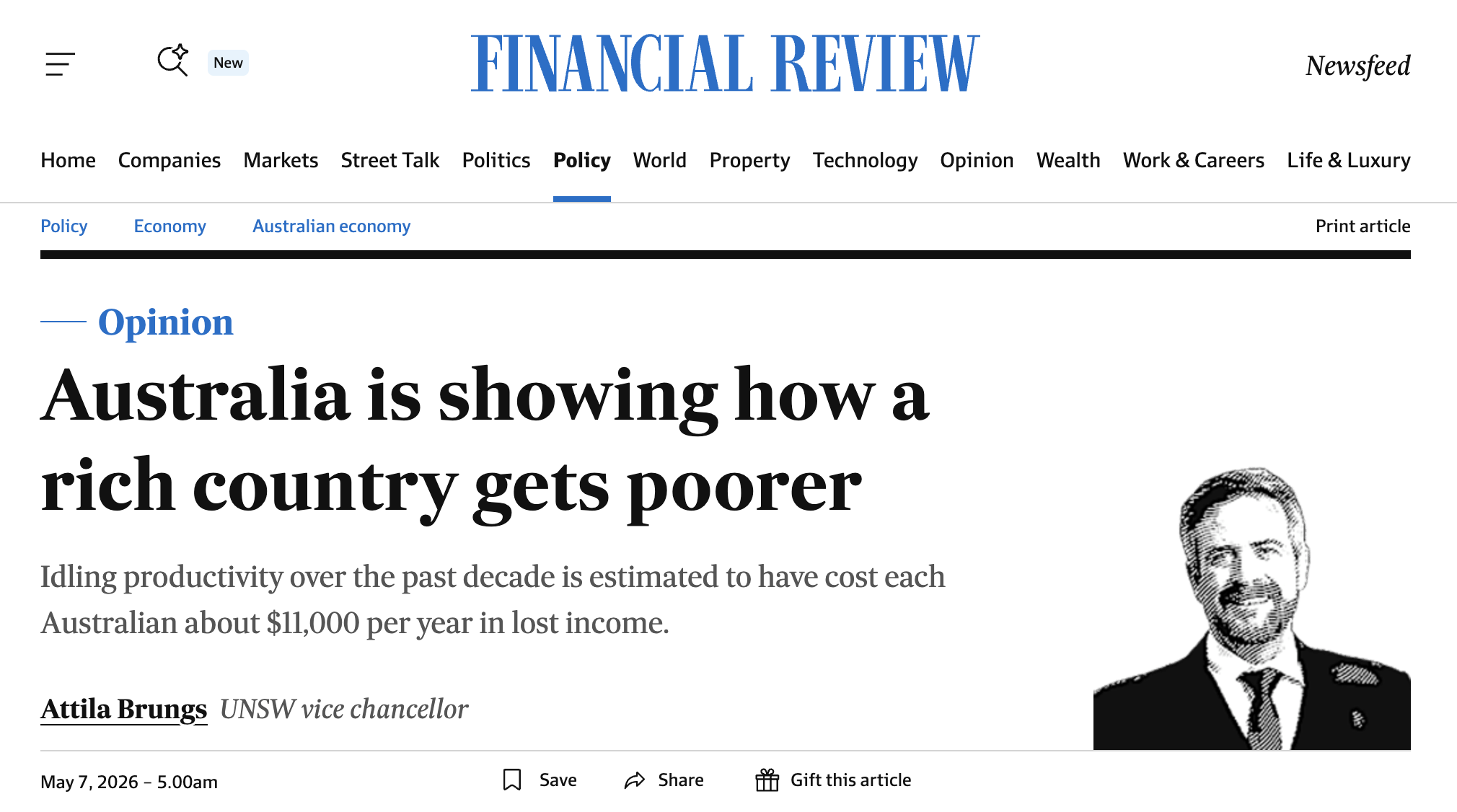
A country with per-capita income in the global top ten. Over thirty years without a single recession. And right now, Australia is going through an economic and social crisis it has never seen before. Not long ago, the vice-chancellor of UNSW, one of this country’s top universities, wrote an article with a title that says it all: “Australia is showing the world how a wealthy country goes broke.” What he wrote lines up almost exactly with what I’ve been thinking. So today I want to dig into the fundamental problems that have made me, year after year since the pandemic, more and more disappointed in this country. And what ordinary people living here can actually do about it.
Productivity has stalled for a decade
The UNSW vice-chancellor pointed straight at the core issue in his article: over the past decade, Australia’s productivity has barely moved. The cost of that lost decade? Roughly $11,000 less per person, per year.
Now, what does productivity actually mean? Don’t overthink it. It’s whether you can create more value in the same eight-hour workday than you did last year. If the whole country’s productivity isn’t moving forward, wages can’t grow. And if wages can’t grow but prices keep climbing, your money buys less.
So have you noticed more people around you saying “I’m working harder than ever, but my money doesn’t go as far”? The first reaction is to blame inflation. And yes, inflation is part of it, but it’s just the symptom. The deeper issue is that this country’s ability to create wealth has stalled, or even gone backwards. When productivity doesn’t grow, the pie doesn’t get bigger. And no matter how hard you work, your slice keeps shrinking.
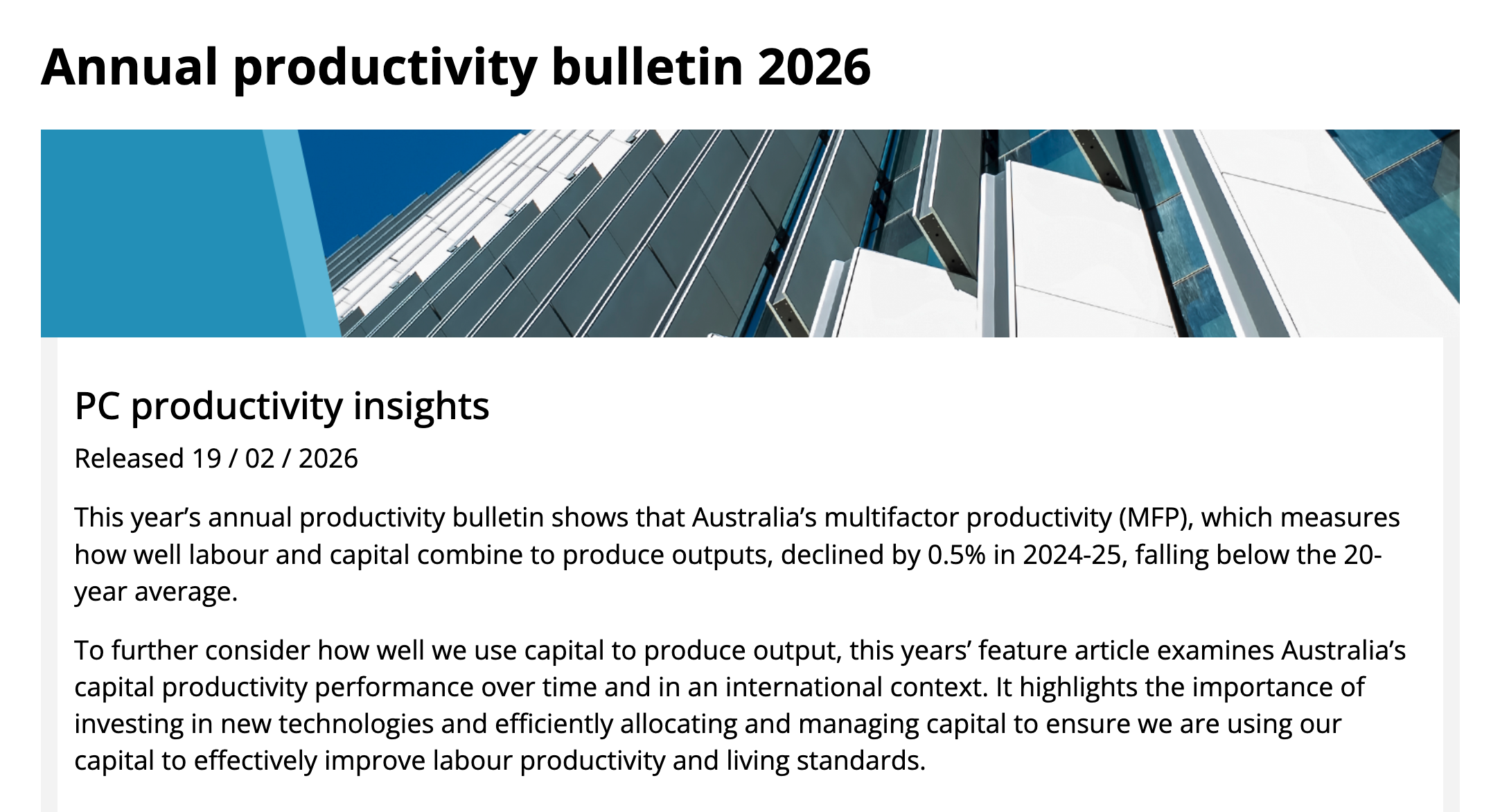
The Productivity Commission put out its annual report in February, and the numbers are ugly. Australia’s productivity in 2024-25 didn’t just flatline, it actually fell by 0.5%. Compare that to the golden decade from the nineties to the early 2000s, when it was growing at 1.6% a year. They also worked out that a typical Australian worker needs five days to produce what an American worker puts out in four.
So productivity isn’t growing and the pie isn’t getting bigger. That’s the big picture. But when it hits your wallet, how much are you actually losing?
Your wallet is shrinking
The OECD 2026 report laid it out: over the past five years, real wages in Australia have dropped about 5%. No other developed country has fallen that far.
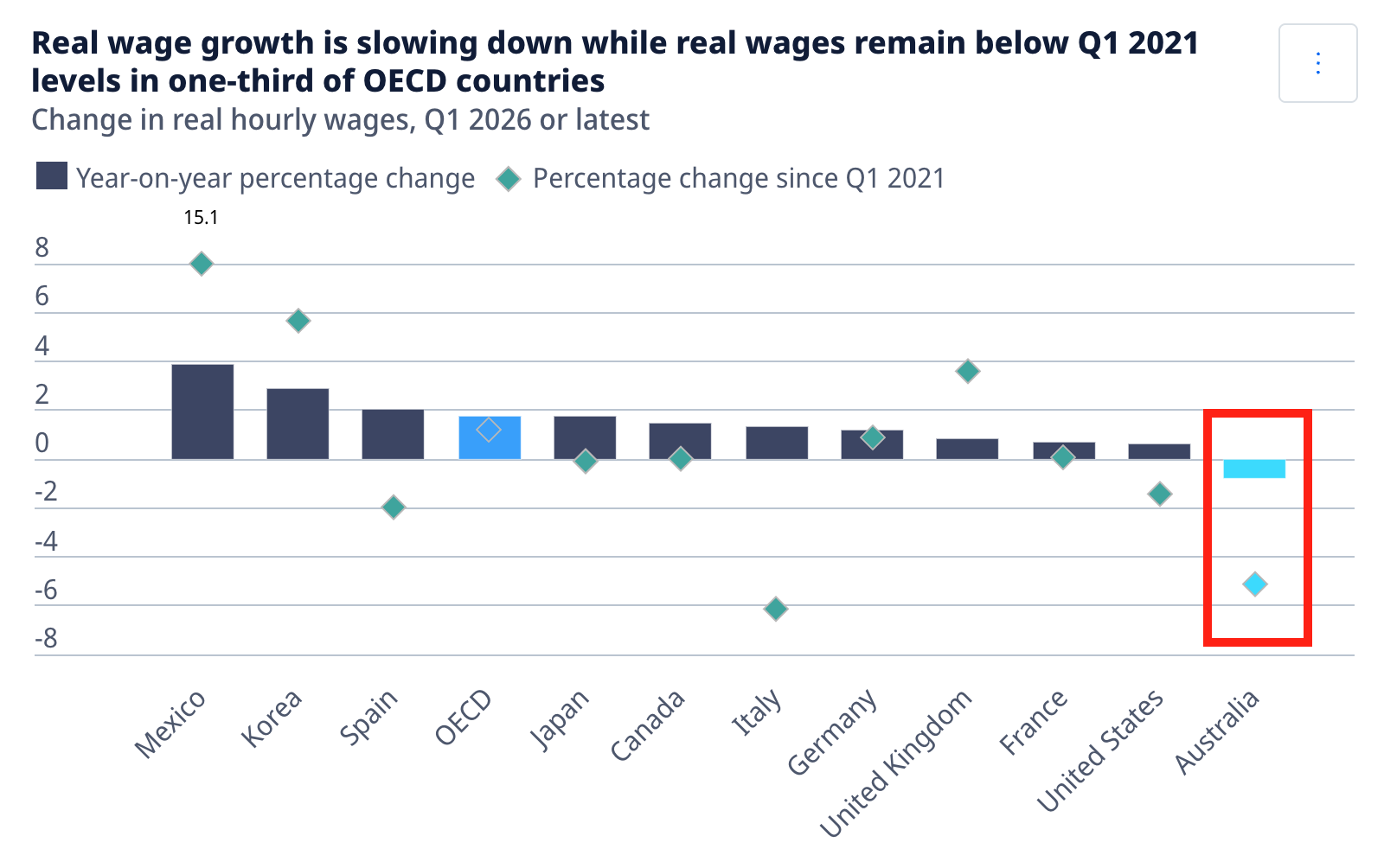
ABS published the wage price index in May, showing wages grew 3.3%. Sounds alright on its own, but CPI inflation is sitting at 4%, and the RBA has bumped up rates three times already this year, from 3.6% to 4.35%. So wages up 3.3, inflation at 4, rates at 4.35. Do the maths. You’re going backwards no matter how you run the numbers. And since the start of 2021, Australians have lost more purchasing power than people in any other developed country. Over the past two years, what Australians actually have left to spend after inflation and tax has dropped about 8% per person. In plain English, everyone is earning more on paper but buying less in real life. And that 8% drop is the worst in the entire developed world. And keep in mind, that’s per person. GDP is still going up, but per-person income is going down. More people, same-sized pie, smaller slices for everyone.
Now look at housing. The national price-to-income ratio is 8.2 times. In Sydney, it’s 14 times, second in the world behind only Hong Kong. Saving up for a deposit in Sydney takes 11 years. Three years ago, 43% of median-income households could afford a median-priced home. Today, it’s 14%. We’re trying to squeeze 11 million households into 10 million homes. No wonder prices keep going up.
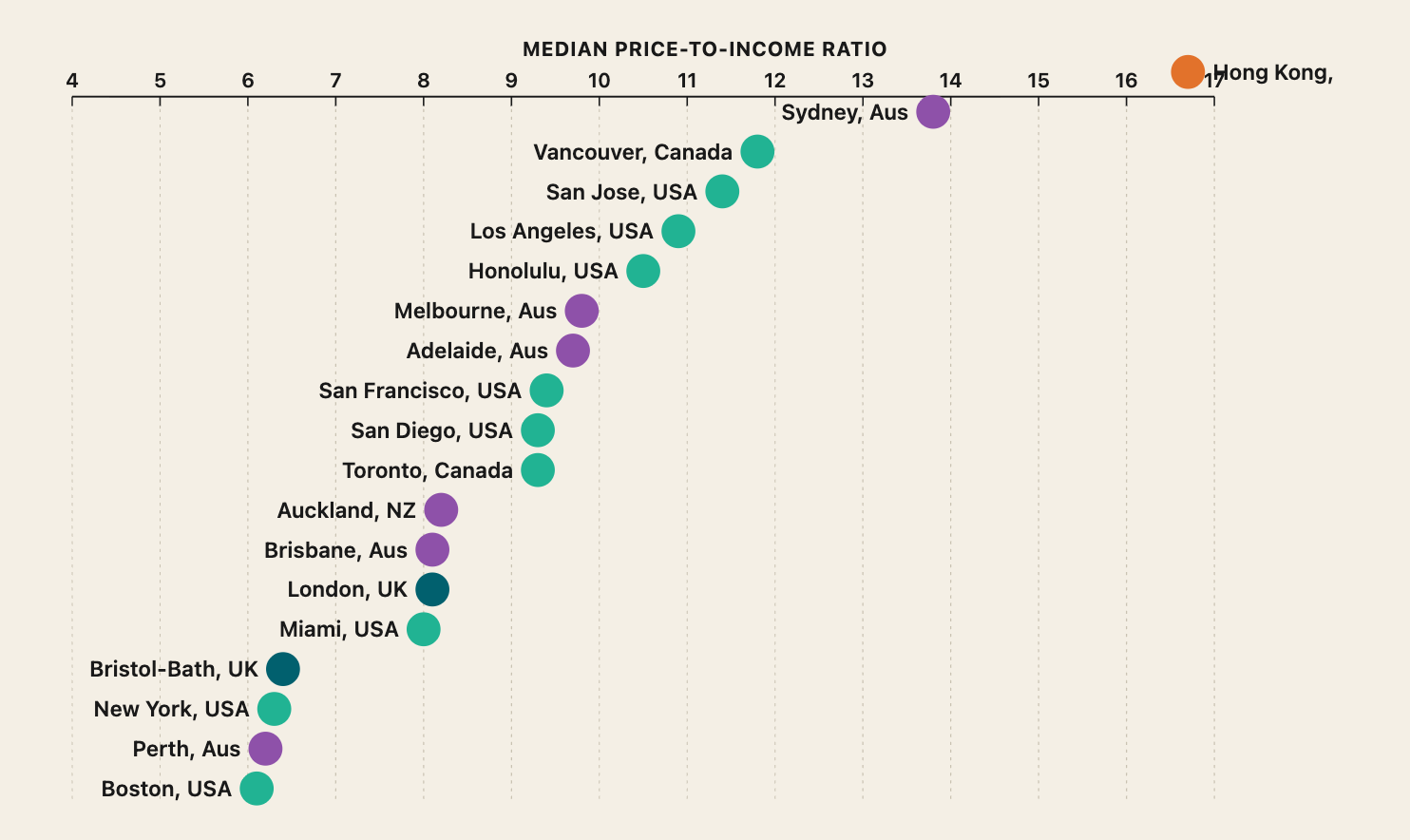
So wages are falling, house prices and interest rates are rising, and saving is becoming almost impossible. But that’s still just the surface. Where are your tax dollars actually going? That story is more outrageous than you’d think.
Infrastructure is eating your taxes
Take Melbourne’s West Gate Tunnel for example. In 2015, the government said the budget was $5.5 billion, four years to build. What actually happened? It opened in December 2025, nearly eight years later, at a final price tag of $10.2 billion, nearly double the original budget. Victorian taxpayers went from putting in $400 million to shelling out $4.2 billion. One project, $4.2 billion over budget, and it barely made the news. The Grattan Institute found that over twenty years, Australian governments have spent $34 billion more on transport infrastructure than they originally told taxpayers. That’s a 21% blowout across the board.
The money was spent and the debt piled up. Victoria’s total debt six years ago was $49.7 billion. Now it sits at $163.7 billion. In another four years, it’s on track to approach $200 billion. It has more than tripled in six years. And interest alone eats up $32 million every single day. Of all Australian states, Victoria has the lowest credit rating. In plain English, the people lending money to Victoria think it’s the least likely state in the country to pay them back.
But wait, it gets worse. Because the question isn’t just how much was spent. It’s how it was spent.
Here’s something you can see with your own eyes. I watched a crew show up to fix underground pipes on my street at 7am, right in the middle of peak hour. They immediately blocked off half the road and six people started holding stop-slow signs, while the whole road turned into a car park. By 10:30, the site was empty. Not a single worker in sight. Why couldn’t they start at 9:30? They’d skip the rush-hour chaos and cut the cost of blocking traffic. And if you try to complain to the council? You wait a week for a response. By then the job is done anyway.
And those stop-slow signs could be bolted to a barrier or mounted on a vehicle. Why are we paying people to stand there holding them for hours, chatting away in the sun? That’s not work. That’s running down the clock. But here’s the strange part: nobody thinks this is a problem. Everyone just goes along with it.
And that’s when you realise what this society is actually missing. It’s not money. It’s drive. Nobody is thinking “how can I do this faster and better.” The thinking is “how do I do as little as possible without getting fired.” That mindset has spread from construction sites to government departments to big corporations, layer by layer. And that’s the real reason productivity isn’t improving. But why? Why has the whole country’s drive disappeared? There’s a deeper cycle behind it.
The death spiral of ambition
Why don’t people have drive? Because they won’t starve either way. Australia’s welfare system is generous, and the government can’t afford to let people fall into real hardship, because that’s how you lose votes. So it has to hand money to people who aren’t working and tax people who are working harder to pay for it. The system, at its core, rewards people who don’t try and punishes people who do.
And that creates a loop. More people without ambition means more policy aimed at keeping them comfortable, because that’s how you win elections. Australia has locked itself into a death spiral.
There’s no way to break out of this in peacetime, unless a prime minister comes along with the courage to force real reform. To push the country back into motion, cut through the red tape strangling businesses, loosen the financial system, and make it impossible to coast through life on handouts. That’s the only way this country could recreate the economic boom of 1993 to 2003.
But nobody has that courage right now. So who ends up paying for all this debt? You do. Higher taxes, bigger fines, higher council rates and tolls. Every dollar comes out of the taxpayer’s pocket in the end. All that spending, all that debt, and ask yourself: is life actually getting any better?
Want to know exactly where you stand and what your next property move should be? Book a VISION Blueprint Session — in 45 minutes, you'll walk away with a personalised Property Investment Blueprint built around your numbers, your goals, and your timeline. And if you want ongoing support from a team that handles everything from strategy to settlement, VISION Gold Membership is your next step. Link in the description below.
Society is tearing itself apart
The Australian Society is tearing itself apart. Start with public safety. Crime in Victoria went up 20% in 2025. The most recent year showed a tiny 1% dip, but overall levels are still sitting high. Vehicle theft shot up 47%, the highest in over twenty years. But what’s really alarming is youth crime. In Victoria, 62% of robberies are committed by minors, and close to half of all home burglaries involve young offenders. For carjackings, 58% are carried out by young people. Earlier this year, Flinders Street Station in Melbourne saw a mass brawl involving teenagers armed with machetes. Meanwhile, Victoria’s police force is short by more than 1,500 positions. Crime is going up and police numbers are going down. That gap only gets wider from here.
Now let’s talk about something many people avoid: immigration. In 2024-25, net overseas migration came in at 306,000. That’s down from the peak of 538,000, but more than 300,000 people are still coming in every year. And housing? Fewer than 180,000 new homes go up annually, but demand sits above 220,000. The national rental vacancy rate is barely over 1%.
In April, ABS put out a historic number: Australian residents born in India hit 971,000, overtaking those born in England for the first time ever. Australia now has 32% of its population born overseas, the highest proportion since 1891. The country’s demographics have fundamentally changed in the past decade.
Now, I want to be clear. Demographic change on its own isn’t the problem. The problem kicks in when immigration outpaces social integration. That’s when friction between communities starts showing up. When large groups come in and keep their own culture without taking on Australian values, and the law encourages each community to operate separately, you end up with different groups electing their own representatives and pushing for their own interests. If any single group eventually reaches a majority, Australia could turn into a fundamentally different country.
History has a real-world example. Mauritius, an island nation off east Africa, is now 70% of Indian descent. Elections and parliament are run by Indian-origin citizens, and the local population lost control of their own country long ago. Indian labourers were brought in without restrictions. They stayed, picked up citizenship, and got the right to vote. By the 1960s, the Indian community had taken over. Whether Australia’s politicians see this as a cautionary tale, I have no idea.
I’m not saying immigration is bad, but I am saying the speed of it has far outpaced what this country can handle. I’m an immigrant myself, and I understand the contribution immigrants make. But the infrastructure and housing supply simply can’t keep up. And what I’d call “cultural infrastructure,” how fast Australian culture can actually absorb newcomers, can’t keep up either. More than 300,000 people arrived, but where are the homes, the roads, the hospitals, the schools? The housing shortfall runs into tens of thousands every year. It’s getting harder and harder to see a GP. Roads under construction for a decade still aren’t done. Classrooms are packed. This isn’t the fault of immigrants. It’s a policy failure. The government let people in but didn’t build the infrastructure to back them up. At the same time, some groups have brought over habits from their home countries that don’t fit here, and they want to reshape Australia into something different.
Now, some might say, “Didn’t you already know Australia was slow?” Sure. But the slowness ten years ago felt like a lifestyle choice, like easygoing calm. The slowness today feels like helplessness. You call a bank, you’re on hold for an hour. You call the council, same thing. Roads that were supposed to take two years are still going a decade later. Government agencies take longer and longer to get anything done. It’s not that you’ve become more picky. The system is getting worse.
So here’s where we are. Productivity has stalled, wallets are sais splitting apart. And yet, plenty of people still think everything’s fine. So what should you actually do about it?
What you should think about
Look, if you’re settled here with a home, a job, and kids in school, ask yourself this: after everything you’ve heard today, do you believe this country is heading in the right direction? Productivity is going backwards. Real wages are falling. Public safety is getting worse. Infrastructure sits near the bottom of the developed world, and government debt is at record highs. Do you want your children growing up somewhere that feels comfortable but is going nowhere? When they’re adults, will this still be a wealthy, safe country with real opportunity?
I’m not saying Australia is done and you need to pack up. The fundamentals are still there. Unemployment at 4.4% is low. The sovereign credit rating is still AAA. But this is a question every family should think about seriously, because the decisions you make today aren’t just about your life. They’re about the next generation’s life.
Here’s my personal take. You can actually split your identity, your wealth, and your daily life across three different countries. If you hold Australian citizenship and you’re an Australian tax resident, you’re paying very high tax on worldwide income. That’s not a position I enjoy being in. So the way I see it, Australia works as your identity base and nothing more. You move your wealth to a low-tax or zero-tax jurisdiction, and you live day-to-day in a country with a low cost of living that you actually like. If you have those three centres in place, it means you’ve figured the game out and you’re not letting any single country take advantage of you. You’ve become a global citizen, and nobody can put a fence around your money or your freedom.
The way I see it, Australia’s next ten years will be more of the same. Wealthy people leaving, businesses leaving. It’s only a matter of time. But if you have to stay in Australia, property investment is still your best shot at getting out of the rat race.
Watch the video version of the blog on YouTube.
15 Minutes Free Consultation (Limited-Time Free Offer)
If you have any questions about Australian real estate, we invite you to use our 15 Minutes Free Consultation service. Once you have filled in the form, a professional property investment strategist will be in touch with you. They will assess your needs and provide fundamental advice. This service is designed to help answer general property-related queries. BOOK NOW.
VISION Membership
Our Flagship Service: VISION Membership. Your One-Stop Property Investment Manager – Build a Tailored Portfolio and Achieve Financial Freedom
Whether you're an employee, a professional, a business owner or even a new migrant, everyone has a financial goal for the future. The VISION Membership is designed to solve all the pain points in your Australian property investment journey through one single, comprehensive service.
By analysing your current financial situation and long-term goals, we'll tailor a property investment plan just for you. Our team will match you with the ideal mortgage structure, tax strategies, wealth planning, and legal support, empowering you to go further, faster, and smarter on your path to financial freedom.
VISION Membership is perfect for busy individuals who want a professional team to create, expand and manage their Australian investment portfolio. If you're looking for a dedicated team, including real estate investment experts, mortgage brokers, accountants, financial planners, and property solicitors, VISION Membership is your ideal solution.
Start with an obligation-free 30-minute discovery session on Zoom. BOOK NOW.
VISION Buyer’s Agent
No time for inspections? Tired of dealing with pushy selling agents? Unsure how much to offer or feeling nervous about auctions? Worried about buying the wrong property? If any of these sound like you, AusPropertyStrategy's Australia-wide VISION Buyer's Agent Service is here to help.
We provide end-to-end support to help you build an optimised property portfolio and achieve your financial goals—whether you're investing interstate, refinancing, or planning post-settlement leasing or resale. Our services cover everything from suburb research and property selection, to price negotiation, auction bidding, and post-settlement support.
Start with an obligation-free 30-minute discovery session on Zoom. BOOK NOW.
real estate australia,real estate investing,australian property,australian housing market,australian economy,australian property investment,australian property market,buying property,australian real estate,mortgage brokers brisbane,first home buyer,Australian Real Estate,Australian Real Estate Investment,Australian Property Investment,Real Estate Investment,Property Investment,Property Investment Australia,Passive Income,Positive Cash Flow,Australia Real Estate Investing,Australian Real Estate Investors,Australian Property Investors,Vision Wealth Mentors,Vision Real Estate Investors Australia,financial freedom, freedom through property investment,real estate investors,property investment,passive income,positive cash flow,real estate course,real estate courses,real estate training,australian property market,property investment brisbane,property investment sydney,melbourne property market,investing in brisbane,investing in melbourne,how to invest in property,buying properties,start investing in property,property investment strategy,how to buy investment property,property investing tips,best suburbs to invest in sydney,locations real estate,prime location,property growth by suburb,capital growth suburbs


