

Australia’s Housing Time Bomb Has A New Fuse — And AI Just Lit It | APS144
“AI will take your job, then you’ll miss your mortgage, then the market will crash.” That’s the comment I’ve been getting on this channel lately. Honestly, when I first read it, the logic sounded right. So I spent two weeks digging into this and ran four rounds of cross-checking. Here’s what I found. Every link in that logic chain is a lot weaker than it looks, and sitting right in the middle is one variable almost nobody has even noticed.
In this episode, I’ll walk you through that chain one link at a time. Is AI actually taking jobs at scale? If more people lose work, does a housing market crash really follow? And why is AI destroying jobs and making the housing shortage worse at the same time? This isn’t a market-wide rise or fall. It’s about which suburbs rise, and which suburbs fall.
1. Is AI Really Taking Jobs?
Let’s start with the basic question. Is AI actually replacing jobs, or is this just media hype? It’s real, and it’s moving faster than most people realise. In 2025, the US saw almost 55,000 layoffs directly linked to AI. Microsoft cut 15,000 roles, Amazon axed 14,000 corporate jobs, and last month, Atlassian let 1,600 people go, with more than 900 of them coders. A Stanford University study found employment among software developers aged 22 to 25 tanked 20%. Entry-level gets hit first.
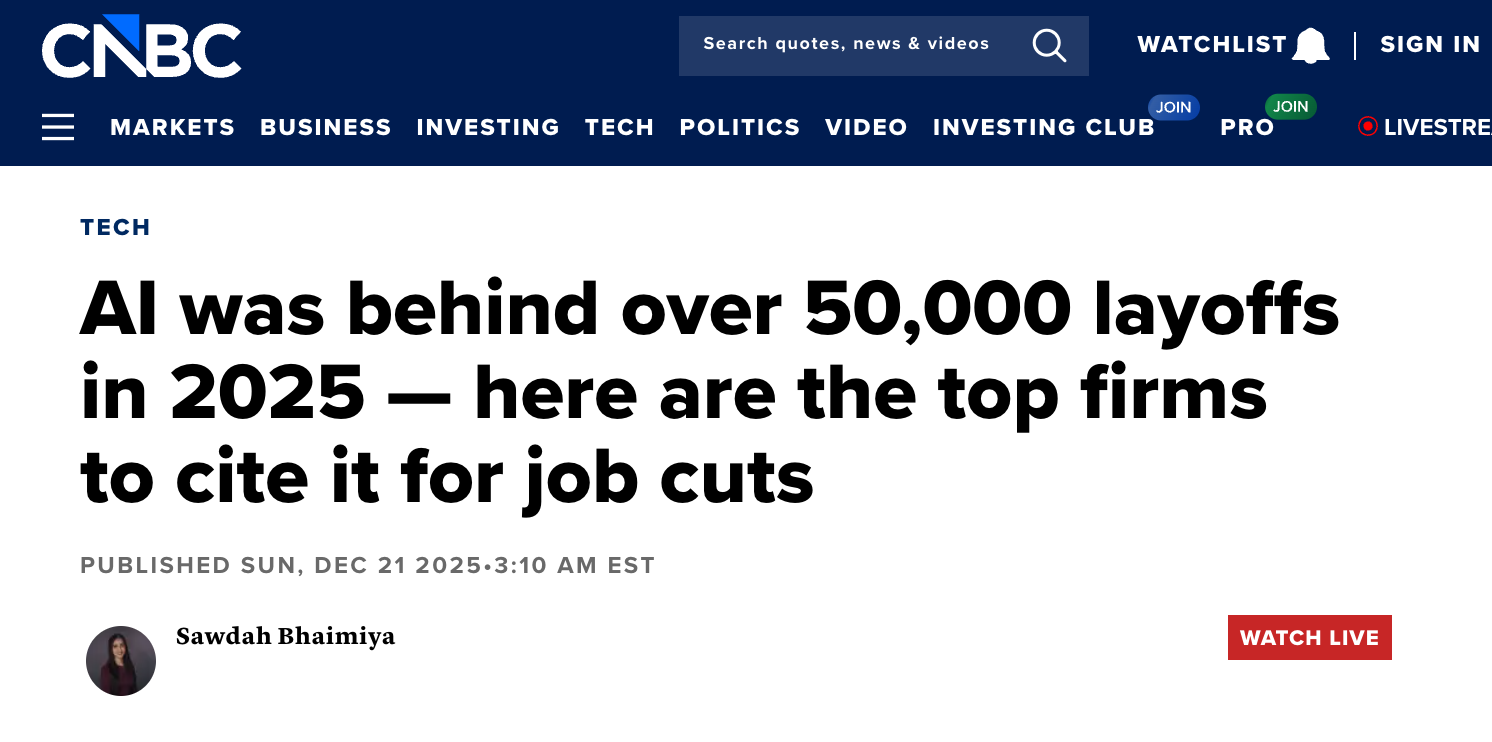
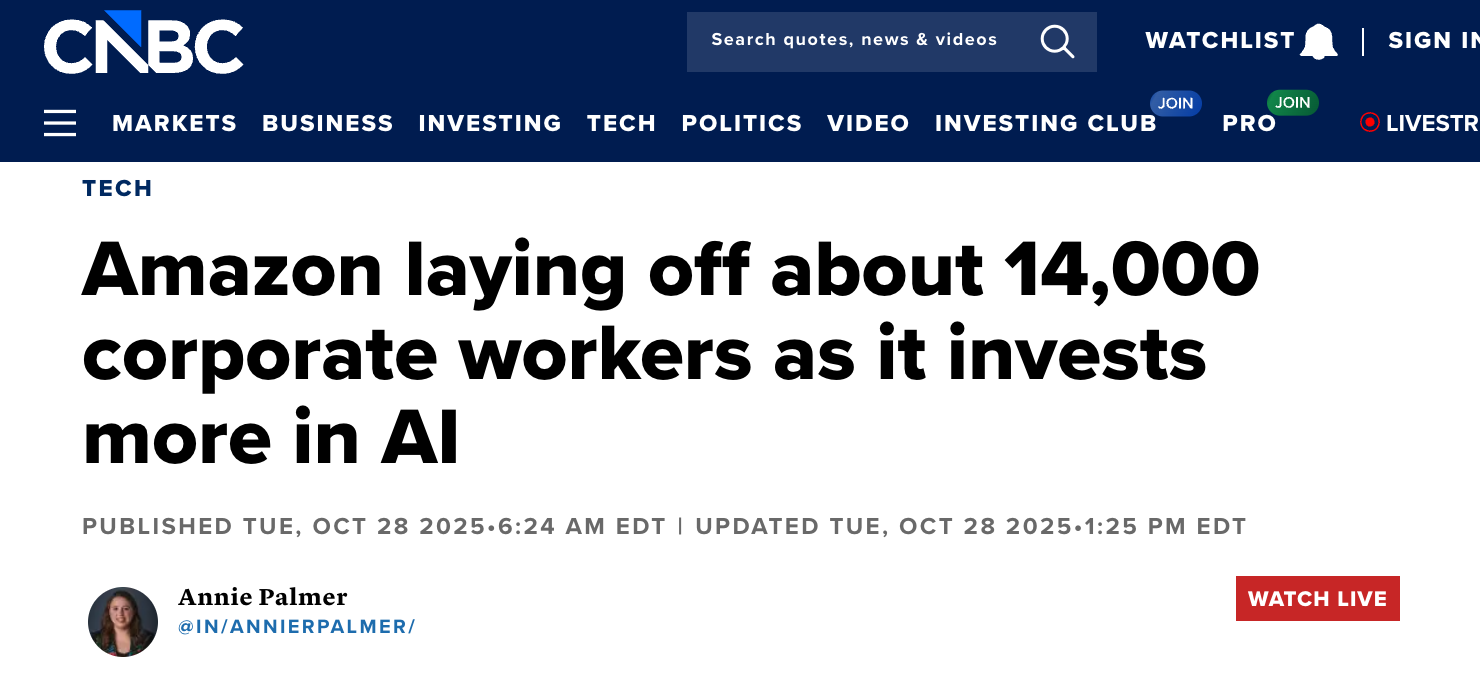
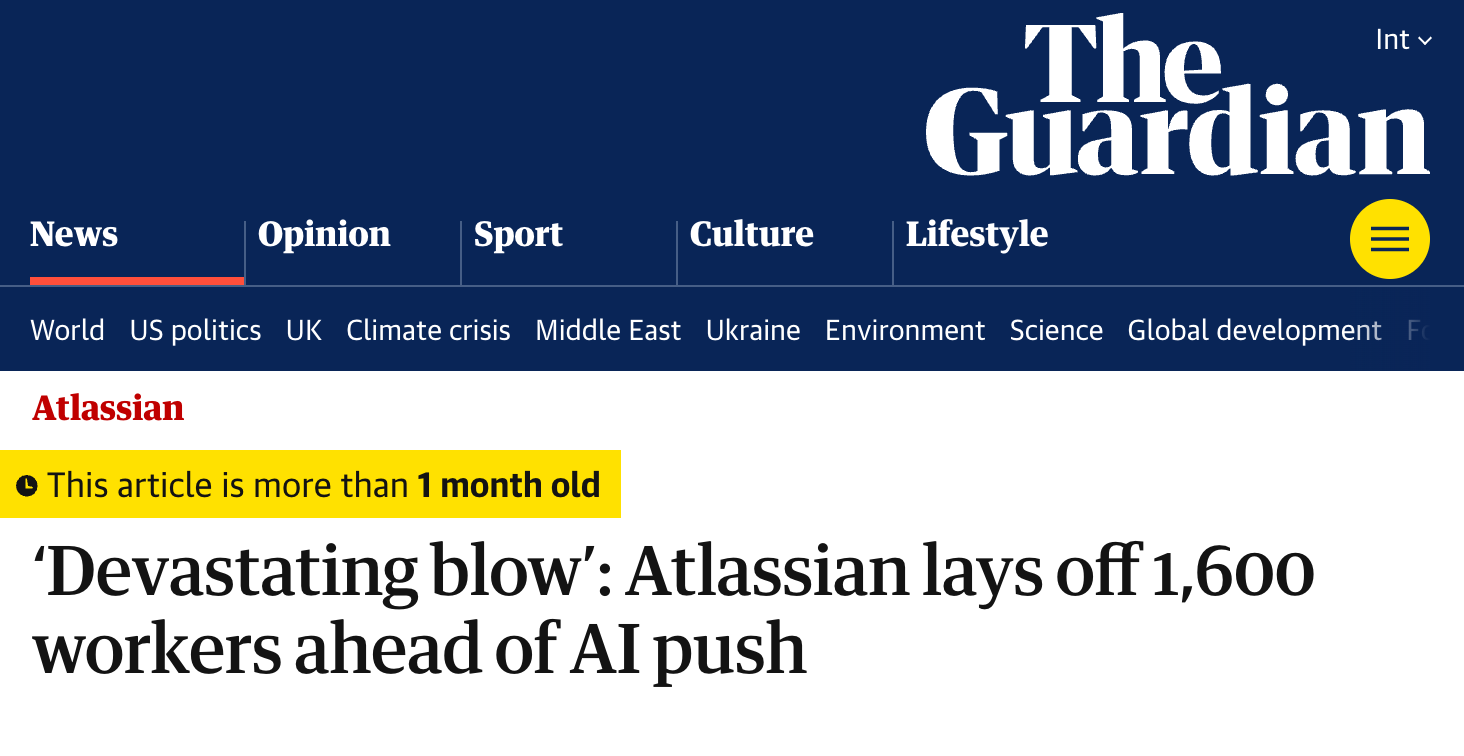
Now you might push back. Aren’t these companies hiring while they fire? They’re not shrinking, they’re swapping staff out, cutting non-AI roles and hiring AI ones in their place. Old jobs go, new jobs arrive, but the two don’t line up one-for-one. And the people who got replaced? Who pays their mortgage? That’s the question that matters to your wallet.
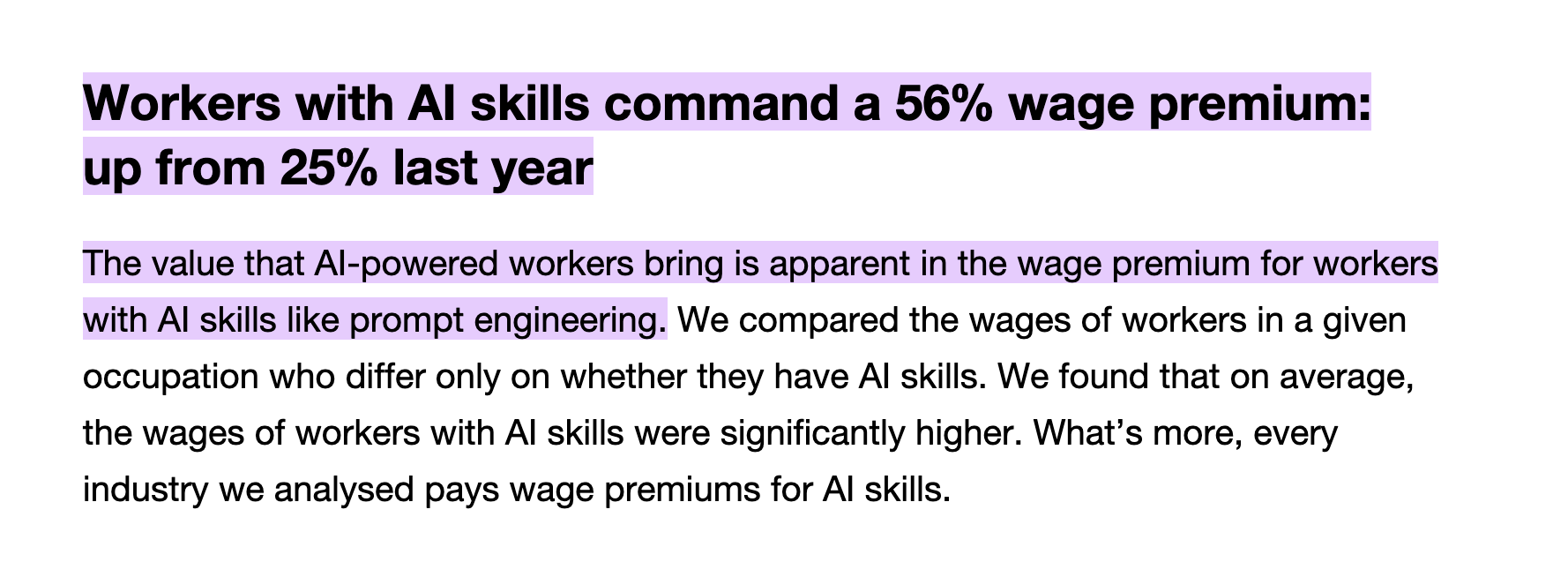
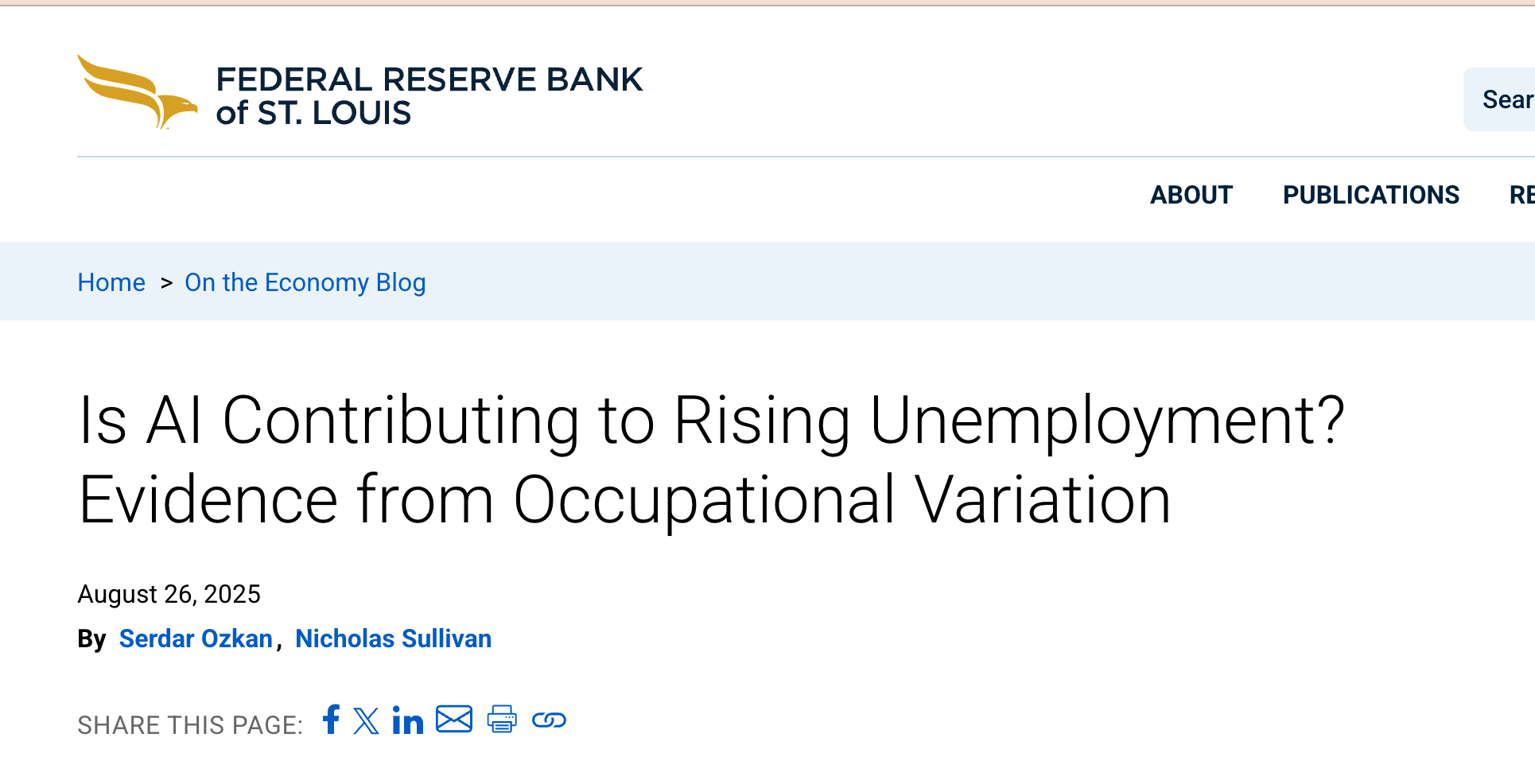
PwC data shows AI-skilled workers are commanding a 56% wage premium, but St. Louis Fed data shows the jobs most exposed to AI also have the fastest-rising unemployment. That premium has a shelf life. Let's run the numbers. If AI cuts 1,000 white-collar jobs at $75,000 and creates 200 AI roles at $160,000, total spending power drops from $75 million to $54 million. That’s a 28% fall. A handful of people earn more, but they can’t fill the hole the other 800 leave behind.
So here’s the first takeaway. That takes us to the second question.
2. When People Lose Jobs, Do House Prices Crash?
The short answer is no, not necessarily. There are buffers in between, and they’re bigger than most people think. I call them the three firewalls.
The first firewall is interest rates. A 2005 paper in the Economic Record ran the numbers. For every 1 point rise in unemployment, house prices only fall 0.2%. For every 1 point move in interest rates, prices shift 5.4%. That’s a 27-fold gap. On a million-dollar home, a 1-point rise in unemployment costs you $2,000, barely noticeable, while a 1-point cut in rates is worth $54,000, enough for a new car. That’s what explains the 1992 mystery. Unemployment hit 10.8%, the worst reading since the war, yet Sydney prices only fell 6%, because the RBA slashed rates from 17.5% down to 4.75%. Rates crushed the jobs effect.
Now, what about the “AI will just help you do your job better” argument? Jobs and Skills Australia put out a 124-page report saying AI dominates, but significant uncertainty remains. Put simply, that’s a paper projection, not a real-world result. History shows that augmentation works only until one tool can do most of the tasks. ATMs augmented tellers for 30 years. Then mobile banking arrived and wiped most of the role out. Generative AI reads, writes, analyses, and codes. That coverage is enormous.

The second firewall is immigration. Australia takes in about 300,000 net overseas migrants a year, and they all need somewhere to live.
The third firewall is the supply shortage. Australia is short 262,000 homes right now. That’s the hardest wall to break, and I’ll come back to it.
Three firewalls, all sounding solid. But here’s the big “but.” On March 17, the RBA voted 5 to 4 to raise rates another 25 basis points, pushing the cash rate to 4.1%. That’s a second consecutive monthly hike, which we haven’t seen since mid-2023. Q1 CPI comes out on April 29, and the big four banks still expect another rise on May 5, possibly to 4.35%. Inflation at 3.8% is above target, and the labour market is still tight.
Watching this cycle, one thought hit me. Back in the 1990s, the RBA had 13 percentage points of room on interest rates to soak up an unemployment shock. In 2026, the first firewall flipped. It’s gone from protecting you to actively hurting you. Rising unemployment on top of rising rates has never hit Australia before. But in 2026, it’s a real possibility. Your purchasing power is getting squeezed from both ends.
So here’s the second takeaway. Unemployment doesn’t equal a crash, because three firewalls stand in the way. But the most important one has flipped direction, and only two are still holding.
Up to this point, you’ve only seen AI’s destructive side. The next chapter flips the picture. AI companies are pouring money into Australia to build data centres, and how that money hits house prices isn’t quite what most people assume.
3. AI Is Pouring In $50 Billion
Can AI demand push house prices up? And if so, whose house prices?
AWS has committed $20 billion to Australian data centres, Microsoft has put in $5 billion, and with NEXTDC, AirTrunk, Goodman Group, and CDC piling in, the total tops $50 billion. Prime Minister Albanese called it “the biggest tech investment in Australia’s history.” Out in Western Sydney right now, there are 109 cranes in the sky, more than the 69 in the inner city. For the first time in Sydney’s history, the western skyline is busier than the CBD.
50 billion dollars sounds huge. But once the data centre is built, who actually lives around it? Vantage built a centre in Reno with over 4,000 workers during construction, and just 73 permanent jobs ten years later. The Brookings Institution spelled it out plainly. Large data centres rarely create significant employment beyond the construction phase.
So why do prices in Northern Virginia, the densest data centre cluster on the planet, stay high? A 2025 study from George Mason University figured it out, and it wasn’t data centre staff living locally. Two indirect forces were doing the work. First, tax revenue. Loudoun County data centres make up over 70% of the county’s commercial tax base, keeping local property tax rates 25% lower than the next county. Second, infrastructure. The roads, fibre, and grid upgrades built to serve the centres end up serving the whole region. So data centres lift regional value indirectly, not by the staff moving in next door.
Here’s another signal worth paying attention to. During the AI boom in San Francisco, overall prices rose 10.9%, yet Pacific Heights fell 40% and Haight-Ashbury fell 30%. Same city, same boom, some suburbs surging, others sinking. That’s polarisation in plain sight.
Now how many jobs has AI actually created in Australia? The Tech Council of Australia says 200,000 by 2030, but that report was sponsored by Microsoft and LinkedIn. To hit that target, tech employment would need to ramp up 500% in seven years. Growth over the previous seven was only 46%, and as of May last year, Australian tech had actually lost a net 31,000 jobs. So 200,000 is a ceiling, not a real number.
But the most important point isn’t the headcount. The real conflict is that 50 billion dollars of data centres is competing with residential builds for the same construction workers and the same patches of land. That AI investment is actually making the housing shortage worse.
So here’s the third takeaway. AI demand can push prices up, but only in specific regions, and only through indirect channels. And here’s the bigger irony. It’s deepening the supply crisis at the same time. Which brings us to the last piece of the puzzle. Can the supply shortage firewall hold?
Want to know exactly where you stand and what your next property move should be? Book a VISION Blueprint Session — in 45 minutes, you'll walk away with a personalised Property Investment Blueprint built around your numbers, your goals, and your timeline. And if you want ongoing support from a team that handles everything from strategy to settlement, VISION Gold Membership is your next step. Link in the description below.
4. Can Supply Hold the Line?
Construction tech is advancing. There are bricklaying robots, 3D printing, and modular prefab. Someone in Perth even 3D-printed a two-storey shell in 18 hours at 22% lower cost. But every advanced method combined still only makes up 3 to 5% of the industry. And Australian residential construction productivity hasn’t increased in 30 years. Since 2013, the workforce has grown 25% while output has dropped 25%. Construction might be the only industry in Australia where more people produce less.
The National Housing Accord targets 1.2 million homes by mid-2029. Actual delivery is running 30% short. The NHSAC forecasts total completions of 938,000, which is 262,000 below target. And the industry itself is short 130,000 workers.
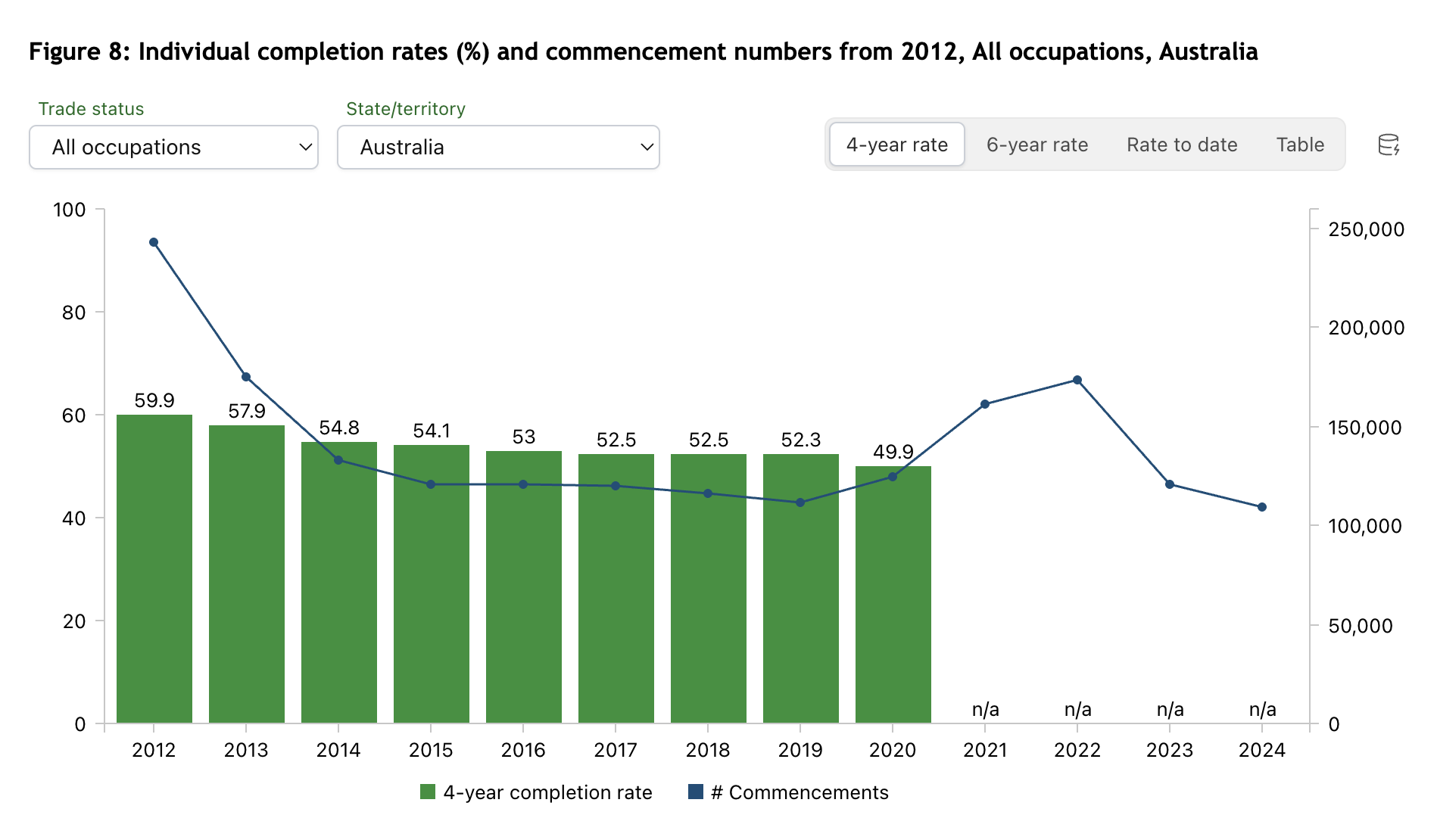
Speaking of that shortage, you might be thinking of a “perfect solution” right now. Can’t the white-collar workers laid off by AI just become trades workers? Nice idea, but the maths falls apart. Electricians take four years plus a licence exam. Plumbers take four years. Bricklayers take three, minimum. Apprentice wages sit at $854 a week, barely enough to cover rent on a Sydney unit. You’re asking someone who used to earn $80,000 or $100,000, with a mortgage, to take a 50% pay cut and stick it out for four years. When Australian car manufacturing shut down in 2017, about one-third found stable work, one-third went casual, and one-third ended up unemployed. Nationally, the trades apprenticeship completion rate is only 49.9%.
And the people AI is laying off aren’t the people construction needs anyway. An International Labour Organisation report points out that in high-income countries, women face AI automation risk at nearly three times the rate of men, because clerical and admin roles are majority female. Women in construction trades make up under 3%. That’s a structural mismatch, not a rounding error. White-collar construction roles can absorb a few people, but net growth is only a few thousand a year, and Buildxact already turns out construction quotes in 30 seconds using AI.
So here’s the takeaway on supply. The shortage is the strongest firewall of the three. AI doesn’t solve it. By competing for workers and land, AI actually makes it worse. All four pieces are now on the table. Let’s put them together.
5. Not Up, Not Down, Polarised
Look, I want to be clear here. I’m not saying Australian property is about to crash. I’m saying the risk profile has shifted in a way we haven’t seen in a generation. And here’s how it boils down.
First, AI is replacing jobs, and purchasing power is falling. That’s bearish. Second, three firewalls stand between unemployment and a crash, but the most important one, interest rates, has flipped direction. So not a crash, but the cushion is thinning. Third, AI is pouring $50 billion into Australian demand, but only specific regions benefit, and only indirectly. That’s bullish, but it’s concentrated. Fourth, the supply shortage is the hardest support of all, and AI is making it worse.
Pull all four together and the picture is clear. This isn’t a market-wide rise or fall. It’s polarisation. Good locations, with infrastructure investment stacked on top of the supply shortage, will keep rising. Bad locations, with job shocks stacked on top of rate pressure, will fall behind. Going back to our AusPropertyStrategy 5-4-1 rule, 50% of investment success comes down to location. In the AI era, that ratio needs to be even higher, because picking the wrong suburb now costs more than it ever did.
You might think you’re waiting for the right moment, but your purchasing power has been shrinking the whole time. Every year you hesitate, rates eat into your borrowing capacity, and the entry price in the winning regions climbs again. Waiting isn’t a strategy. It’s erosion.
So, looking at data centres and infrastructure alone, here are the likely winning regions. First, the Western Sydney Corridor, covering Marsden Park, St Marys, and Penrith, where $50 billion in data centres, Western Sydney Airport opening late 2026, and Sydney Metro West are all stacking up. St Marys is up over 13% in a year. Just keep this clear. It’s not data centre staff living there. It’s regional spillover from infrastructure. Second, inner-city Brisbane, covering Fortitude Valley and Woolloongabba. Cross River Rail opens soon, the 2032 Olympics are on the horizon, vacancy is just 1%, and apartments have risen strongly. Third, Perth, with population growth at 2.2%, the fastest in the country, and prices that are still affordable compared with Sydney and Melbourne.
Regions to avoid? Melbourne CBD apartments. Office vacancy at 19% is the highest since 1997, AI keeps eating into CBD white-collar numbers, and too much was built between 2015 and 2019. That’s three bearish factors hitting the same suburb at the same time. High-leverage outer-fringe “mortgage belt” suburbs need care too, because they have no AI catalyst and will bleed first. Picking a suburb is a bit like picking a partner. You can’t just go on face value. You’ve got to ask whether it’s got ten years of growth ahead of it.
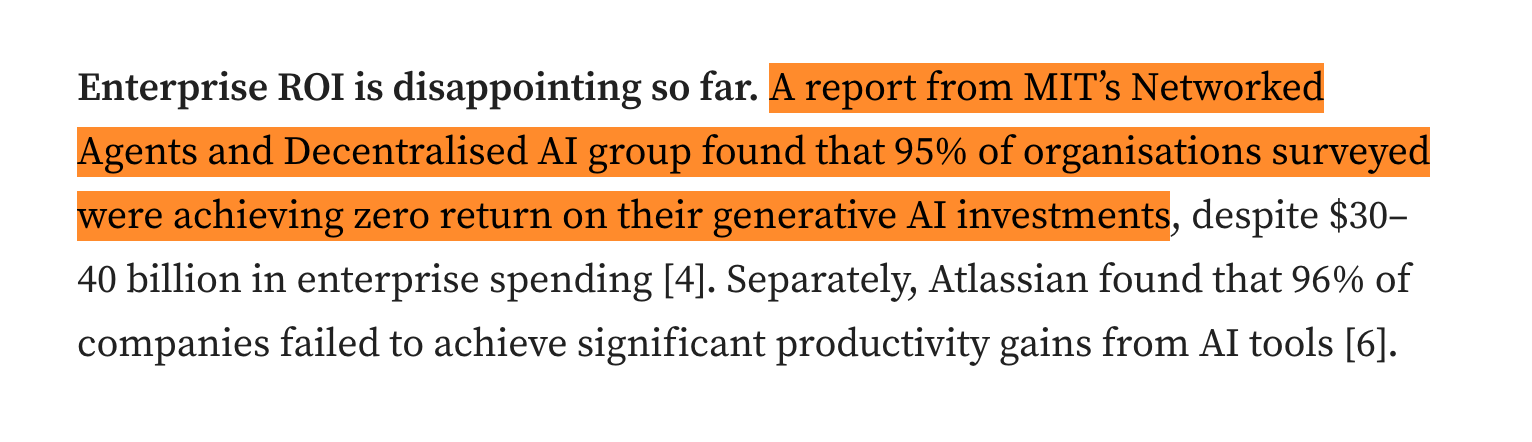
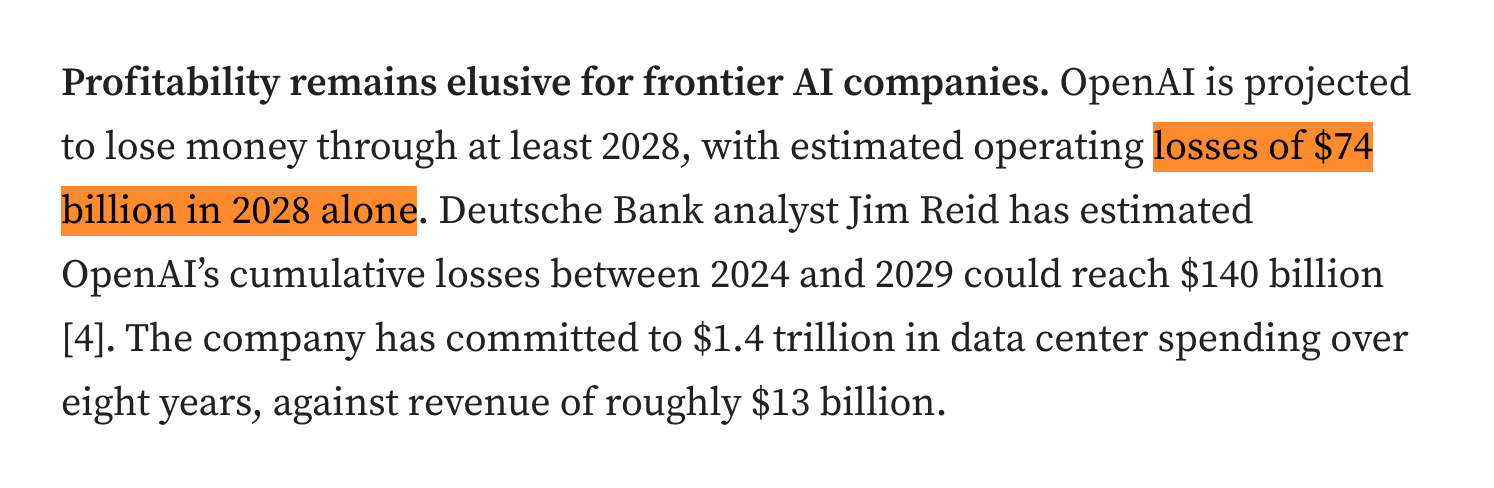
Here’s one cold water note before we move on. An MIT study last year found 95% of corporate AI investments generated zero return, and OpenAI is projected to pile up $74 billion in losses by 2028. AI as an industry has real bubble risk. So don’t bet on a single AI theme. Buy where multiple catalysts stack, so even if the AI story underdelivers, the other drivers still hold prices up.
OK, here’s the good news. You’re not powerless here. Here are three moves you can start on straight away. First, favour assets that come with land. Houses and townhouses beat apartments, because land appreciation drives long-term returns. Second, buy where multiple catalysts stack. Close to a data centre corridor, close to transport nodes, close to diversified employment hubs. That’s the logic behind our VISION All Weather Investment approach. Third, get positioned in Sydney, Brisbane, and Perth now. Don’t wait. We’re in the early-to-mid stage of infrastructure-driven growth, with 5 to 10 years of catalysts still ahead.
6. Can Prices Keep Rising?
There are two questions from the comments I’ve been wanting to answer properly. First, if AI eventually replaces every job, can house prices still rise? And the sharper version. Even without full replacement, if AI creates permanent structural unemployment and real wages stop growing, can prices keep rising? The second one is more realistic and harder to answer.
Rising Australian house prices have relied on one quiet assumption. Incomes were rising too. Incomes up, borrowing capacity up, prices follow. But what happens if AI really does suppress real wage growth? In that world, what keeps prices rising?
My take is that growth slows but doesn’t go to zero, and there are two reasons. The first is the supply constraint. Good location, land is limited, and construction productivity hasn’t moved in 30 years. Even if wages stop rising across the board, the housing shortage doesn’t go away. The floor under house prices isn’t set by income. It’s set by supply. The second reason is inflation hedging. If governments roll out Universal Basic Income or major fiscal stimulus to deal with mass unemployment, the currency weakens, and property is a natural hedge. When wages don’t rise but prices do, cash loses value while property at least preserves it.
So the logic of future property investment may shift. From “rental yield plus capital growth” to “essential housing plus inflation hedge.” Returns might drop from 7 to 8% down to 4 to 5%, but they don’t go negative.
In the short term, over the next five years, prices most likely keep rising. Not because AI is bullish, but because the supply shortage and migration are tougher forces than the AI shock. With rates heading to 4.35%, the pace gets capped. Medium term, 10 to 15 years out, uncertainty is at its highest. If AI hits its “mobile banking moment” and starts replacing whole roles, white-collar employment could fall off a cliff. But AI could also create entirely new economic activity, the way the internet did. Long term, 30 to 50 years, even if AI and robots end up doing all the work, you still want to live by the sea, near good schools, with a balcony that looks out over the Sydney Opera House. It comes back to the same principle. 50% of it is location. In the AI era, I’d push that to 60%.
The surface area of the earth is fixed. Good locations are permanently scarce. The Industrial Revolution wiped out hand-spinning work for 8% of Britain’s population. Did the value of city land go to zero? No. It rose. In a fully AI-automated world, what you own isn’t just a house. You own a physical coordinate. And good coordinates are always scarce.
If what’s actually holding you back right now is not knowing what to buy, where to buy, and how to avoid the traps, please don’t run on gut feel alone. Our VISION Acquisitions buyer’s agency runs the research, shortlisting, due diligence, and negotiation for you. If you want to move on with this seriously, the service details are in the description below.
Watch the video version of the blog on YouTube.
15 Minutes Free Consultation (Limited-Time Free Offer)
If you have any questions about Australian real estate, we invite you to use our 15 Minutes Free Consultation service. Once you have filled in the form, a professional property investment strategist will be in touch with you. They will assess your needs and provide fundamental advice. This service is designed to help answer general property-related queries. BOOK NOW.
VISION Membership
Our Flagship Service: VISION Membership. Your One-Stop Property Investment Manager – Build a Tailored Portfolio and Achieve Financial Freedom
Whether you're an employee, a professional, a business owner or even a new migrant, everyone has a financial goal for the future. The VISION Membership is designed to solve all the pain points in your Australian property investment journey through one single, comprehensive service.
By analysing your current financial situation and long-term goals, we'll tailor a property investment plan just for you. Our team will match you with the ideal mortgage structure, tax strategies, wealth planning, and legal support, empowering you to go further, faster, and smarter on your path to financial freedom.
VISION Membership is perfect for busy individuals who want a professional team to create, expand and manage their Australian investment portfolio. If you're looking for a dedicated team, including real estate investment experts, mortgage brokers, accountants, financial planners, and property solicitors, VISION Membership is your ideal solution.
Start with an obligation-free 30-minute discovery session on Zoom. BOOK NOW.
VISION Buyer’s Agent
No time for inspections? Tired of dealing with pushy selling agents? Unsure how much to offer or feeling nervous about auctions? Worried about buying the wrong property? If any of these sound like you, AusPropertyStrategy's Australia-wide VISION Buyer's Agent Service is here to help.
We provide end-to-end support to help you build an optimised property portfolio and achieve your financial goals—whether you're investing interstate, refinancing, or planning post-settlement leasing or resale. Our services cover everything from suburb research and property selection, to price negotiation, auction bidding, and post-settlement support.
Start with an obligation-free 30-minute discovery session on Zoom. BOOK NOW.
real estate australia,real estate investing,australian property,australian housing market,australian economy,australian property investment,australian property market,buying property,australian real estate,mortgage brokers brisbane,first home buyer,Australian Real Estate,Australian Real Estate Investment,Australian Property Investment,Real Estate Investment,Property Investment,Property Investment Australia,Passive Income,Positive Cash Flow,Australia Real Estate Investing,Australian Real Estate Investors,Australian Property Investors,Vision Wealth Mentors,Vision Real Estate Investors Australia,financial freedom, freedom through property investment,real estate investors,property investment,passive income,positive cash flow,real estate course,real estate courses,real estate training,australian property market,property investment brisbane,property investment sydney,melbourne property market,investing in brisbane,investing in melbourne,how to invest in property,buying properties,start investing in property,property investment strategy,how to buy investment property,property investing tips,best suburbs to invest in sydney,locations real estate,prime location,property growth by suburb,capital growth suburbs


