
![Australian Property 2026: The 5 Costly Errors Keeping You From Real Wealth [APS125]](https://images.leadconnectorhq.com/image/f_webp/q_80/r_1200/u_https://storage.googleapis.com/msgsndr/jjqCY1xqmzF3WbceHAHT/media/696f8b264a646456cebf8e22.jpg)
Australian Property 2026: The 5 Costly Errors Keeping You From Real Wealth [APS125]
In 2025, Australian property prices went up 8.6%. That's the strongest growth since that crazy 24% surge back in 2021. The total value of all residential property in this country is now sitting close to 12 trillion dollars. We're talking about the nation's biggest asset class, which just had one of its best years in recent memory.
But here's the uncomfortable truth. Most people watching this video right now didn't capture that 8.6%. And I'm confident saying that. Why? Because you probably made at least three of the five mistakes I'm about to walk you through. These aren't minor errors. These are the kinds of mistakes that separate the people who build real wealth from those who spend years going nowhere. If you're still using last year's thinking to make this year's decisions, this video might be the most important 15 minutes you spend all month. I'm here to show you what's actually happening in this market and what it means for your money.
Did You Actually Capture That 8.6%?
Let's start with what really happened in 2025, because the headline number doesn't tell the whole story. Cotality released their year-end report on January 2nd, 2026. National prices up 8.6%. Median price hit 900,000 dollars for the first time—an all-time high.
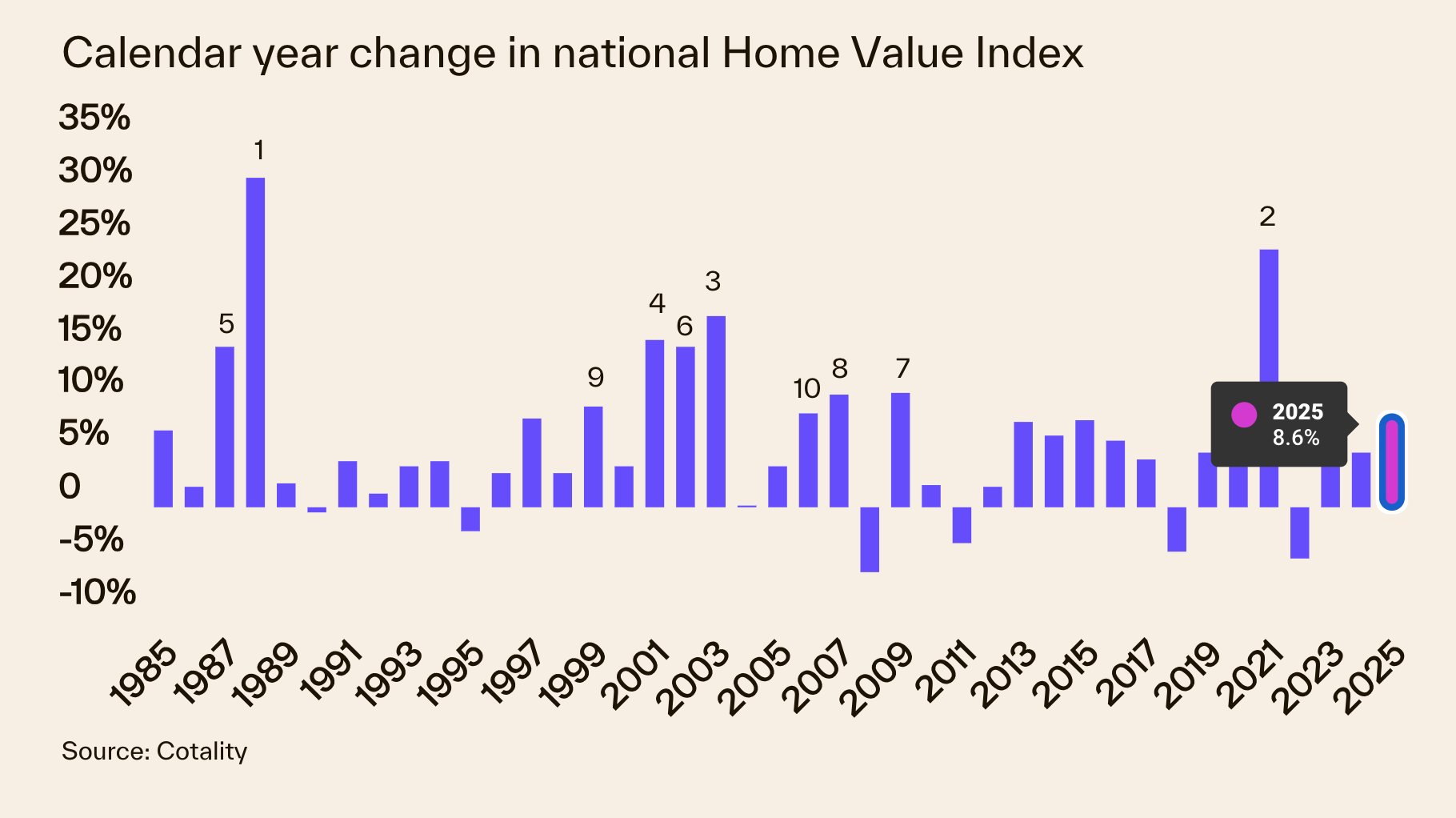

Sounds great, right? But look at December alone, and you'll see something different. Sydney dropped 0.1%. Melbourne fell 0.1%. That was the first monthly decline for both cities in all of 2025. The rest of the country was rising, but the two largest markets began to pull back just as the year ended.
This isn't a random move. This is divergence, and it's been building for years. The gap between winners and losers in this market has never been wider.
Look at the five-year cumulative growth numbers, and the picture becomes crystal clear. Perth is up 89%. Brisbane is up 87%. Adelaide is up 80%. Those are extraordinary gains. Now look at Sydney. Just 36%. And Melbourne? Dead last among all capital cities. It still hasn't recovered to its March 2022 peak. We're talking about a city that's been flat for nearly four years while other markets have been running hot.

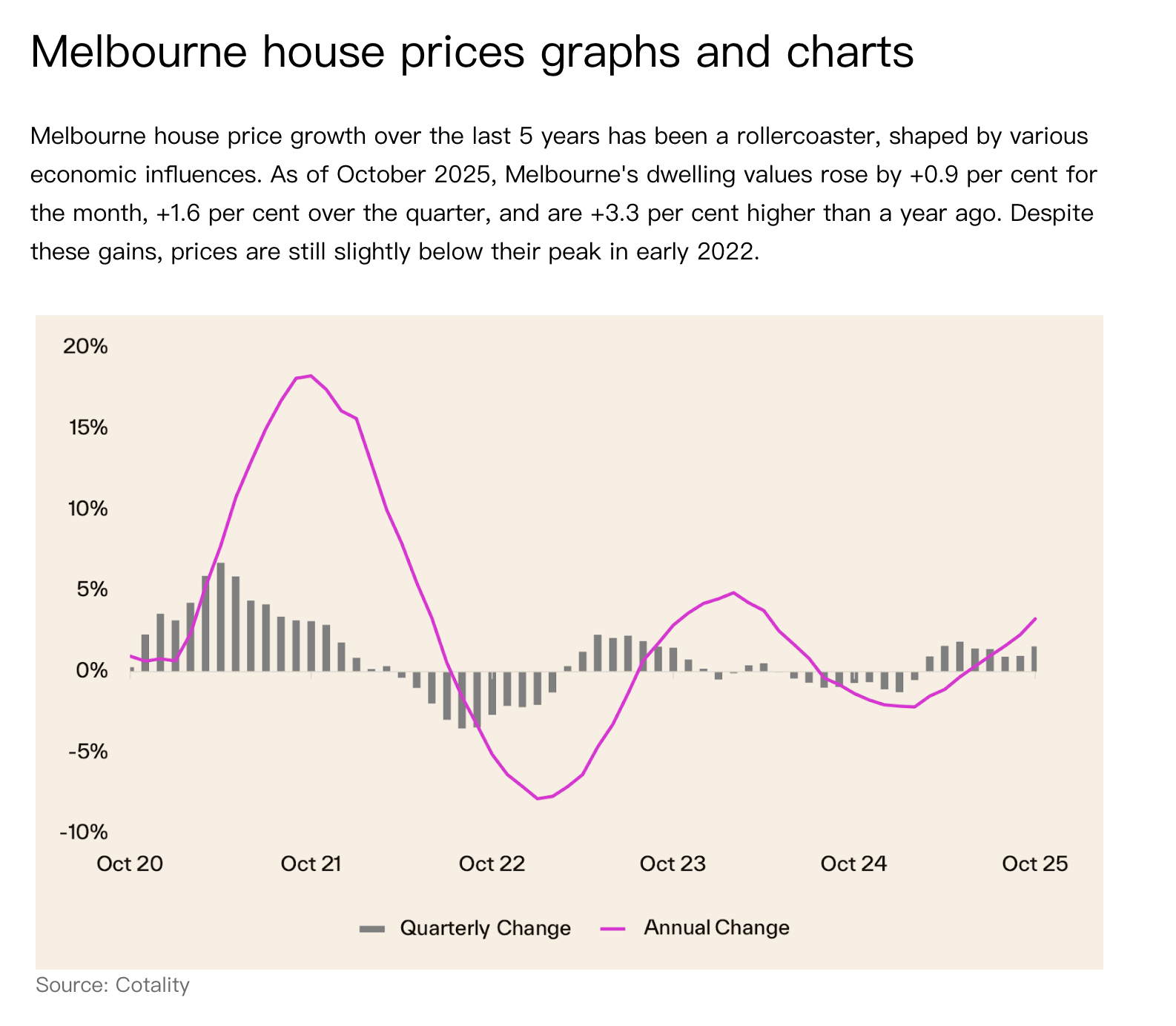
Same country. Same asset class. Same five years. Some investors nearly doubled their money. Others barely moved. And some are still sitting on paper losses, wondering what went wrong.
What made the difference? It comes down to these five mistakes. And the first one might be the most common.
Mistake One: Betting on the Government to Fix Things
You've heard of the National Housing Accord. It's the federal government's big plan to build 1.2 million homes over five years. That works out to 240,000 homes a year. Politicians love talking about it. It sounds impressive in press conferences and budget announcements.
Here's the reality check. On January 14th, 2026, just a few days ago, Master Builders Australia put out a warning. The government is on track to miss its target for the second year in a row.

The year one target was 240,000 homes. The actual number completed? Around 170,000. That's a shortfall of more than 60,000 homes in the first year alone.

To catch up now, they'd need to build 255,000 homes every single year for the next four years. Let me explain why that's basically impossible given the current situation.
First, construction costs have exploded. According to the ABS, building costs in Australia have risen 43% since the pandemic started. Materials are more expensive. Labour is more expensive. Land is more expensive. Everything in the supply chain costs more. Building a house today costs almost 50% more than it did just three years ago. That's not a small increase. That fundamentally changes the economics of development.
Second, the construction industry has been gutted by insolvencies. Around 7,000 building companies have gone bankrupt in the past three years, according to ASIC data. That's 27% of all business failures nationwide, the highest proportion of any industry. The capacity that existed five years ago no longer exists. You can't build 255,000 homes a year when a quarter of your builders have gone broke.
Third, land prices have gone through the roof. The UDIA reports that median lot prices in capital cities have jumped 39% since 2021. In Perth specifically, land prices rose 38% in a single year. When developers can't afford to buy the land, they won't build anything on it. The numbers don't work.
Fourth, we're facing a massive labour shortage. HIA data shows we need an additional 83,000 construction workers to hit the government's targets. We can't find them. Construction wages are already growing at nearly double the national average, and it's still not enough to attract enough workers into the industry.

So here's what you need to understand. Politicians announcing housing targets doesn't mean houses actually get built. Press releases don't pour concrete. Budgets don't install roofs. The supply shortage in Australia is structural. It's not something that's fixed by changing the numbers in a spreadsheet. If you're waiting for the government to solve this problem and push prices down, you might be waiting until you're ready to retire.
Mistake Two: Waiting for the Crash
I know many people have this fantasy. Property prices crash 30 or 40 per cent, you swoop in at the bottom, buy everything cheap, and become wealthy overnight. It's a compelling story. It's also a story that has never played out in the Australian market.
Here's a hard truth. Every single person who has predicted an Australian property crash over the past 20 years has been wrong. Not some of them. All of them.
In 2008, economist Steve Keen famously predicted prices would fall 40%. After the GFC hit, prices dipped briefly, then kept climbing. He lost a public bet and had to walk from Canberra all the way to Mount Kosciuszko wearing a t-shirt that read "I was hopelessly wrong on house prices." It became one of the most famous moments in Australian economics. He still has a YouTube channel, and honestly, his message hasn't changed much. There's always a fresh crop of viewers ready to hear that a crash is coming.

In 2014, American forecaster Harry Dent visited Australia and confidently predicted Sydney prices would collapse by 55%. Since then, Sydney has risen more than 30%. I'm sure he sold plenty of books and got lots of attention at the time. But the people who believed him and stayed out of the market? They missed out on substantial gains.

In 2016, 60 Minutes ran a major segment featuring researcher Jonathan Tepper, who predicted a 30 to 50 per cent crash was coming. The following year, Sydney and Melbourne continued surging higher, as if that episode had never aired.
In 2018, the same program ran a piece called "Bricks and Slaughter," predicting property would crash 40 to 45 percent within 12 months. Prices did fall, about 10 to 15 percent, then started recovering in the second half of 2019.
In 2020, the pandemic arrived. Countless commentators said the property market was finished. The economy was shutting down, unemployment was spiking, and prices would surely collapse. What actually happened? In 2021, national prices surged 24%, the biggest annual gain on record.
Between 2022 and 2023, people warned about the mortgage cliff. Interest rates were rising so quickly that there would be mass defaults and forced sales. Prices pulled back 5 to 8 per cent, then hit new all-time highs in 2024. And 2025 added another 8.6% on top.
Why do these predictions keep failing? Because the people making them don't understand the structural features of the Australian market.
The housing shortage is real and persistent. We're currently about 200,000 to 300,000 homes short of what we need, and the gap is widening, not shrinking. Migration continues flowing in. Net overseas migration for the 2024-25 financial year was 306,000 people. Around 80% of new arrivals settle in the capital cities. They rent first, then eventually buy. Demand doesn't stop.
Unemployment stays low at around 4.3%. That's nowhere near the 10% plus that America experienced during the subprime crisis. Without mass unemployment, you don't get mass forced sales.
And APRA maintains strict lending standards. Australian banks run stress tests and serviceability buffers that American lenders never had to deal with. A subprime-style collapse is structurally very difficult to replicate here.

If you're still holding out for that crash, I'd suggest you reconsider your strategy. This is exactly why we emphasise the 541 Rule. When it comes to investment success, timing only accounts for 10% of importance. Location accounts for 50%. And the holding period accounts for 40%. Instead of wasting energy trying to pick the perfect moment to buy, spend that energy figuring out where to buy and how long to hold.

If you have any questions about property investment, please book a free discovery call on our website. If you want a team offering one-stop service to help you build a property investment portfolio, achieve financial freedom and retire early, join our VISION Gold Membership starting with a 30-minute discovery session. Or to keep it simple, our data-driven buyer's agency service can help. We buy and manage properties for our clients anywhere in Australia. If you have an international view, talk to us about the UAE VISION Gold Membership. We help you invest in the UAE property market, plan your tax residency, reduce your taxes to almost 0 and handle CRS/AML auditing. Links to the service are in the description below.
Mistake Three: Believing Subsidies Are Helping You
On October 1st, 2025, the First Home Guarantee scheme went through a major expansion. Previously, there were strict limits. 35,000 spots available per year. Income caps of 125,000 for individuals and 200,000 for couples. In Sydney, the property price ceiling was 900,000 dollars.
After the changes? No more quota limits. No more income restrictions. The Sydney price cap jumped from 900,000 to 1.5 million dollars.
On the surface, that sounds fantastic. The government helps you skip paying LMI, potentially saving you tens of thousands of dollars upfront. It makes buying seem more accessible.
But think about what's actually happening here. If more people can now afford to enter the market as buyers, and the number of properties for sale hasn't increased, what's the result? Prices rise faster. That's basic supply and demand.
According to Housing Australia, the scheme has now helped more than 230,000 people purchase property since it launched. In the 2024-25 financial year alone, over 61,000 people used it. Market coverage expanded from 33% to 63%.

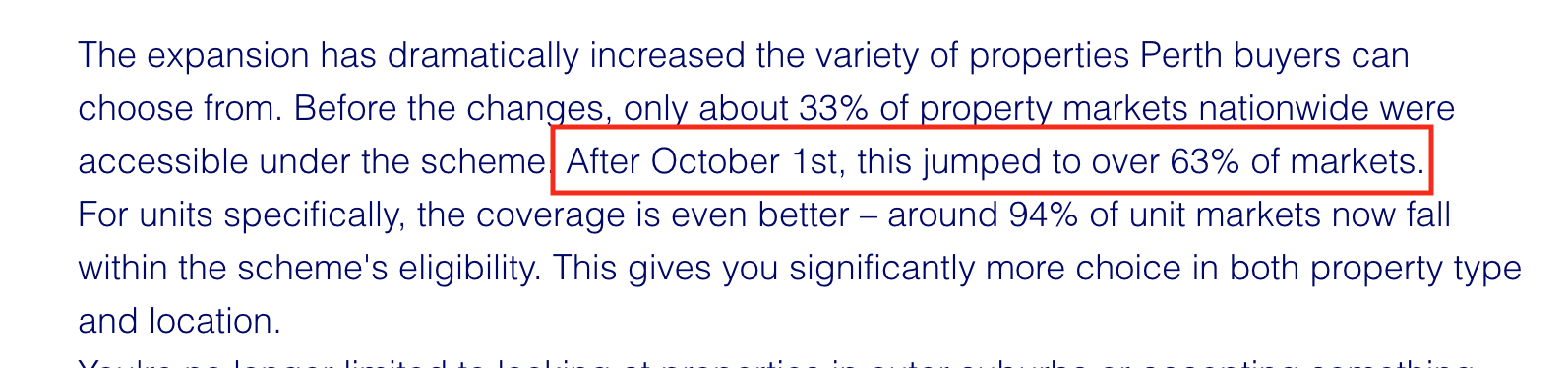
Before, roughly one-third of properties in Sydney were within your potential reach. Now it's two-thirds. That sounds like progress until you realise that everyone else got the same expansion. More buyers competing for the same limited number of homes doesn't help you buy. It helps you compete. And more competition drives prices higher, which is the opposite of what most people hoped these schemes would achieve.
Then there's the Help to Buy scheme that launched in December 2025. Under this program, the government can contribute up to 40% of your deposit, and you only need to come up with 2% yourself.
The Australian Financial Review quoted several economists who were quite direct about what this means. In a market where housing supply is constrained and construction costs remain elevated, these demand-side schemes only add more buyers to an already crowded market. They don't create any additional housing.

So the government can't build homes fast enough, but keeps rolling out programs that make it easier to buy them. Less supply. More demand. You don't need advanced economics to figure out where that leads.
Mistake Four: Only Looking at Sydney and Melbourne
Here's the number that should make you rethink your entire approach. Over the past five years, Perth property prices rose 89%. Sydney rose 36%. That's a gap of 53%.
Let's put that in real money terms. If you bought a million-dollar property in Perth five years ago, it's now worth about 1.89 million. If you bought a million-dollar property in Sydney at the same time, it's worth about 1.36 million now. That's a difference of 530,000 dollars. For many people, that's several years' worth of their salary just because they chose the wrong city.
Why did the markets diverge so dramatically? Sydney and Melbourne are primarily service-based economies. Their property markets respond mainly to interest rate cycles and international capital flows. When rates go up, these markets typically slow down first.
Perth, Brisbane, and Adelaide are resource-based economies. Their markets respond to mining cycles and commodity prices. Over the past few years, iron ore, lithium, and natural gas have traded at elevated prices. Mining investment has been strong. And since the pandemic, there's been significant population movement from Sydney and Melbourne toward the west and north. Demand in the resource cities has been exceptional.
The vacancy rate data tells the same story. SQM Research December 2025 figures show Perth at 0.7% vacancy, Adelaide at 0.8%, and Hobart at just 0.4%. In markets that tight, landlords have massive bargaining power. Finding tenants is effortless.

Meanwhile, Melbourne sits at 2.0%, the highest vacancy rate of any capital city. When vacancy is that high, rents struggle to grow, which means investment returns underperform.
But here's the pattern I've seen repeatedly. Investors based in Melbourne tend to only consider buying in the same city. They know the area, they live there, so they invest there. Data suggests only about 10% of Melbourne-based investors look interstate when buying investment property.
That geographic bias meant 90% of those investors completely missed the strongest gains of this property cycle. This is precisely why we developed the Golden 21 Rules framework. When evaluating suburbs and properties, you need to examine 21 different dimensions. Population growth, vacancy rates, rental yields, bank lending appetite, infrastructure projects, and employment trends. And you need to apply that analysis across the entire country, not just the suburbs you happen to drive through on your commute.
Mistake Five: Getting the Interest Rate Cycle Wrong
Last week, RBA Deputy Governor Andrew Hauser made a statement that sent ripples through the market. He said the rate-cutting cycle has very likely already ended.
Let's step back and look at what happened throughout 2025. The RBA cut rates three times during the year, moving from 4.35% down to 3.60%. That's a total reduction of 75 basis points. At the time, plenty of people thought this was the beginning of an extended cutting cycle. They assumed prices would keep rising and decided it was time to jump in with maximum leverage.

But from September onwards, something changed. Four consecutive meetings, and the RBA made no moves. November, no change. December, no change. Rates have stayed the same at 3.60%.
The reason? Inflation remains above 3%. Hauser was direct about it. He said it's still too high. The RBA's target band is 2% to 3%, and we haven't reached it yet.

What makes the current moment particularly interesting is that the four major banks are completely divided on what happens next. CBA is forecasting a 25 basis point hike in February, which would take rates to 3.85%. NAB is even more aggressive, predicting rate increases in both February and May, ending at 4.10%. But ANZ and Westpac both predict rates will stay exactly where they are.

Two major banks say rates are going up. Two say they're staying flat. All four institutions have teams of professional economists analysing the same data, and they've reached completely opposite conclusions. Who's right? The honest answer is nobody actually knows.
But here's what we can observe with certainty. The banks have already started moving. Canstar data shows that 34 lenders have raised their fixed interest rates in recent weeks. A month ago, 43 different lenders were offering fixed rates below 5%. Today, only 29 still do. That window is closing quickly.


I've watched the same mistake play out countless times. When rates are high, people get scared and decide to wait. "I'll buy when rates come down." I've heard that line more times than I can count. Then rates actually drop, they think opportunity has finally arrived, and they leverage up to the maximum the bank will allow. If rates then tick back upward, their repayments surge, cash flow collapses, and they find themselves in serious financial stress.
Roy Morgan data shows that by November 2025, 24.7% of mortgage holders were already in the stress category. If the RBA raises rates by 25 basis points in February, an estimated 41,000 additional households will join them.

The reality is that nobody can predict interest rates with complete accuracy. The central bank itself doesn't always get it right. So don't build your entire investment strategy around trying to guess what rates will do. Focus on what you can control. Manage your leverage responsibly. Ensure your cash flow can handle some volatility. Don't put yourself in such a fragile financial position that one unexpected move knocks everything over.
What Should You Actually Do in 2026?
This is my honest suggestion on what you should do in 2026.
First, stop waiting for a crash. Apply the 541 Rule to your thinking. Location matters five times more than timing does.
Second, look at the entire country when you're evaluating opportunities. Use a systematic framework like the Golden 21 Rules to compare markets properly. Don't limit yourself to buying in the city where you happen to live.
Third, pay close attention to vacancy rates. Focus on cities where vacancy sits below 1%. Right now, that means Perth, Adelaide, and Hobart. Rental markets in these locations are exceptionally tight.
Fourth, manage your leverage carefully. Keep your total debt-to-income ratio under five times. Maintain at least six months of mortgage repayments in reserve cash.
Fifth, get your loan pre-approval done now. Lending policies and borrowing criteria can change quickly. Lock in your borrowing capacity before any potential rule changes come through.
Sixth, if you want a fixed rate, make a move soon. Thirty-four lenders have already increased their fixed rates. The favourable prici ng window is narrowing week by week.
Watch the video version of the blog on YouTube.
15 Minutes Free Consultation (Limited-Time Free Offer)
If you have any questions about Australian real estate, we invite you to use our 15 Minutes Free Consultation service. Once you have filled in the form, a professional property investment strategist will be in touch with you. They will assess your needs and provide fundamental advice. This service is designed to help answer general property-related queries. BOOK NOW.
VISION Membership
Our Flagship Service: VISION Membership. Your One-Stop Property Investment Manager – Build a Tailored Portfolio and Achieve Financial Freedom
Whether you're an employee, a professional, a business owner or even a new migrant, everyone has a financial goal for the future. The VISION Membership is designed to solve all the pain points in your Australian property investment journey through one single, comprehensive service.
By analysing your current financial situation and long-term goals, we'll tailor a property investment plan just for you. Our team will match you with the ideal mortgage structure, tax strategies, wealth planning, and legal support, empowering you to go further, faster, and smarter on your path to financial freedom.
VISION Membership is perfect for busy individuals who want a professional team to create, expand and manage their Australian investment portfolio. If you're looking for a dedicated team, including real estate investment experts, mortgage brokers, accountants, financial planners, and property solicitors, VISION Membership is your ideal solution.
Start with an obligation-free 30-minute discovery session on Zoom. BOOK NOW.
VISION Buyer’s Agent
No time for inspections? Tired of dealing with pushy selling agents? Unsure how much to offer or feeling nervous about auctions? Worried about buying the wrong property? If any of these sound like you, AusPropertyStrategy's Australia-wide VISION Buyer's Agent Service is here to help.
We provide end-to-end support to help you build an optimised property portfolio and achieve your financial goals—whether you're investing interstate, refinancing, or planning post-settlement leasing or resale. Our services cover everything from suburb research and property selection, to price negotiation, auction bidding, and post-settlement support.
Start with an obligation-free 30-minute discovery session on Zoom. BOOK NOW.
real estate australia,real estate investing,australian property,australian housing market,australian economy,australian property investment,australian property market,buying property,australian real estate,mortgage brokers brisbane,first home buyer,Australian Real Estate,Australian Real Estate Investment,Australian Property Investment,Real Estate Investment,Property Investment,Property Investment Australia,Passive Income,Positive Cash Flow,Australia Real Estate Investing,Australian Real Estate Investors,Australian Property Investors,Vision Wealth Mentors,Vision Real Estate Investors Australia,financial freedom, freedom through property investment,real estate investors,property investment,passive income,positive cash flow,real estate course,real estate courses,real estate training,australian property market,property investment brisbane,property investment sydney,melbourne property market,investing in brisbane,investing in melbourne,how to invest in property,buying properties,start investing in property,property investment strategy,how to buy investment property,property investing tips,best suburbs to invest in sydney,locations real estate,prime location,property growth by suburb,capital growth suburbs


