

93% of Suburbs Falling — Australia’s Property Market Just Got Worse | APS171
Cotality’s August data just dropped, and it’s worse than July. Seven out of eight capital cities are falling. Only Darwin is still holding on. National prices have now fallen for five straight months, down 3.6% from the March peak. Sydney has dropped 7.1% in six months, faster than the 2022 correction. Brisbane, still flat last month, just fell 1% in a single month and has officially tipped into decline.
But here’s the part that really matters. The market has turned. Traders are pricing in two more rate hikes to 4.85%. A few weeks ago, everyone was still talking about when the first cut was coming. The speed of this reversal has caught the market off guard.
If you own an investment property, or you’re thinking about buying one, today’s video is packed with information. Stay with me through to the end.
August: Full-Scale Retreat
August 2026 was a full-scale retreat for property prices across the country.
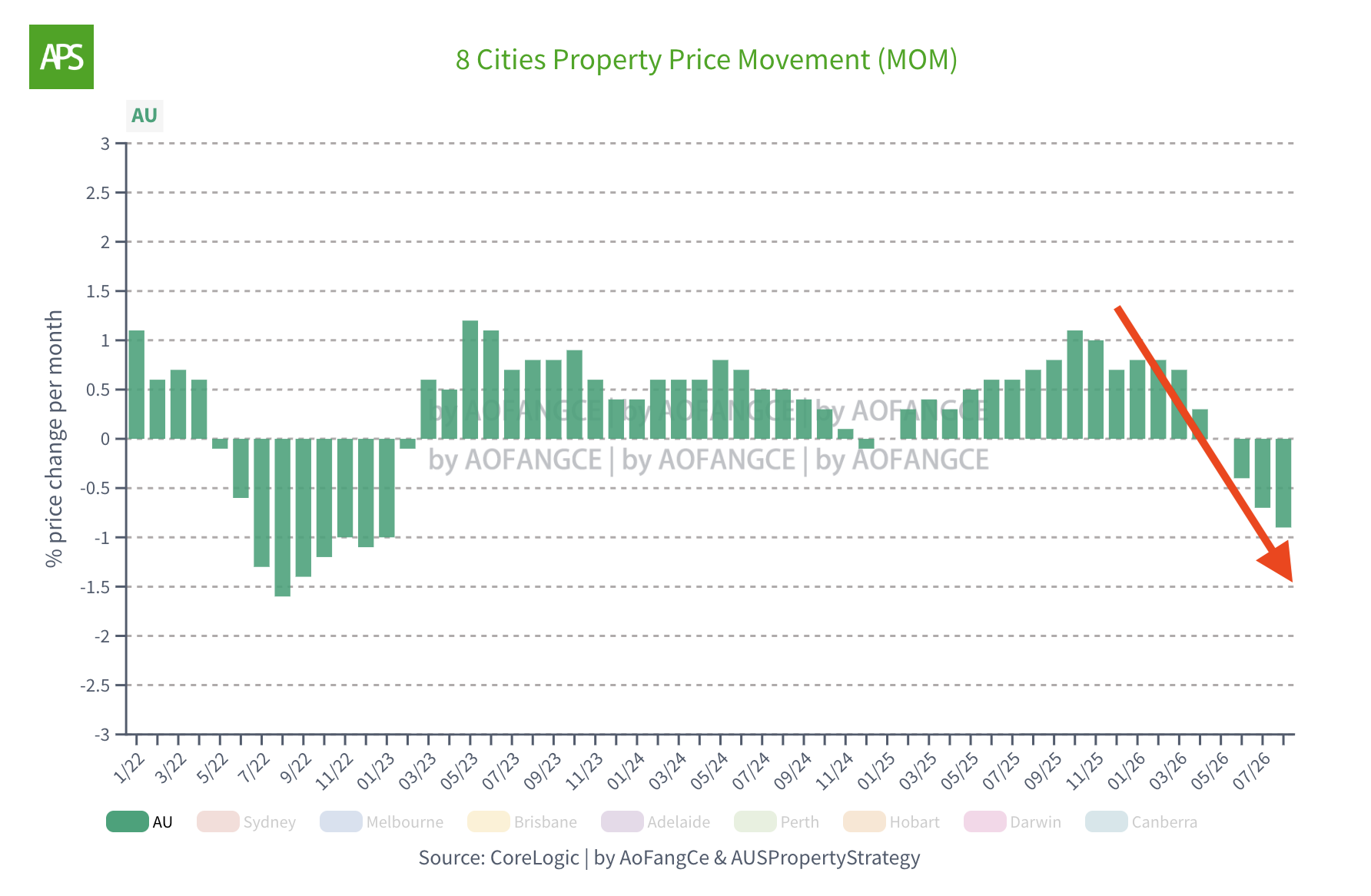
National prices fell 0.9% in August, up from 0.7% in July. The decline is accelerating. Five straight months of falls. The national median has come down to roughly $913,000. From the March peak, prices are off 3.6%. Annual growth has collapsed from over 10% at the start of the year to just 2.7%, almost a fourfold drop.
Now let’s break it down city by city.
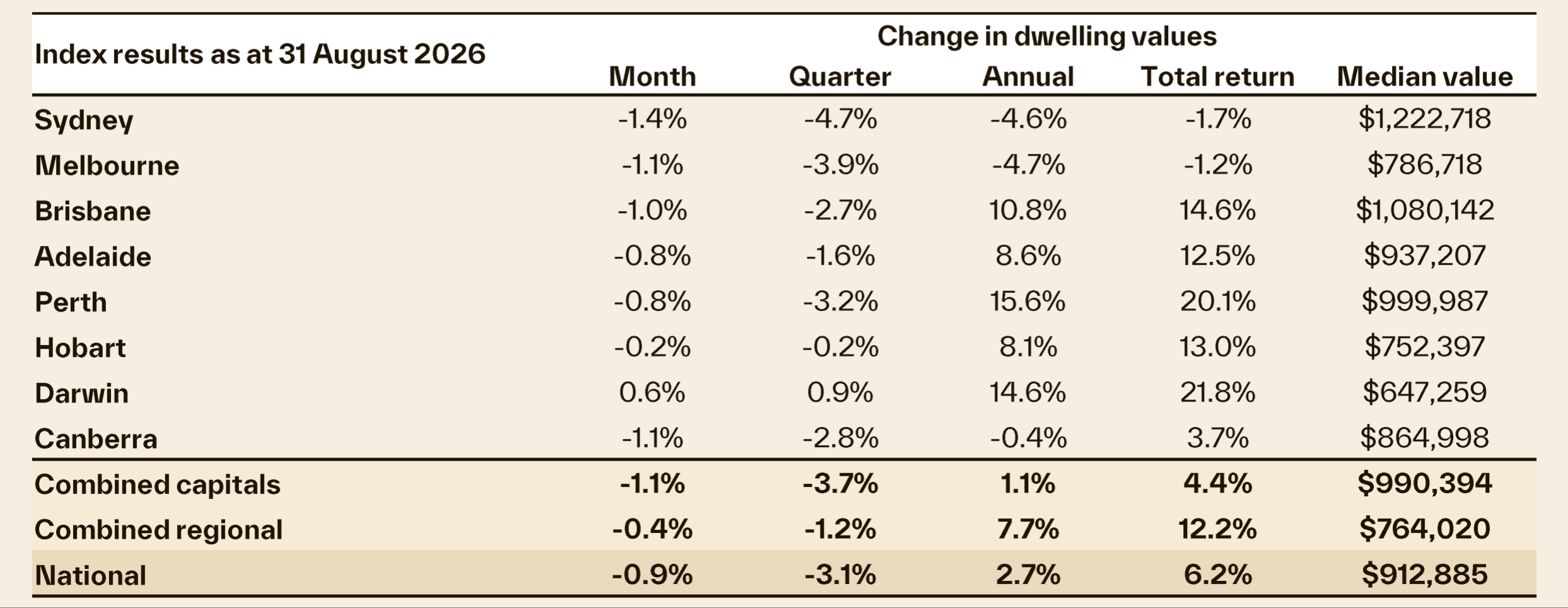
Sydney fell 1.4% in August, sliding since February, now 7.1% below its peak. During the 2022 to 2023 correction, Sydney dropped 6.6% over the same six-month window. This time, it’s falling faster. Sydney is a finance and services city, extremely sensitive to rates. A hike can knock $100,000 off a dual-income household’s borrowing capacity. People who couldn’t afford to buy before are even further away now.
Melbourne dropped 1.1% in August. Since its peak in March 2022, it’s fallen 6.8%, almost four years of going nowhere while Perth and Brisbane roughly doubled.
What really caught my attention was the mid-tier cities. Brisbane fell 1% in August, with a quarterly decline of 2.7%. Last month it was still flat, and a lot of people were asking whether it had officially entered a downturn. I said give it another month or two. Now the data is in. Brisbane has entered a downward cycle.
Adelaide dropped 0.8%. Perth also fell 0.8%, with a quarterly decline of 3.2%. Canberra was down 1.1%, Hobart fell 0.2%. Only Darwin posted a gain, up 0.6% for the month, but at this rate it’ll probably join the rest within a month or two.
What concerns me more than prices is transaction volumes. Total residential sales across Australia are down 15.5% year on year and 11.5% below the five-year average. In Brisbane, Perth, and Sydney, sales volumes have dropped more than 20%. Meanwhile, listings are up 24% year on year and 8% above the five-year average. Properties are sitting unsold while buyers watch from the sidelines. The market has moved into a standoff.
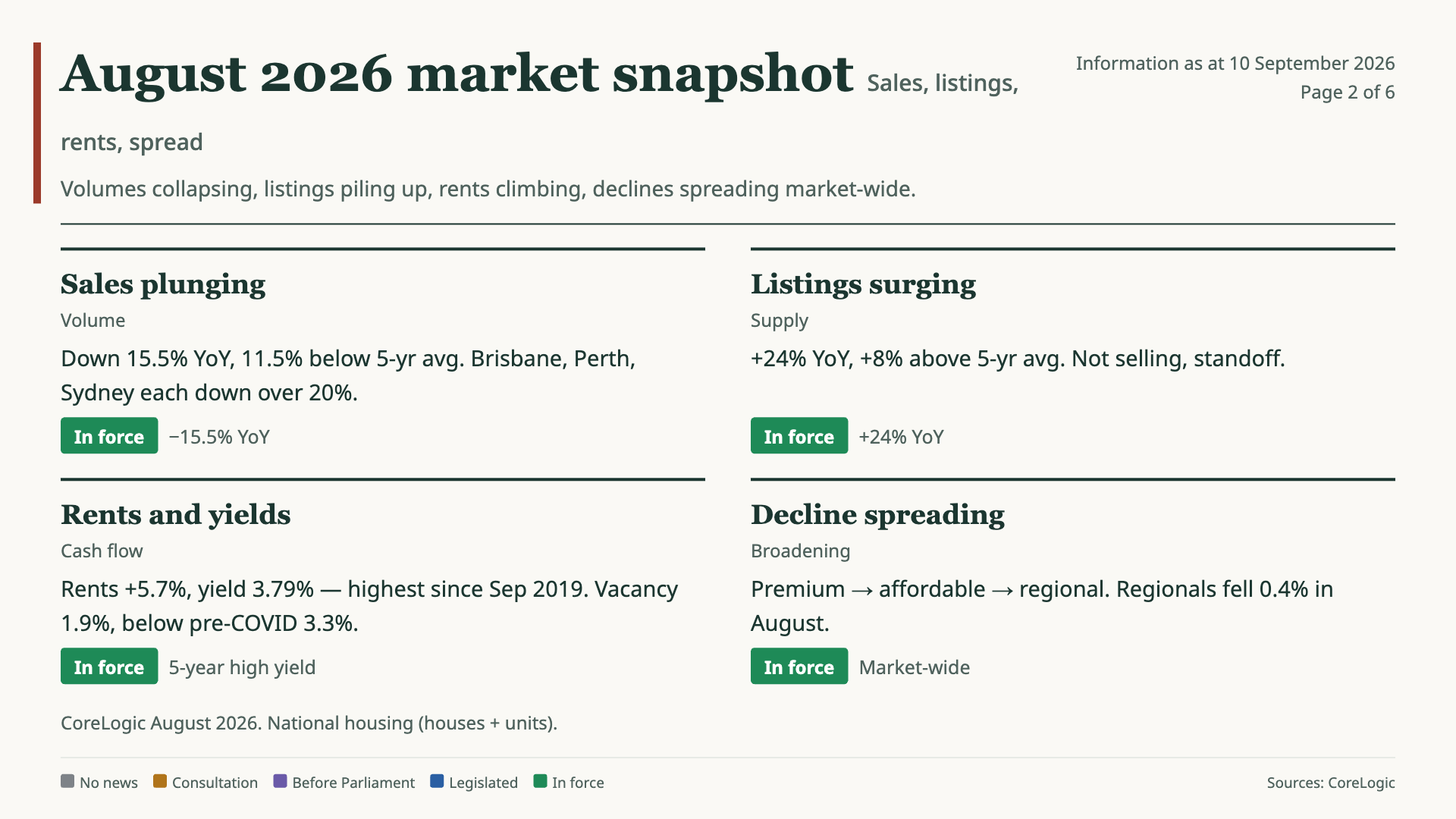
National rents are up 5.7% year on year. Gross rental yields have climbed to 3.79%, the highest since September 2019. Prices are falling but rents are rising, which means cash flow on investment properties is actually improving. Vacancy rates sit at 1.9%, ticking up but still well below the pre-pandemic ten-year average of 3.3%. The top end has been hit hardest, but now the lower end is following. The decline is spreading from premium suburbs to the broader market. Regional areas aren’t immune either, with national regional prices falling 0.4% in August.
The K-shaped market has changed. It used to be mid-tier cities rising while the big two fell. Now the entire market has entered a broad-based downturn. So what’s driving this acceleration?
Economic Headwinds Intensify
Economic headwinds are getting stronger.
The July monthly CPI indicator came in at 3.5% year on year, down slightly from June’s 3.8%. But core inflation, the trimmed mean that the RBA watches most closely, is stuck at 3.6%, unchanged from June. The monthly increase was 0.5%, nearly double what the market expected. Housing costs, up 5% year on year, were the biggest contributor. So headline inflation is coming down, but the number the RBA actually cares about hasn’t moved at all. That’s the worst possible combination for the central bank.
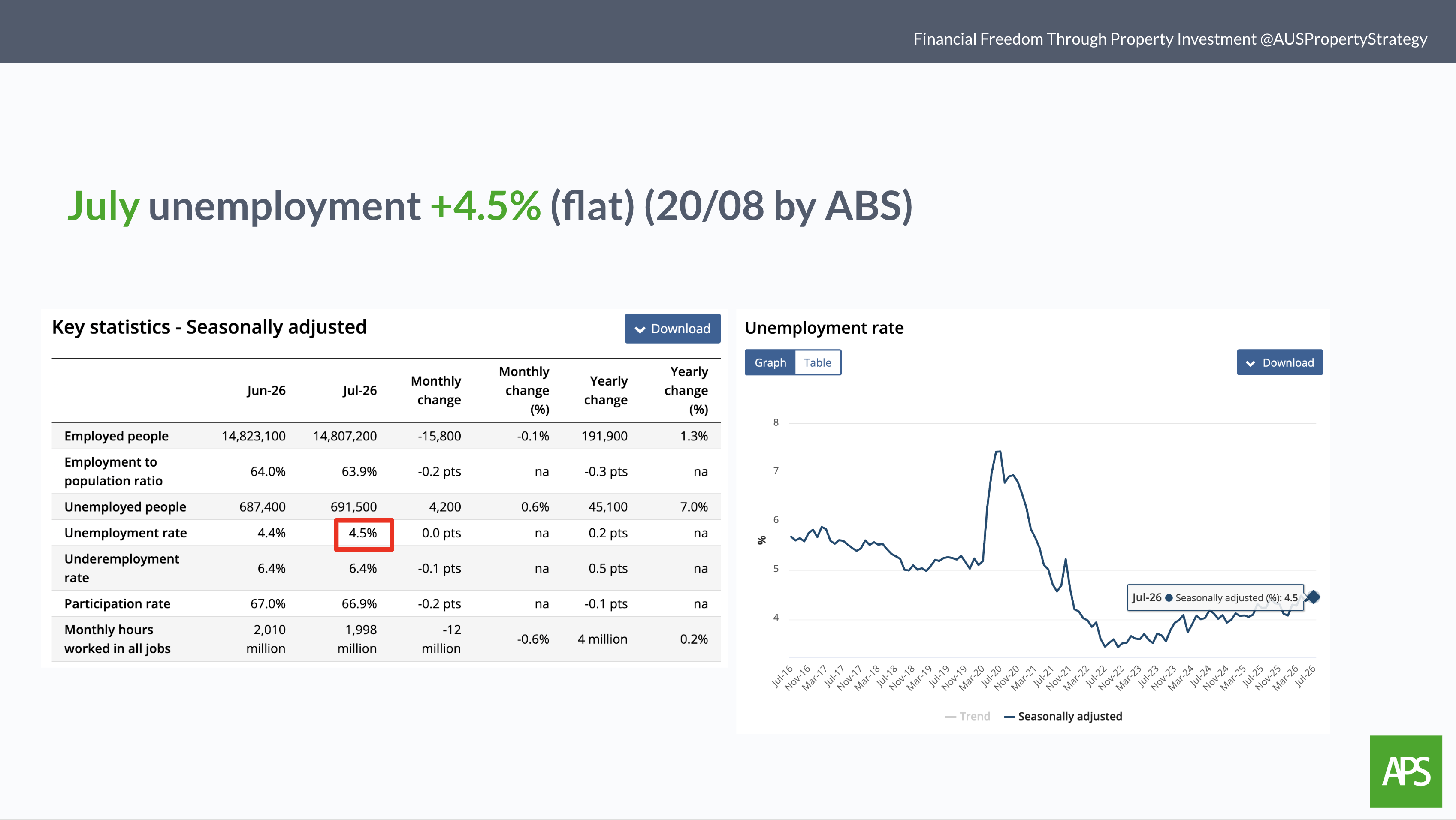
Unemployment rose to 4.5% in July, the highest since November 2021. Employment fell by nearly 16,000. Underemployment climbed to 6.4%, a two-year high, meaning a lot of people have jobs but aren’t getting enough hours. Full-time positions added 16,000, but part-time roles shed 32,000. Businesses are cutting non-core staff first, trimming part-time workers to see if they can still operate.
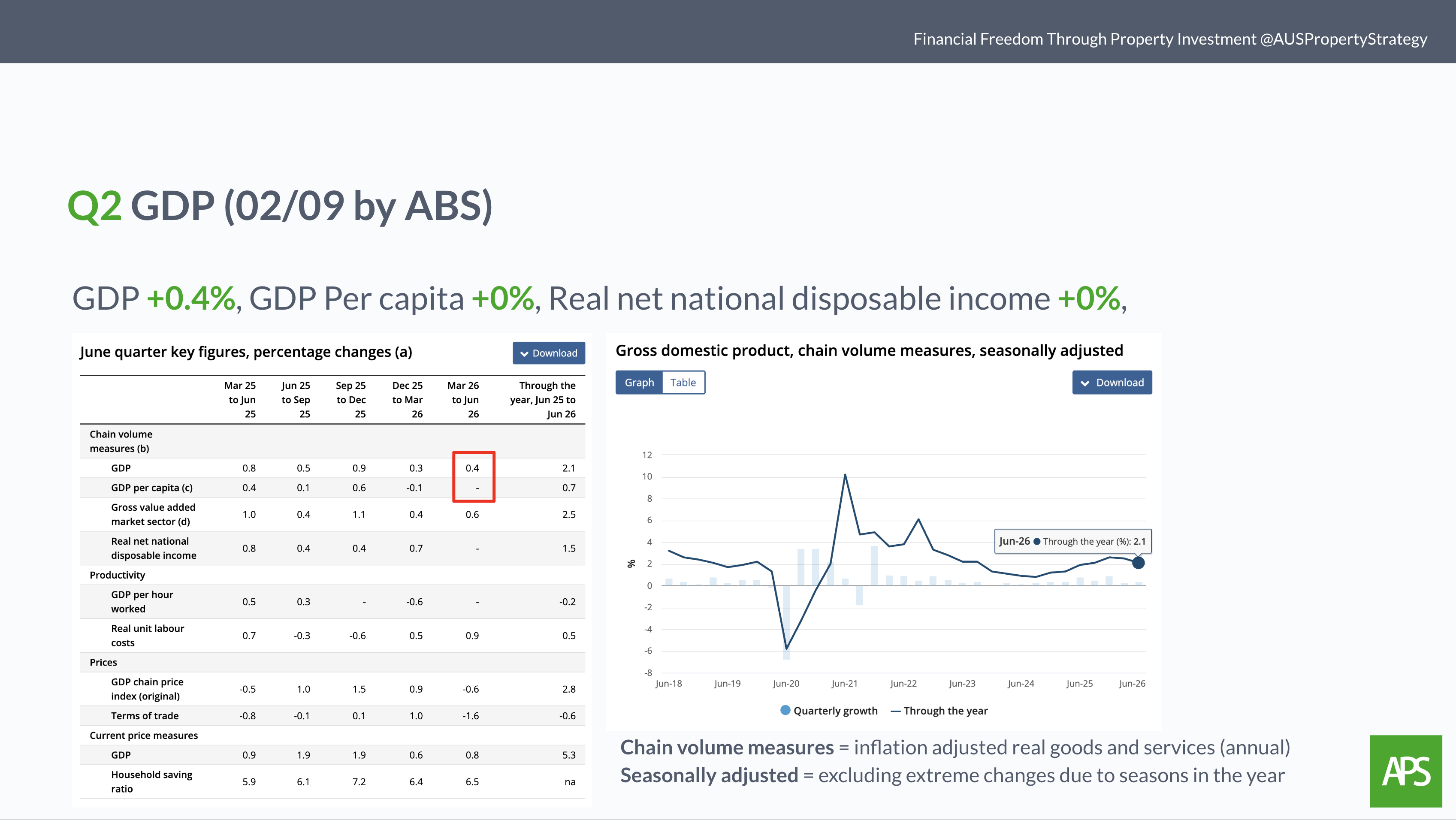
GDP grew 0.4% in the June quarter, 2.1% annualised, released on September 2nd. Slightly better than expected, but still basically flat. Household spending grew 0.4%, which sounds fine until you realise nearly half came from record electric vehicle sales. That’s not consumers spending freely. It’s people switching cars because fuel costs are too high. The savings rate climbed back to 6.5%, meaning people are holding onto their money. Electricity prices came down a bit in July but are still up more than 20% year on year because last year’s energy rebates expired. CBA’s chief economist expects growth to slow to around 1.5% by year end. The economy isn’t collapsing, but the slowdown is real.
Core inflation at 3.6% won’t come down, and the economy isn’t weak enough for the RBA to start cutting. So what will the central bank do? That’s the most important question right now.
Before we keep going — if anything in today's video has you thinking about your own situation, there are two ways to get real answers. A free 15-minute call with one of our property investment strategists — bring your questions, get a straight answer, no strings. Or if you want the full done-for-you path — strategy, lending, property selection, portfolio, tax structure, wealth planning, all of it — book a free 30-minute Discovery Session and see how VISION Gold Membership actually works. Both links are in the description. Alright, let's get back to it.
Rates Could Still Go Higher
Interest rates may still go higher.
On August 11th, the RBA held the cash rate at 4.35%. The good news is they didn’t hike. The bad news is the statement made it clear they’re keeping the door open, with the exact wording “retaining the option of a further increase.” The RBA’s own forecasts show core inflation won’t return to the target midpoint until late 2027 or early 2028. At that point, most people still assumed rates had peaked.
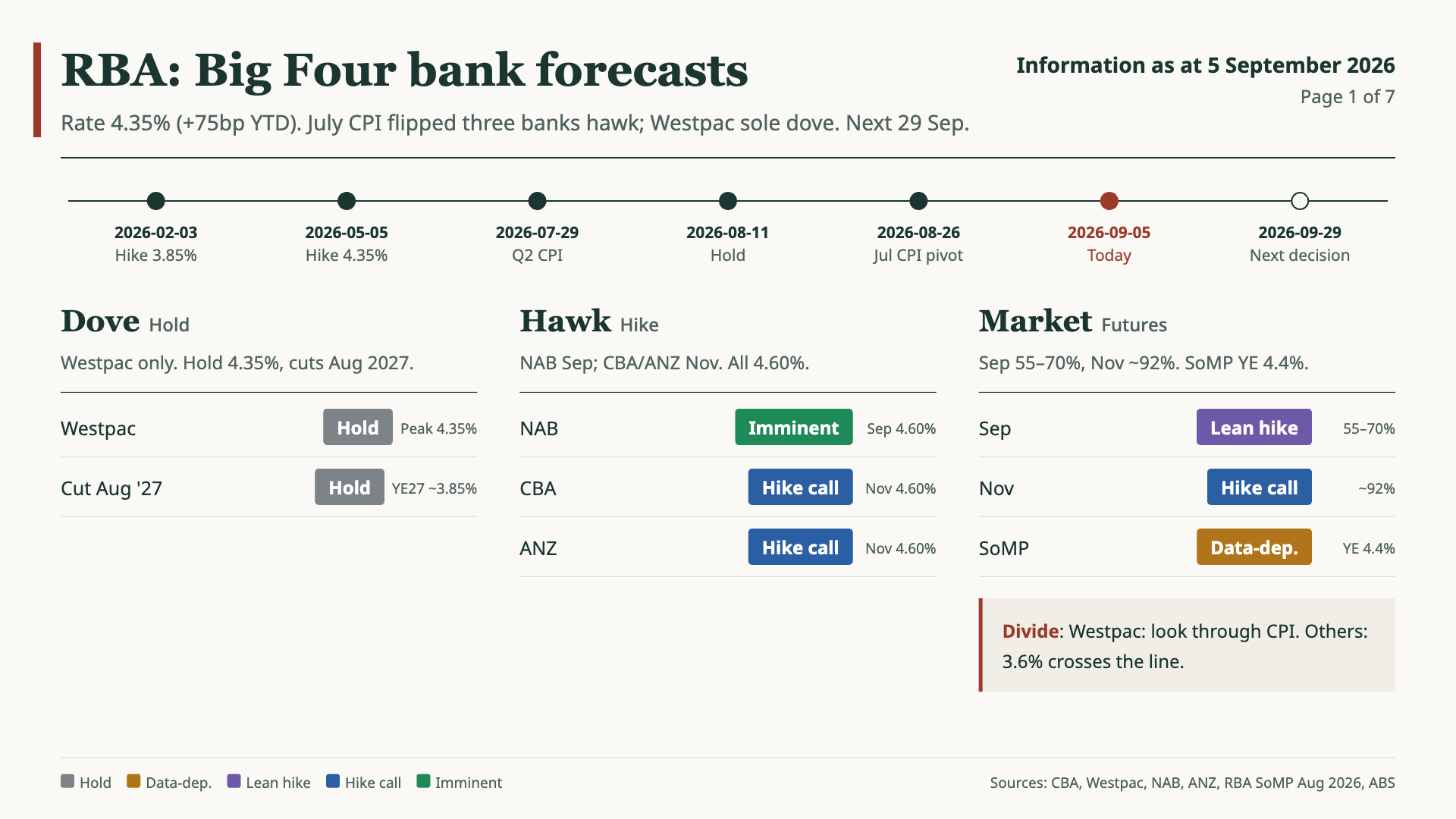
Then the July CPI data dropped, and the mood changed completely. Three of the four major banks rushed to revise their forecasts. NAB called for a hike to 4.6% as early as September. ANZ and CBA said November at 4.6%. Only Westpac held the line on no further hikes. A few weeks earlier, all four were debating when the first cut would come. Now three are saying there’s another hike to go. A 180-degree reversal inside a single month is very rare.
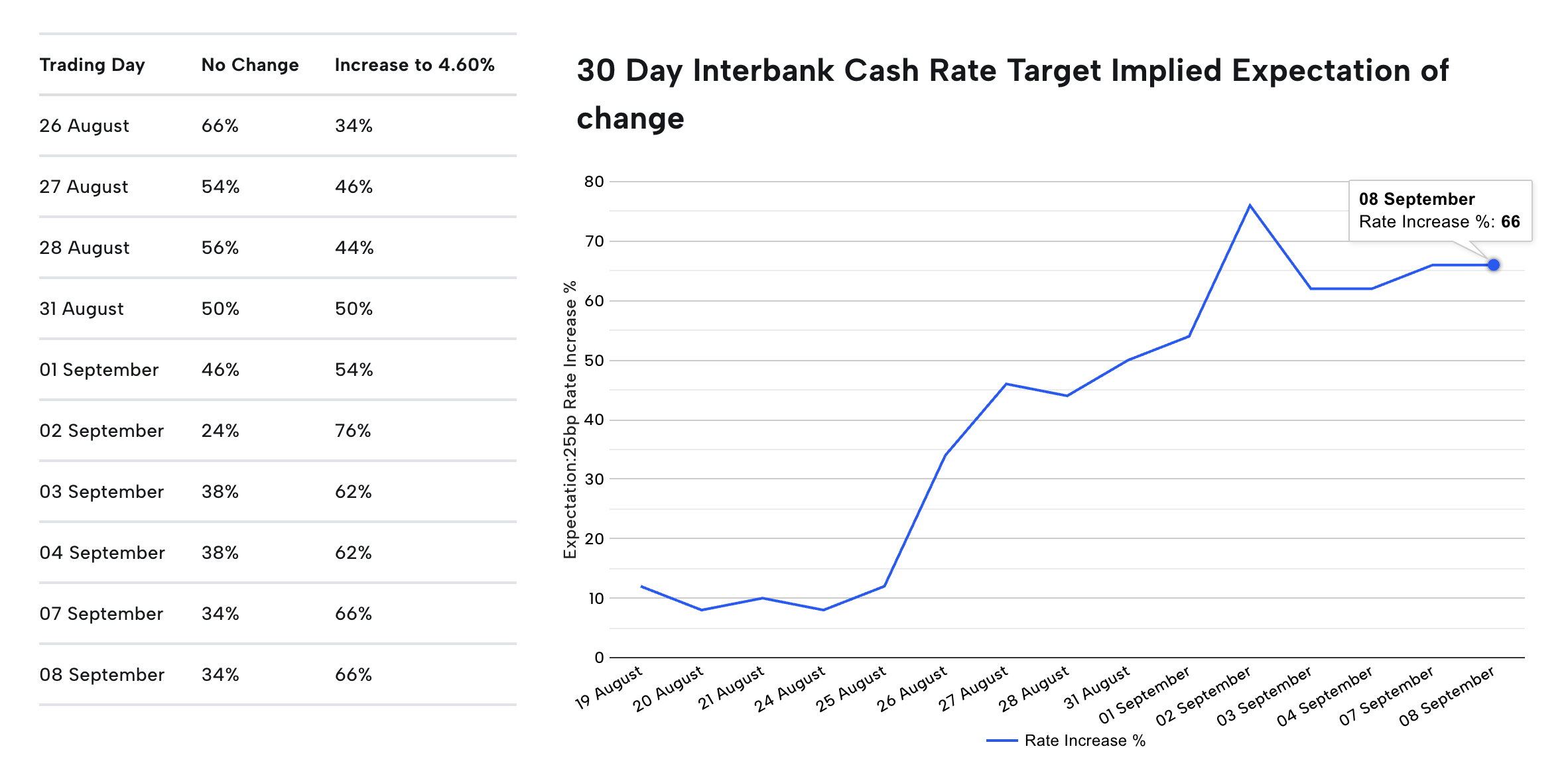
ASX interest rate futures are pricing a 66% probability of a hike on September 29th. If rates hit 4.6%, that’s 100 basis points of tightening from the 2025 low of 3.6%, we are at 4.35% now. For a household with a $1 million loan over 30 years, monthly repayments would be roughly $600 higher than at the low point. Borrowing capacity shrinks further, with a dual-income household potentially borrowing $100,000 to $150,000 less. The market is also pricing in another hike by March next year, with no cut expected until February 2028. These futures-based forecasts change almost daily. If there’s an update, I’ll share it right away.
Interest rates are a short-term variable. They go up, and they come down. But what comes next could change the rules permanently
Tax Reform Lands Fast
Tax reform is landing fast.
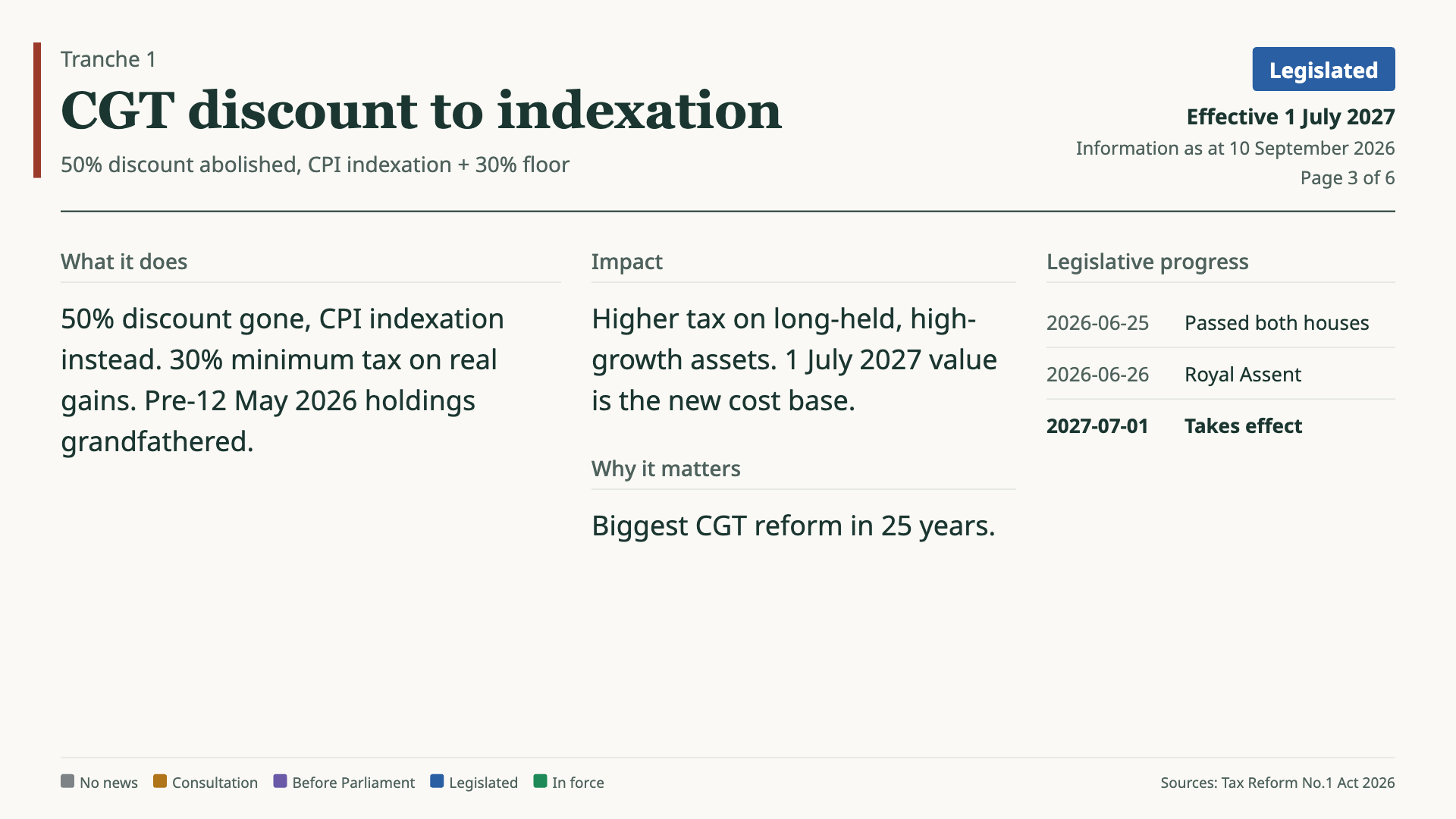
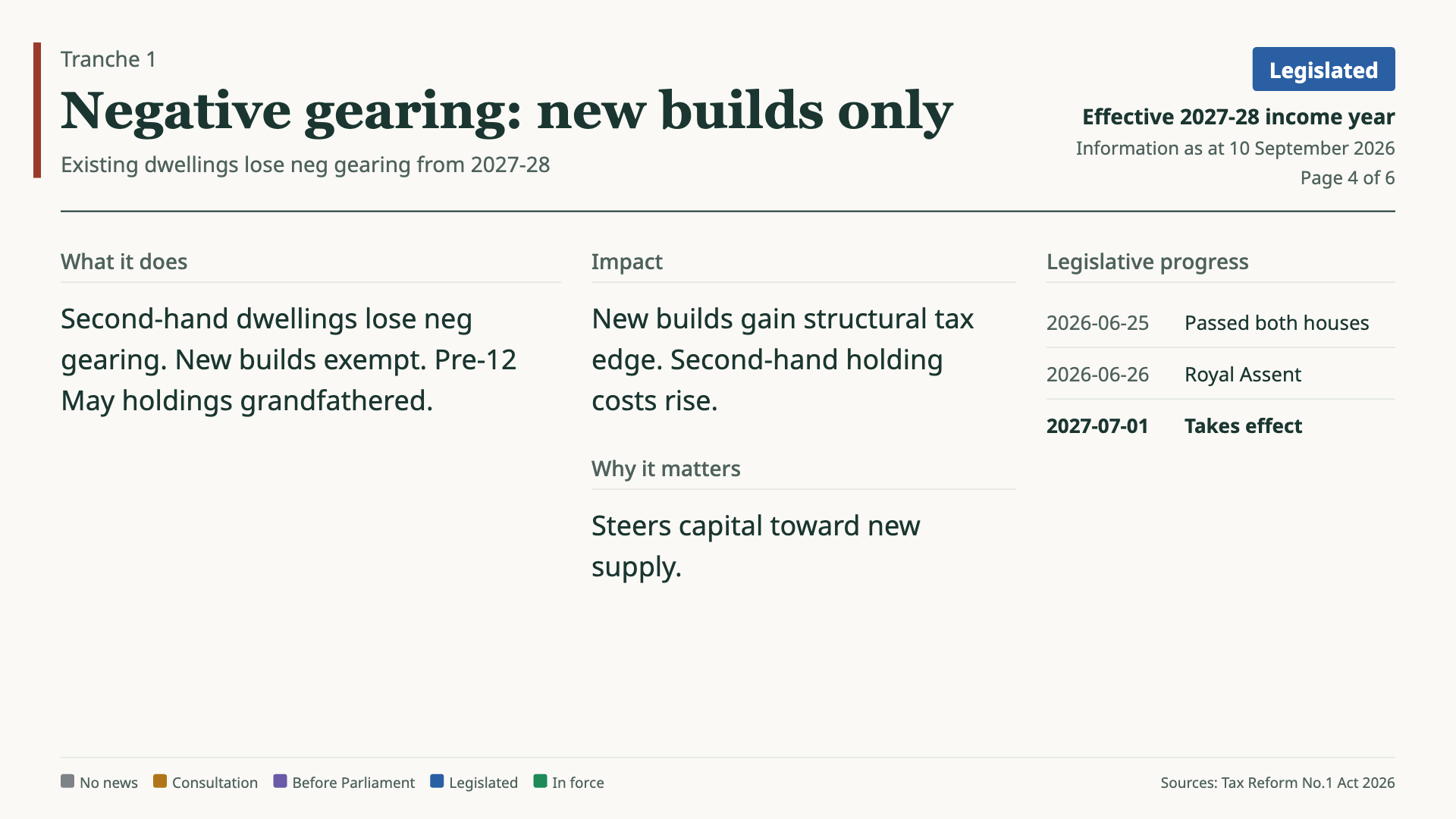
The first wave of negative gearing and CGT reform passed both houses of parliament on June 25th and received Royal Assent on June 26th. It’s now law, effective from July 1st, 2027. Two key changes: the 50% CGT discount is gone, replaced by cost base indexation plus a 30% minimum capital gains tax. Negative gearing on established homes gets restricted, but new builds are exempt. Any investment property held before 7:30pm on May 12th, 2026 is grandfathered under the old rules.
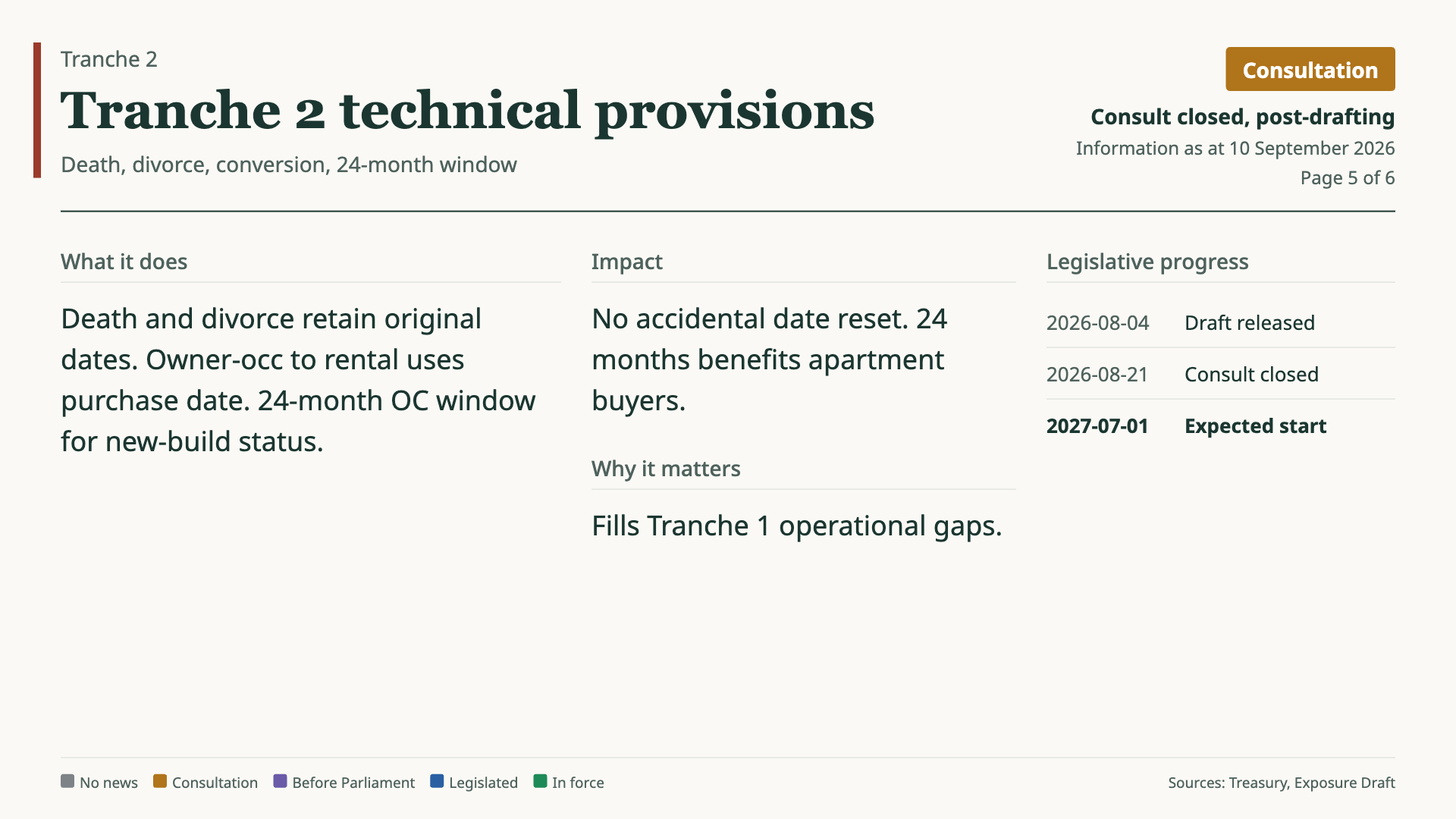
The second wave of draft legislation was released in early August, with public consultation closing on August 21st. It’s still in the drafting stage. This wave deals with technical details. If a spouse dies, the inherited share keeps the original purchase date. In a divorce, if the court awards you your ex-spouse’s investment property, the original timestamp carries over. Owner-occupied homes converted to rentals are assessed based on the original purchase date. Trust rules for new-build CGT concessions have also been clarified. One provision directly affects new property investors: the 24-month window. If you buy from a developer and settle within 24 months of the first occupancy certificate being issued, it qualifies as new, and both the negative gearing and CGT concessions apply. The developer can rent it out during that window.
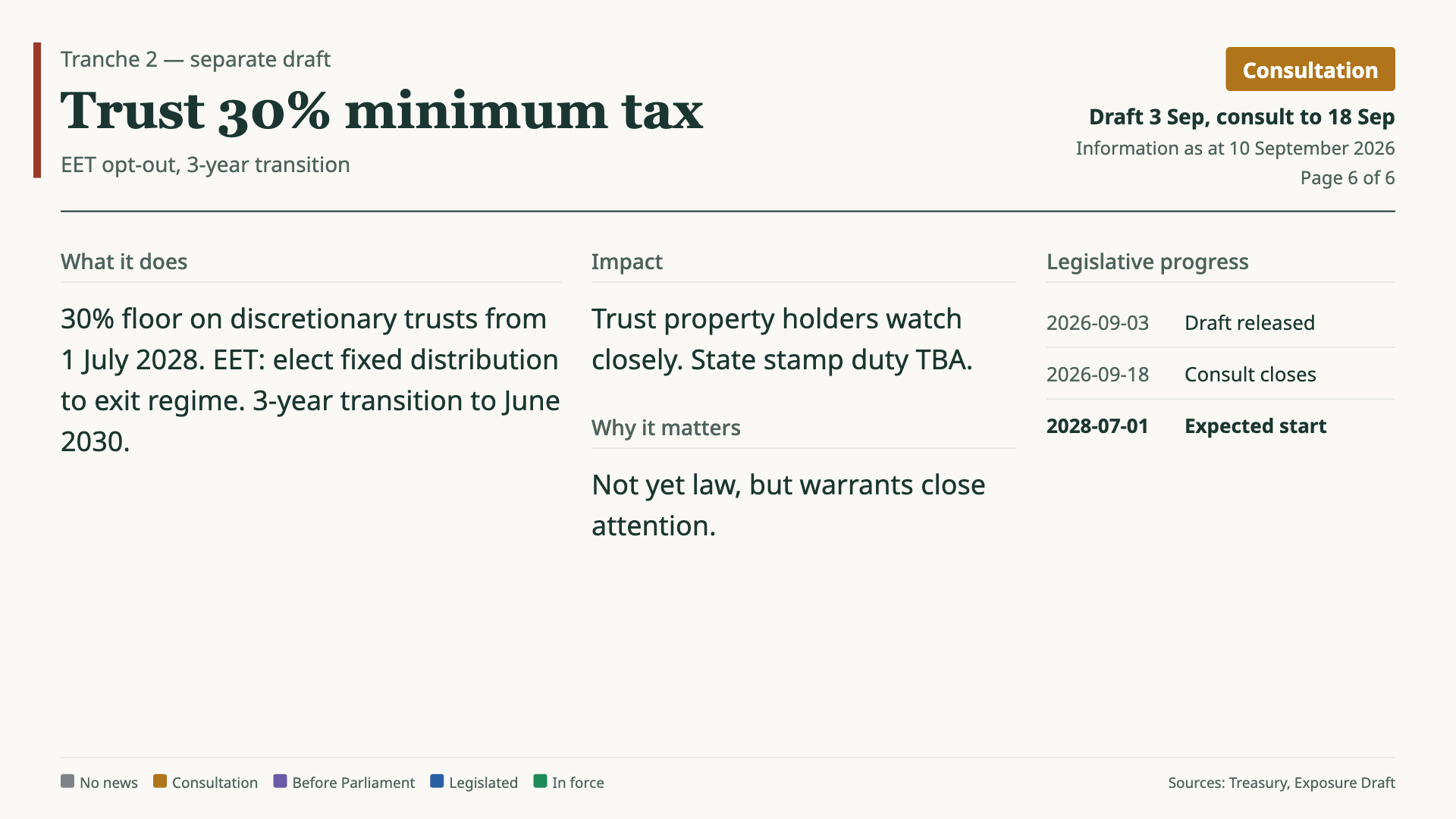
Then there’s the trust 30% minimum tax. Treasury released the draft legislation on September 3rd, with public consultation open until September 18th. It takes effect from July 1st, 2028, and it’s not yet law. The core mechanism is a 30% minimum tax at the trust level. The draft introduces an Excluded Election Trust, allowing certain discretionary trusts to opt out by electing fixed distributions to pre-nominated beneficiaries. No restructure needed, and it doesn’t trigger stamp duty. As long as you distribute to individual beneficiaries at fixed allocations rather than routing income through a bucket company, those beneficiaries won’t be subject to the 30% minimum tax. There’s also a three-year restructure transition from July 2027 to June 2030. If you hold investment property through a trust, this is worth paying close attention to, though how state and territory stamp duty applies during restructuring hasn’t been clarified yet.
Tax reform changes the rules. But the next variable could change who’s playing the game.
The Political Variable
The political picture is shifting.
A late August Newspoll produced a number that surprised a lot of people. One Nation’s primary vote hit 30%, overtaking Labor’s 29% for the first time. The Coalition sat at just 19%. On August 29th, One Nation won a lower house seat in the Secret Harbour by-election in Western Australia, flipping a long-held Labor seat.
A separate DemosAU poll in early September showed One Nation pulling back to 24%, with female voters the biggest source of losses. On two-party preferred, Labor still leads roughly 53 to 47. A lead in primary votes doesn’t mean you can form government. The Victorian state election is November 28th, New South Wales in March 2027, and the next federal election in 2028.
For property investors, One Nation’s most important policy is cutting net overseas migration from 225,000 to 130,000, nearly half. Housing demand, the tenant pool, population growth, all the fundamentals that support prices would be affected. One Nation also wants to scrap net zero, keep coal-fired power stations running, and lift the nuclear ban. If energy policy reverses, construction costs and long-term holding costs could fall. But most of these policies are still at the announcement stage, with no legislation introduced.
What may matter more is the pressure this puts on the two major parties. Even if One Nation never forms government, Labor and the Coalition could tighten immigration under electoral pressure. That’s the real transmission mechanism to the property market.
Rates are expected to rise. Tax reform is landing. Political dynamics are shifting. Three layers of pressure stacking up at once, and the market is genuinely hard to read. But if you zoom out and look at the longer timeframe, you’ll see a very different picture.
When Does the Recovery Come?
Over the past 40 years, national home prices in Australia have only fallen in six years. That’s just 15% of the time. 85% of the time, prices were going up. Every single downturn has been followed by multiple years of sustained growth.
Housing supply remains critically short. Last financial year, building approvals barely crossed 200,000, well short of the National Housing Accord target of 240,000 per year. With unemployment at 4.5%, the vast majority of mortgage holders are still making repayments, so there’s no wave of forced selling coming. Construction costs remain elevated, meaning new supply can’t ramp up quickly. Rental yields at 3.79% are at a seven-year high. Prices are adjusting, and nobody enjoys the process. But the probability of a full-scale crash is, in my view, close to zero.
Three things to take away from today’s video.
First, run your loan stress test at 4.85% or even 5.1%. If rates do hit 4.6% in September, the bank’s assessment rate could land around 5.1%. Don’t budget on the actual rate. Stress test your cash flow against the worst-case scenario.
Second, new-build properties now have an even bigger tax advantage. Negative gearing still applies, the CGT concession still applies, and the trust rules for new builds have been clarified, all favouring new construction over established homes. If you’re considering an investment property, new builds should be at the top of your list.
Third, choose your city based on supply gaps. Every city is adjusting, but recovery speeds will differ. Cities with tighter supply bounce back faster.
Short-term prices go up and down. Long-term, they always go up. The bottom is where panic sellers lose and patient buyers win.
Watch the video version of the blog on YouTube.
15 Minutes Free Consultation (Limited-Time Free Offer)
If you have any questions about Australian real estate, we invite you to use our 15 Minutes Free Consultation service. Once you have filled in the form, a professional property investment strategist will be in touch with you. They will assess your needs and provide fundamental advice. This service is designed to help answer general property-related queries. BOOK NOW.
VISION Membership
Our Flagship Service: VISION Membership. Your One-Stop Property Investment Manager – Build a Tailored Portfolio and Achieve Financial Freedom
Whether you're an employee, a professional, a business owner or even a new migrant, everyone has a financial goal for the future. The VISION Membership is designed to solve all the pain points in your Australian property investment journey through one single, comprehensive service.
By analysing your current financial situation and long-term goals, we'll tailor a property investment plan just for you. Our team will match you with the ideal mortgage structure, tax strategies, wealth planning, and legal support, empowering you to go further, faster, and smarter on your path to financial freedom.
VISION Membership is perfect for busy individuals who want a professional team to create, expand and manage their Australian investment portfolio. If you're looking for a dedicated team, including real estate investment experts, mortgage brokers, accountants, financial planners, and property solicitors, VISION Membership is your ideal solution.
Start with an obligation-free 30-minute discovery session on Zoom. BOOK NOW.
VISION Buyer’s Agent
No time for inspections? Tired of dealing with pushy selling agents? Unsure how much to offer or feeling nervous about auctions? Worried about buying the wrong property? If any of these sound like you, AusPropertyStrategy's Australia-wide VISION Buyer's Agent Service is here to help.
We provide end-to-end support to help you build an optimised property portfolio and achieve your financial goals—whether you're investing interstate, refinancing, or planning post-settlement leasing or resale. Our services cover everything from suburb research and property selection, to price negotiation, auction bidding, and post-settlement support.
Start with an obligation-free 30-minute discovery session on Zoom. BOOK NOW.
real estate australia,real estate investing,australian property,australian housing market,australian economy,australian property investment,australian property market,buying property,australian real estate,mortgage brokers brisbane,first home buyer,Australian Real Estate,Australian Real Estate Investment,Australian Property Investment,Real Estate Investment,Property Investment,Property Investment Australia,Passive Income,Positive Cash Flow,Australia Real Estate Investing,Australian Real Estate Investors,Australian Property Investors,Vision Wealth Mentors,Vision Real Estate Investors Australia,financial freedom, freedom through property investment,real estate investors,property investment,passive income,positive cash flow,real estate course,real estate courses,real estate training,australian property market,property investment brisbane,property investment sydney,melbourne property market,investing in brisbane,investing in melbourne,how to invest in property,buying properties,start investing in property,property investment strategy,how to buy investment property,property investing tips,best suburbs to invest in sydney,locations real estate,prime location,property growth by suburb,capital growth suburbs


