

$80K TAX BOMB IN 40 DAYS. 3 Fatal Mistakes That Will Destroy Your Property Wealth Before May | APS140
In 40 days, the Federal Budget could change how every investment property in this country gets taxed. The Senate report is out, Treasury is modelling the numbers, and the CBA CEO has gone on national TV backing the change. This is not speculation; this is policy in motion. And the number one question I’m hearing from investors is: “Should I sell before the rules change?” I went through the Senate report, Treasury’s modelling, Senator Pocock’s cross-party proposal, all of it. My team ran its own numbers, and we came to one conclusion: 90% of people are focused on the wrong thing.
What’s actually changing isn’t whether property is worth investing in. It’s how you invest from now. Those are two very different questions, and later I’ll show you the gap with a specific set of numbers. After May, a brand new investment logic is taking shape, and if you figure it out before everyone else does, you get first access to the new era.
What’s Most Likely to Change
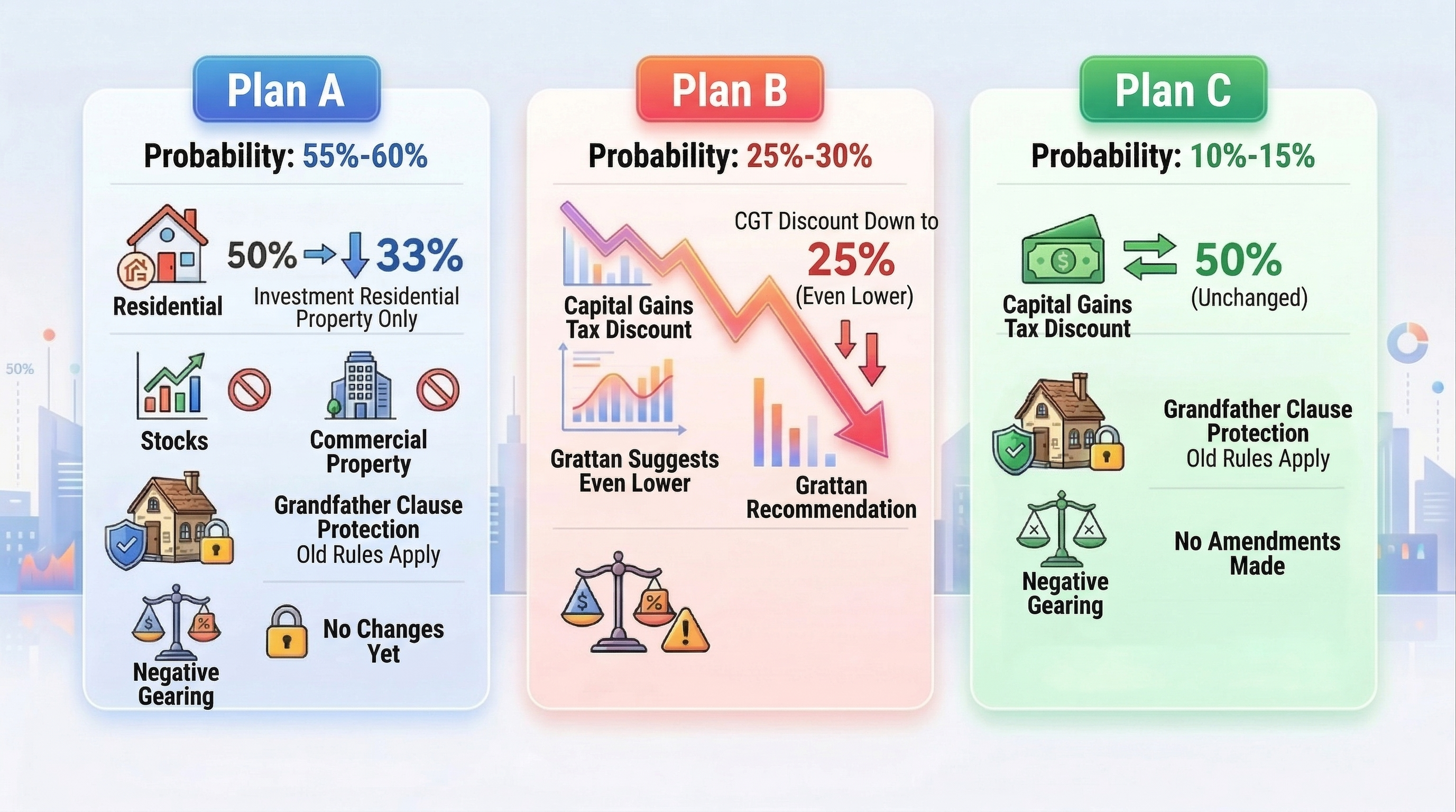
So first things first, what’s the most likely reform going to look like? Pulling everything together, the highest-probability scenario goes like this: the CGT discount, that’s the Capital Gains Tax discount, drops from 50% to 33%, targeting residential investment properties only. Shares, commercial property, untouched. Properties you already own will most likely get grandfathered, meaning your current holdings stay under the old rules. Negative gearing doesn’t get touched. I’m putting this scenario at 55% to 60% probability. Call it Scenario A.
Why so confident? The evidence is right there. Treasury has already been modelling 33%, first reported by the AFR on February 25th, confirmed by Accounting Times two days later. CBA CEO Matt Comyn went on ABC’s 7.30 and said it out loud: “not retrospectively, but going forward.” When this many people are all pointing the same direction, the signal is hard to miss. The Senate inquiry dropped its full report on March 17th, saying in black and white that the CGT discount “biases the housing market towards investors.”
Now let me translate that 33% into real dollars. Right now, if you sell an investment property and pocket a million-dollar profit, you only pay tax on $500,000. Under the new model, you’d pay tax on $670,000. At the top marginal rate of 47%, that’s about $80,000 more tax out of your pocket.
Could the reform go harder? Sure. The Grattan Institute has pushed for 25%, but the odds on that are lower, maybe 25% to 30%. That’s Scenario B. Back in 2019, Labour tried to go after both CGT and negative gearing at the same time, and voters shut it down hard. That lesson is carved deep. No change at all? I’m putting that at 10% to 15%. Scenario C.
So now you know the most likely playbook. But what comes next is the real point of today’s video, because the first reaction most people have after hearing all of that is exactly the kind of mistake that costs them serious money.
Three Fatal Mistakes
Mistake Number One: hearing “reform” and wanting to sell straight away.
Has someone been telling you this week, “Sell now, CGT’s changing, get out”? Stop and Think about it. If there’s grandfathering, your current property still gets taxed under the 50% discount. So what are you rushing for?
But here’s the calculation most people completely miss. Say you’ve got a property worth a million dollars. You sell it now, the new policy drops, turns out it doesn’t even affect you, and you want to buy back in. Agent’s commission, conveyancing, marketing, stamp duty, that round trip costs you sixty to seventy thousand dollars. The extra CGT you were worried about? Maybe thirty to fifty thousand. So to “save on tax,” you panic-sold and panic-bought, and you’re down sixty to seventy grand. That maths doesn’t stack up no matter how you run it.
The right move? Wait until May 12th. See the full policy details, then make your decision. Right now, the only thing you should actually do is get your accountant to model your tax position under both 33% and 25% scenarios. That step costs almost nothing but could save you from a six-figure mistake. Don’t let panic make your decisions for you.
There’s an even more dangerous idea floating around, and I need to deal with it right now.
Mistake Number Two: thinking property investment is no longer worth it.
Look, let’s run the actual numbers. Even if the CGT discount drops to 33%, you’re only paying tax on 67% of your profit when you sell. Your salary income? Nearly all of it hits the tax table. Property still carries a big tax advantage, even after reform.
And the benefits of property have never been just about CGT. You’ve got leverage: you use the bank’s money to capture growth, and it’s the cheapest, highest-quality leverage ordinary people can get. Depreciation: a new build gives you $10,000 to $20,000 in deductions in year one, straight off your taxable income. Negative gearing is most likely staying put. And forced savings: every monthly repayment is money you’re tucking away into an asset that grows over time.
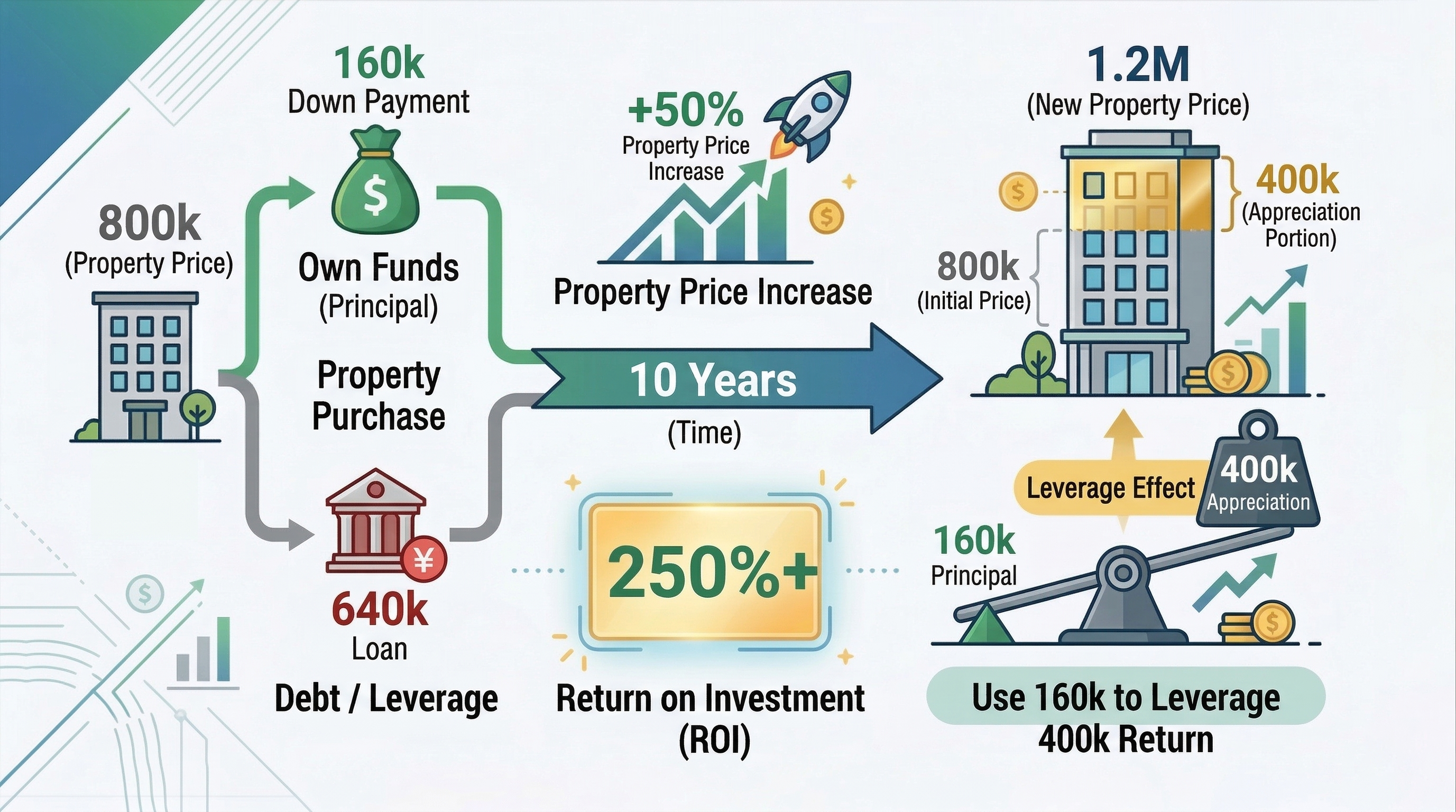
Let me put it this way. $800,000 property, you put in $160,000, borrow $640,000. Ten years later it’s worth $1.2 million. You turned $160,000 into $400,000 of growth, that’s over 250% return on your money. Even with a higher effective tax rate, your net return crushes bank deposits, beats bonds, and outperforms most options available to everyday people. I’ve run these numbers over and over. CGT may well change, but property investment is still worth doing, and for ordinary Australians there’s still nothing out there that replaces it.
So we’ve sorted out “should you sell” and “is it still worth investing.” But there’s one more trap, and this one might be the most dangerous of all.
Mistake Number Three: assuming it won’t go through, just like 2019.
2026 and 2019 are completely different animals. In 2019, “reform” was a pre-election pitch, and voters killed it at the ballot box. In 2026, the election is done, the governing party holds the House, and they’ve got the Greens and Pocock backing them in the Senate. In 2019, they went after both CGT and negative gearing at once and overreached. In 2026, they’ll likely only touch CGT, because they learned the hard way. In 2019, Sydney prices were falling about 15% from the 2017 peak, and voters were sensitive to anything that might push prices down further. In 2026? Major city prices are at historic highs, and the public mood is “housing is too expensive.” That sentiment actually makes reform easier to push through.
See the pattern? All three mistakes share the same root problem: they’re using an old map to find their way through a new world. But here’s the question that actually matters. If the old map doesn’t work anymore, what does the new one look like?
If you have any questions about property investment, please book a free discovery call on our website. If you want a team offering one-stop service to help you build a property investment portfolio, achieve financial freedom and retire early, join our VISION Gold Membership starting with a 30-minute discovery session. Or to keep it simple, our data-driven buyer's agency service can help. We buy and manage properties for our clients anywhere in Australia. If you have an international view, talk to us about the UAE VISION Gold Membership. We help you invest in the UAE property market, plan your tax residency, reduce your taxes to almost 0 and handle CRS/AML auditing. Links to the service are in the description below.
Four Shifts Under the New Rules
For 27 years, the 50% CGT discount made “buy anything, hold it, watch it grow” an almost effortless strategy. After May, that era is very likely over. What takes its place? Four structural shifts. Get your head around these four, and you’ve got the new map in your hands.
Shift One: “never sell” goes from a good strategy to the only strategy.
The logic here is dead simple. CGT only kicks in when you sell. With the discount shrinking, every sale gets more expensive. So the most rational move is clear: if you can avoid selling, don’t sell.
And there are international examples that show exactly how this plays out. Ireland’s CGT rate sits at 33%, and the result has been a persistent lock-in effect where investors refuse to let go. Germany goes further: hold a property for more than 10 years, and you pay zero CGT on the sale. Long-term holding has become the default national investment habit.
So how do you access your gains without selling? Refinance. Use the bank’s updated valuation to pull out equity. But there’s a hard requirement: the property has to be going up in value, and the rent needs to cover higher repayments.
Shift Two: new builds pick up an even bigger tax edge.
Now here’s a detail in Pocock’s proposal that most people walked right past: brand-new residential properties held more than three years could keep their full CGT discount, getting better treatment than other investments. Even if this clause doesn’t make the final cut, the government’s push to channel investment towards new supply is unmistakable. Stack on $10,000 to $20,000 in first-year depreciation, something second-hand properties barely get, and the after-tax gap only widens from here.
I’ll be straight with you, when I read Pocock’s proposal, I felt relieved. Because it lines up directly with the house-and-land direction we’ve been matching for paid members on a new-property strategy. But one thing you cannot forget: location has to be right. Tax savings might run into tens of thousands, but picking the wrong suburb could cost you hundreds of thousands. For those paid members on a second-hand strategy, the investment logic may need a serious rethink.
And the new-build advantage is just one layer. There’s a deeper shift underneath it that most people haven’t even thought about.
Shift Three: holding structure matters for the first time. Properly.
Before all this, the 50% discount under personal ownership was good enough. Most people didn’t need to think twice about it. Going forward, that changes.
The effective CGT rate under personal ownership jumps from about 23.5% to roughly 31.5%. Inside an SMSF in accumulation phase? About 10%. After Division 296 kicks in on July 1st, balances above $3 million see the effective rate go up to 20%, but that’s still a night-and-day difference compared to holding personally.
That said, SMSF isn’t for everyone. Compliance costs are real, restrictions are heavy, and liquidity risk is there. This path suits high-net-worth individuals with long horizons and professional advisers.
And I know many of you are asking: “Should I move my investment property into a trust or company?” Here’s my take. Don’t rush to move existing properties. The moment you transfer, the ATO treats it as a sale at current market value, and you cop a CGT bill before you’ve avoided a single cent. But if you’re buying something, now is the time to sit down with your accountant and sort out the structure. This decision you make once and it has to be right, because unwinding it later is very hard. This is what “All entity” means inside our VISION All-Weather Investment Framework: different entity combinations produce dramatically different results across different tax environments.
Shift Four: rental income and capital growth finally stand as equals.
With after-tax returns on growth shrinking, investors will naturally pay more attention to rental yield. Net residential yields sit around 2% right now, and a pure “bet on growth” strategy keeps getting less efficient. Going forward, you can’t only ask “how much will this go up?” You also need to ask “how much rent does it bring in each week?”
Those are the four new rules. But knowing the rules alone isn’t enough. You need to see what the numbers actually look like under each possible scenario, and that’s where it gets interesting.
Running the Numbers
Some of you might be thinking, that’s all opinion, where’s the data? Here it is. Our team modelled several scenarios and worked out the figures to the dollar. We also built a free interactive calculator on our website, link in the description. Let me walk you through the findings.
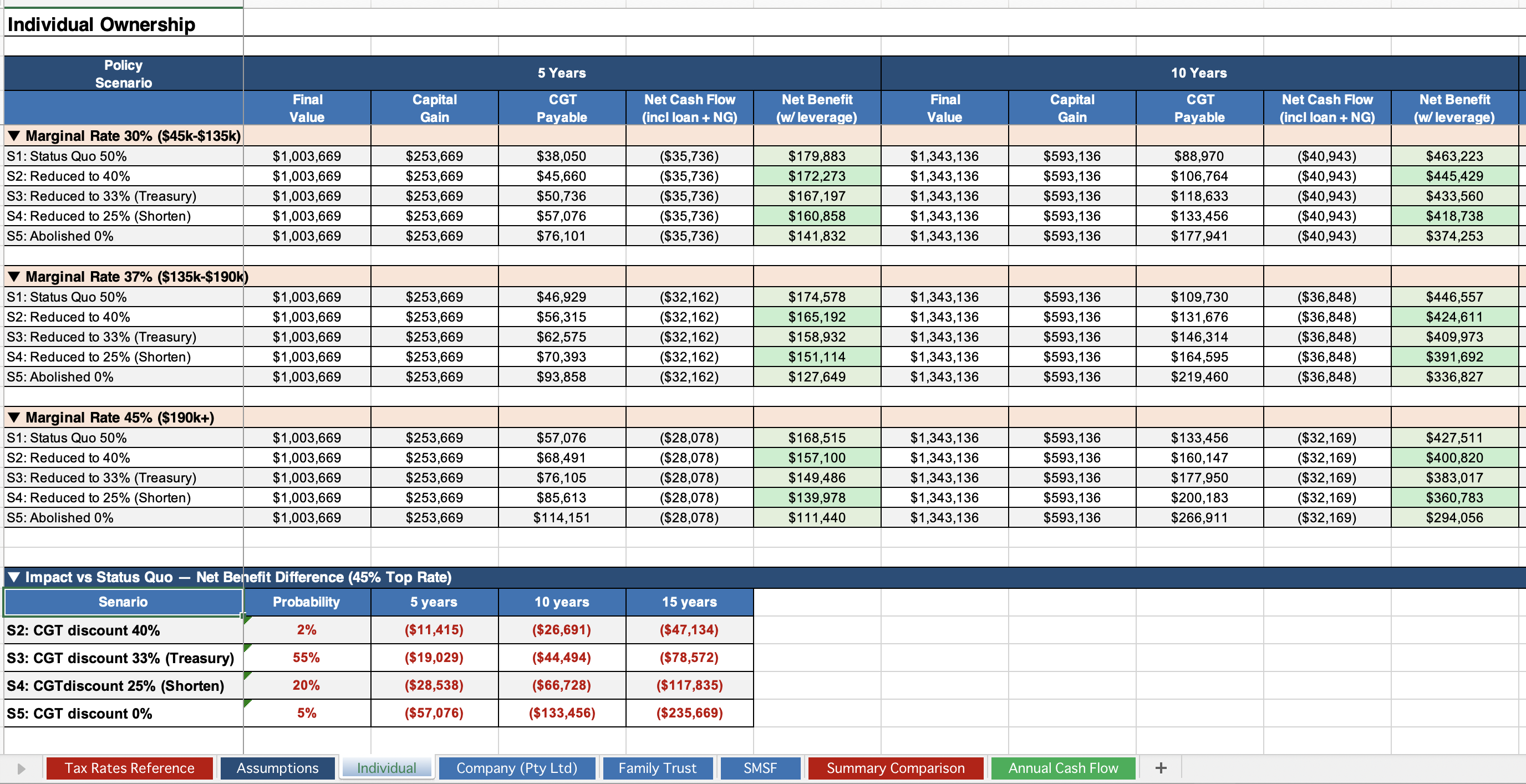

All assumptions are on the website for anyone who wants to dig in. I’ll cut straight to the conclusions. For personal ownership: the longer you hold, the bigger the impact; the higher your marginal rate, the bigger the hit. A $750,000 property at a 45% marginal rate, CGT discount at 33%, held for 15 years, you earn about $78,000 less than a no-change scenario. But your total profit is still considerably more than that gap.
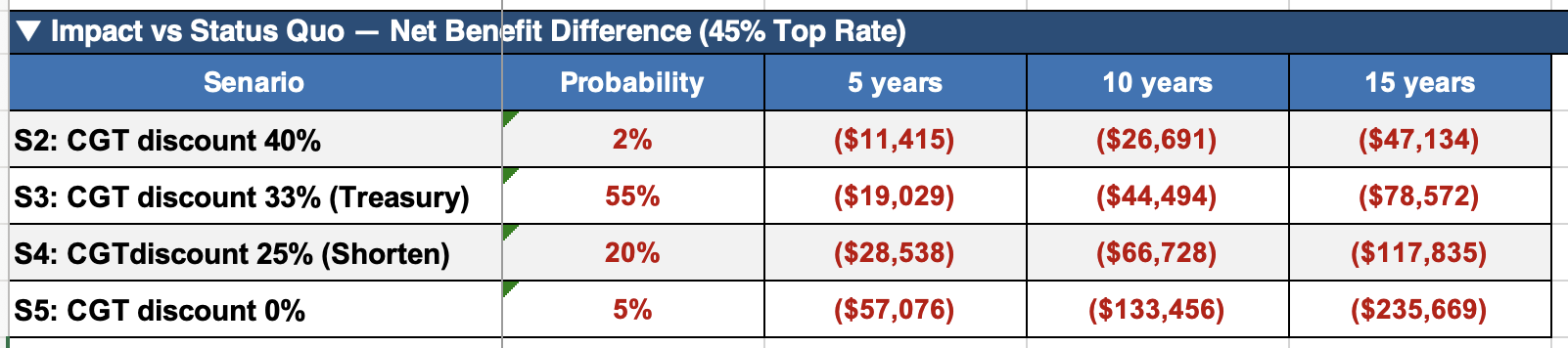
Companies see zero change, because they never had the CGT discount in the first place. Family trusts distributing to individuals at a 45% marginal rate? Same impact as personal ownership, because the CGT from trust-held property ultimately lands on the individual anyway.
And here’s the part that surprised me. SMSF ownership is likely the biggest winner under the new rules. Same property, 15-year hold, and the total impact is only around $20,000. That’s almost nothing.

So what does all this mean for how the market reacts? If the reform lands at 33%, expect some turbulence in the first few months that settles once people realise the actual impact isn’t as dramatic as the headlines suggested. Personal and family trust ownership loses a bit of appeal, company ownership stays the same, and SMSF becomes more attractive, which could trigger a wave of SMSF and corporate property buying.
To help subscribers get clarity during this period, we’ve launched “VISION Blueprint” consultation service: a 45-minute Zoom “Blueprint Session” covering your financial health, borrowing capacity estimation, existing investment portfolio review, tax structure check, and the goal pathway, with a Personal Property Investment Blueprint PDF afterwards. It’s a paid service, but we’re giving away a limited number of free spots to new clients. Link in the description.
What You Should Do Right Now
If you want to handle your property investment decisions yourself, here’s the play. Two situations.
Already own investment property? Three steps. First, don’t panic-sell. Wait for the May 12th Budget, read the actual details, then decide. Second, get your accountant modelling the tax impact under both 33% and 25% right now, so your contingency plan is ready before the announcement. Third, if you’re thinking about changing your holding structure, don’t touch what you own now. Before buying the next one, make sure the structure is sorted.
Looking to get into the market? If there’s grandfathering, anything purchased before July 1st might lock in the old rules, and that’s a window worth taking if you’ve done the research, got your loan approved, and you’re ready. But rushing purely to beat a deadline without preparation is too aggressive, and the risk isn’t worth it. The structural tax advantage of new builds becomes even more obvious after reform, and I’ve already walked through why. And never throw out your entire investment plan because of one policy change. The leverage logic is still there, the growth logic is still there, it’s the method that needs upgrading. The core principles haven’t changed: buy the right property, hold long-term, pick the right structure.
Watch the video version of the blog on YouTube.
15 Minutes Free Consultation (Limited-Time Free Offer)
If you have any questions about Australian real estate, we invite you to use our 15 Minutes Free Consultation service. Once you have filled in the form, a professional property investment strategist will be in touch with you. They will assess your needs and provide fundamental advice. This service is designed to help answer general property-related queries. BOOK NOW.
VISION Membership
Our Flagship Service: VISION Membership. Your One-Stop Property Investment Manager – Build a Tailored Portfolio and Achieve Financial Freedom
Whether you're an employee, a professional, a business owner or even a new migrant, everyone has a financial goal for the future. The VISION Membership is designed to solve all the pain points in your Australian property investment journey through one single, comprehensive service.
By analysing your current financial situation and long-term goals, we'll tailor a property investment plan just for you. Our team will match you with the ideal mortgage structure, tax strategies, wealth planning, and legal support, empowering you to go further, faster, and smarter on your path to financial freedom.
VISION Membership is perfect for busy individuals who want a professional team to create, expand and manage their Australian investment portfolio. If you're looking for a dedicated team, including real estate investment experts, mortgage brokers, accountants, financial planners, and property solicitors, VISION Membership is your ideal solution.
Start with an obligation-free 30-minute discovery session on Zoom. BOOK NOW.
VISION Buyer’s Agent
No time for inspections? Tired of dealing with pushy selling agents? Unsure how much to offer or feeling nervous about auctions? Worried about buying the wrong property? If any of these sound like you, AusPropertyStrategy's Australia-wide VISION Buyer's Agent Service is here to help.
We provide end-to-end support to help you build an optimised property portfolio and achieve your financial goals—whether you're investing interstate, refinancing, or planning post-settlement leasing or resale. Our services cover everything from suburb research and property selection, to price negotiation, auction bidding, and post-settlement support.
Start with an obligation-free 30-minute discovery session on Zoom. BOOK NOW.
real estate australia,real estate investing,australian property,australian housing market,australian economy,australian property investment,australian property market,buying property,australian real estate,mortgage brokers brisbane,first home buyer,Australian Real Estate,Australian Real Estate Investment,Australian Property Investment,Real Estate Investment,Property Investment,Property Investment Australia,Passive Income,Positive Cash Flow,Australia Real Estate Investing,Australian Real Estate Investors,Australian Property Investors,Vision Wealth Mentors,Vision Real Estate Investors Australia,financial freedom, freedom through property investment,real estate investors,property investment,passive income,positive cash flow,real estate course,real estate courses,real estate training,australian property market,property investment brisbane,property investment sydney,melbourne property market,investing in brisbane,investing in melbourne,how to invest in property,buying properties,start investing in property,property investment strategy,how to buy investment property,property investing tips,best suburbs to invest in sydney,locations real estate,prime location,property growth by suburb,capital growth suburbs


