
3.7 Million Young Australians Want Out — What’s Driving the Exodus? APS172
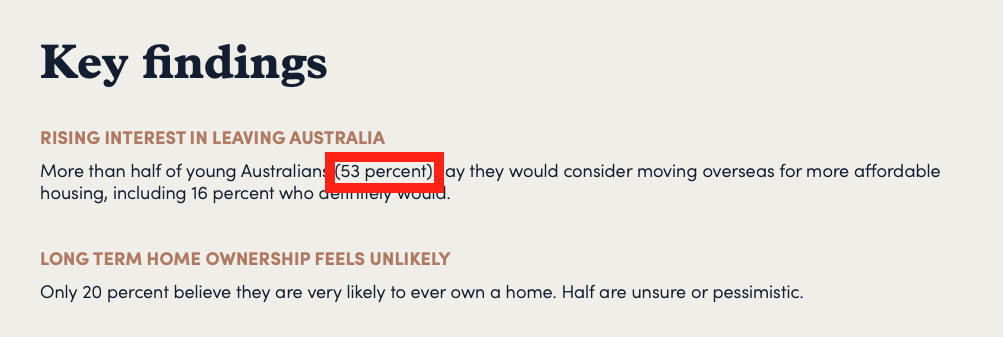
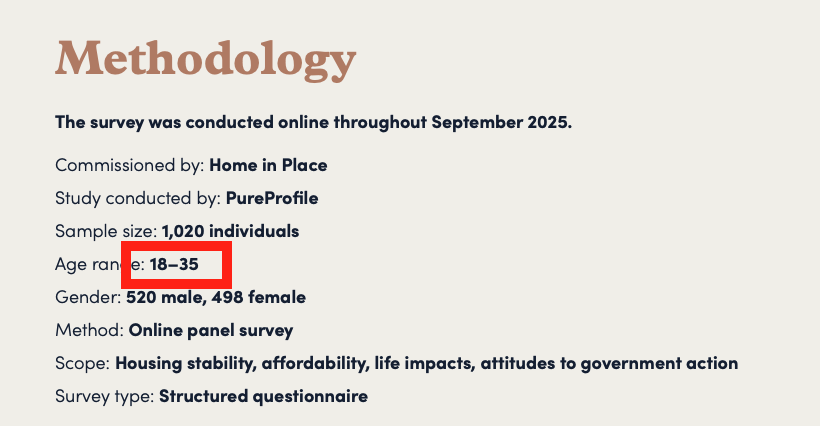
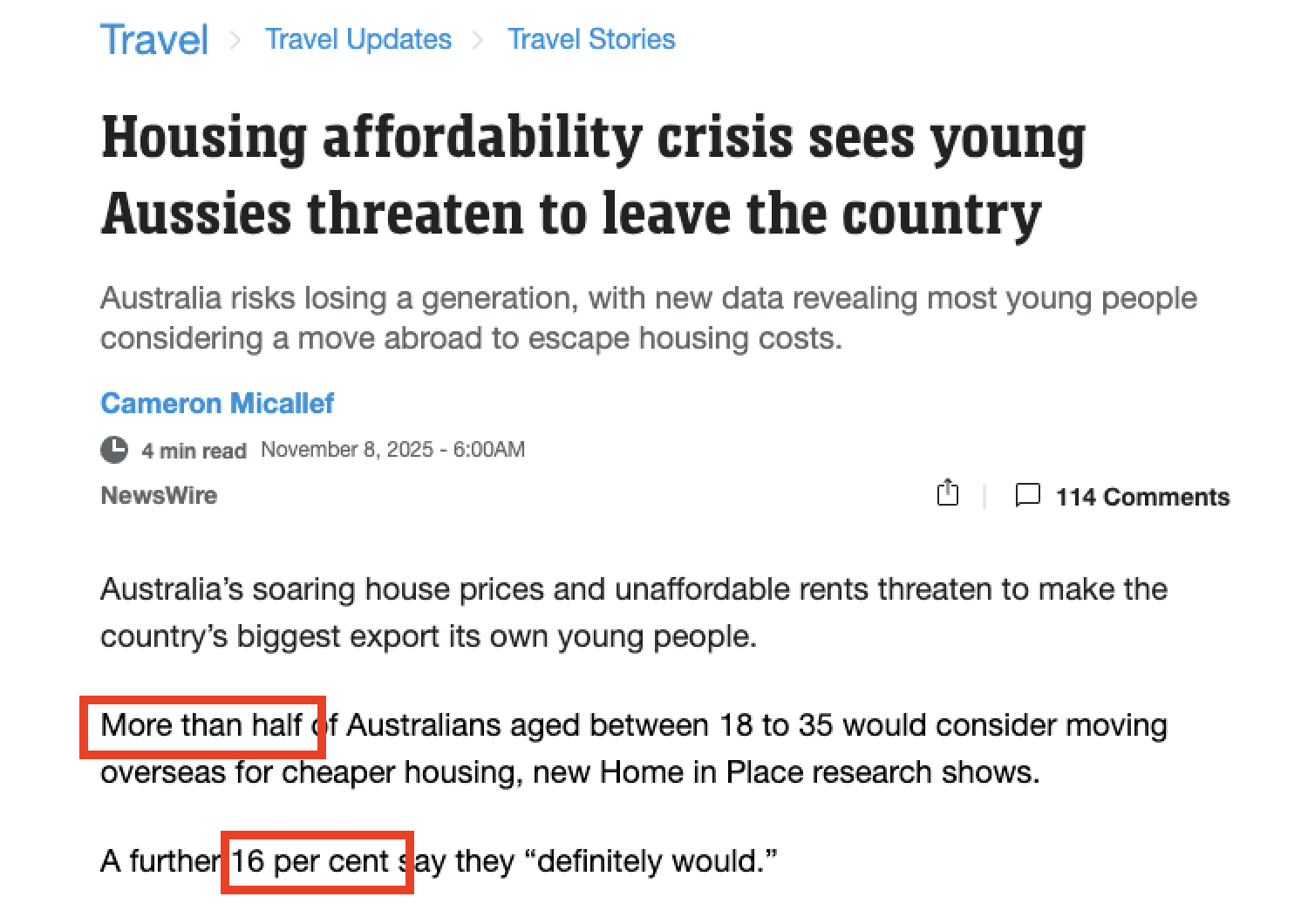
53% of Australians between the ages of 18 and 35 want to leave the country, and 16% are already making plans. Based on the current population, that’s 3.7 million people who want out, and 1.1 million actively preparing. Those numbers are staggering, and they tell you this isn’t one person’s frustration. It’s widespread. The reasons are different for everyone, because everyone sees Australia differently. Here’s my version.
I’ve been in Australia for 20 years. This is the first time I’ve seriously thought about whether it’s time to leave. How many 20-year stretches do you get in a lifetime? For two decades I believed this was a place where you breathe clean air, enjoy blue skies, sunshine, and beaches, live at a relaxed pace, and as long as you work hard, you’ll have a good life. But Australia today is nothing like it was 20 years ago. I’m going to walk you through where this feeling came from, what I’ve decided, and why. It’s complicated, it’s conflicting, and it wasn’t something I wanted to face. But I hope it gives some perspective to anyone living here or thinking about moving here.
Cost of Living
Let’s start with what you feel every single day. After the federal energy rebate expired late last year, electricity bills jumped 37%. Home insurance has gone up 20% to 40% in two years, same coverage, just higher premiums. Childcare fees are up 9% year on year, well above inflation. And every time you grab a few things at the supermarket and see the total, you can’t believe it. Compared to two years ago, it’s a different world, let alone compared to pre-pandemic or 20 years ago.
Then there’s property. Since the pandemic, Brisbane, Perth, and Adelaide property prices have nearly doubled. If you own a home, great. But if you don’t, especially if you’re young, the Australian dream has become a fantasy. At current wages, spending, and savings rates, it takes five to ten years just to put together a deposit.
Some people say, "If costs are high, just earn more and spend less." But the next one isn't something you can fix with a budget.
Public Safety
Melbourne has been officially labelled the car theft capital of Australia by the Insurance Council. Over 30,000 vehicles were stolen last year, the highest in 24 years, more than every other state and territory combined.
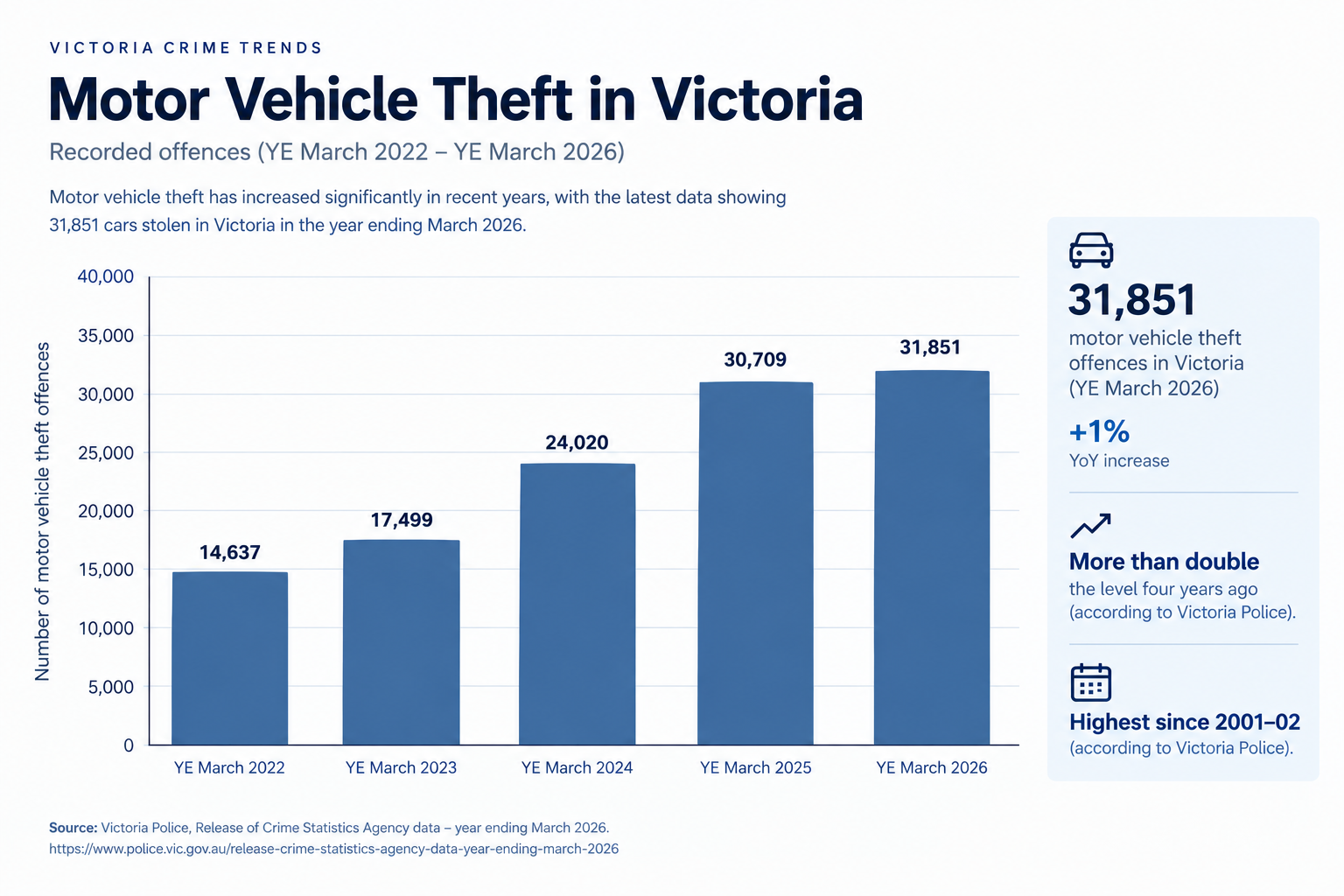
In August this year, a 60-year-old grocery store owner in Sunshine saw a group of kids stealing from a shop nearby. He stepped in to stop them and was beaten so badly he died days later. The oldest suspect was 15. He’d run that shop on that street for 30 years. Everyone in the neighbourhood knew him.
Some people say young offenders don’t go to jail. That’s not entirely accurate. Victoria’s laws do allow juvenile detention, and bail conditions were tightened in 2025. But the feeling on the ground is that it’s not safe. I live in Sydney, and when I see a group of teenagers hanging around, I walk the other way because I’m worried about getting stabbed. Is that what a normal society looks like? I don’t think I’m the only one feeling the same.
In Sydney’s far south, one of my staff had a property on Airbnb. A 15-year-old boy who’d stayed there before booked the place again, then brought close to 200 minors to throw a party. They got drunk, smashed the place up, and injured a neighbour. The kid was found, but no criminal charges could be laid because of his age. We looked at civil damages, but once we heard the cost and the timeline, we let it go. You’ve probably heard stories like this. Australia is no longer a safe country.
Tax
Now let’s talk about tax. A lot of people don’t want to face this. They think the law is the law, just pay on time and move on. That works when life is affordable. When it isn’t, tax becomes something you have to confront.
Personal income tax first. Australia runs a progressive system with a top marginal rate of 45%, plus a 2% Medicare Levy. Then the hidden charges: Medicare Levy Surcharge of 1% to 1.5% without private health insurance, Division 293 where income above $250,000 gets hit with an extra 15%, and Division 296 where super balances above $3 million have their gains taxed an additional 15%. On top of that, 10% GST on everything you buy.
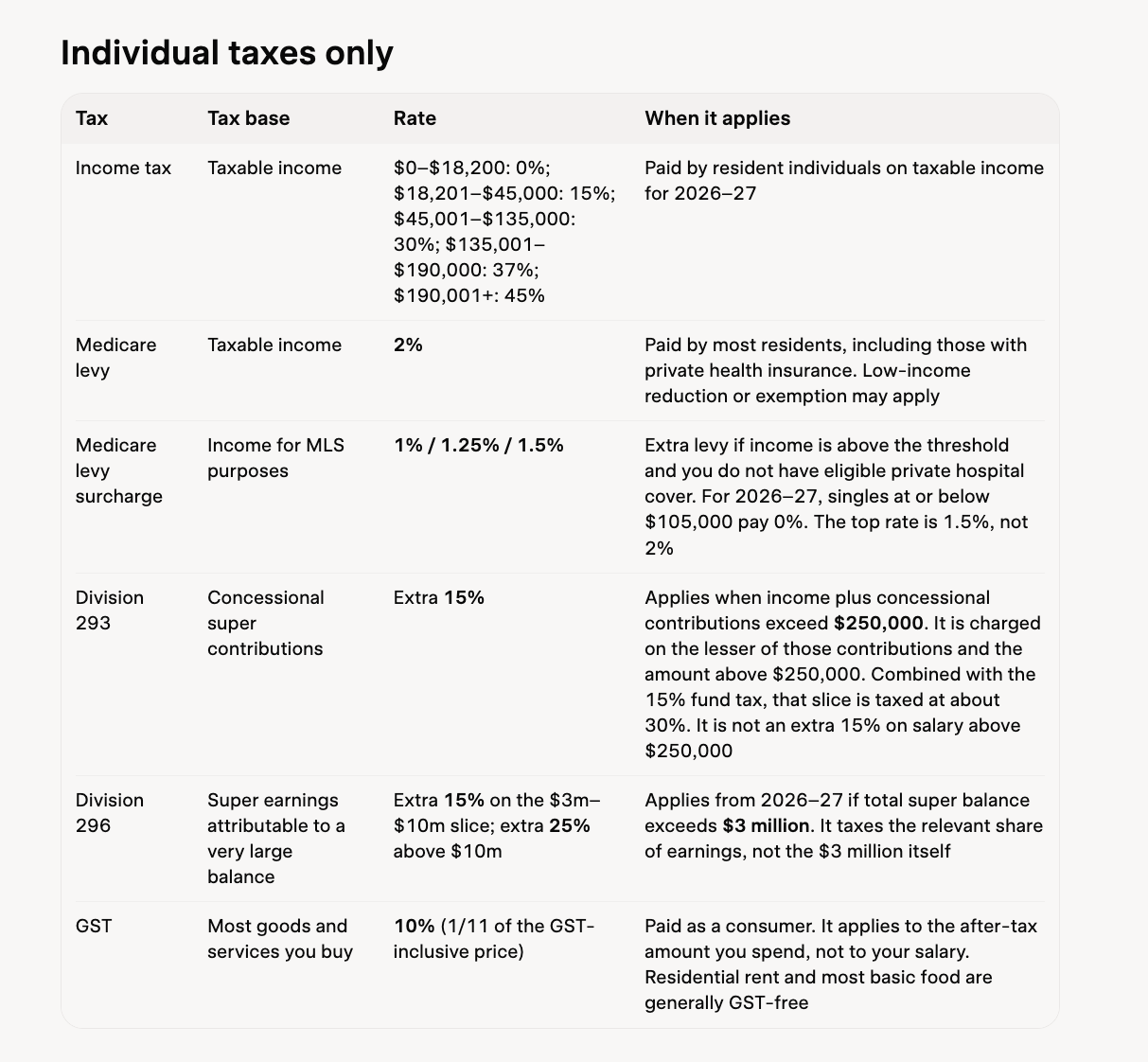
From earning to spending, assuming you spend everything you take home, the government can take up to 45% of your gross salary. That’s not the marginal rate. That’s the effective rate, the actual share of your pre-tax income that goes to the government.
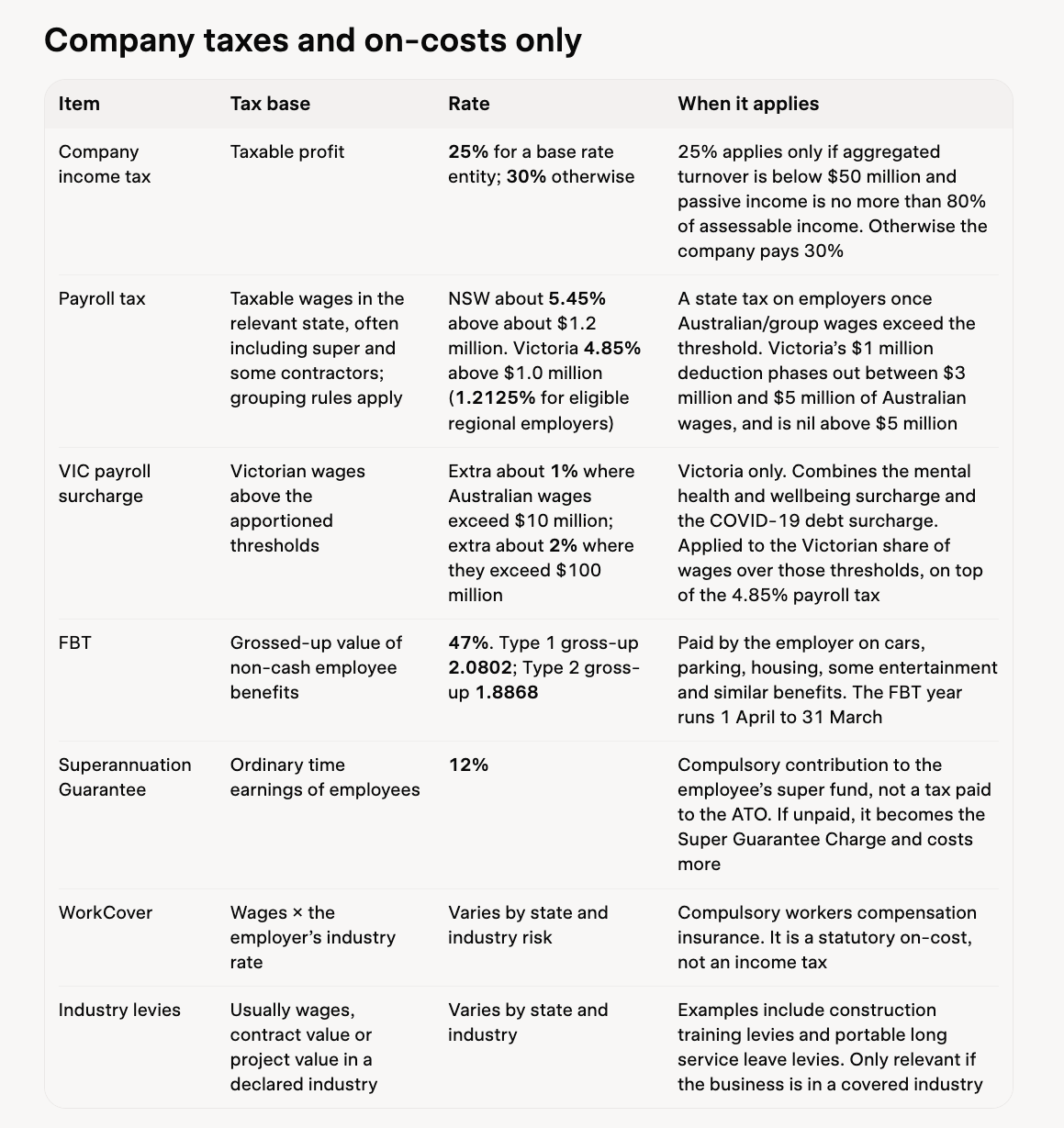
Now the business side. Corporate tax sits between 25% and 30%. Payroll Tax kicks in once your wage bill exceeds a threshold, and Victoria adds its own Payroll Tax Surcharge. Fringe Benefits Tax runs at 47%. Employers pay 12% super for every worker, plus WorkCover. The effective rate for businesses lands between 30% and 60%, with a median around 45% and closer to 50% in Victoria.
Then there’s investment. My area is property, so I’ll use that, though many of these issues apply to other asset classes. When you buy, stamp duty runs 4% to 6%. Foreign buyers pay an additional 7% to 9% surcharge plus FIRB fees. While you hold, rental income gets taxed, plus land tax, a land tax surcharge, and in Victoria a vacancy tax. Certain states charge extra land tax when you buy through a trust. When you sell, there’s capital gains tax plus a 15% withholding tax.
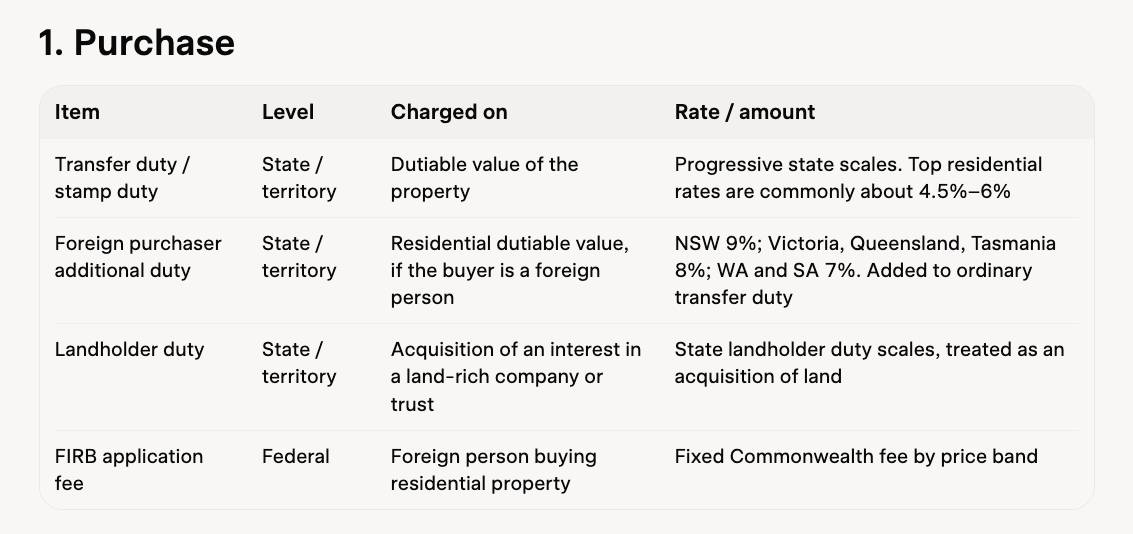
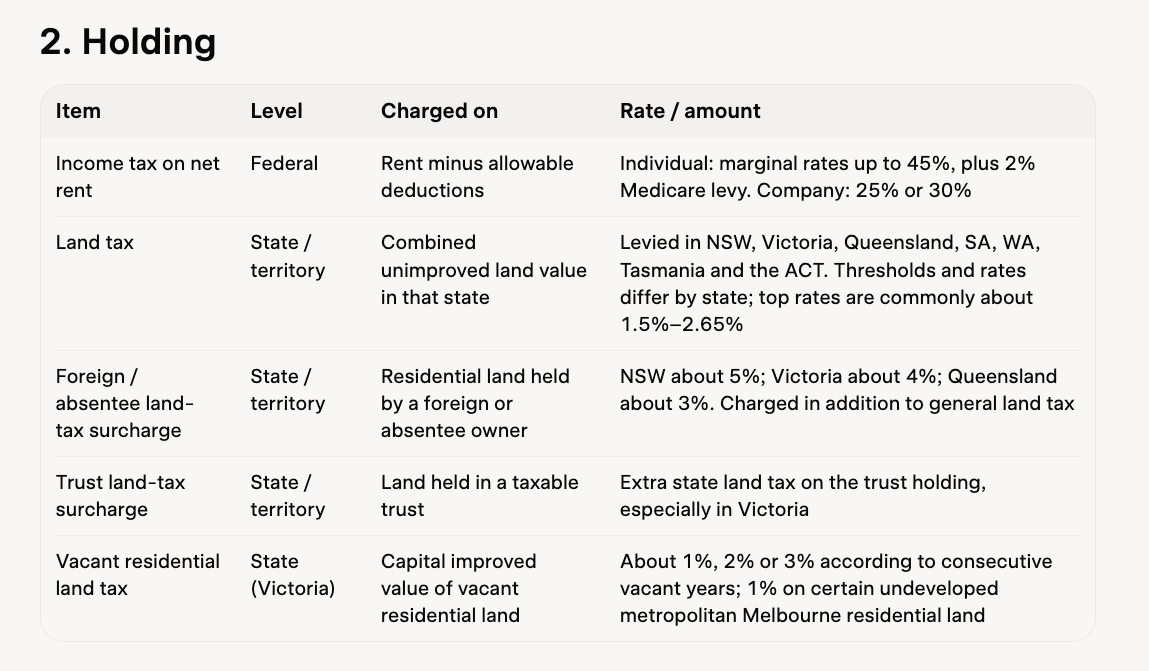
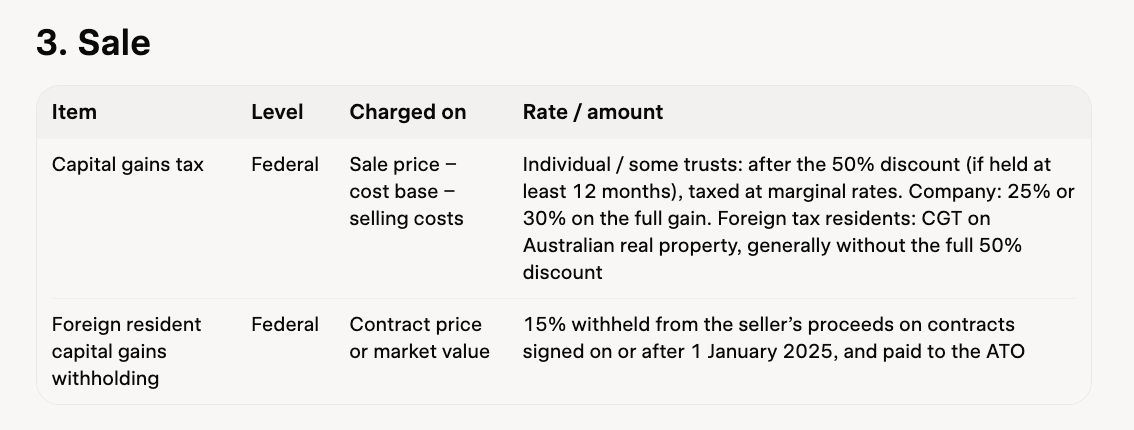
On a $1 million property held for five years, how much do the federal and state governments take? For a local buyer, about $160,000. For an overseas buyer, about $320,000.
The number of taxes on property keeps growing, especially since the pandemic. If you want to invest in this country, you have to be a tax expert. I’ve had to turn myself into one. With property growth set to run below the 40-year average, tax is now the number one consideration. It used to be population and land supply. Now you look at tax first.
Everything I’ve covered so far is what you feel day to day. But if that’s all you see, you’re only looking at the tip of the iceberg.
Before we keep going — if anything in today's video has you thinking about your own situation, there are two ways to get real answers. A free 15-minute call with one of our property investment strategists — bring your questions, get a straight answer, no strings. Or if you want the full done-for-you path — strategy, lending, property selection, portfolio, tax structure, wealth planning, all of it — book a free 30-minute Discovery Session and see how VISION Gold Membership actually works. Both links are in the description. Alright, let's get back to it.
Australia Has Entered Another Rate Hike Cycle
At the start of 2026, the RBA did a complete U-turn. A hike in February, another in March, the 3rd one in May, and the cash rate is back at 4.35%. All four major banks are forecasting this cycle will continue, with potentially one or two more to come.
Why? Conflict in the Middle East has pushed oil prices higher. Oil goes up, shipping costs follow. Shipping costs go up, supermarket shelves follow. And when prices go up, interest rates have to go up, otherwise you can’t keep inflation under control.
Australia’s economy is already weak. GDP growth has sat near zero for four straight quarters. Per capita GDP keeps going backwards. Wage growth has fallen behind inflation. If rates keep climbing, an economic and social crisis isn’t out of the question. People can’t afford to live. When living standards rise, people adjust easily. When they drop from a high point, people can’t handle it.
And what set all of this off? Australia's immigration policy over the past few years.
Immigration
When people talk about immigration, they see one big number: over 300,000. But break that number down and the composition matters more than the headline.
India is now Australia’s largest source of permanent migrants. In 2024-25, Indian nationals received close to 48,000 permanent visas, more than double the second-largest source, China. Add Nepal, Sri Lanka, and Pakistan, and South Asia accounts for a major share of permanent migration. The latest ABS data shows Australia now has 970,000 India-born residents, surpassing England-born residents for the first time.
People coming in isn’t the problem. The problem is where they live. Over 300,000 people arrived, but only 170,000 homes were built that year. Nobody is filling that gap. That’s why rents are climbing, prices are climbing, and competition is getting tougher. It’s not because immigration is “bad.” It’s because supply hasn’t kept up with demand.
The government brings in large numbers of people on one hand and can’t build enough housing on the other. Those two things don’t match, and the pressure falls on the rental market and entry-level housing, forcing people already here to compete with new arrivals for somewhere to live. Australia has just over 26 million people. Over the past few years, roughly a million have come in. That many, that fast, before the country has had a chance to absorb them, and they’ve already begun to change the culture of Australian society. That’s the fundamental reason long-term residents feel this country isn’t what it used to be.
I’m not against immigration. I’m a migrant myself. But any population policy without matching housing supply, infrastructure, and anti-cultural infiltration is a time bomb. And that bomb has already gone off.
One Nation
When people are desperate, they turn to extremes. And that’s exactly what’s happening. The biggest variable in this election isn’t whether Labour or the Coalition wins. It’s One Nation.
One Nation had almost no presence in Victoria. In 2022, they picked up one upper house seat. But 2026 has been a different story. In March, at the South Australian state election, One Nation pulled 23% of the primary vote, the highest since 1998. That momentum carried straight into Victoria. In the latest polling, their support sits between 22% and 23%, with some polls putting them ahead of Labour. A genuine three-way contest, something that’s never happened in Victoria’s history.
Their policies are straightforward: cap migration at 130,000 per year, deport 75,000 visa overstayers, and immediately send back any visa holder who commits a crime.
You don’t have to agree, but you can’t ignore it. These is the response from people who feel the system has failed them. If One Nation wins enough seats, they become the power behind the throne. Whoever they form government with, crime and immigration policy will shift hard to the right. This election will have a real impact on your sense of security, your investment environment, and the environment your children grow up in.
My Take
We’ve covered the cost of living, public safety, the tax system, immigration, and the political shift to the right. So the question is: with all of that, do you still want to stay?
Here’s where I stand. I’m a migrant. I adopted Australian culture years ago and my lifestyle is Australian. But what I’ve felt since the pandemic is the same thing many of you have. I may have spent more time studying the politics and the tax system, so my angle is slightly different.
I want to stay, and I don’t. Both at the same time.
The part that wants to leave is tired of working hard, living carefully, and still handing 50% to the government, while worrying about grocery bills, worrying about whether I'm safe going for a walk, and worrying about whether my car is still there when I get back. And for what? So the government can throw it away, funnelling money through the NDIS while providers and the people behind them get rich.Do you know what an NDIS provider charges for sending one carer to walk with a disabled person for a day? On a Sunday, 12 hours, the government pays $1,600, and the carer takes slightly more than half. At that rate, why doesn’t everyone just become an NDIS provider? Why bother with tech or an office work? And what bothers me most is knowing my taxes support people with zero motivation to work, people happy to coast through life on handouts. I don’t understand why I should fund that. That’s why part of me wants to leave.
The part that wants to stay is my connections, my assets, and my businesses are all here. I want to contribute to making things better, whether through speaking up in the media or using my vote to protect the values this country was built on. So I’m not leaving yet. There’s unfinished business. I just don’t know how long I can keep it up.
If that day comes, I’d move somewhere with low costs, a comfortable lifestyle, decent healthcare, and a place suited for retirement. My assets and business would go to a low or no-tax jurisdiction where I can grow wealth and keep business operating costs down. I’ve already done research on Hong Kong, Singapore, and the UAE for research, and the UAE is the clear winner. I’m heading back to the Middle East soon to finish what I started, and I’ll stop in Europe to look at markets, tax, investment, and second passport programmes. If you have the money and you are sick of Australia, make your Plan B now.
Watch the video version of the blog on YouTube.
15 Minutes Free Consultation (Limited-Time Free Offer)
If you have any questions about Australian real estate, we invite you to use our 15 Minutes Free Consultation service. Once you have filled in the form, a professional property investment strategist will be in touch with you. They will assess your needs and provide fundamental advice. This service is designed to help answer general property-related queries. BOOK NOW.
VISION Membership
Our Flagship Service: VISION Membership. Your One-Stop Property Investment Manager – Build a Tailored Portfolio and Achieve Financial Freedom
Whether you're an employee, a professional, a business owner or even a new migrant, everyone has a financial goal for the future. The VISION Membership is designed to solve all the pain points in your Australian property investment journey through one single, comprehensive service.
By analysing your current financial situation and long-term goals, we'll tailor a property investment plan just for you. Our team will match you with the ideal mortgage structure, tax strategies, wealth planning, and legal support, empowering you to go further, faster, and smarter on your path to financial freedom.
VISION Membership is perfect for busy individuals who want a professional team to create, expand and manage their Australian investment portfolio. If you're looking for a dedicated team, including real estate investment experts, mortgage brokers, accountants, financial planners, and property solicitors, VISION Membership is your ideal solution.
Start with an obligation-free 30-minute discovery session on Zoom. BOOK NOW.
VISION Buyer’s Agent
No time for inspections? Tired of dealing with pushy selling agents? Unsure how much to offer or feeling nervous about auctions? Worried about buying the wrong property? If any of these sound like you, AusPropertyStrategy's Australia-wide VISION Buyer's Agent Service is here to help.
We provide end-to-end support to help you build an optimised property portfolio and achieve your financial goals—whether you're investing interstate, refinancing, or planning post-settlement leasing or resale. Our services cover everything from suburb research and property selection, to price negotiation, auction bidding, and post-settlement support.
Start with an obligation-free 30-minute discovery session on Zoom. BOOK NOW.
real estate australia,real estate investing,australian property,australian housing market,australian economy,australian property investment,australian property market,buying property,australian real estate,mortgage brokers brisbane,first home buyer,Australian Real Estate,Australian Real Estate Investment,Australian Property Investment,Real Estate Investment,Property Investment,Property Investment Australia,Passive Income,Positive Cash Flow,Australia Real Estate Investing,Australian Real Estate Investors,Australian Property Investors,Vision Wealth Mentors,Vision Real Estate Investors Australia,financial freedom, freedom through property investment,real estate investors,property investment,passive income,positive cash flow,real estate course,real estate courses,real estate training,australian property market,property investment brisbane,property investment sydney,melbourne property market,investing in brisbane,investing in melbourne,how to invest in property,buying properties,start investing in property,property investment strategy,how to buy investment property,property investing tips,best suburbs to invest in sydney,locations real estate,prime location,property growth by suburb,capital growth suburbs


