

28 Days: The Window That Could Define Your Property Future | APS143
The Australian property market just split into two. Sydney and Melbourne tipped into a downturn in March, while Brisbane, Perth, and Adelaide hit all-time highs. Same country, same interest rate, completely opposite outcomes.
And here’s the thing — this split didn’t happen by accident. It’s a signal. Over the next 28 days, we’re about to get hit by a few things that could reshape this market for years. Another rate hike. A federal budget that might cut the CGT discount and negative gearing. An inflation number being driven by a real war. And a state election that could turn Melbourne’s property market into a comeback story of the year. Today, I’m walking you through what happened in March, what’s coming in the next four weeks, and what you should be doing about it right now. If you’re serious about Australian property, the next fifteen minutes could save you — or make you — a lot of money.
The Cracks Are Showing
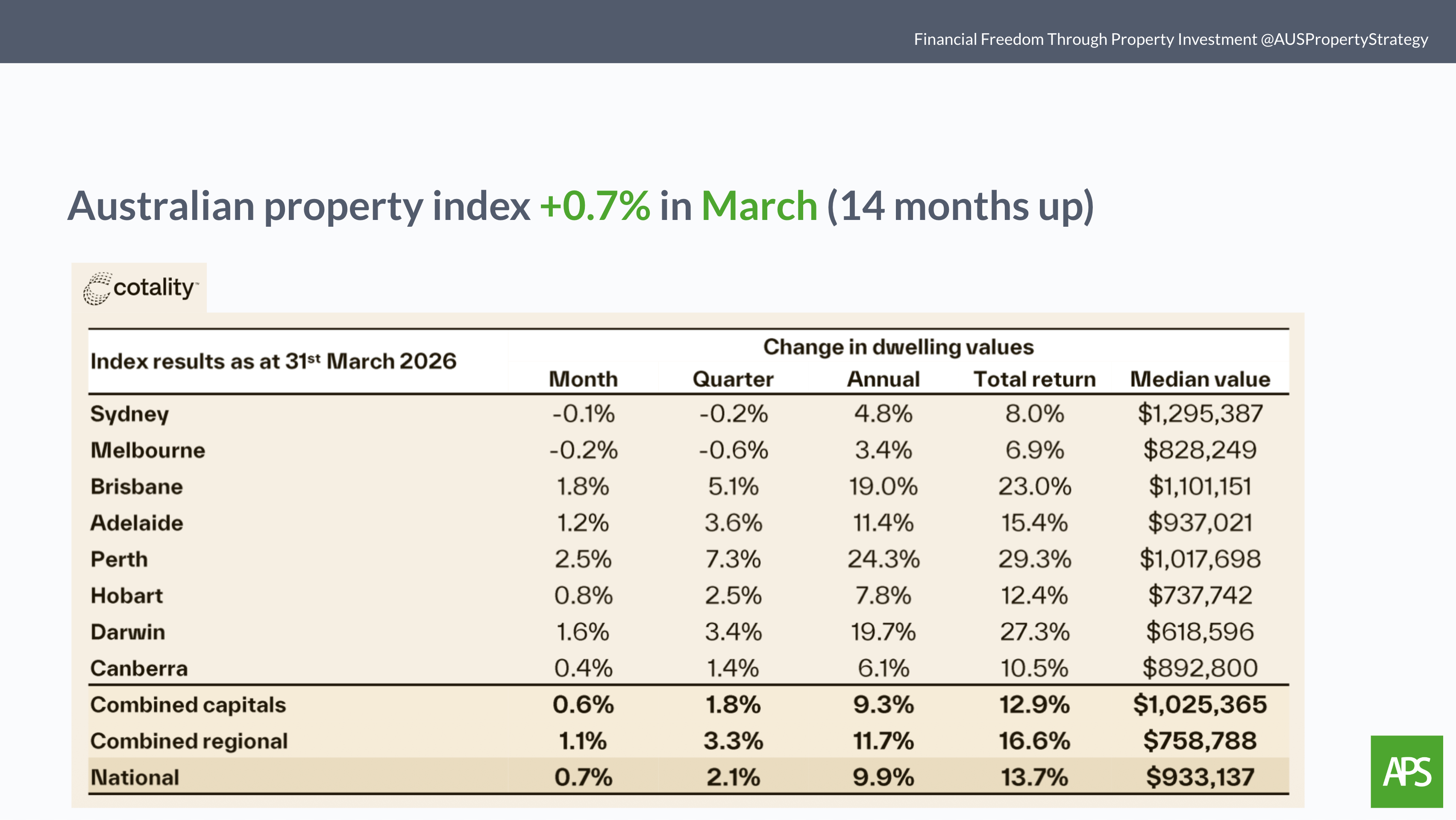
Let’s go straight to the numbers. March 2026: the national property index rose 0.7%, making it fourteen months in a row of growth. Sounds fine on paper, right? But the pace is fading. The engine’s still running, just not as hard. That tells you something — this cycle is moving into its second half.
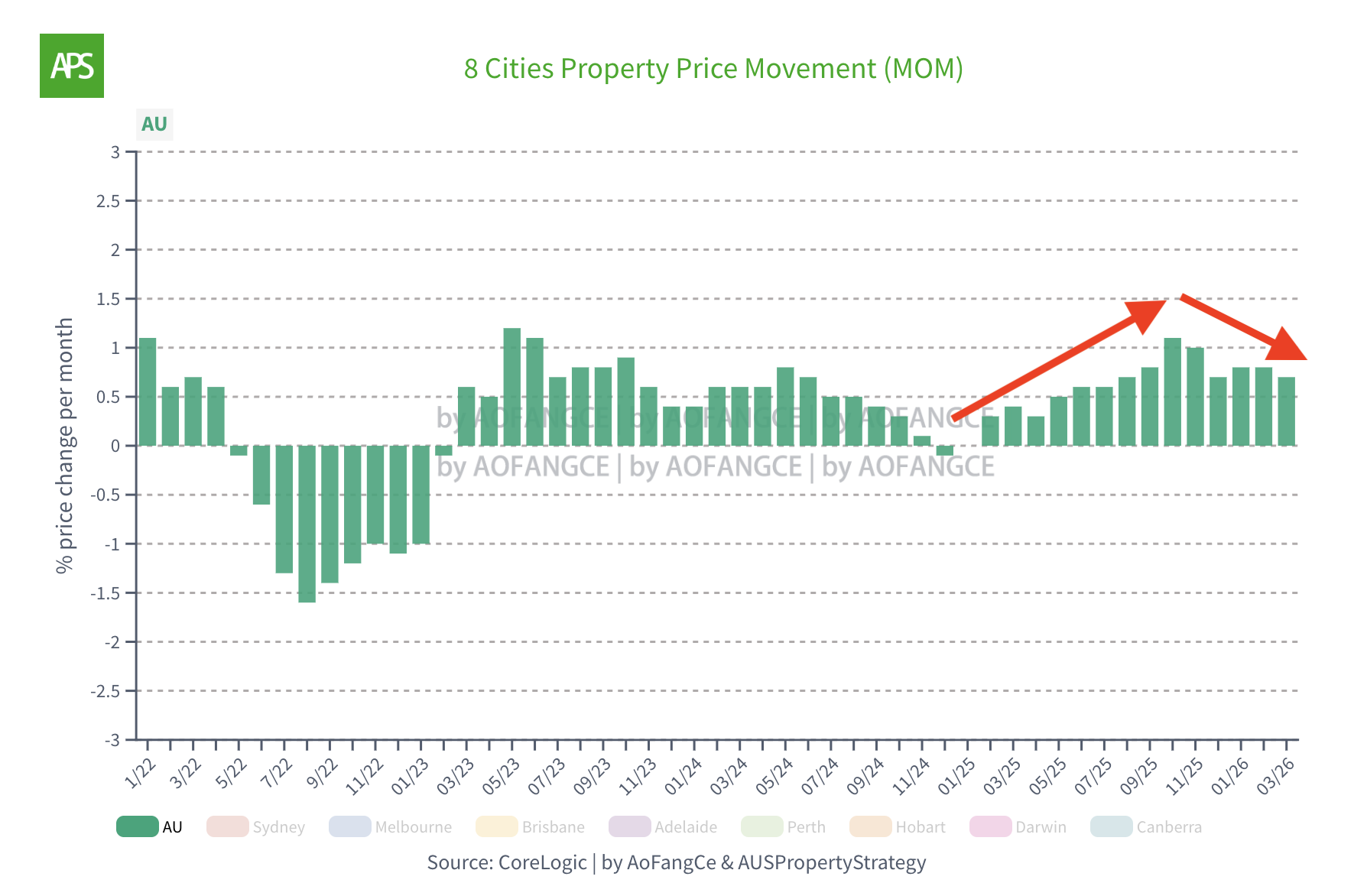
Now, that’s the national average — every city, ever y property type, all blended together. Break it down by city and the picture gets way more interesting.
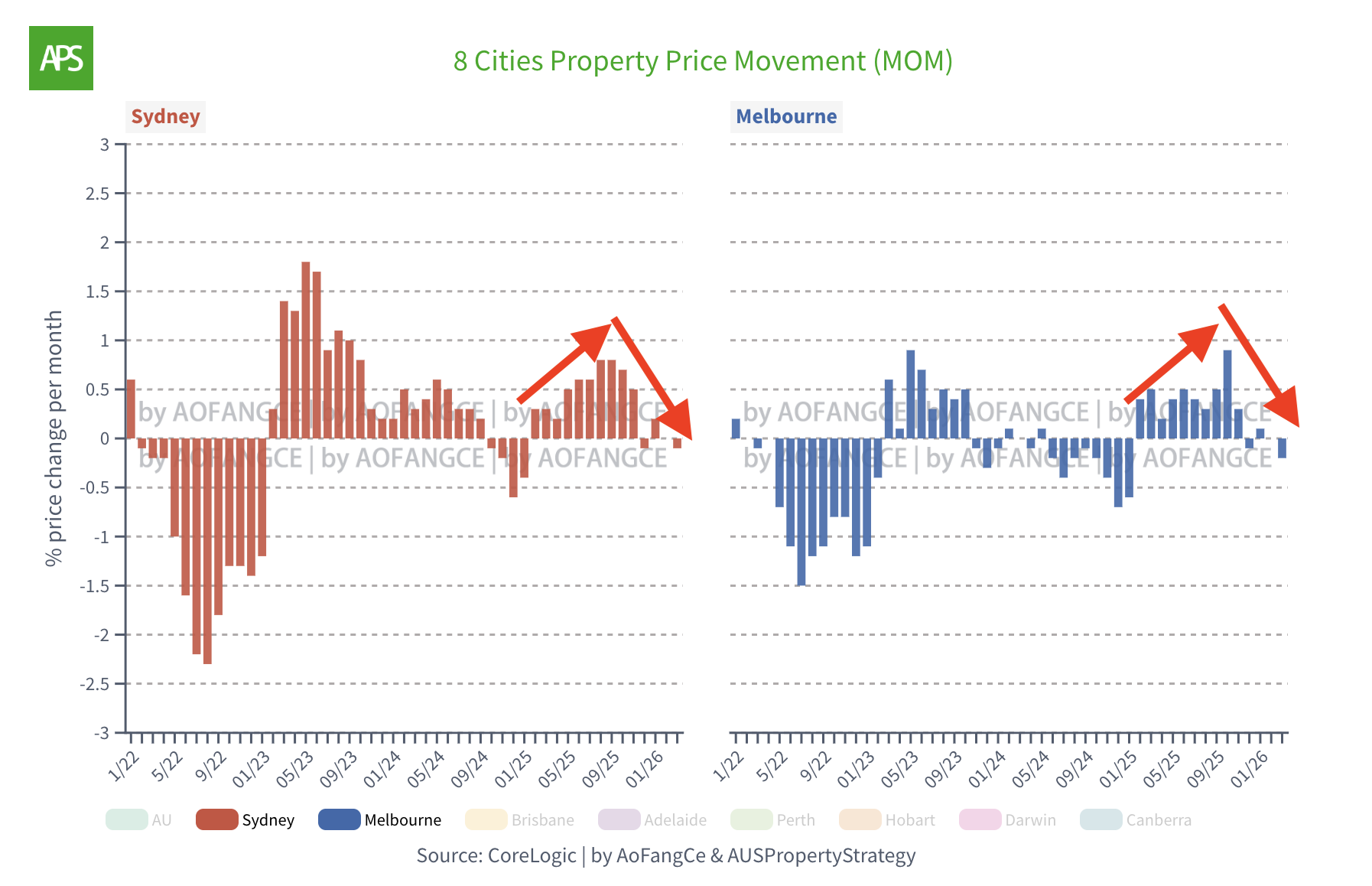
Sydney dropped 0.1% in March. Might not sound like much, but it could be the start of a proper downturn. I normally wait for three months of decline before I call it, but honestly, a slow, steady slide looks more likely. Melbourne fell 0.2%. Not dramatic by itself, but zoom out three years and prices have barely moved. If you invested in Melbourne during that period, your real return is almost certainly negative once you add in higher mortgage costs and rising land tax. Compare that to the mid-size cities, where prices have jumped 50% or more. That gap is hard to ignore.
And that brings us to the other side of the story. Brisbane, Adelaide, and Perth have been climbing for over three years straight. After a brief pause in February, they accelerated again in March. Brisbane gained 1.8%. Perth — 2.5% in a single month. That kind of speed is very rare.
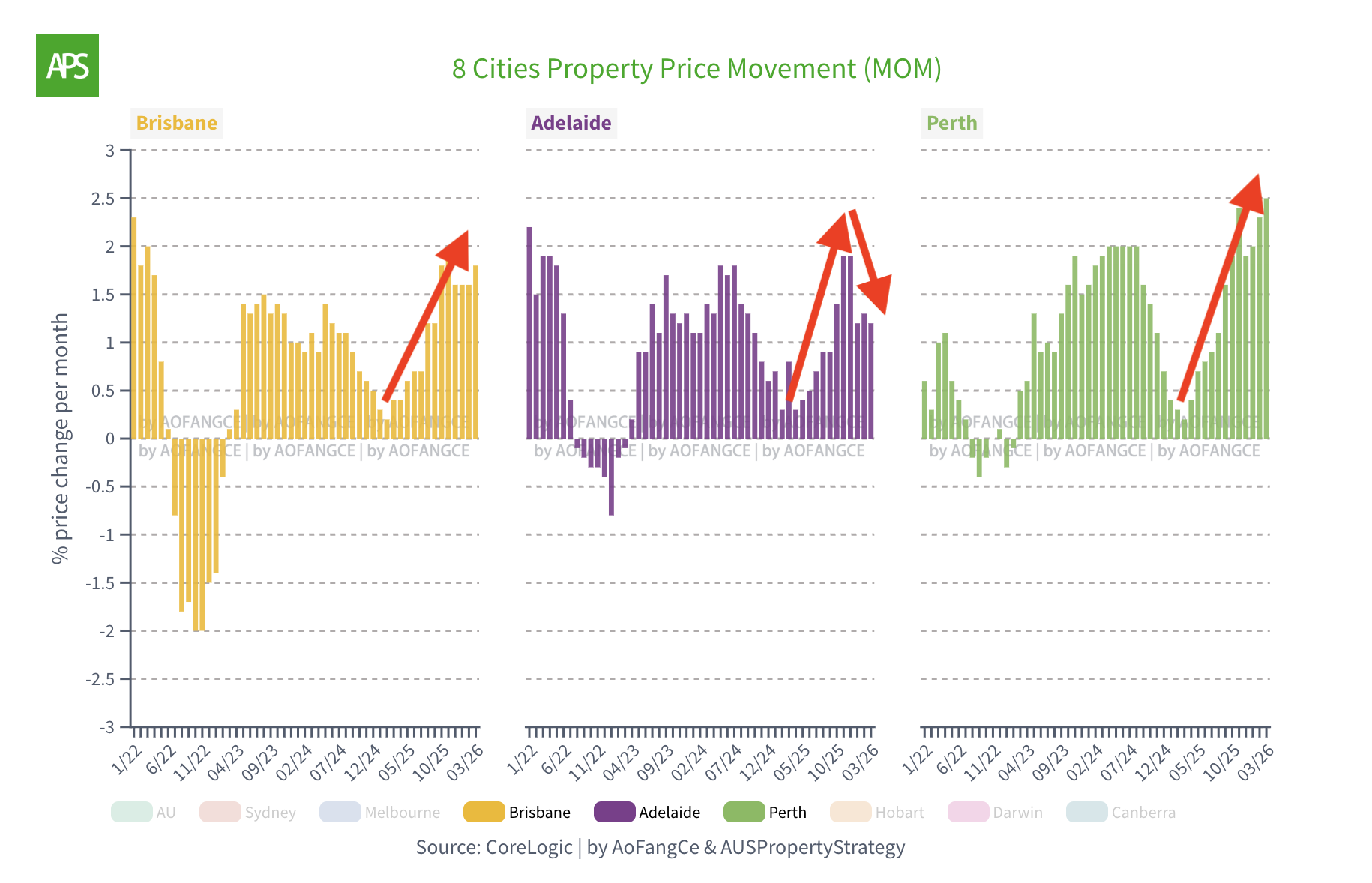
Brisbane and Perth accelerated while interest rates were going up. Think about that. Higher rates should mean tighter budgets, smaller loans, and falling prices. So why aren’t the property prices falling? Because property prices come down to supply and demand, and in those cities right now, there are far more buyers than homes. When that gap is wide enough, rate hikes alone just can’t close it.
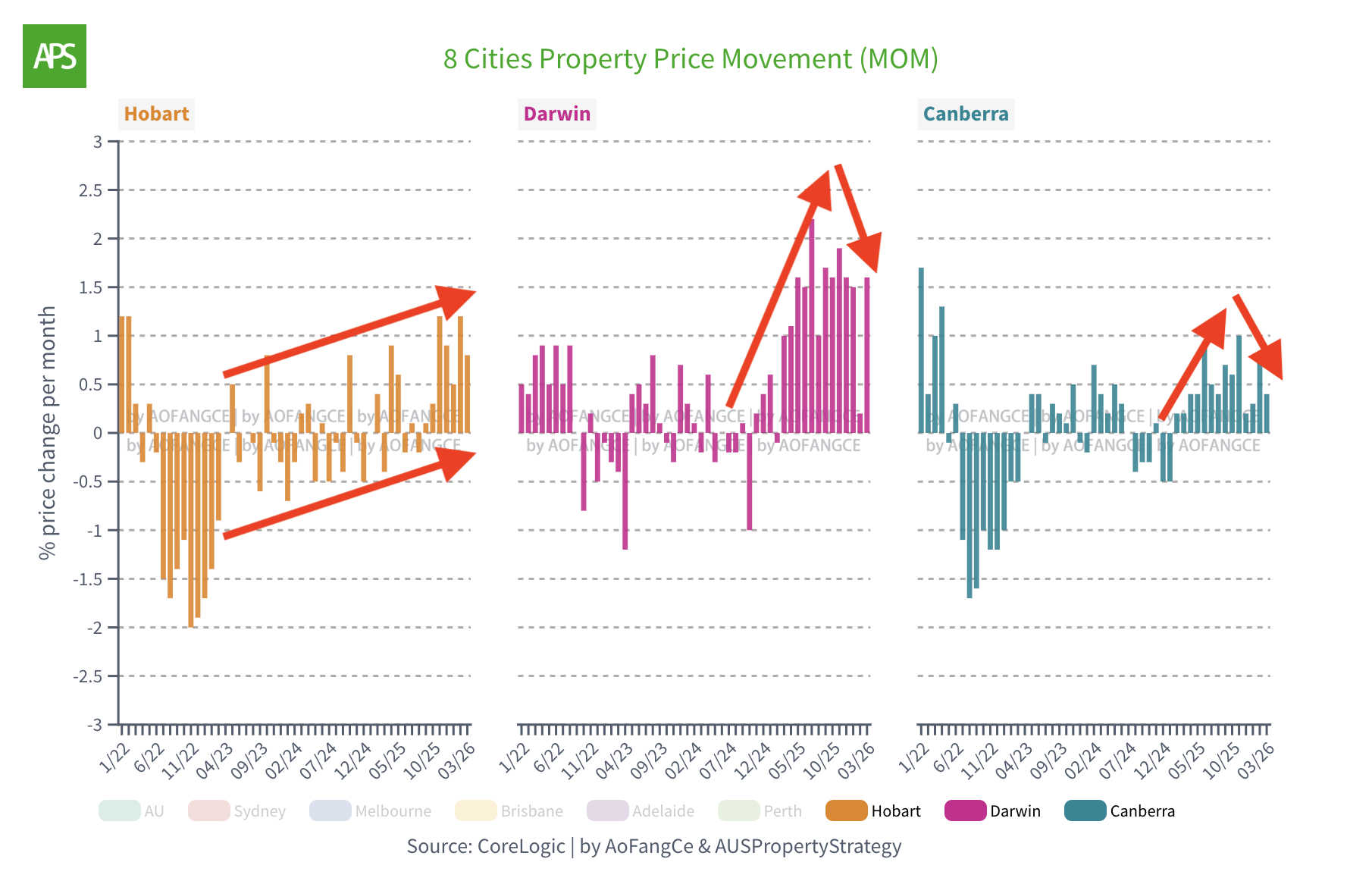
The smaller capitals told their own stories too. Hobart continued its choppy upward trend, up 0.8%. Darwin bounced back with a 1.6% gain. Canberra is clearly running out of steam, up just 0.4%.
For the clearest read on the trend, look at the 90-day moving average — it smooths out the monthly noise. The direction is unmistakable: major cities trending down, mid-size cities firmly in an upswing.
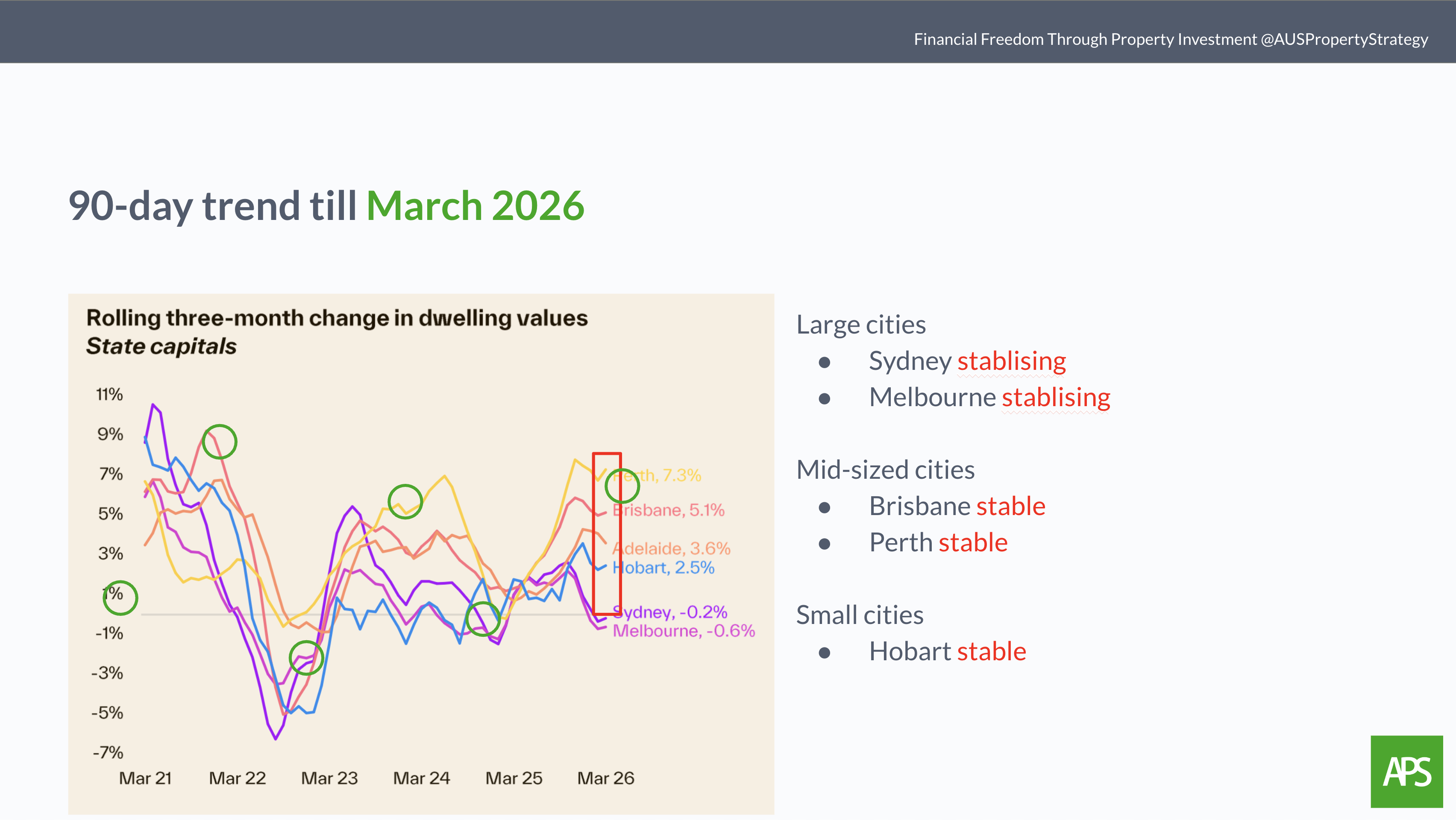
As of right now, Brisbane, Adelaide, Perth, and Darwin are all at record highs. Sydney had just touched a new peak before pulling back. Melbourne was within sight of its record, then turned and dropped. If you’re looking at either of those two in the next twelve months, go in with your eyes wide open.
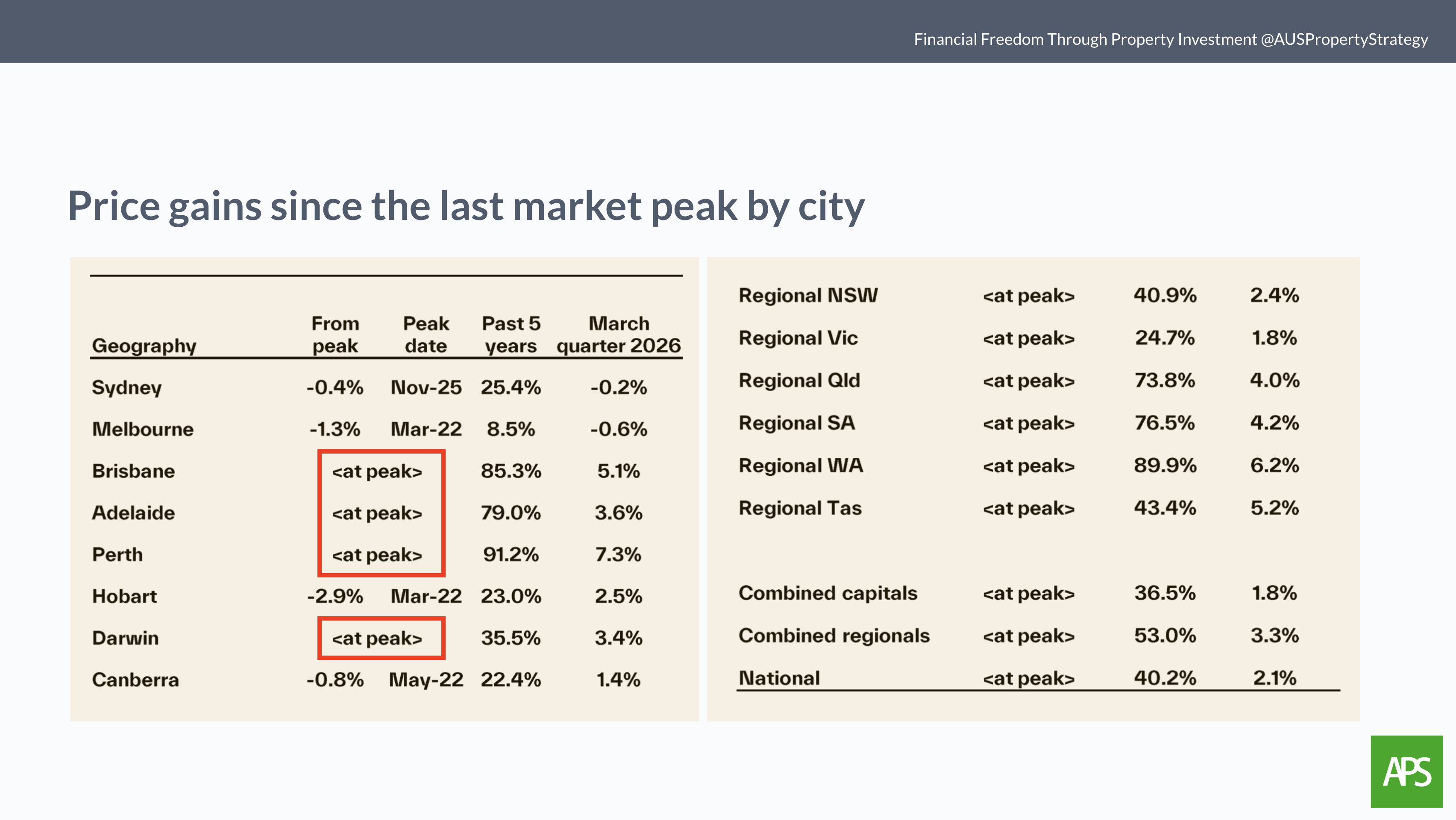
For the contrarians — buying into a falling market is actually one of the smartest moves you can make. Prices are lower, you’ve got more options, and sellers negotiate. But that takes nerve and cash flow, most people don’t have. Most of us buy on the way up. That’s just human nature.
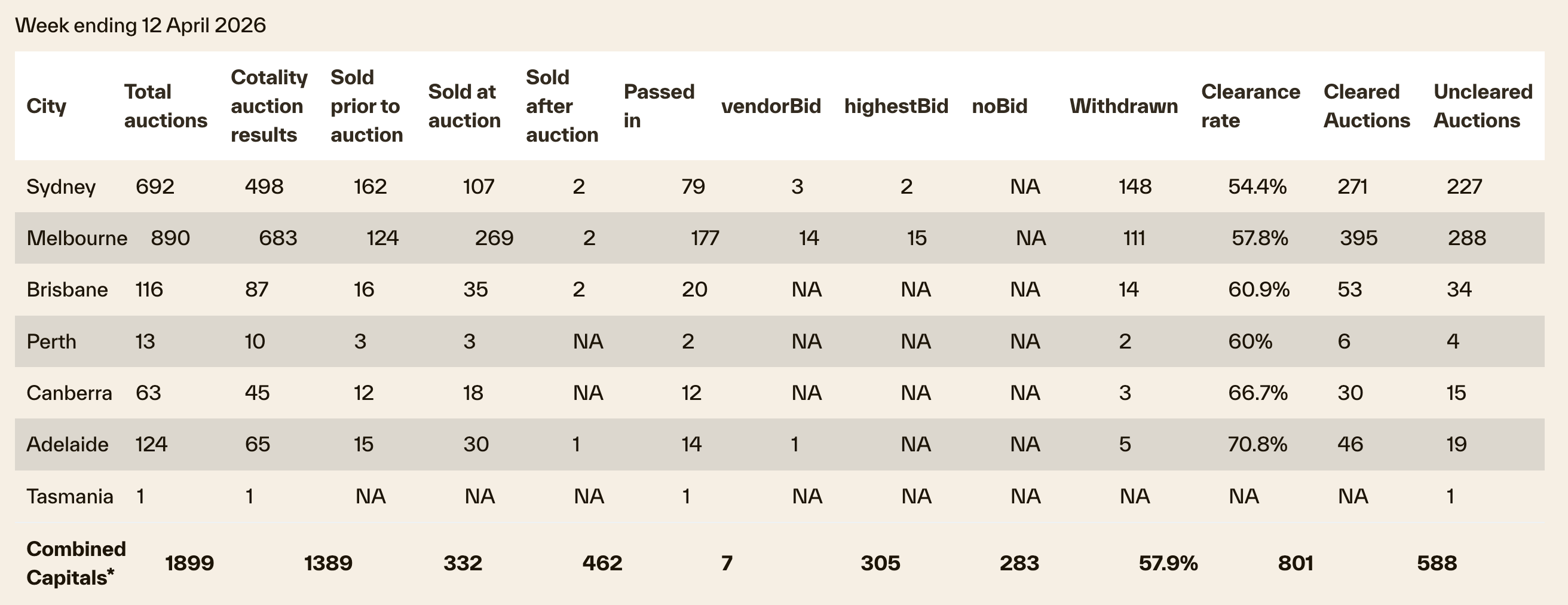
Auction clearance rates tell the same story. National clearance dropped to 57% by late March. Sydney and Melbourne hit 54% and 57% — buyer’s markets. In the mid-size cities, a lot of sellers moved off-market, shifting from open auctions to private negotiations. And the result? Prices climbed even faster.
So here’s the bottom line: we’re in a K-shaped market. The top arm is the mid-size cities — still accelerating through rate hikes, because supply-demand pressure is outweighing the cost of money. The bottom arm is the major cities, where every RBA move still stings.
Headwinds are piling up. Price-to-income ratios have hit record highs. Wages aren’t keeping pace with inflation. Consumer confidence has been crushed by geopolitics and the cost of living. Energy costs are squeezing household budgets. That’s the scary part. But there’s a floor too — tight supply, stable employment, rising construction costs that choke off new builds, and planning rules that prevent land from flooding the market. Adjustment is coming. A crash? The data doesn’t support it.
Alright, that’s the market snapshot. Now let me show you what’s driving the next chapter — because what’s coming in the next 28 days could matter more than everything that happened in March.
Want to know exactly where you stand and what your next property move should be? Book a VISION Blueprint Session — in 45 minutes, you'll walk away with a personalised Property Investment Blueprint built around your numbers, your goals, and your timeline. And if you want ongoing support from a team that handles everything from strategy to settlement, VISION Gold Membership is your next step. Link in the description below.
Where Rates Are Headed
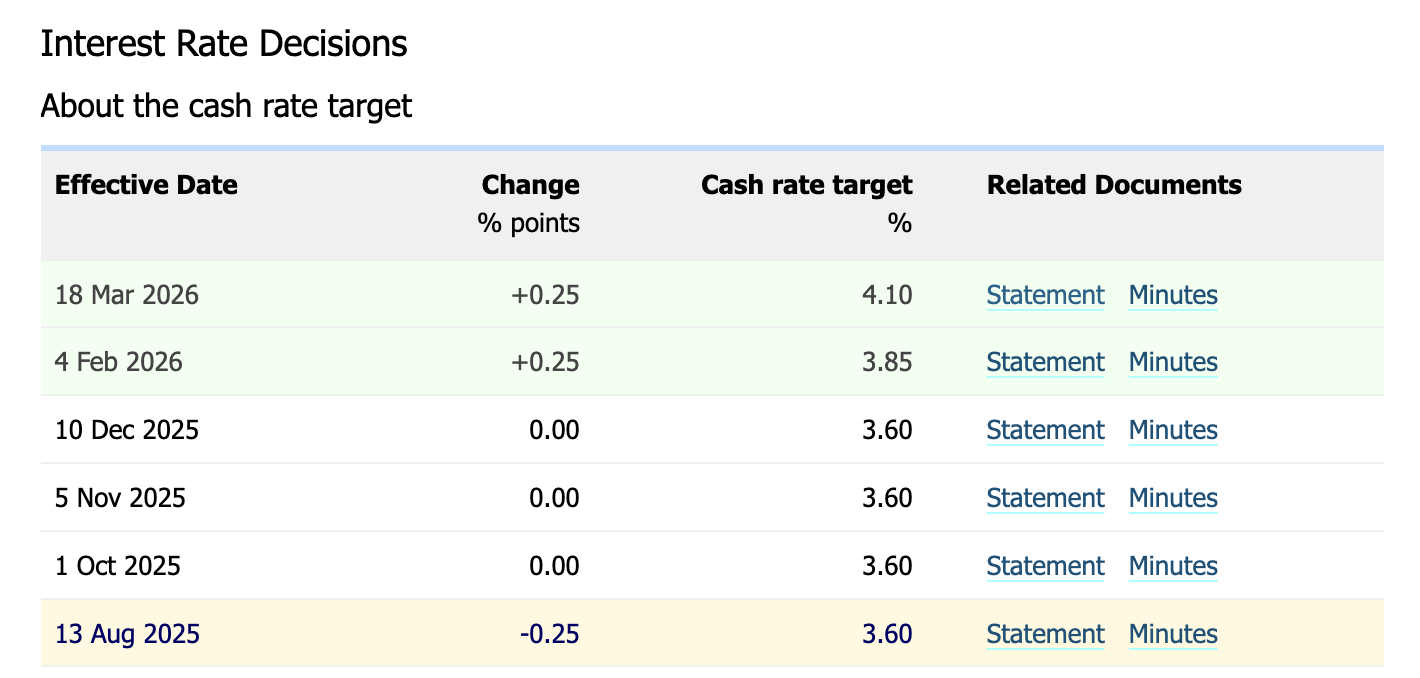
On March 18th, the RBA raised the cash rate to 4.1% — the second hike in the cycle. Markets are pricing in another hike to 4.35% in May, then 4.6% by October, holding there until September 2027.
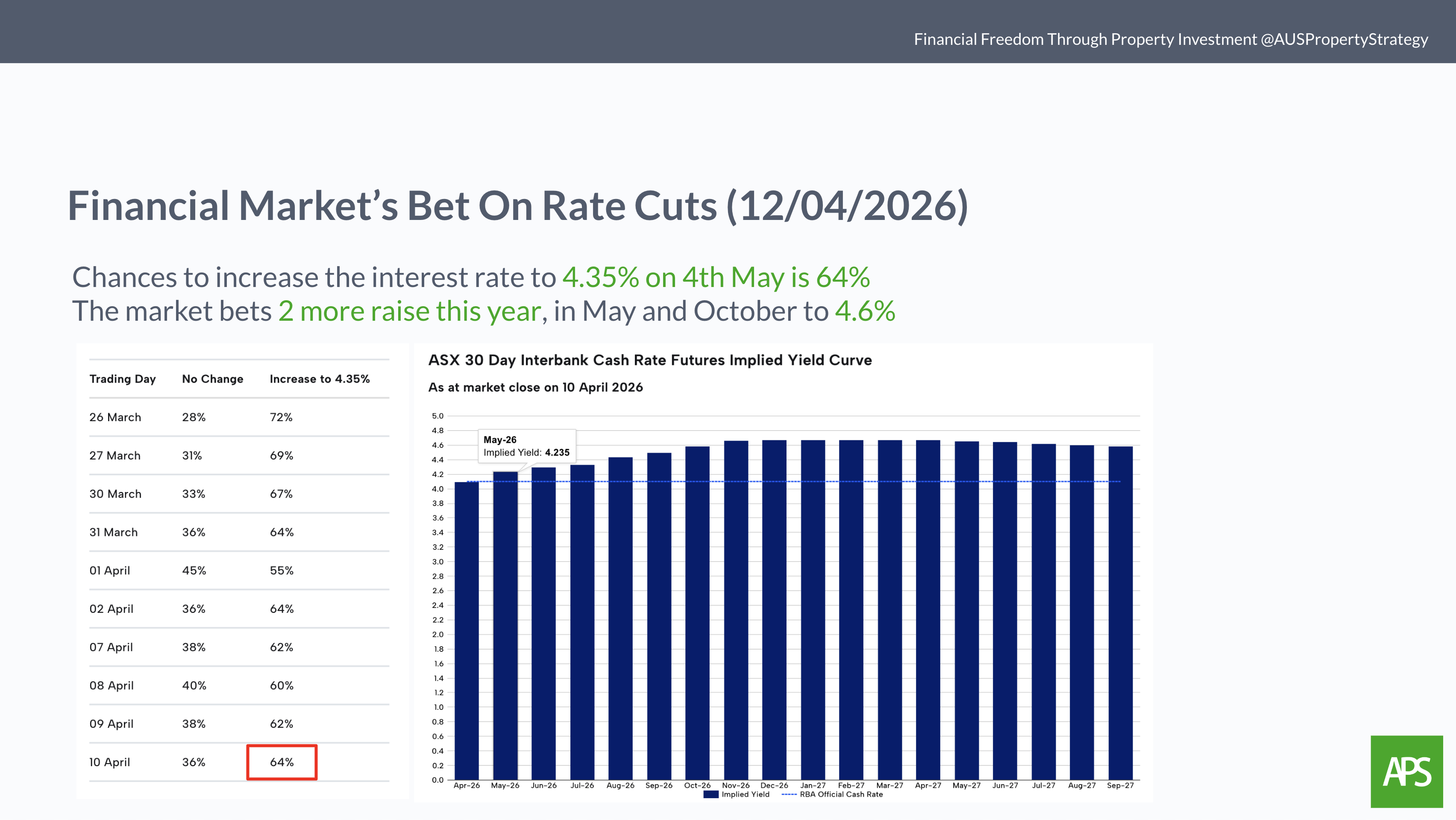
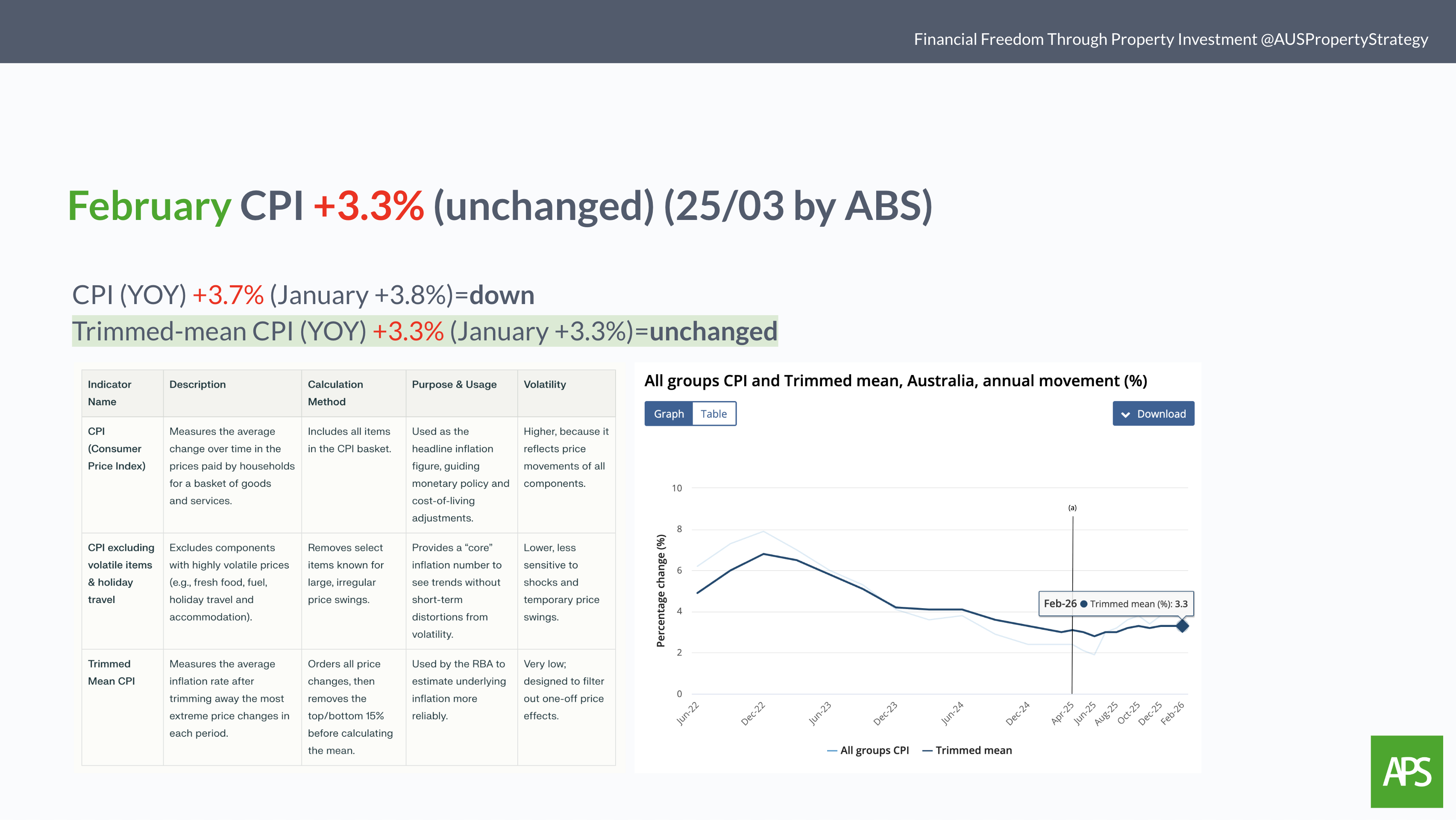
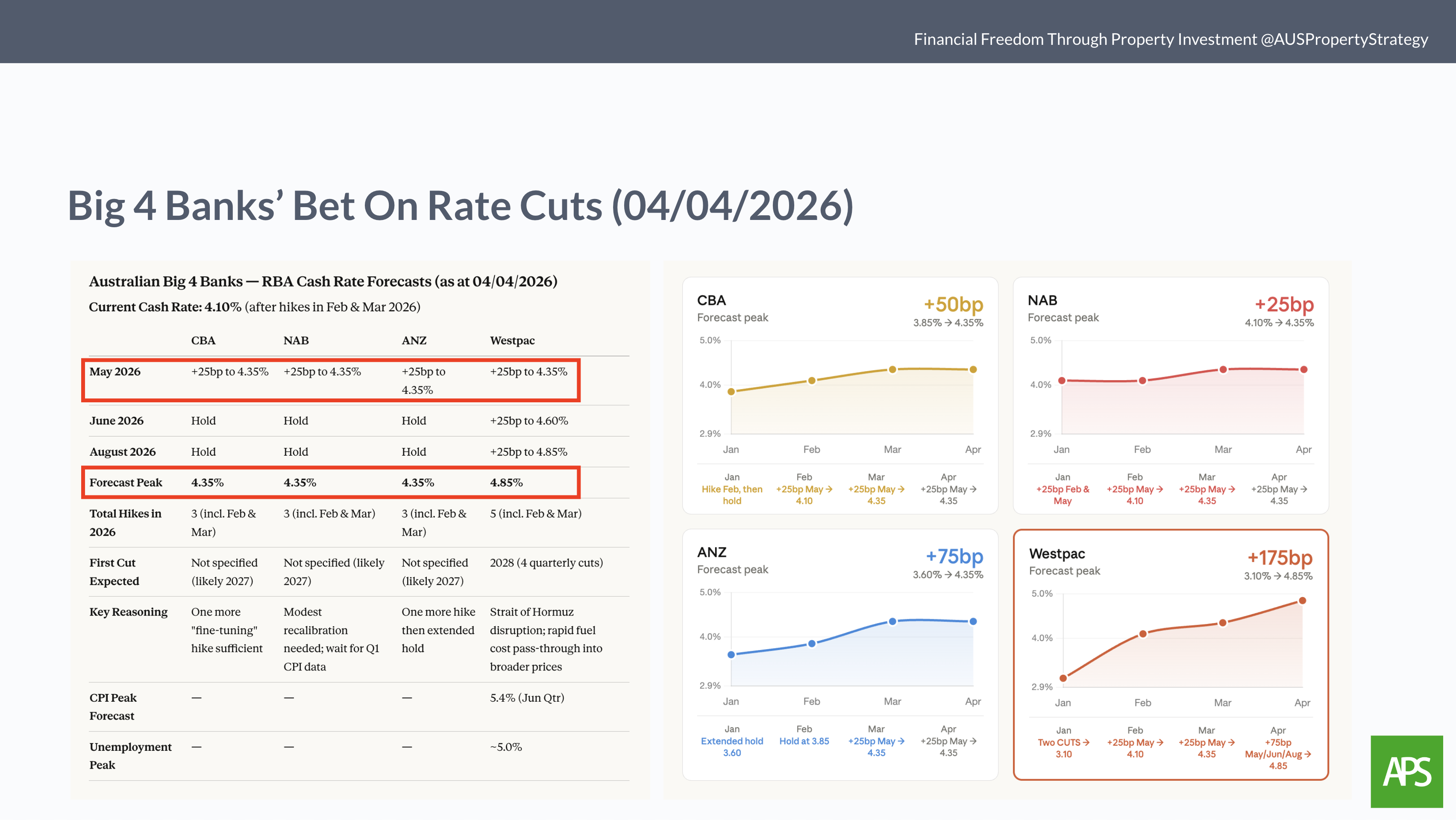
February’s core inflation came in at 3.3%. Here’s the problem: that data was collected before the war escalated. It doesn’t capture the oil price surge or its knock-on effects. March figures land in late April and feed straight into the RBA’s May decision. I think a May hike is almost locked in at this point — all four major banks are calling for it.
Westpac goes further — two more hikes after May, pushing the terminal rate to 4.85%. When I first saw that number, I sat with it for a minute. That would be half a per cent above the pandemic-era peak. For cities like Sydney and Melbourne, that kind of pressure is serious. Even mid-size cities would feel it—the question is whether supply-and-demand dynamics can keep outrunning the drag.
So that’s the rate path. But rates are only half the picture. The other that’s about to drop could hit even harder.
The Tax Reform Storm
On March 17th, the Senate Committee on the CGT discount released its report, and I want you to really let these numbers sink in. The 50% CGT discount has been steadily pushing housing away from owner-occupiers toward investors. The wealthiest 1% are capturing 59% of the benefit. Over ten years, this single concession will cost the government $247 billion — enough to build roughly a million social houses. If you’re the Treasurer, and that lands on your desk, you’re not looking away.
This has moved past “will they or won’t they.” Treasury is already running models. Most likely scenario: the CGT discount drops from 50% to 33%, only for residential investment properties. Shares keep the full 50%. The key detail — properties you already own would almost certainly be grandfathered. New rules only apply to purchases made after the change.
On negative gearing, the model under review caps the deduction at two properties per person. From the third onward, rental losses can only offset future rental income — not your salary. The Treasurer said on March 20th — and I’m paraphrasing here — “I’m ready to make difficult but responsible decisions.” May 12th, Budget night, is when we find out.
I’m not saying this to scare you. I’m saying it because if you’re planning to buy under the current rules, your window might be down to one month. This government holds 94 seats across both chambers — the biggest single-party majority in Australian history. What they backed away from in 2019, they won’t hesitate to act on this time.
But tax reform isn’t even the biggest political wildcard. What comes next gets far less attention, but the long-term impact could be even bigger.
The Variable Bigger Than Tax
Roy Morgan’s February poll showed One Nation pulling 26.5% of first-preference votes in Victoria — ahead of Labor at 25.5% and the Coalition at 21.5%. Victoria has never seen anything like that.
You might be thinking — what does a minor party’s poll number have to do with whether I buy a property? A lot, actually. One Nation’s entire platform is built around slashing immigration. If that kind of public sentiment forces the major parties to tighten migration, the demand side of the housing equation gets rewritten. Over the past three years, net migration of 400,000-plus per year has been a core engine of price growth. But even if migration slows, the supply shortage doesn’t vanish overnight — labour gaps, slow approvals, and high construction costs aren’t going anywhere. Reduced migration might slow price growth, but it’s very unlikely to trigger a crash.
The real danger is the uncertainty itself. Markets don’t fear bad news — they fear not knowing what’s coming next. That state of limbo can do more damage to investment decisions than any rate hike.
Speaking of uncertainty — let’s talk about the biggest one of all
War Lights the Inflation Fuse
February 28th: a joint US-Israeli strike on Iran. The Strait of Hormuz gets blocked — 20% of the world’s seaborne oil and 20% of global LNG passes through that strait. Brent crude shot up to US$118 a barrel. Australian petrol hit a record 253 cents a litre. A ceasefire on April 8th brought oil down 17%, but then Trump announced a naval blockade over the weekend. Day 46 of the conflict, and nothing is settled.
You might wonder how a war halfway around the world connects to your mortgage. The chain is straightforward: oil prices rise, inflation goes up, the RBA hikes, your repayments jump, buyers hesitate, prices soften. February CPI came in at 3.7%, and that doesn’t reflect the March oil shock. Westpac is forecasting mid-year inflation at 5.5%. The Q1 CPI on April 29th will directly determine whether the RBA hikes again on May 5th.
But I want to be fair about this — an oil shock is a supply-side disruption, not demand-driven overheating. Every oil crisis in modern history has hit hard but burned out fast. Medium-term rates are unlikely to stay elevated permanently. The real question isn’t whether this passes — it’s whether you can ride out the roughest stretch without being forced to sell.
OK — after all that, you’re probably thinking the sky is falling. It’s not. Here’s the part that should help you sleep at night.
The Strongest Floor Under Prices
Let’s talk about supply — because this is what keeps a floor under this market no matter what else is happening. January building approvals dropped 7.2% month-on-month, well below the 20,000 per month the National Housing Accord requires. Perth listings are 40% below the five-year average. Brisbane listings are half their pre-COVID level. Adelaide’s rental vacancy rate is 0.9% — the tightest in the country. And every trade in the construction industry is facing a nationwide worker shortage.
Here’s a number that puts it in perspective. The Victorian government pledged 800,000 homes over a decade. How many did Melbourne actually finish last year? 11,888 — that’s 9% below the ten-year average. The gap between what gets promised and what gets built is enormous.
Demand might cool temporarily, but the supply gap isn’t closing anytime soon. Prices can dip short-term — that’s normal. But the structural support underneath hasn’t cracked. Australia has never had a shortage of people who want to buy property. What it’s always lacked is enough homes for them to buy.
And that brings me to the city everyone has written off — but probably shouldn’t have.
Melbourne’s Comeback Script
A lot of people look at Melbourne and see a lost cause. Three years of flat prices, rising land tax, investors heading for the exits. I get it. But I think Melbourne might deliver 2026’s biggest surprise, and the reason comes down to November 28th — the Victorian state election.
Labor’s primary vote has dropped to 25%. The Premier’s approval sits at 37%. Liberal leader Wilson is polling ahead across the board. If the Coalition wins, the land tax regime driving investors away will almost certainly be scaled back. Wilson has pledged to raise the first-home buyer stamp duty exemption to $1 million, fast-track growth corridors, and scrap the emergency services levy.
Melbourne fell 0.2% in March — dead last nationally. But KPMG is forecasting 6.6% growth this year. The median house price is $830,000 — just 64% of Sydney’s. Last time the gap was this wide, Melbourne rallied for two straight years. The election itself is the catalyst — both sides will race to release housing-friendly policies, and a change of government could restore investor confidence faster than most people expect. Melbourne’s not a question of value — it’s a question of patience.
Your Four-Step Action Plan
Let me bring it together. March 2026 — there will be short-term headwinds, but the long-term foundations haven’t changed.
Here’s what I’d do.
First — take advantage of the tax window while it’s still open. Before May 12th, the current CGT discount and negative gearing rules are still in play. Buying now very likely locks you into the old framework. Even if nothing changes, you haven’t lost anything.
Second — stress-test your borrowing at 4.85%. Don’t budget at 4.6% and hope for the best. If your cash flow survives the worst case, you’re in a position to move with confidence.
Third — buy where supply is tightest. Perth, Brisbane, and Adelaide are the strongest short-to-medium-term plays. Melbourne is the longer-term value bet, but you’ll need patience and the willingness to sit through quiet months.
Fourth — save four dates to your phone. April 29th: inflation data. May 5th: RBA decision. May 12th: Federal Budget. November 28th: Victorian state election. Every one of these could shift the market’s direction.
War, rate hikes, tax reform, a state election — I can’t remember a year with this many moving pieces hitting at once. Trying to track all of it on your own, it’s easy to focus on one thing and miss the full picture. That’s exactly why VISION Gold Membership exists — full investment planning, data-driven property selection, and end-to-end support from lending through to settlement. Australia-wide, always on the buyer’s side. Click the link below and book a free Discovery Session. Thirty minutes, and you’ll know exactly what your next step looks like.
Watch the video version of the blog on YouTube.
15 Minutes Free Consultation (Limited-Time Free Offer)
If you have any questions about Australian real estate, we invite you to use our 15 Minutes Free Consultation service. Once you have filled in the form, a professional property investment strategist will be in touch with you. They will assess your needs and provide fundamental advice. This service is designed to help answer general property-related queries. BOOK NOW.
VISION Membership
Our Flagship Service: VISION Membership. Your One-Stop Property Investment Manager – Build a Tailored Portfolio and Achieve Financial Freedom
Whether you're an employee, a professional, a business owner or even a new migrant, everyone has a financial goal for the future. The VISION Membership is designed to solve all the pain points in your Australian property investment journey through one single, comprehensive service.
By analysing your current financial situation and long-term goals, we'll tailor a property investment plan just for you. Our team will match you with the ideal mortgage structure, tax strategies, wealth planning, and legal support, empowering you to go further, faster, and smarter on your path to financial freedom.
VISION Membership is perfect for busy individuals who want a professional team to create, expand and manage their Australian investment portfolio. If you're looking for a dedicated team, including real estate investment experts, mortgage brokers, accountants, financial planners, and property solicitors, VISION Membership is your ideal solution.
Start with an obligation-free 30-minute discovery session on Zoom. BOOK NOW.
VISION Buyer’s Agent
No time for inspections? Tired of dealing with pushy selling agents? Unsure how much to offer or feeling nervous about auctions? Worried about buying the wrong property? If any of these sound like you, AusPropertyStrategy's Australia-wide VISION Buyer's Agent Service is here to help.
We provide end-to-end support to help you build an optimised property portfolio and achieve your financial goals—whether you're investing interstate, refinancing, or planning post-settlement leasing or resale. Our services cover everything from suburb research and property selection, to price negotiation, auction bidding, and post-settlement support.
Start with an obligation-free 30-minute discovery session on Zoom. BOOK NOW.
real estate australia,real estate investing,australian property,australian housing market,australian economy,australian property investment,australian property market,buying property,australian real estate,mortgage brokers brisbane,first home buyer,Australian Real Estate,Australian Real Estate Investment,Australian Property Investment,Real Estate Investment,Property Investment,Property Investment Australia,Passive Income,Positive Cash Flow,Australia Real Estate Investing,Australian Real Estate Investors,Australian Property Investors,Vision Wealth Mentors,Vision Real Estate Investors Australia,financial freedom, freedom through property investment,real estate investors,property investment,passive income,positive cash flow,real estate course,real estate courses,real estate training,australian property market,property investment brisbane,property investment sydney,melbourne property market,investing in brisbane,investing in melbourne,how to invest in property,buying properties,start investing in property,property investment strategy,how to buy investment property,property investing tips,best suburbs to invest in sydney,locations real estate,prime location,property growth by suburb,capital growth suburbs


