
![Australian Property 2026: The 5 Costly Errors Keeping You From Real Wealth [APS125]](https://images.leadconnectorhq.com/image/f_webp/q_80/r_1200/u_https://storage.googleapis.com/msgsndr/jjqCY1xqmzF3WbceHAHT/media/6974a9d0c1fa0c858a423cb2.jpg)
2026 Property Forecast: Why Interest Rates Don't Matter【APS126】
Last month, something strange happened. The big four banks started fighting — not about profits, but about where interest rates are heading. You might be thinking, why should I care about some bank economists arguing? Here's why. Interest rates touch everything — how much you can borrow, what your monthly payments look like, and whether now is the right time to buy or if you should wait.
But here's the thing most people miss. In 2026, interest rates won't be what decides where property prices go. There's something bigger happening underneath the surface, and that's what I want to show you today.
We'll cover four things. First, what are the banks actually fighting about, and who's got it right? Second, there's a 300,000-home shortage nobody's talking about — what does that mean for you? Third, Sydney, Melbourne, Perth, Brisbane — which city makes sense for property investment in 2026? And fourth, first-home buyers and investors are now hunting in the same territory. How do you play that? By the end, you'll know whether to buy, where to buy, and why most of the noise out there is just noise.
The Rate Debate
Let's get the interest rate story straight. Right now, the RBA cash rate sits at 3.60%. That's after three cuts last year, each one 25 basis points. Total drop of 0.75%. Logic says the cutting should continue, right?
Then November's inflation numbers landed. CPI came in at 3.4% year-on-year. Sounds okay until you dig deeper. Strip out the volatile stuff — food prices jumping around, petrol swings — and you get core inflation, what the RBA calls "trimmed mean." That's still sitting at 3.2%. The target range is 2% to 3%. We're not there yet.


CBA's chief economist Belinda Allen looked at this and said the economy's running too hot. She's calling for a 25-basis point hike in February, taking us to 3.85%. NAB went bigger — they want two hikes, pushing to 4.10%.


ANZ and Westpac aren't having it. They say yes, inflation's a bit sticky, but jobs data and spending numbers don't justify a hike. Their bet is that rates stay put all year. Though even they admit if something moves, it's more likely up than down.
Who's right? My read is that hike odds are higher than most people think. The RBA has been burned before. In 2022, they called inflation temporary — wrong. In 2023, they said they'd get it under control quickly — wrong again. They've learned to be cautious. Better to be too tight than get hammered in the press for being too slow.
The key date is January 28th — that's when fourth-quarter CPI numbers drop. If core inflation won't come down, the February 3rd meeting will be very interesting.
But here's what I really want you to understand. Even if rates go up, prices don't automatically go down. In a market missing 300,000 homes, one 25-point move barely means anything. Interest rates matter, but supply and demand matter more. And that's where the real story begins.
260,000 People Need Somewhere to Live
Let's talk about demand. A lot of people think the post-COVID migration wave is over. Numbers are falling, sure. Net overseas migration hit 306,000 in 2024-25, down from 429,000 the year before and way off the 538,000 peak.

But don't let the slowdown fool you. The Treasury's 2025 Population Statement projects 260,000 arrivals in 2025-26, settling at around 235,000 annually in the long term. That's still 20% above the pre-pandemic average. The migration engine didn't stop. It just downshifted from turbo to cruise.
Every year, those quarter-million people need a roof. Rent or buy, they're adding to demand.
What's interesting is where people are moving. Western Australia hit 2.2% population growth — the highest in the country — and just crossed 3 million total. Mining's back, jobs are plentiful, and housing's still affordable compared to the east. Queensland's pulling even more — 24,000 net interstate arrivals, double WA's number. Since 1981, Queensland has absorbed population from other states almost every single quarter.
New South Wales? Net outflow of 24,300. Sydney's too expensive. People are leaving. But they're not disappearing. They're moving to Brisbane, Perth, and Adelaide. Still buying. Still renting. Just somewhere else.
The demand picture is clear. People keep coming. Not as fast as before, but fast enough to keep pressure on the market. Now the real question: can we build enough homes to keep up?
The Supply Disaster
Remember 2022? Labour came in promising 1.2 million new homes over five years. That's 240,000 a year. It sounded great at the time.Reality check. In 2024, we built 177,000. That's a 26% miss — one in four homes never got built.The National Housing Supply and Affordability Council did the math. At the current pace, five years gives us about 938,000 completions. The gap? 262,000 homes. The industry group UDIA thinks the capital city shortfall alone could hit 400,000.What do 300,000 homes look like? Greater Sydney's entire annual supply. We'd need to build another Sydney to catch up.


Why can't we get there? Three words: costs are brutal. Construction costs up 53% over the past five years. Build times stretched 50% longer. Skilled workers are impossible to find. And builders themselves are going under — 3,217 construction companies collapsed in 2024, up 26% from the year before. That's 27% of all business failures nationwide.

Here's the kicker. Not one state will hit their housing targets. New South Wales won't make 65% of the goal. Victoria, Queensland, Western Australia — all falling short.
This isn't a temporary problem. It's structural. Waiting won't fix it. We're looking at a shortage of five to ten years.
So when someone asks me, "If rates go up 25 points, will prices crash?" I ask them back — in a market missing 300,000 homes, what exactly is 25 basis points going to change? This is why at AusPropertyStrategy we talk about the 541 Rule. 50% location. 40% is about how long you hold. 10% is the timing to buy. In a supply-starved market, timing matters less than people think. Pick the right spot, hold on, and the fundamentals will do the heavy lifting. Now let's go city by city.

If you have any questions about property investment, please book a free discovery call on our website. If you want a team offering one-stop service to help you build a property investment portfolio, achieve financial freedom and retire early, join our VISION Gold Membership starting with a 30-minute discovery session. Or to keep it simple, our data-driven buyer's agency service can help. We buy and manage properties for our clients anywhere in Australia. If you have an international view, talk to us about the UAE VISION Gold Membership. We help you invest in the UAE property market, plan your tax residency, reduce your taxes to almost 0 and handle CRS/AML auditing. Links to the service are in the description below.
Sydney: The West Is Where It's At
Sydney's median house price is $1.58 million. December saw a 0.1% dip — the first monthly fall since rate cuts started in January 2025. But Year-on-year, prices are still up 6.9%.
The problem? $1.58 million is a lot of money. Even dual-income households struggle with deposits and repayments. There's a ceiling.

But opportunity exists if you know where to look. Two words: look west.Western Sydney Airport opens late 2026. The Aerotropolis precinct and Metro West line are the most significant growth drivers for the next decade—entry-level areas under $1.5 million cluster in the south-west and north-west corridors.
Domain predicts 7% growth for Sydney in 2026. Inner-city premium areas might see 2%. Outer suburbs could hit 10% or more. Pick the right suburb. That's the game.
Melbourne: Underrated and Underpriced
Melbourne median house price sits at $981,000 — just 62% of Sydney's. That gap is the widest since 1981. We're talking over $600,000 difference between the two cities.

Everyone's writing off Melbourne. Land tax too high, people moving north, negative headlines everywhere. All true.
But that's exactly why it's cheap. When everyone agrees something's bad, prices reflect it. KPMG called Melbourne the most undervalued capital city in Australia.History shows a pattern. Every time the Sydney-Melbourne gap stretches this wide, Melbourne stages a comeback.
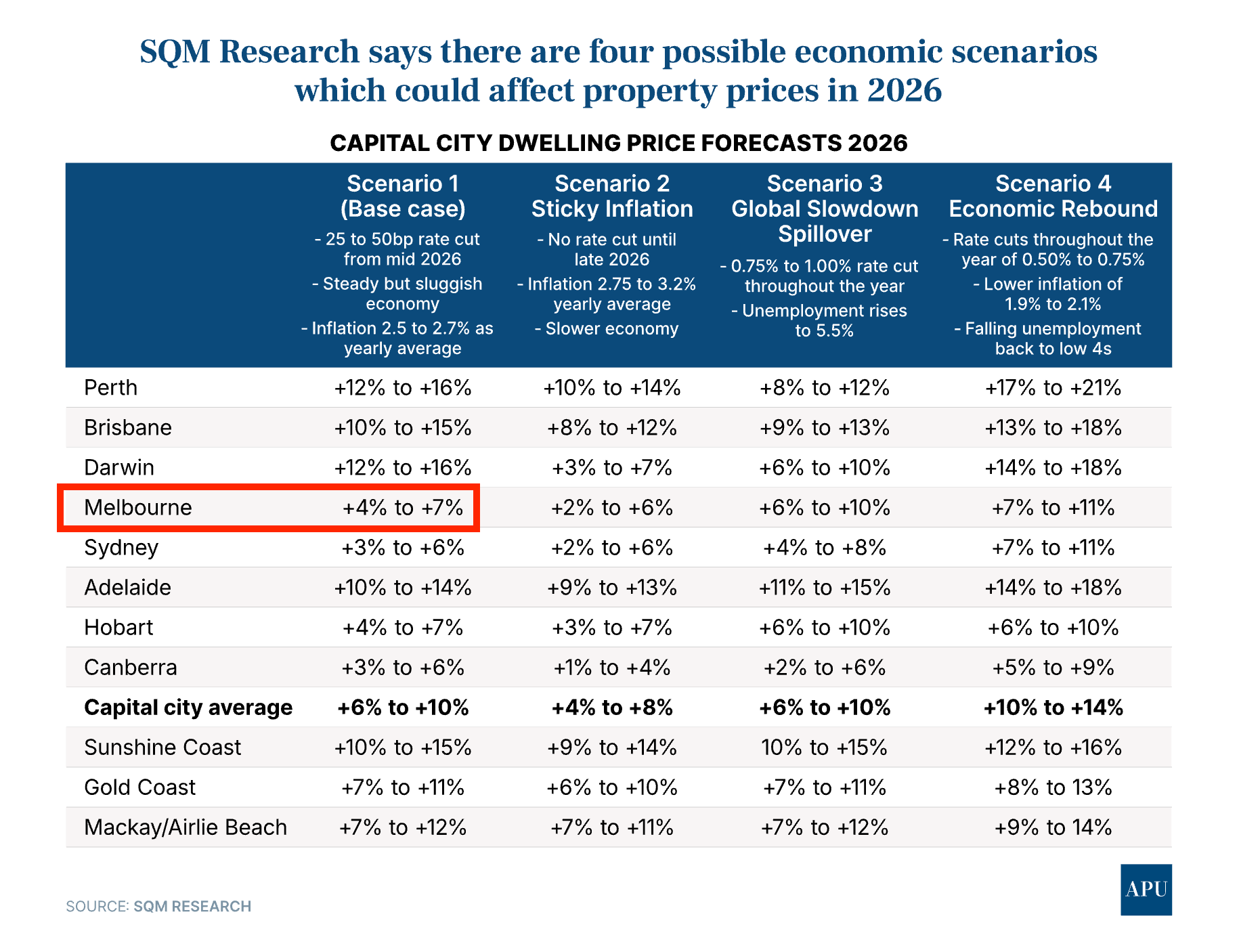
SQM Research predicts 4% to 7% growth. Domain says 6%. Not the highest numbers, but if you're looking at value for money with long-term upside, Melbourne deserves a serious look. We just don't know exactly when the turnaround hits. When sentiment shifts, prices move fast. The window won't stay open forever.
Perth: 1,881 Listings, 3 Million People
One number tells Perth's story. December listings: 1,881 homes. That's a record low — down 57% from last year. Average time to sell? Nine days. Median price $983,000. Up 1.9% in December alone. Up 15.7% over the year. Five-year gain? 89%. Nearly doubled.People say Perth has peaked. Too much, too fast. But the data says different. SQM predicts 12% to 16% growth in 2026, the highest of any capital. The fundamentals are simple. Mining cycle coming back. The population keeps growing. Housing supply is basically non-existent. Until one of those three things changes, Perth keeps running.


Brisbane: Inner Ring Gets Expensive
Brisbane median hit $1.13 million — now more expensive than Melbourne. Up 1.5% in December, up 14% over the year. But the market's splitting. Inner suburbs and premium areas are slowing down. They've run hard for years, and affordability's maxed out.

Growth is shifting outward. Ipswich, Logan, Moreton Bay — still in the $800,000 to $900,000 range. That's where interstate migrants are landing. Queensland's first home buyer policies are the best in the country. Buy new, any price, full stamp duty exemption. Plus a $30,000 grant. SQM sees 10% to 15% growth. My advice? Focus on the outer ring. At $1.13 million median, the inner city's getting out of reach. The value sits further out.

Three Buyer Groups, One Battlefield
Here's what 2026 will look like on the ground. First home buyers and investors are going to war in the same territory — the affordable end of the market.
First home buyers get stamp duty breaks. New South Wales caps at $800,000, Victoria at $600,000, and Queensland has no cap on new builds. Add the federal guarantee scheme needing just 5% deposit, and you've got massive numbers of buyers flooding into sub-$800,000 areas.
Investors see the same thing from a different angle. Premium areas have weak rental yields. The math doesn't work. But affordable areas have better cash-flow, and all that first-home buyer demand will push prices up. Then there's a third group — what I call parent-investors. Established homeowners are using their equity to help their kids buy. Their budget? Also lands in affordable areas. Three groups. Same price range. Limited supply. You can see where this goes. And there's a ripple effect. When one area gets too expensive, demand spills to the next suburb. Then the next. Gradually lifting the entire city's price floor. You're not competing with the market. You're competing with 300,000 other people who need a place to live.
The Crash That Never Comes
Every price rise brings out the crash callers. They did it in 2015, 2017, 2021. They're still doing it now. Sydney's median crossed $1 million in 2015. Today it's pushing $2 million. Those who waited for a crash have been waiting ten years while prices doubled. Why doesn't Australia crash? Three reasons.
One, APRA never went soft. Banks stress-test at 3% above the loan rate. Starting February 2026, there's a new debt-to-income cap — loans exceeding six times income can't exceed 20% of new lending.
Two, despite high household debt, defaults stay low. Banks already tested for higher rates. Borrowers can handle it.
Three, the supply shortage is structural. The 300,000 gap won't close for years. As long as demand exceeds supply, prices have a floor.
A local correction here and there? Sure. A systemic crash? I don't see it anywhere in the data.
The Takeaway
Interest rates won't decide 2026 prices. A 25-basis-point move doesn't shift a 300,000-home shortage. City selection beats timing. Sydney — look west. Melbourne — value play if you can hold. Perth — momentum continues. Brisbane — outer suburbs win. First home buyers and investors will fight over affordable areas. Make your decision quickly. Waiting for the perfect moments means missing out.
The crash risk is very low. Don't let internet fear-mongering drive your decisions. The market doesn't wait for anyone. But it rewards those who prepare.
We went through the big picture today. Real decisions need suburb-level detail — supply, demand, rents, vacancies, growth potential. That's what our Golden 21 Rules filter for.
Want to skip the guesswork? Book a free strategy session. See if VISION Gold Membership makes sense for you. Links are in the description and pinned comment.
Watch the video version of the blog on YouTube.
15 Minutes Free Consultation (Limited-Time Free Offer)
If you have any questions about Australian real estate, we invite you to use our 15 Minutes Free Consultation service. Once you have filled in the form, a professional property investment strategist will be in touch with you. They will assess your needs and provide fundamental advice. This service is designed to help answer general property-related queries. BOOK NOW.
VISION Membership
Our Flagship Service: VISION Membership. Your One-Stop Property Investment Manager – Build a Tailored Portfolio and Achieve Financial Freedom
Whether you're an employee, a professional, a business owner or even a new migrant, everyone has a financial goal for the future. The VISION Membership is designed to solve all the pain points in your Australian property investment journey through one single, comprehensive service.
By analysing your current financial situation and long-term goals, we'll tailor a property investment plan just for you. Our team will match you with the ideal mortgage structure, tax strategies, wealth planning, and legal support, empowering you to go further, faster, and smarter on your path to financial freedom.
VISION Membership is perfect for busy individuals who want a professional team to create, expand and manage their Australian investment portfolio. If you're looking for a dedicated team, including real estate investment experts, mortgage brokers, accountants, financial planners, and property solicitors, VISION Membership is your ideal solution.
Start with an obligation-free 30-minute discovery session on Zoom. BOOK NOW.
VISION Buyer’s Agent
No time for inspections? Tired of dealing with pushy selling agents? Unsure how much to offer or feeling nervous about auctions? Worried about buying the wrong property? If any of these sound like you, AusPropertyStrategy's Australia-wide VISION Buyer's Agent Service is here to help.
We provide end-to-end support to help you build an optimised property portfolio and achieve your financial goals—whether you're investing interstate, refinancing, or planning post-settlement leasing or resale. Our services cover everything from suburb research and property selection, to price negotiation, auction bidding, and post-settlement support.
Start with an obligation-free 30-minute discovery session on Zoom. BOOK NOW.
real estate australia,real estate investing,australian property,australian housing market,australian economy,australian property investment,australian property market,buying property,australian real estate,mortgage brokers brisbane,first home buyer,Australian Real Estate,Australian Real Estate Investment,Australian Property Investment,Real Estate Investment,Property Investment,Property Investment Australia,Passive Income,Positive Cash Flow,Australia Real Estate Investing,Australian Real Estate Investors,Australian Property Investors,Vision Wealth Mentors,Vision Real Estate Investors Australia,financial freedom, freedom through property investment,real estate investors,property investment,passive income,positive cash flow,real estate course,real estate courses,real estate training,australian property market,property investment brisbane,property investment sydney,melbourne property market,investing in brisbane,investing in melbourne,how to invest in property,buying properties,start investing in property,property investment strategy,how to buy investment property,property investing tips,best suburbs to invest in sydney,locations real estate,prime location,property growth by suburb,capital growth suburbs


