
Victoria's $200 Billion Debt: What It Means for Australian Property
Last updated: 2026-11-18
🔑 Key Takeaways (TL;DR)
Victoria's net debt is forecast to reach almost $200 billion by June 2030, with interest close to $12 billion a year.
On the core measure, net debt was 24% of the economy at June 2026, against a 1990s peak of around 16%.
Since 2024, the land tax threshold has been $50,000, pulling more than 328,000 extra people into land tax.
None of the three signals that turned Melbourne's last property cycle has shown up yet.
Contents
What Happened the Last Time Victoria's Debt Got This High?
How Long Did Melbourne House Prices Take to Recover After 1992?
How Heavy Is Victoria's Debt Compared With 1992?
Who Pays Victorian Land Tax Now?
Who Else Pays for Victoria's Debt This Time?
What Are Labor and the Coalition Promising on Land Tax and Stamp Duty?
Should Melbourne Build Up or Spread Out?
Will Either Side Pay Down Victoria's Debt?
Where Is Melbourne in the Property Cycle Now?
Has Melbourne's Next Property Cycle Arrived?
Frequently Asked Questions
Should You Hold, Sell or Buy Property in Victoria?
By June 2030, the Victorian government's net debt is forecast to reach almost $200 billion, after taking away its cash and financial assets. That's from the pre-election budget update, and by then interest alone will cost close to $12 billion a year. This isn't the first time Victoria's debt has been this high, and in 1992 part of the fix was a flat charge on every property in the state.
Victorians vote on November 28th, and I'm not here to tell you who to vote for. I'll set out what happened last time, how much heavier this debt is than in 1992, what each side has promised, and whether to hold, sell or buy property in Victoria. This article is based on my latest AusPropertyStrategy episode. Watch the full APS184 video on YouTube →
Examples are simplified, the election promises still have to pass parliament, and this is general information, not financial advice.
What Happened the Last Time Victoria's Debt Got This High?
The last time Victoria's debt got this high, the fix came mostly from spending cuts and asset sales. In October 1992, Labor lost office after ten years, and that month Moody's cut Victoria's rating by two levels. The new Coalition government then brought in the State Deficit Levy.
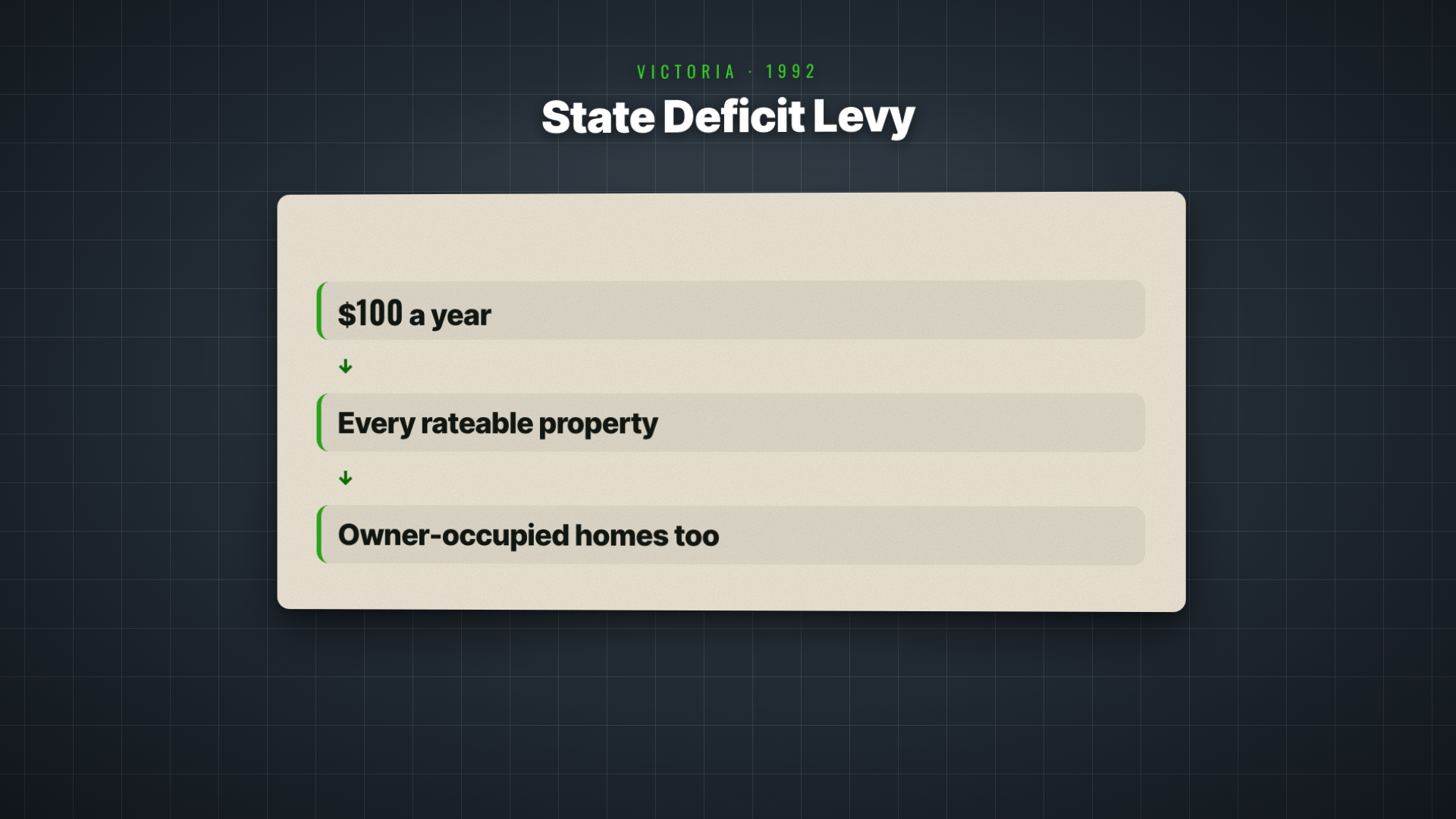
The levy was $100 a year on every rateable property, owner-occupied homes included. It was charged per property, so one home plus two rentals meant $300 a year, and it ran until July 1995. In its first year, it brought in just over $170 million.
Three years of the levy came to less than $600 million, so it was never the main tool. Most of the work came from spending cuts, with about 44,000 public sector jobs gone by the end of 1993. The other big step was selling the state's electricity and gas companies from 1995.
That money paid down debt, and in April 1998, S&P gave Victoria back its AAA rating.
The way I see it, the levy reached every front door, family homes included, but it was the visible part of the fix, not the part that did the work. Keep that in mind when you weigh up each side's promises in this election.
1990s fix | What it did | Size |
State Deficit Levy | $100 a year per rateable property, homes included, until July 1995 | Just over $170 million in year one; less than $600 million over three years |
Spending cuts | Public sector jobs cut | About 44,000 jobs gone by the end of 1993 |
Asset sales | Electricity and gas companies sold from 1995 | Paid down debt; AAA back in April 1998 |
How Long Did Melbourne House Prices Take to Recover After 1992?
Melbourne house prices took seven to eight years to recover. They peaked in the late 1980s, drifted lower, and didn't get back to that peak until 1997. Then they climbed faster than before: according to the RBA, Melbourne prices rose almost 90% from March 1997 to March 2002.
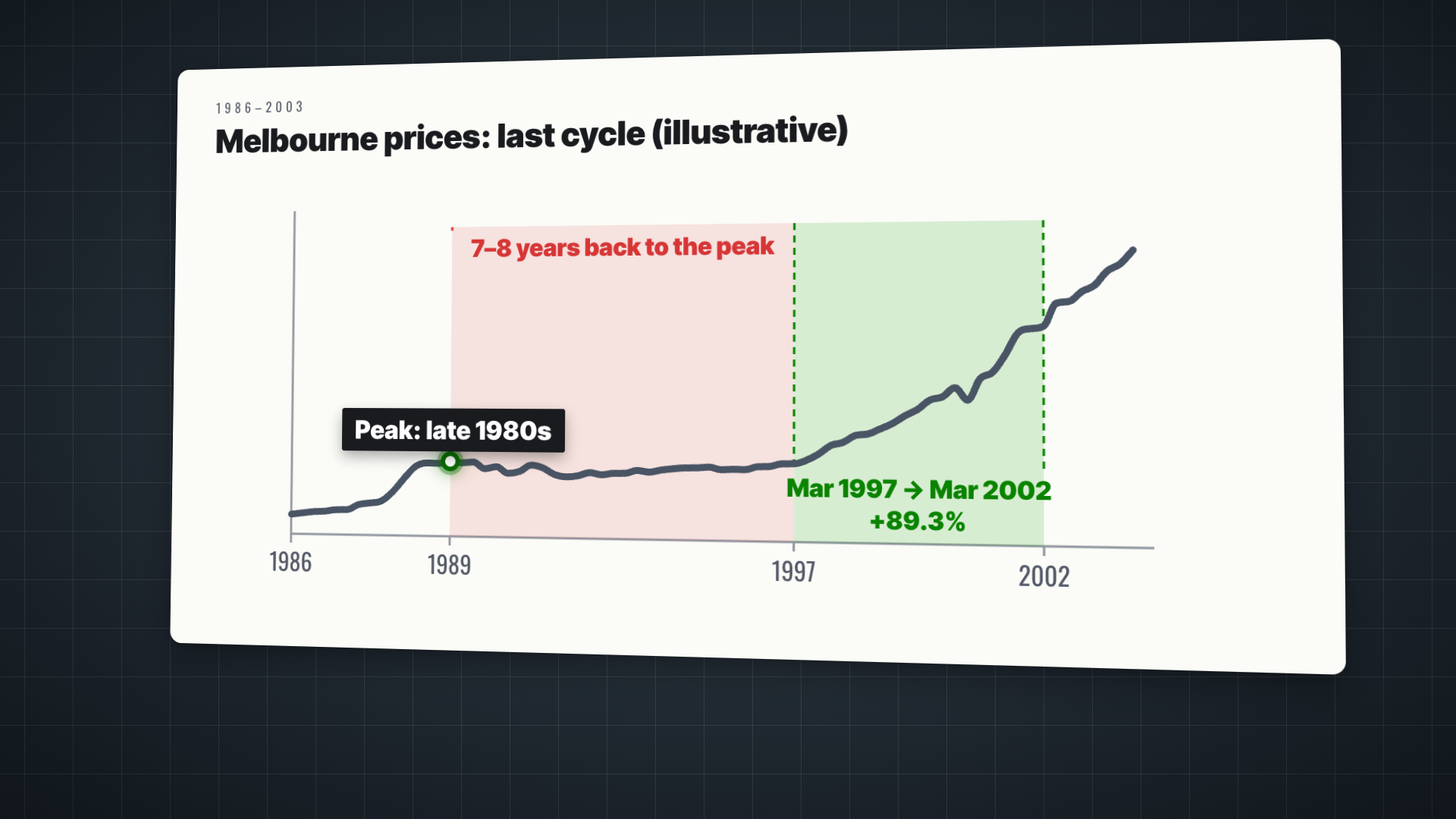
Three things showed up when prices turned. Rates came down, the state's debt came down every year, and people came back from other states. I use those three signals later in this article to check whether Melbourne's next cycle has started.
Rates moved first. The average mortgage rate was 17% in June 1989, which meant $17,000 a year in interest on a $100,000 loan. By around 1995, it was the lowest in a generation.
Debt came down every year as the spending cuts and asset sales took effect, and S&P restored the AAA rating in April 1998.
Population was the last piece. In 1993, Victoria had a net loss of 28,700 people to other states. By 1998, it recorded the decade's first net interstate gain, while prices were climbing again.
An owner who bought at the late-1980s peak waited seven to eight years just to get back to even, and only then did prices run ahead.
Signal | Early 1990s | When prices turned |
Interest rates | 17% average mortgage rate in June 1989 | Lowest in a generation by around 1995 |
State debt | High after 1992 | Came down every year |
Interstate migration | Net loss of 28,700 people in 1993 | First net gain of the decade in 1998 |
How Heavy Is Victoria's Debt Compared With 1992?
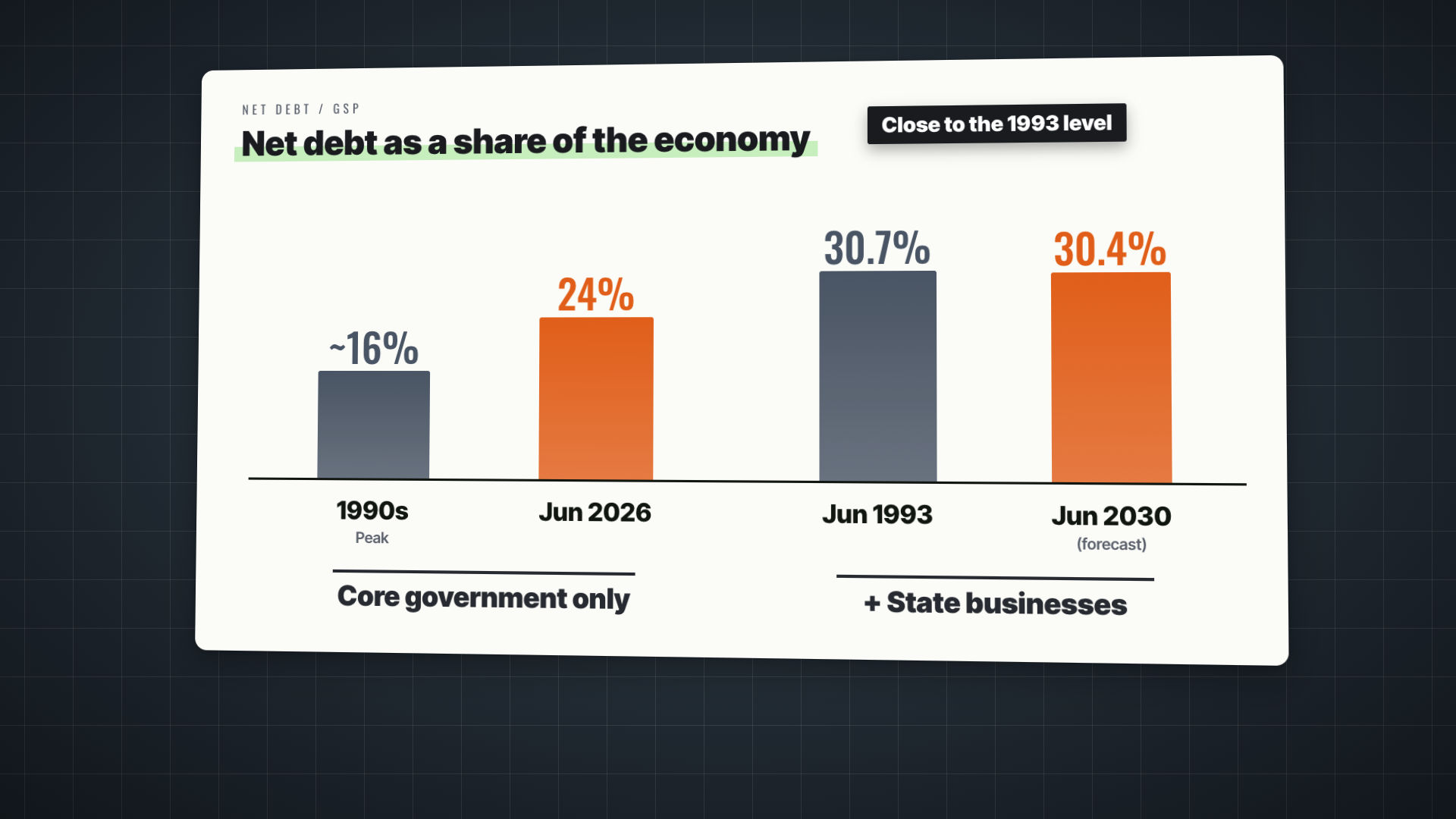
Victoria's debt is heavier today on the core measure. The Victorian Auditor-General's October 2026 report puts core net debt at $160.7 billion at June 2026, or 24% of the economy. That's almost a quarter of a year's output, while the same measure peaked at around 16% in the 1990s.
There are two ways to count it. The core government covers departments, public schools and public hospitals. Add in state-owned businesses like electricity and gas, and the May budget has net debt heading to about 30% of the economy by 2030, close to June 1993's level of just over 30%.
Debts more than 30 years apart only compare fairly as a share of the economy, because the same $10 billion weighed far more in the 1990s.
I focus on the core measure because that's the account your land tax goes into and the interest comes out of. In the 1990s, almost half the debt sat with the state-owned businesses, and selling them turned the finances around.
The speed is as striking as the size. In June 2018, core net debt was under 5% of the economy, and eight years later it's 24%. The money mostly went on big infrastructure and the pandemic, when the state paid people and businesses through the lockdowns while tax revenue fell with profits.
The budget update has interest at about $8.9 billion in 2026-27 and close to $12 billion by 2029-30. That's about $33 million a day, which I'd call close to unsustainable.
Measure | 1990s | Now |
Core government net debt | Peaked at around 16% of the economy | $160.7 billion at June 2026, 24% of the economy |
Including state-owned businesses | Just over 30% in June 1993 | Heading to about 30% by 2030 (May budget) |
Credit rating | Moody's cut two levels in October 1992; AAA back in April 1998 | S&P cut two notches in December 2020 |
Who Pays Victorian Land Tax Now?
Investment property owners pay the part of the debt plan that matters most for property, which is land tax. The May 2023 COVID Debt Repayment Plan aims to pay back about $31.5 billion over ten years. Land tax is a yearly charge on the value of the land you own apart from your home.
It's based on what you held on December 31st of the year before. The tax-free threshold used to be $300,000 of taxable land, and from 2024 it's $50,000, charged in brackets a bit like income tax. That lower threshold is what this election could change.
Here's how the brackets work in practice. If your share of the land under one Melbourne investment apartment is worth $80,000, you pay a flat $500 a year. Buy a second one and push the total up to $120,000, and it's a flat $975.
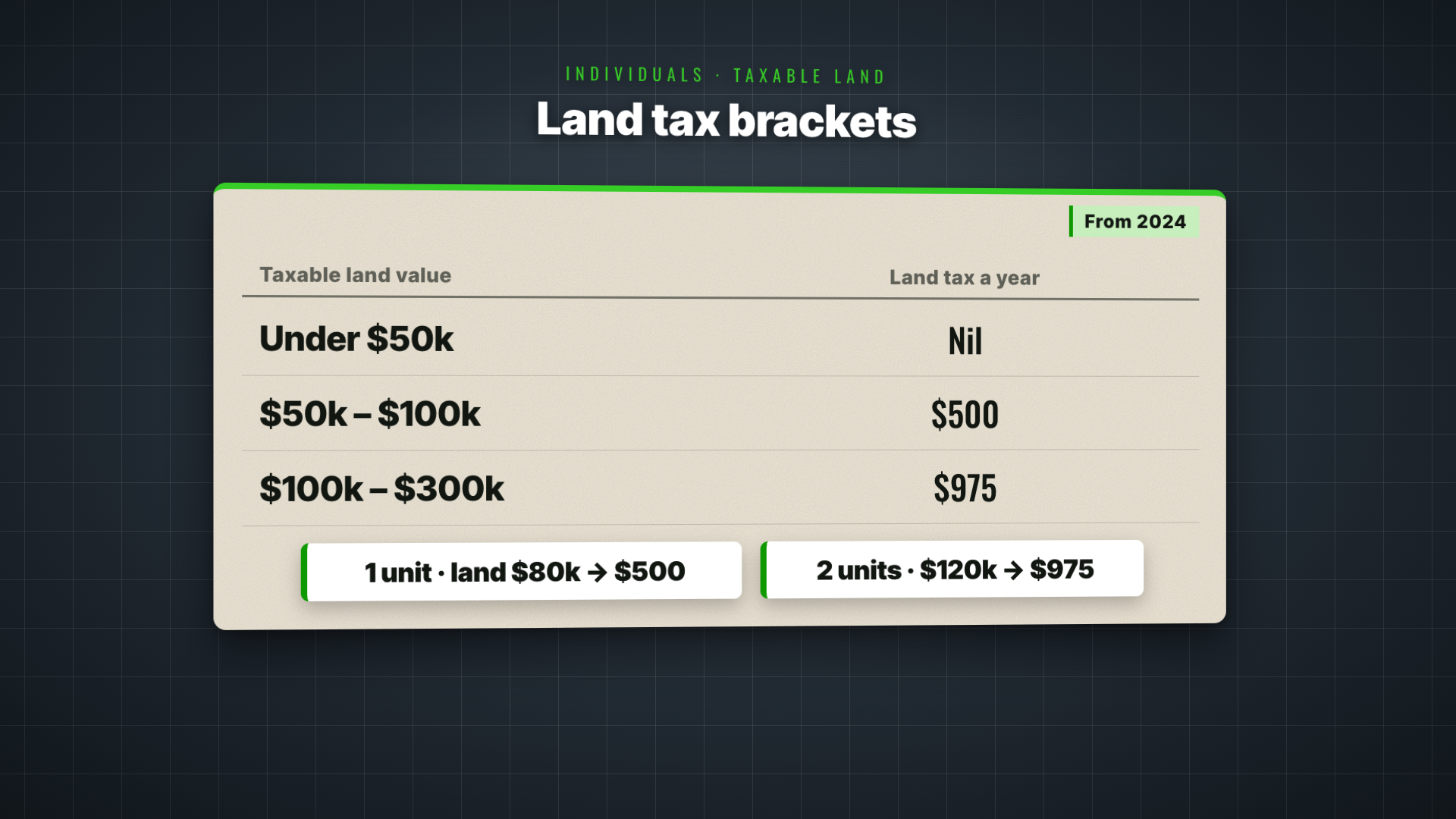
Above $300,000, you pay the normal land tax plus $975 and an extra 0.1% on the rate. That's a temporary measure running until 2033.
The lower threshold pulled more than 328,000 extra people into land tax. In 2025-26, it raised just over $1.1 billion, which covers about a month and a half of interest. So investors are paying more, but the money barely touches the interest bill.
Taxable land (excluding your home) | Land tax | Note |
$80,000, one apartment's land share | Flat $500 a year | Simplified example from the video |
$120,000, two apartments | Flat $975 a year | Simplified example from the video |
Above $300,000 | Normal land tax plus $975 and an extra 0.1% on the rate | Temporary, until 2033 |
Who Else Pays for Victoria's Debt This Time?
Everyone who lives in Victoria pays for the debt, not the politicians, and three groups carry most of it: investment property owners, big business and future taxpayers. Investors also face charges beyond land tax, from the emergency services levy to extra costs on short stays, empty homes and overseas buyers.
Since July 2023, businesses with payrolls over $10 million pay extra payroll tax, a state tax on the wages a business pays. Future taxpayers carry what's left, because unpaid debt keeps costing interest, and if that gets too much to carry, Victorians will cover it themselves.
The emergency services levy replaced the fire services levy in July 2025, at the same rate for owner-occupiers and landlords. Stays under 28 days, which is mostly on Airbnb, carry a 7.5% levy. Overseas buyers pay an extra 8% stamp duty, plus extra land tax every year.
Payroll tax is a tax on giving people jobs, and I don't think it makes any sense. For future taxpayers, it's like owning an apartment in a strata building: if the lift breaks down, you either sell up or wait for a huge repair bill.
Unlike 1992, when the $100 levy hit owner-occupiers too, the land tax changes from 2024 only hit investment property, which tells me the state isn't trying to encourage property investment at all.
Who pays | Charge | Detail |
Investment property owners | Land tax | $50,000 threshold from 2024 |
Owner-occupiers and landlords | Emergency services levy | Replaced the fire services levy in July 2025, same rate for both |
Short-stay hosts | Short-stay levy | 7.5% on stays under 28 days |
Owners of homes left empty too long | Charge on empty homes | 1% of value, rising to 3% |
Overseas buyers | Extra stamp duty and land tax | 8% extra stamp duty, plus extra land tax every year |
Big business | Extra payroll tax | Payrolls over $10 million, since July 2023 |
Future taxpayers | Interest on unpaid debt | Close to $12 billion a year by 2029-30 |
📌 Thinking about your own situation?
Book a free 15-minute call with one of our property investment strategists and get a straight answer, no strings. For the full done-for-you path, from strategy, lending and property selection to portfolio, tax structure and wealth planning, book a free 30-minute Discovery Session and see how VISION Gold Membership works.
What Are Labor and the Coalition Promising on Land Tax and Stamp Duty?
Both sides would lift the $50,000 land tax threshold, on different timelines. The Coalition proposed its changes first, in May 2026, and would lift the threshold by $50,000 a year, back to $300,000 by 2031-32. Labor would raise it by $25,000 a year from 2027-28, four times, to $150,000.
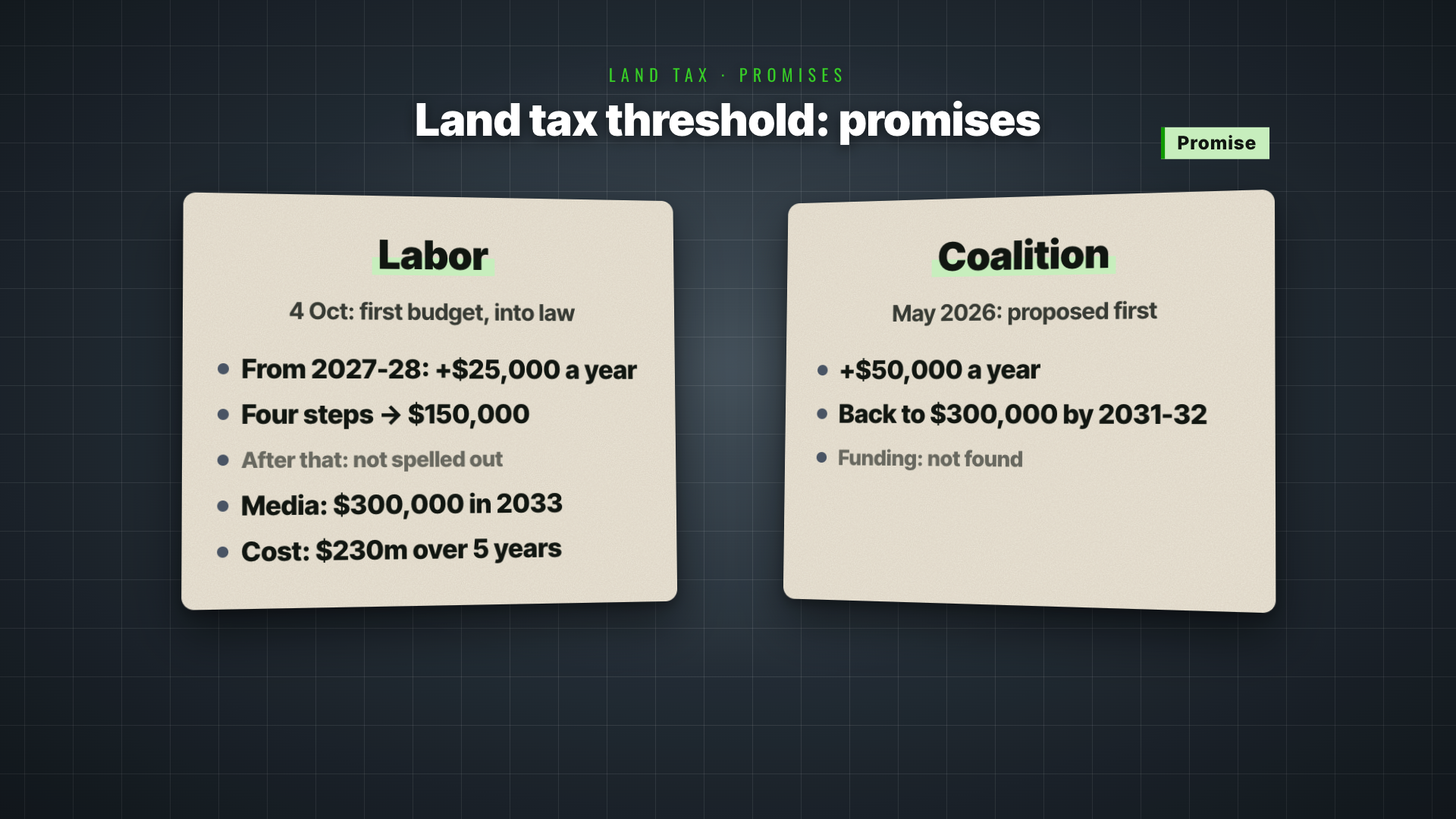
Labor announced its plan on October 4th, promising to cut land tax in its first budget after the election and write it into law. It hasn't spelled out later steps, and media reports have it back at $300,000 in 2033. Labor puts the cost at $230 million over five years.
Labor says that's paid for by merging the government car fleet, delaying some level crossing removals and cutting senior executive jobs. For the Coalition's plan, I couldn't find where the money comes from, and less tax revenue has to be made up somewhere.
The gap matters if your taxable land is worth $200,000. The Coalition's plan takes you out of land tax in year four, while Labor's first four steps still leave you paying $975.
On stamp duty, the Coalition promises none for first home buyers under $1 million, while Labor keeps the current exemption under $600,000 and the partial discount up to $750,000. They also split on the emergency services and short-stay levies (see the table).
Neither land tax plan is law yet. The threshold sits in the Land Tax Act, so changing it needs both houses, and Labor doesn't hold a majority on its own in the 40-seat upper house.
Promise | Coalition | Labor |
Land tax threshold | Up $50,000 a year, back to $300,000 by 2031-32 | Up $25,000 a year from 2027-28, four times, to $150,000; media reports $300,000 in 2033 |
$200,000 of taxable land | Out of land tax in year four | Still $975 after the first four steps |
Cost and funding | Alex couldn't find a funding source | $230 million over five years: car fleet merger, delayed level crossing removals, fewer senior executive jobs |
Stamp duty for first home buyers | None under $1 million | Current exemption under $600,000, partial discount up to $750,000 |
Emergency services levy | Back to the old fire services levy | Kept, with the farmland rate capped |
Short-stay levy | Scrapped | No change announced |
Should Melbourne Build Up or Spread Out?
Housing supply matters most, because it shapes the market, the economy and public services for years. Put simply, the Coalition wants Melbourne to spread out, and Labor wants it to build up. The Coalition would scrap Labor's high-rise activity centres and speed up approvals for new land on the edge of the city.
Under Labor's activity centres, if your home is near a train station or tram stop, taller and denser housing could be allowed around it. Labor says that adds more than 300,000 homes by 2051. Each approach has a clear trade-off for prices, wages and public services.
Building up puts new homes on the existing train and tram network. It tends to lift wages over time, because employers find the right workers more easily when people and jobs sit close together. But it changes established streets, and local pushback can slow it down.
Spreading out can deliver homes faster at first, because land is cheaper and approvals are quicker. Over time it costs more, because every new suburb needs roads, schools and hospitals, which usually arrive years after the houses.
The biggest difference is prices. The worst shortage is in established areas close to jobs and transport, so Labor's plan does more to ease prices in those suburbs. I still prefer the expansion approach, because it protects existing investors and gives young people a cheaper way in. That's my view, and the call is yours.
Approach | Strengths | Costs |
Build up (Labor's activity centres) | Homes on the existing train and tram network; more supply where the shortage is worst; tends to lift wages over time | Changes established streets; local pushback can slow it down |
Spread out (the Coalition's plan) | Faster at first, with cheaper land and quicker approvals; a cheaper way in for young buyers | Roads, schools and hospitals arrive years later; does less for inner and middle ring prices |
Will Either Side Pay Down Victoria's Debt?
It's not clear yet. Labor ran a $2.4 billion surplus on day-to-day spending in 2025-26, but the Auditor-General says its plan doesn't spell out when or how debt gets paid down. The Coalition says it'll get back to surplus within six years and freeze public service hiring.
Labor will keep building the Suburban Rail Loop, the line around Melbourne's middle suburbs, with some add-ons trimmed, and another independent review says that will save $2 billion. I don't believe it at all. The Coalition would pause the Suburban Rail Loop for a review.
Its hiring freeze would last until numbers fall back to 2014-15 levels, which it says saves $22 billion over ten years. The Australia Institute estimates that means more than 30,000 fewer jobs in the public service sector.
On tax, the Coalition promises no new taxes and would lift the payroll tax threshold to $1.2 million by 2028-29. It's like running a business, where you cut what needs cutting and back what needs backing.
In the 1990s, the turnaround came from spending cuts and selling state-owned businesses, and the debt came down every year. That's the test I'd apply to both plans: is the debt actually falling? These are still only promises, and nothing changes for you until the laws are amended.
Budget plan | Labor | Coalition |
Surplus | $2.4 billion on day-to-day spending in 2025-26 | Back to surplus within six years |
Paying down debt | Plan doesn't spell out when or how (Auditor-General) | Public service hiring freeze to 2014-15 levels, which it says saves $22 billion over ten years |
Suburban Rail Loop | Keep building, some add-ons trimmed | Pause for a review |
Taxes | Land tax threshold steps from 2027-28 | No new taxes; payroll tax threshold to $1.2 million by 2028-29 |
Where Is Melbourne in the Property Cycle Now?
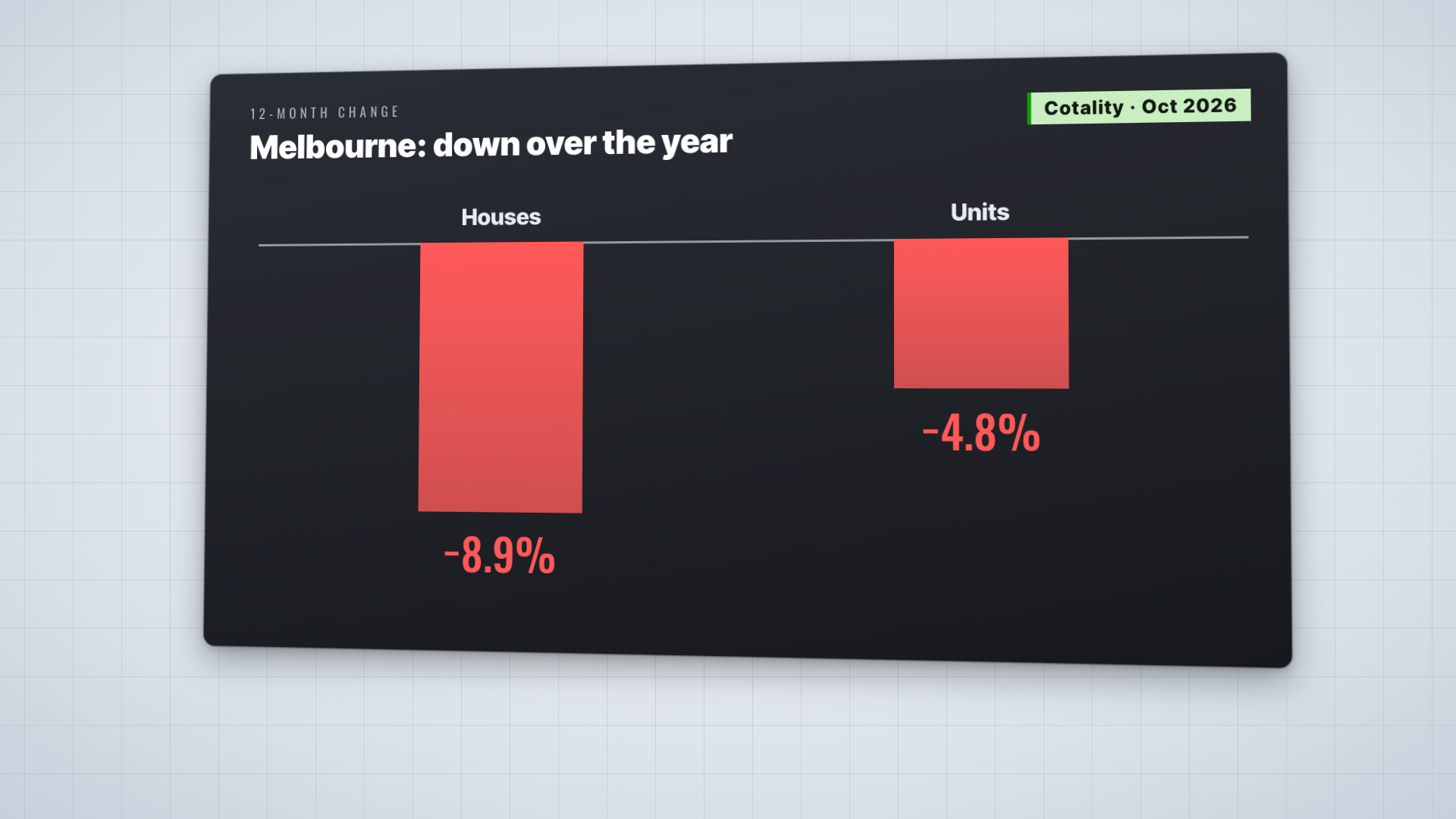
Melbourne is still below its last peak. Cotality's October 2026 data has prices down 7.6% over the year, to a median of just over $770,000, with houses down 8.9% and units down 4.8%. Melbourne peaked in March 2022 and is still 8.2% below that peak.
Rents and rates aren't helping. The Real Estate Institute of Victoria's May 2026 data has the median Melbourne house rent at $590 a week, up 1.7%. The RBA has raised five times in 2026, taking the cash rate to 4.85% from November 3rd.
Over ten years, Melbourne is up just over 20%, while Brisbane, Adelaide and Perth have roughly doubled. The national market only peaked in March 2026, four years after Melbourne. With vacancy up to 2.8%, rentals are taking longer to fill.
The budget update assumes prices go back to their long-run growth of about 6% a year. Every 1% rise brings the state over $200 million a year, so the government has a built-in reason to want prices to rise.
Population is growing, but not from the rest of Australia. Victoria grew 1.6% in the year to March 2026, the second-fastest in the country, mostly from overseas. Net interstate migration added just 82 people all year, so other Australians aren't choosing Melbourne.
Indicator | Figure | Period and source |
Melbourne prices | Down 7.6%, median just over $770,000 | Year to October 2026, Cotality |
Houses and units | Houses down 8.9%, units down 4.8% | Year to October 2026, Cotality |
Distance from peak | 8.2% below | Peak in March 2022 |
Median house rent | $590 a week, up 1.7% | May 2026, REIV |
Vacancy | 2.8% | REIV |
Cash rate | 4.85%, after five hikes in 2026 | From November 3rd |
Investor mortgage rates | Close to 7% | Cotality |
Population growth | 1.6%, second-fastest in the country | Year to March 2026 |
Net interstate migration | 82 people | Year to March 2026 |
Has Melbourne's Next Property Cycle Arrived?
Not yet. None of the three signals that turned the last cycle has shown up. In the 1990s, mortgage rates fell to a generational low, debt shrank every year, and interstate migration turned positive by 1998. Now rates are still rising, debt is still growing, and interstate migration is 82 people a year.
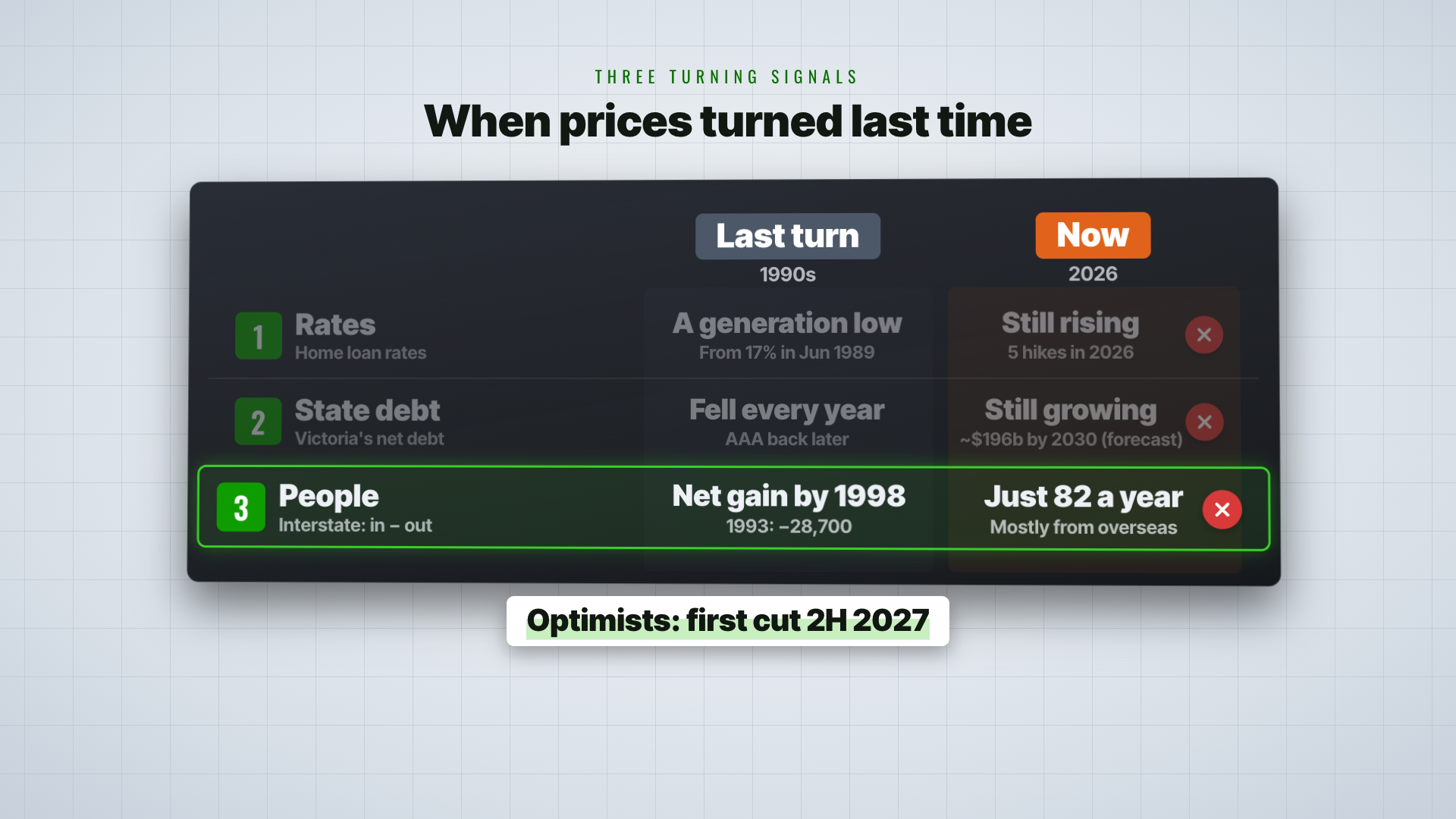
I'm not saying Melbourne prices will keep falling, only that the signals that turned the last cycle aren't here yet. That's a comparison with history, not a forecast. One thing does look familiar: Melbourne has spent four and a half years below its peak, and last time recovery took seven to eight years.
Over the next 12 to 18 months, watch interest rates first and population second. The signs of a turn are the same three as last time: the RBA cutting rates, Victoria's debt coming down, and higher wages pulling people in from other states.
This election can't move the two biggest drivers, because the RBA sets rates and Canberra sets migration, while the state controls tax, planning, spending and borrowing. A Labor win means things carry on, with change coming slowly. A Coalition win means bigger changes, but I think it's unlikely to turn the market around unless Victoria pays down its debt, grows wages and draws people in from interstate.
If neither side wins a majority, a hung parliament means a tug-of-war over every policy. That's the worst result for investors, because what they fear isn't bad news, it's uncertainty.
Signal | 1990s | Now |
Interest rates | Mortgage rates fell to a generational low | Cash rate 4.85% and still rising; no cut expected before the second half of 2027 |
State debt | Shrank every year | Still growing |
Interstate migration | Turned positive by 1998 | 82 people in the year to March 2026 |
Frequently Asked Questions
How much does Victoria owe?
Victoria's net debt is forecast to reach almost $200 billion by June 2030, after taking away cash and financial assets, according to the pre-election budget update. On the core government measure, the Auditor-General put net debt at $160.7 billion at June 2026, or 24% of the economy.
What was Victoria's State Deficit Levy?
It was a flat $100 a year on every rateable property in Victoria, owner-occupied homes included, brought in by the new Coalition government after October 1992. Charged per property, it ran until July 1995, raising just over $170 million in its first year and less than $600 million in all.
What is the land tax threshold in Victoria?
From 2024, the tax-free threshold is $50,000 of taxable land, down from $300,000. Land tax is charged in brackets on the land you own apart from your home, based on what you held on December 31st of the year before. A land share worth $80,000 pays a flat $500 a year.
What are Labor and the Coalition promising on Victorian land tax?
The Coalition would lift the threshold by $50,000 a year, back to $300,000 by 2031-32. Labor would raise it by $25,000 a year from 2027-28, four times, to $150,000, and media reports have it back at $300,000 in 2033. Either change needs both houses of parliament.
How long did Melbourne house prices take to recover in the 1990s?
About seven to eight years. Melbourne prices peaked in the late 1980s, drifted lower and didn't get back to that peak until 1997. Then they climbed faster than before: according to the RBA, Melbourne prices rose almost 90% from March 1997 to March 2002.
What signals would show Melbourne's next property cycle has started?
The same three that turned the last one: the RBA cutting rates, Victoria's debt coming down, and higher wages pulling people in from other states. None has shown up yet. The cash rate is 4.85%, debt is still growing and net interstate migration added just 82 people in the year to March 2026.
Should You Hold, Sell or Buy Property in Victoria?
My take is that Victoria's debt won't decide your next move on its own, but it shapes what the state does to property owners. On the core measure, the debt is heavier as a share of the economy than in the 1990s, investors already carry the land tax changes from 2024, and neither side's promise is law yet. The two biggest drivers sit outside this election, because the RBA sets rates and Canberra sets migration. Watch rates and interstate migration, because the next cycle will show up there before it shows up in prices. And if neither side wins a majority, expect a tug-of-war over every policy, which is the uncertainty investors fear most.
Check your taxable land against $50,000
Work out your land tax under both plans
Follow the land tax bill through parliament
Watch the RBA's rate decisions
Track net interstate migration
Check Cotality's Melbourne figures
Count your short-stay and empty-home costs
Book your free strategy call today.
Prefer to watch? See the full APS184 video on YouTube →
About the author
Alex is the founder of AusPropertyStrategy, a Sydney-based licensed buyer's agent and property investment strategist with dual master's degrees in accounting and an MBA, and a former general manager of a listed company. For APS184, he went through Victoria's debt and Melbourne's property market from the 1990s to today, alongside the Victorian Auditor-General's October 2026 report, the pre-election budget update, Cotality's October figures and both sides' election promises.
What we tested: today's debt against 1992 on two measures (the core government, and including state-owned businesses) as a share of the economy; land tax under the $50,000 threshold for one and two investment apartments; the gap between the two land tax plans for $200,000 of taxable land; and the three signals that turned Melbourne's last cycle, checked against today's rates, debt and interstate migration.
About the figures: debt, interest and budget figures are from the Victorian Auditor-General's October 2026 report, the May budget and the pre-election budget update. Melbourne price figures are from Cotality's October 2026 data, and rent and vacancy figures are from the Real Estate Institute of Victoria. The land tax examples are simplified, and the election promises still have to pass parliament. This is general information, not financial advice.


