

RBA Rate Hike to 4.10% — 4 Forces Reshaping Australian Property in 2026
Last Updated: 2026-03-18
TL;DR — Key Takeaways
The RBA raised the cash rate 25 basis points to 4.10% with a historic 5:4 split — but all nine board members agreed rates need to go higher, making a May hike to 4.35% highly likely.
Four forces are converging simultaneously: inflation at 3.8%, GDP running above the RBA's 2% speed limit at 2.6%, a once-in-a-generation oil shock pushing Brent Crude past $100, and new APRA lending caps tightening credit.
Australia's property market is now K-shaped: Perth (+22% annual), Brisbane (+17.3%), and Adelaide (+11%) are sprinting, while Sydney and Melbourne sit flat with falling clearance rates.
Mortgage stress is projected to hit 1.43 million households (28.9%) after banks pass through the full rate increase in April.
Five actionable strategies — stress-test at current rate +0.50%, evaluate fixed vs variable splits, prioritise cash-flow assets, restructure before tax changes, and target supply-constrained cities if you have capacity.
Table of Contents
What Credit and Regulatory Forces Are Tightening at the Same Time?
What Are 5 Strategies to Protect Your Property Portfolio Now?
Why Did the RBA Hike Rates Again in March 2026?
The RBA raised the cash rate 25 basis points to 4.10% on March 17, 2026, reversing three cuts made in 2025 that had taken rates from 4.35% down to 3.60%. The board voted 5:4 — the closest split on record — yet every member agreed rates needed to rise.
The reversal caught the market off guard. Between February and August 2025, the RBA cut three times. Then on February 3, 2026, it flipped and hiked to 3.85%. Within six months Australia went from a cutting cycle straight back into hikes. By March, ASX futures priced a 70% probability of a further increase. Reuters polled 30 economists and 77% called a hike. All four major banks — CBA, Westpac, NAB, and ANZ — forecast the same path: March to 4.10%, May to 4.35%.
This article is based on Alex's in-depth analysis on AusPropertyStrategy —
As I explained in the video, the conditions for a hike were already baked in before geopolitics made headlines. Inflation was climbing, the labour market was tight, and GDP was running above the RBA's speed limit. Four forces — stacking one on top of the other — explain how we got here and where property is headed next.
How Bad Is Australian Inflation Right Now?
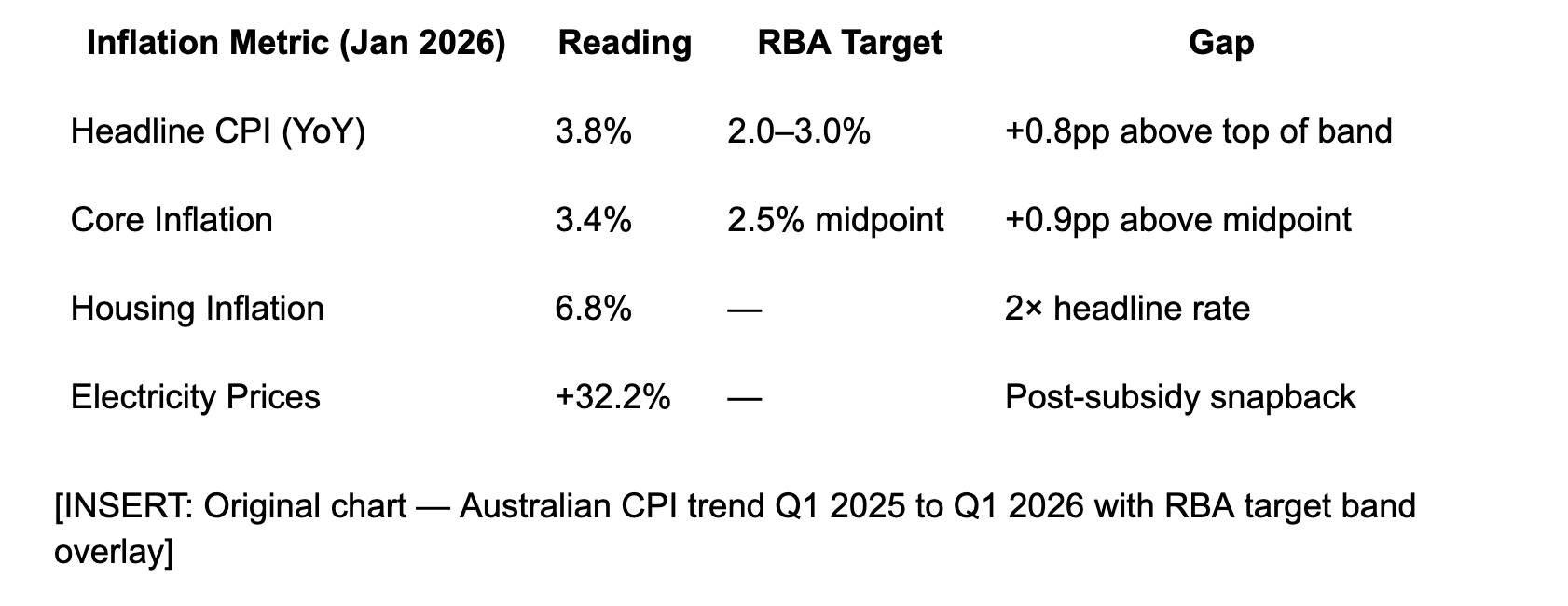
Australian inflation is running at 3.8% year-on-year as of January 2026, more than 50% above the midpoint of the RBA's 2–3% target band. Core inflation sits at 3.4%, confirming broad-based price pressure rather than isolated spikes.
The headline figure only tells part of the story. Housing inflation hit 6.8%. Electricity prices surged 32.2% after federal and state subsidies expired, snapping costs straight back to unsubsidised levels. The RBA's own February statement acknowledged the trajectory in plain language: "inflation rebounded significantly in the second half of 2025." That assessment was written before the Iran conflict — meaning domestic conditions alone justified action.
In my experience tracking RBA communications over multiple cycles, when the central bank uses the word "significantly" in a policy statement, the internal data is worse than the published numbers suggest. The February statement was the clearest forward signal I have seen since 2022.
Why Won't the Australian Economy Slow Down?
Australia's economy is growing at 2.6% annually (December quarter GDP: 0.8% quarterly), well above the RBA's estimated potential growth rate of around 2%. Running above the speed limit feeds inflation pressure, and the RBA's only lever is the interest rate brake.
The labour market reinforces the problem. Unemployment sits at 4.1%, employment hit a record high, and 50,000 full-time jobs were added in a single month. The RBA described conditions as "slightly tighter than expected" — central-bank language for saying the economy is refusing to cooperate with the intended slowdown. Wages grew 3.4% on the Wage Price Index, but with CPI at 3.8%, real wages are going backwards. Workers feel poorer even as headline employment stays strong.
This combination — above-trend GDP, record employment, sticky services inflation — left the RBA with zero room to wait. From a property investment standpoint, the paradox matters: a strong economy supports rents and occupancy, but it also guarantees further rate hikes that compress borrowing power. The investors who recognise this tension early are the ones who position correctly.
How Is the Oil Shock Feeding Into Australian Prices?
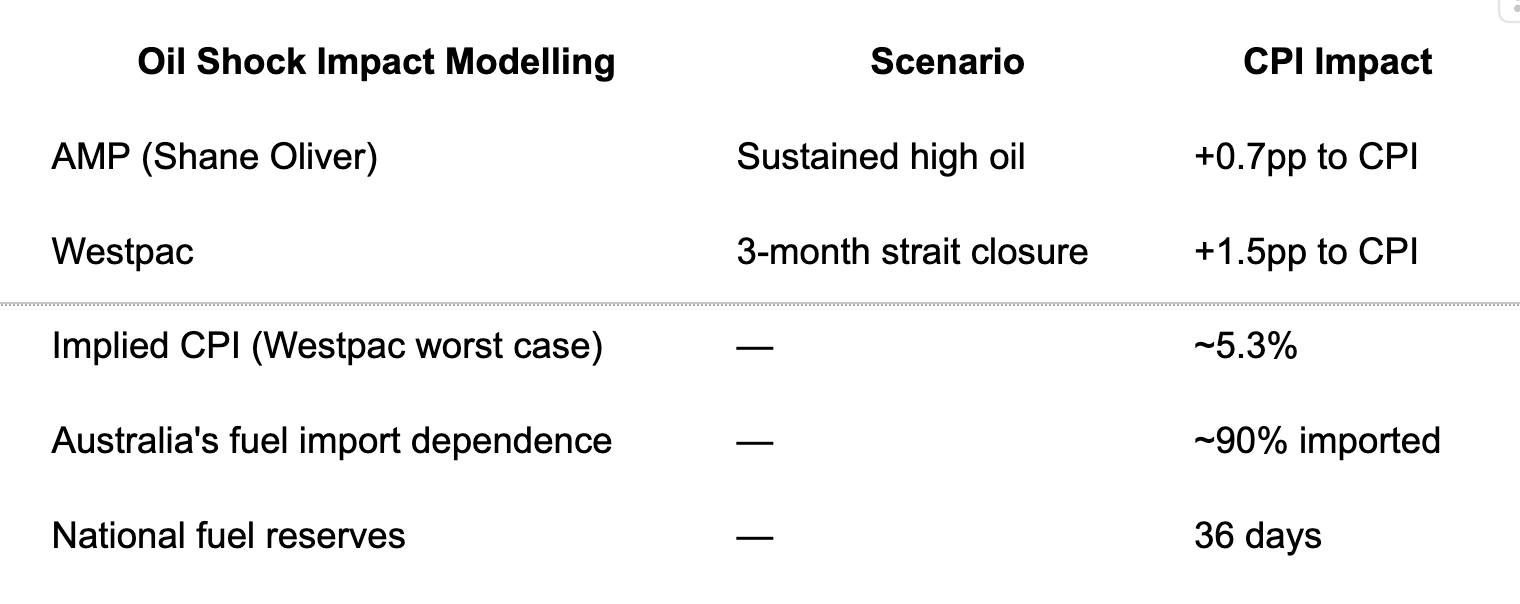
The Strait of Hormuz blockade following US–Israeli operations against Iran in late February 2026 disrupted roughly 20% of global oil supply — the largest disruption in history according to the IEA. Brent Crude surged from approximately $70 pre-conflict to a peak of $119, settling at $103 as of the most recent Friday.
Australia imports approximately 90% of its liquid fuel, and national reserves cover just 36 days. The transmission chain runs directly from the Persian Gulf to Australian supermarket checkouts: oil prices rise, petrol stations follow, then transport costs, then food and household goods. AMP's Shane Oliver estimates sustained high oil adds 0.7 percentage points to CPI. Westpac's modelling is harsher: three months of strait closure adds 1.5 points, which would push inflation close to 5%.
Even if oil prices fall tomorrow, the second-round effects — transport, food, services repricing — carry a lag of six to twelve months. As I told our members in February's briefing, inflation takes the lift going up and the stairs coming down. The RBA Governor made the same point at the press conference: Iran was "not the reason for today's hike," but it accelerated the timeline from "maybe May" to "has to be March."
What Credit and Regulatory Forces Are Tightening at the Same Time?
Four simultaneous regulatory and lending constraints are converging with the rate hike — APRA's debt-to-income cap, potential negative gearing reform, the 3% serviceability buffer, and fixed rates running ahead of the cash rate. This convergence makes the current cycle structurally different from anything in the past decade.
APRA's DTI cap took effect on February 1, 2026. Banks cannot have more than 20% of new quarterly lending going to borrowers with a debt-to-income ratio above six. Only 5.5% of borrowers sit above that threshold today, but every rate increase shrinks what the same income can borrow — pushing more applicants toward the ceiling. New builds are exempt, which remains the one pocket of breathing room.
Treasurer Chalmers confirmed on February 27, 2026 that Treasury is modelling changes to negative gearing and capital gains tax: potentially capping negative gearing at two investment properties and cutting the CGT discount from 50% to 33%, targeting the May budget. Nothing is legislated yet, but the rumour alone is shifting sentiment among leveraged investors. Meanwhile, the 3% serviceability buffer means banks test borrowers at an all-in rate of 9.10%. CBA's two-year fixed rate already sits at 6.04%, three-year at 6.29%, and not a single lender offers a product under 5% — down from 29 lenders a month ago to zero.
Looking for a personalised stress test of your portfolio under these conditions? Book a free 15-minute discovery call with our AusPropertyStrategy team — we run rate-shock and tax-reform scenarios tailored to your specific holdings. Book a Discovery Call →
Which Property Markets Are Winning and Losing in 2026?
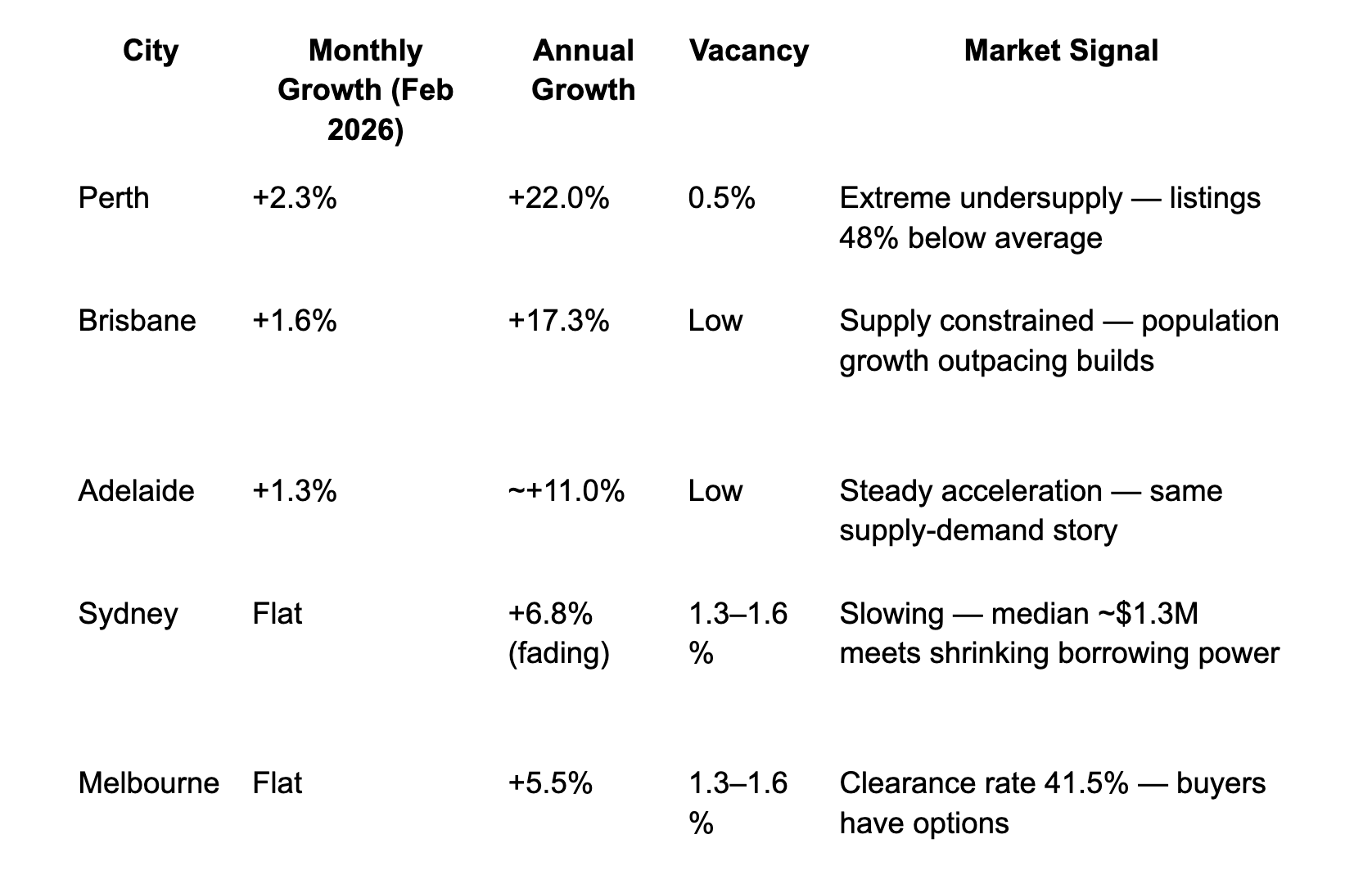
Australia's property market has split into a pronounced K-shape: Perth, Brisbane, and Adelaide are accelerating while Sydney and Melbourne sit flat. The divergence is driven by the gap between population growth and building supply in each city.
Cotality's February 2026 data tells the story clearly. Perth posted +2.3% for the month and +22% for the year, with vacancy at 0.5% and listings 48% below the five-year average — there simply are not enough homes. Brisbane grew +1.6% monthly and +17.3% annually. Adelaide added +1.3% monthly and roughly +11% for the year. On the other side, Sydney and Melbourne recorded zero monthly growth in February. Sydney's 6.8% annual gain is fading fast, and Melbourne at 5.5% still has not recovered to its March 2022 peak. Clearance rates confirm the cooling: Sydney at 65.5% (lowest of 2026), Melbourne at just 41.5%.
This is why we use the "11 Golden Rules" at AusPropertyStrategy when making investment decisions — assessing population growth, building approvals, rate sensitivity, supply-demand balance, and policy direction across every target city. Our VISION all-weather approach means cross-state allocation, full-cycle thinking, and rebalancing as city cycles rotate. The era of buying with your eyes shut is over. 2026 rewards precision and punishes guesswork.
What Did the RBA Statement Actually Reveal?
Five signals from the March 2026 statement and press conference point to a clear policy direction: inflation is the priority, another hike in May is highly likely, and the RBA is prepared to accept economic pain to anchor expectations.
Signal 1 — Inflation outlook. The RBA believes inflation is not just high but accelerating. Once expectations become unanchored, pulling them back costs exponentially more. That framing signals aggressive intent.
Signal 2 — The 5:4 vote is misleading. Every board member agreed rates needed to rise. The four dissenters preferred waiting until May, not holding steady. The direction is unanimous.
Signal 3 — The Governor's priorities. Two lines from the press conference are telling. On Iran: "not the reason for today's hike." On recession risk: "we may have to face that consequence." Inflation comes first; growth comes second.
Signal 4 — May is nearly locked in. Based on the Governor's guidance that "the Board will do what it considers necessary," markets price a 68% chance of another 25bp hike to 4.35% in May. All four major banks hold that forecast. If the February CPI print on March 25 does not pull back sharply, May is confirmed.
Signal 5 — Housing and credit stress. All four banks passed through the full 25bp increase, with NAB going first on March 27. Variable rates broke 6% for the first time this cycle. Roy Morgan estimates roughly 1.32 million households under mortgage stress (27%), projected to hit 1.43 million (28.9%) after full pass-through in April. Consumer confidence dropped to 73.4 — a three-year low. Inflation expectations jumped to 6.1%, exactly the unanchoring the RBA fears most.
What Are 5 Strategies to Protect Your Property Portfolio Now?
With another hike likely in May and four forces converging simultaneously, property investors need to act before the next move — not after. These five strategies are ranked by urgency.
Strategy 1 — Stress-test your cash flow at current rate + 0.50%. Run your numbers tonight: income minus repayments minus living costs at 4.60%. If the result is positive, you have breathing room. If negative, act now — increase rents, restructure your loan, or consider offloading the weakest-performing property dragging down the portfolio.
Strategy 2 — Evaluate fixed versus variable. Locking in above 6% stings, but certainty has real value in a hiking cycle. If you believe rates decline after 2027, variable gives more flexibility. Many experienced investors split their exposure — 50/50 or 30/70 fixed-to-variable — matching the split to their cash-flow tolerance.
Strategy 3 — Prioritise cash flow over capital growth. National rents rose 6.6% over the past year. If you have not adjusted rents in 12 months, you are leaving money on the table. New builds carry three advantages right now: the APRA DTI exemption, higher depreciation, and an easier path to positive cash flow. My personal view: do not panic-sell quality assets. Every hiking cycle ends. A good property sold today does not come back looking for you.
Strategy 4 — Restructure before the rules change. If you hold three or more investment properties, sit down with your accountant now. Personal name, company, trust, SMSF — different structures produce wildly different outcomes under a potential negative-gearing cap and reduced CGT discount. The gap could be worth a deposit on another property.
Strategy 5 — Pressed on debt? Pause. Strong on cash? Look at Brisbane and Perth. The supply-demand gap in these cities is wide and purchases can pay off quickly. Sydney and Melbourne are harder to time short-term but will move up eventually. Patience and precision beat speculation in a tightening cycle.
Frequently Asked Questions
Will the RBA raise rates again in May 2026?
Based on the March statement, all four major bank forecasts, and a 68% probability priced into ASX futures, another 25bp hike to 4.35% in May is highly likely. The February CPI print on March 25 is the key data point — a sharp pullback is the only realistic circuit-breaker, and current trends make that unlikely.
How much has the oil shock added to Australian inflation?
AMP estimates sustained high oil prices add 0.7 percentage points to CPI. Westpac's harsher scenario — three months of Strait of Hormuz closure — models a 1.5-point increase, which would push inflation toward 5%. Australia imports roughly 90% of its liquid fuel and holds only 36 days of reserves.
What is the RBA's current cash rate and where is it heading?
The cash rate is 4.10% as of March 17, 2026. All four major banks forecast 4.35% by May. If inflation remains sticky and the oil shock persists, a peak near 4.60% is within the range of possibility, though not the base case.
Which Australian property markets are outperforming in 2026?
Perth leads with 22% annual growth and 0.5% vacancy. Brisbane follows at 17.3% annual growth. Adelaide sits around 11%. All three are driven by severe undersupply relative to population growth. Sydney and Melbourne are flat, with rising listings and falling clearance rates.
What does APRA's DTI cap mean for borrowers?
APRA's debt-to-income cap, effective February 1, 2026, limits banks to no more than 20% of new quarterly lending at DTI ratios above six. Only 5.5% of current borrowers exceed that level, but each rate hike reduces borrowing capacity and pushes more applicants toward the ceiling. New builds are exempt.
Should I fix my mortgage rate or stay variable?
Fixed rates above 6% are painful, but they buy certainty during a hiking cycle. Variable rates offer flexibility if you believe rates will decline after 2027. Splitting exposure — 50/50 or 30/70 — lets you balance certainty against flexibility based on your specific cash-flow position.
How many Australian households are under mortgage stress?
Roy Morgan estimates approximately 1.32 million households (27%) are currently under mortgage stress. After full pass-through of the March hike in April, that figure is projected to reach 1.43 million — 28.9% of mortgaged households.
Is the RBA prepared to risk a recession?
The Governor stated at the March press conference that the board "may have to face that consequence," making clear that anchoring inflation expectations takes priority over short-term growth. The RBA's mandate places price stability above GDP targets.
What should I do if I hold three or more investment properties?
Review your ownership structure with an accountant before the May budget. Treasury is modelling caps on negative gearing (potentially two properties) and a CGT discount cut from 50% to 33%. Personal, company, trust, and SMSF structures produce very different tax outcomes under these proposed changes.
Are new-build properties a better investment right now?
New builds hold three advantages in the current environment: exemption from APRA's DTI cap, higher depreciation deductions, and a structurally easier path to positive cash flow. These factors partially offset the borrowing squeeze affecting established properties.
Where Australian Property Goes from Here
The hiking cycle is likely not over. A May increase to 4.35% is the base case from all four major banks, and the K-shaped divergence between supply-constrained and buyer-surplus cities will keep widening. What matters now is precision: the right city, the right product type, and the right ownership structure. Missing any one of those three exposes your portfolio to the full weight of this convergence.
Inside VISION Gold Membership at AusPropertyStrategy, we stress-test portfolios against the worst-case scenario: cash rate at 4.60%, negative gearing capped at two properties, CGT discount at 33%. If your portfolio holds up under that combination, it holds up under anything. Book a free 15-minute consultation →
Prefer to watch? See the full video on YouTube — watch APS136 on AusPropertyStrategy →
About the Author
Alex — Founder, AusPropertyStrategy. Specialist in Australian property investment strategy, helping members achieve financial freedom through systematic, data-driven portfolio construction. Alex applies the "11 Golden Rules" framework and the VISION all-weather methodology to navigate full market cycles across all Australian states.
Reviewed by Alex. This article is based on the APS136 video transcript, with all data points sourced directly from the original presentation.
Our Experience: This analysis draws on our team's ongoing tracking of RBA policy cycles, real-time lending data across all four major banks, and portfolio stress-testing conducted for VISION Gold members throughout February and March 2026.


