
Australia's Jobless Rate Hits a 5-Year High: What It Means for Property
Last updated: 2026-11-25
🔑 Key Takeaways (TL;DR)
The Australian unemployment rate rose to 4.9% in October 2026, the highest since October 2021.
Eight big companies announced cuts or restructures in a month, adding up to more than 7,000 jobs, many of them back-office roles.
On redundancy pay, a Sydney couple lasts about 17 months; a one-income Melbourne family lasts just over two months.
The RBA's rate hikes have probably run their course, but the bad news on jobs is only just beginning.
Contents
Which Big Companies Are Cutting Jobs in Australia?
Where Are These Australian Jobs Going?
Is the Australian Unemployment Rate About to Get Worse?
Why Are White-Collar Jobs Being Hit First?
Why Do Australian Companies Send Jobs Overseas?
How Long Can a Family With a Mortgage Last After Redundancy?
What Happens to a Family on One Income?
Is the RBA Done Raising Interest Rates?
With the Unemployment Rate at 4.9%, Has Property Seen the Worst?
Frequently Asked Questions
What Should Families With a Mortgage Do Now?
On 19 November, the Australian Bureau of Statistics said the Australian unemployment rate rose to 4.9% in October, the highest since October 2021. That 4.9% won't be the peak, because the latest wave of big layoffs isn't in the data yet. In less than a month, NAB, David Jones, Canva, Qantas and Bunnings all announced job cuts, almost all in back-office finance, HR and technology roles.
Much of that work is going overseas, and the banks are leading the way. In this article, I look at who is cutting, where the jobs are going and how long a family with a mortgage can last after redundancy. Then I check whether the RBA will hike again, and whether Australian property has already seen the worst of the bad news. This article is based on my latest AusPropertyStrategy episode. Watch the full APS186 video on YouTube →
Examples are simplified, and this is general information, not financial advice.
Which Big Companies Are Cutting Jobs in Australia?
Between 20 October and 18 November, eight big companies announced cuts or restructures: NAB, Westpac, Canva, the energy company Woodside, David Jones, Qantas, Bunnings and the accounting firm KPMG. I added up their numbers, and they come to more than 7,000 jobs. That figure needs a closer look, though.
Canva and Woodside gave global figures, and Canva and Qantas counted "affected" roles, which include redeployments and relocations. NAB's cuts also run until September 2027. So the 7,000 total mixes global, Australian and future cuts, and it isn't 7,000 Australian jobs gone this month.
A company going under is worse than job cuts, because there's no way back. On 5 November, the department store David Jones went into voluntary administration, which means it couldn't pay its debts. Outside administrators will decide whether to sell or close it. It's shutting 19 stores, 18 of them in Australia. On 20 November, 1,689 staff were told their jobs end on 30 December, and only about 170 were offered other roles.
Companies used to avoid layoffs before Christmas. Now they cut anyway, and to me, Australian workplaces have got a lot colder. Multinationals budget by calendar year, so they lock in next year's staff numbers in the last quarter. Under union pressure, NAB agreed to no forced redundancies before Christmas, and Bunnings won't start cutting until early 2027.
More Australians are looking for work, too. The job site SEEK reports fewer job ads, while applications per ad have risen for an eighth straight month to a record.
Company | What was announced | Note |
NAB | Up to 2,500 job cuts, about 6% of its workforce | Mostly back-office; cuts run until September 2027 |
Westpac | Two more rounds of cuts in October | The banks have been cutting in stages |
Canva | Job cuts | A global figure that counts "affected" roles |
Woodside | Job cuts or a restructure | A global figure |
David Jones | Voluntary administration; 19 stores closing, 18 in Australia | 1,689 staff told their jobs end on 30 December |
Qantas | About 850 roles affected | Counts "affected" roles, including redeployments |
Bunnings | 230 technology job cuts | Cutting starts in early 2027 |
KPMG | About 630 roles this year, partners included | Cuts in August and on 18 November |
Where Are These Australian Jobs Going?
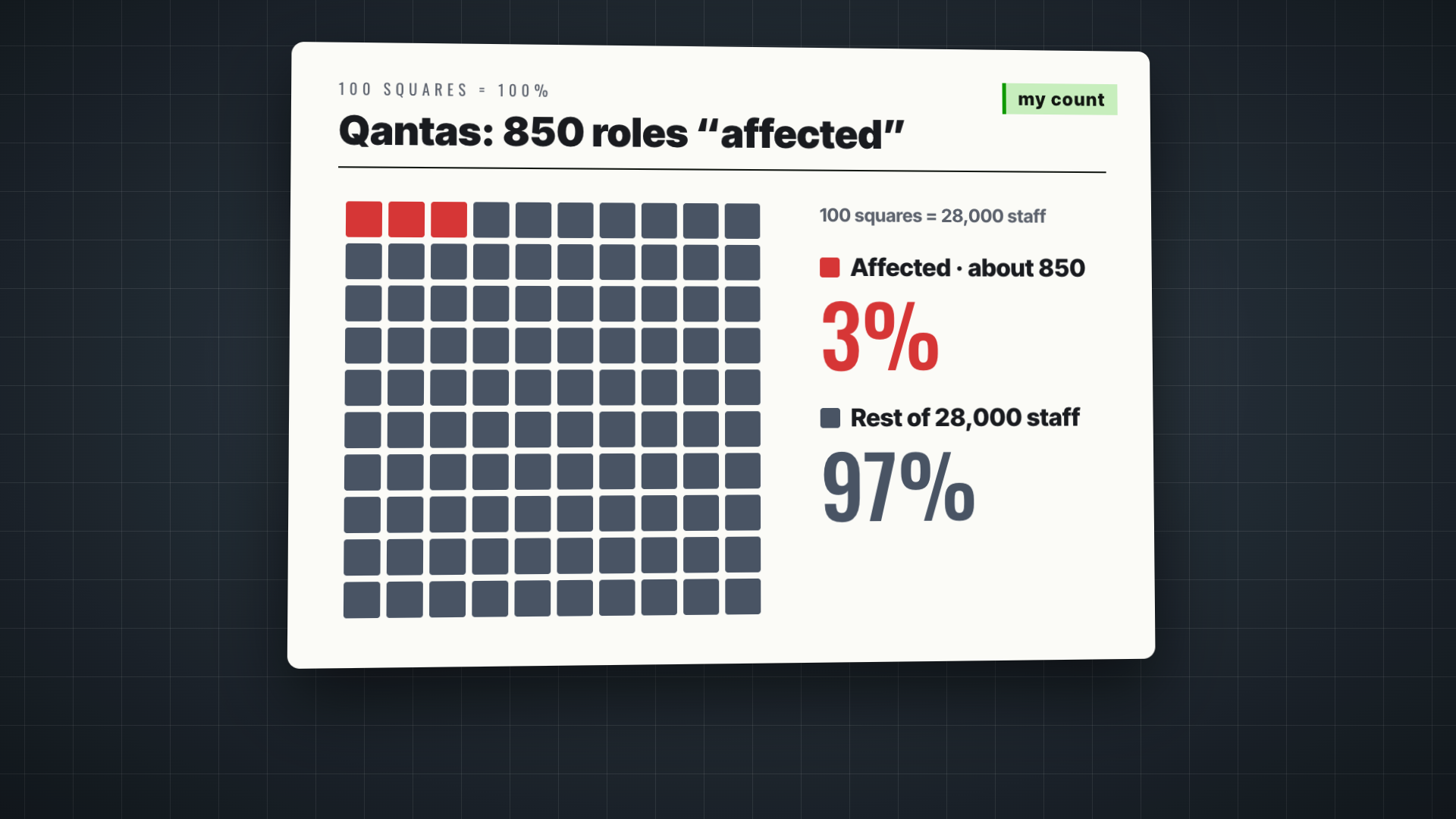
Many of them are going overseas. Qantas recently signed a multi-year deal with the consulting and outsourcing firm Accenture to rebuild its decades-old back-office systems, processes and data management, using more AI. About 850 roles will be affected, around 3% of its 28,000 staff in Australia.
Finance, procurement, HR and marketing go first, mainly to Accenture's team in India, with a small part staying here. The first changes are due by mid-2027 and will go on for years. Qantas says it'll consult staff and unions first and redeploy people where it can.
So we won't know the real job losses until those talks end. For the people losing their jobs, finding the next one is only part of the problem. In the past, you'd move to another company and do the same work. Now that this work is moving overseas, those jobs in Australia are disappearing.
Qantas isn't the first, and the banks moved earlier. On 20 October, NAB announced up to 2,500 job cuts, about 6% of its workforce, mostly in back-office roles. That same day, it put up 172 job ads in Asia, mostly in Vietnam and India. So it's likely some of the jobs cut here have gone to cheaper places overseas.
Bunnings then announced 230 technology job cuts and said it won't renew some outsourcing contracts. That work is going to the IT firm TCS's teams in Australia, India and the Philippines. On 12 and 13 November, Parliament's House Economics Committee questioned the big four bank CEOs. The day before, its chair said the banks are moving Australian jobs offshore while reporting very high profits.
Company | Where the work is going | Detail |
Qantas | Mainly Accenture's team in India; a small part stays in Australia | About 850 roles; first changes due by mid-2027 |
NAB | 172 job ads in Asia, mostly in Vietnam and India | Posted the same day as up to 2,500 job cuts |
Bunnings | TCS's teams in Australia, India and the Philippines | 230 technology job cuts |
Is the Australian Unemployment Rate About to Get Worse?
Yes, and the whole job market is already getting worse. The market expected October employment to rise by more than 20,000. Instead, it fell by 43,500, mostly in part-time jobs, and the number of unemployed rose by almost 18,000. The unemployment rate rose to 4.9%.
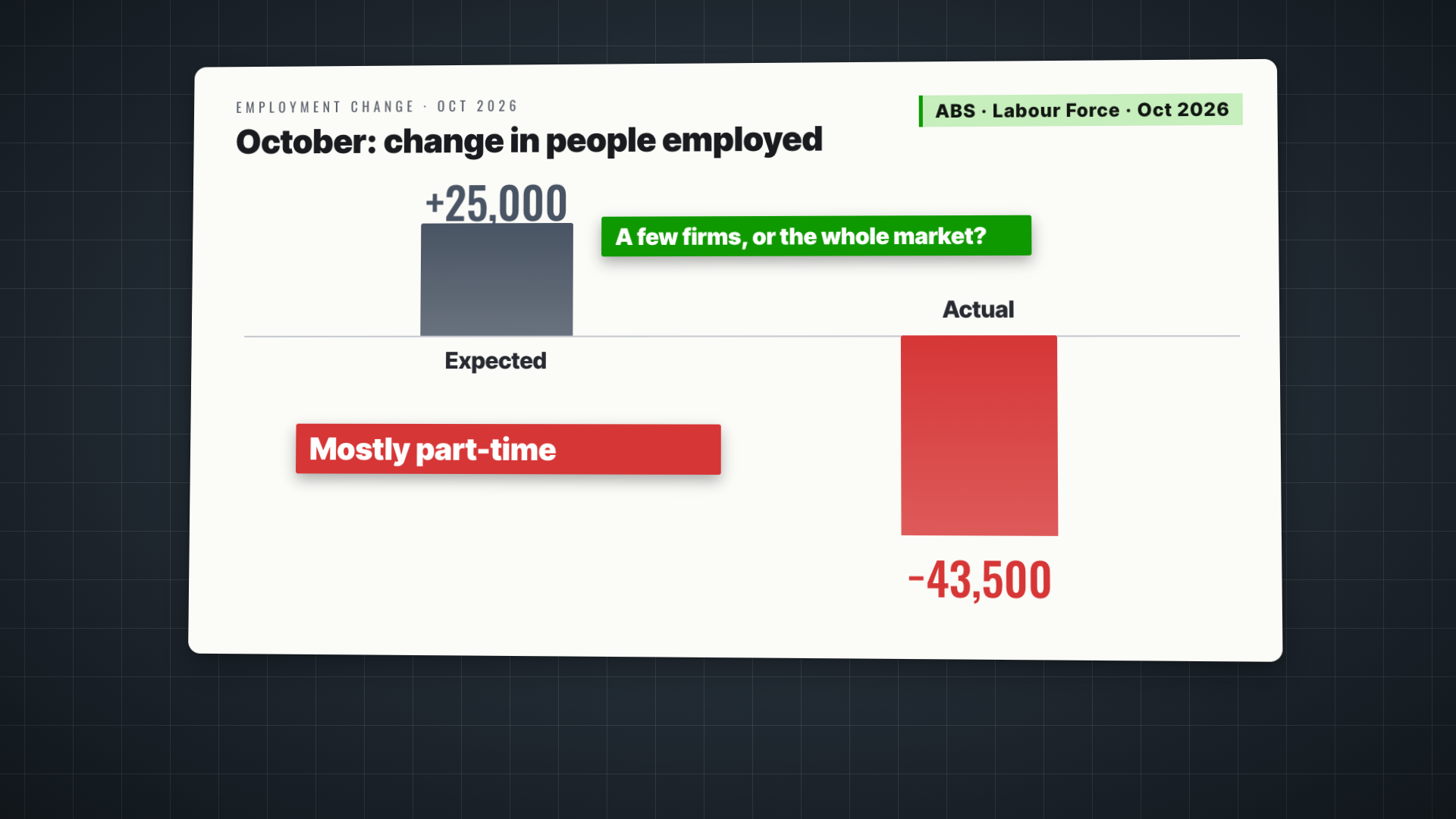
The October survey ran from late September to 10 October, before NAB, Canva and David Jones announced their cuts. Most of NAB's affected staff are still working, and David Jones staff leave at year's end. Those job losses won't show up in the data until early 2027.
On 3 November, the RBA made its fifth 0.25% hike this year, taking the cash rate to 4.85%. Every hike the banks pass on lifts variable-rate mortgage repayments. Businesses pay more to borrow too, and small and medium ones on thin margins may lay off staff again, or even close. Cooling the economy to bring inflation down is the whole point of hiking, so the RBA would have expected the job market to weaken.
The RBA's November forecasts don't have unemployment reaching 5.1% until the end of 2028, yet it's already 4.9%. The banks are more pessimistic. Public sector jobs grew 2.3% in the year to June 2026, the slowest since 2019-20. In August, private sector vacancies fell while government vacancies kept rising, so it's private businesses that are pulling back.
Source | Unemployment rate | When |
ABS, actual | 4.9% | October 2026 |
RBA, November forecast | 5.1% | Not until the end of 2028 |
NAB, expected peak | 5.5% | Timing not stated |
Westpac, expected peak | 5.2% | Mid-2027 |
Why Are White-Collar Jobs Being Hit First?
Because back-office work doesn't involve customers. If it moves elsewhere or to another company, customers barely notice, so these roles are the easiest to cut and hand over. The chief economist at the financial company AMP says this round is hitting more white-collar workers, across a wider range of jobs.
I couldn't find data on whether higher-paid staff are being cut first, so for now, the clearest pattern is the type of job. Young people have it even harder. October unemployment for 15 to 24-year-olds was 11.3%, also the highest since October 2021.
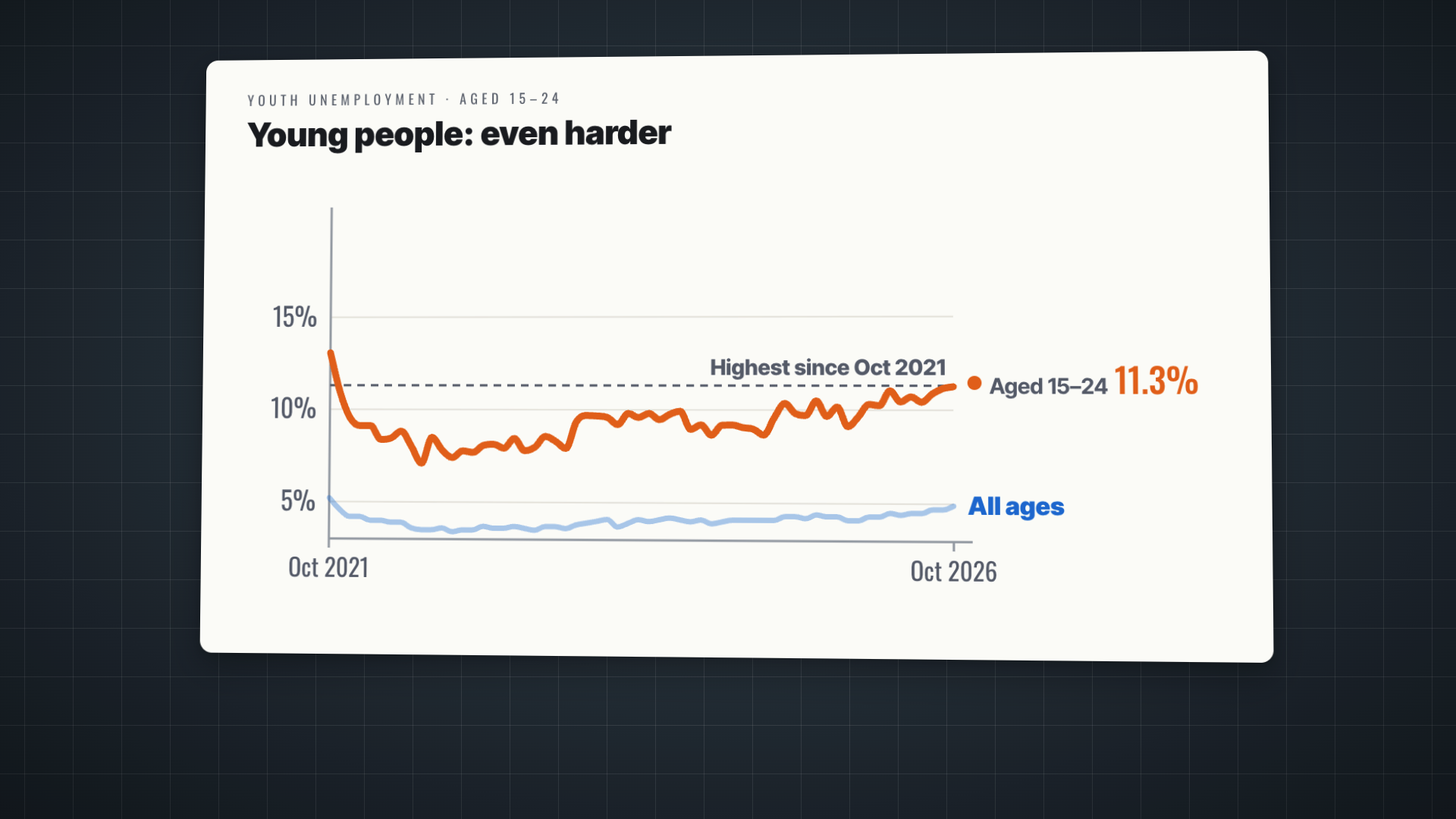
If your child has just graduated, a first job will probably be harder to land than in recent years.
The banks have been cutting in stages all along. Westpac made two more rounds of cuts in October, and the Commonwealth Bank, or CBA, made several smaller ones this year. ANZ announced a big round in September 2025. One media tally puts the big four's cuts, made or planned, at about 6,000 jobs since then. So bank cuts didn't start in the last two months. They've come round after round.
KPMG cut jobs in August, mainly in consulting, and again on 18 November, about 630 roles this year, partners included. After a scandal, it lost most of its government contracts, and it's been barred from new federal ones since June 2026. Its consulting revenue has fallen by at least a third since July. For firms like KPMG, the cuts came because revenue fell first.
Why Do Australian Companies Send Jobs Overseas?
Mostly because of cost. Teams in India and the Philippines used to handle mainly customer service, data entry and repetitive admin. Now it's white-collar work that needs professional skills, like technology, finance and HR, and that's the kind of work leaving Australia in this round of cuts.
At the banks, CBA's staff in India grew from 2,800 in 2022 to 6,700 in June 2025. Add about 11,000 at ANZ in India and Manila and about 7,000 at NAB in India and Vietnam, and that's more than 20,000 people across three banks.
Is AI behind the cuts? Canva's layoff letter doesn't mention AI once, and Canva says the affected roles weren't replaced by AI. NAB's CEO told the parliamentary hearing that its cuts aren't because of AI either. On 9 November, an RBA assistant governor said there's little evidence so far that AI has caused widespread job losses.
Unions and University of Sydney academics say some companies use AI as cover for outsourcing. My read is that, more often, AI is just a convenient story. What's really pushing companies to send jobs offshore is cost. If you work in finance, procurement, HR, marketing or technology, the question this round is whether your own work will move overseas too.
Bank | Staff overseas | Where |
CBA | 2,800 in 2022; 6,700 in June 2025 | India |
ANZ | About 11,000 | India and Manila |
NAB | About 7,000 | India and Vietnam |
📌 Thinking about your own situation?
Book a free 15-minute call with one of our property investment strategists and get a straight answer, no strings. For the full done-for-you path, from strategy, lending and property selection to portfolio, tax structure and wealth planning, book a free 30-minute Discovery Session and see how VISION Gold Membership works.
How Long Can a Family With a Mortgage Last After Redundancy?
In our first example, about 17 months. A Sydney couple has an $800,000, 30-year mortgage at an average variable rate of 6.99%, paying $5,300 a month in principal and interest. The husband has worked in IT at a bank for eight years on a $150,000 salary, and he's just been made redundant.
With eight years but not nine, he gets 14 weeks' redundancy pay, about $40,000, plus four weeks' pay in lieu of notice, about $11,500. Together, that's about $52,000. His wife takes home $6,250 a month after tax, so the household is about $3,000 short each month.
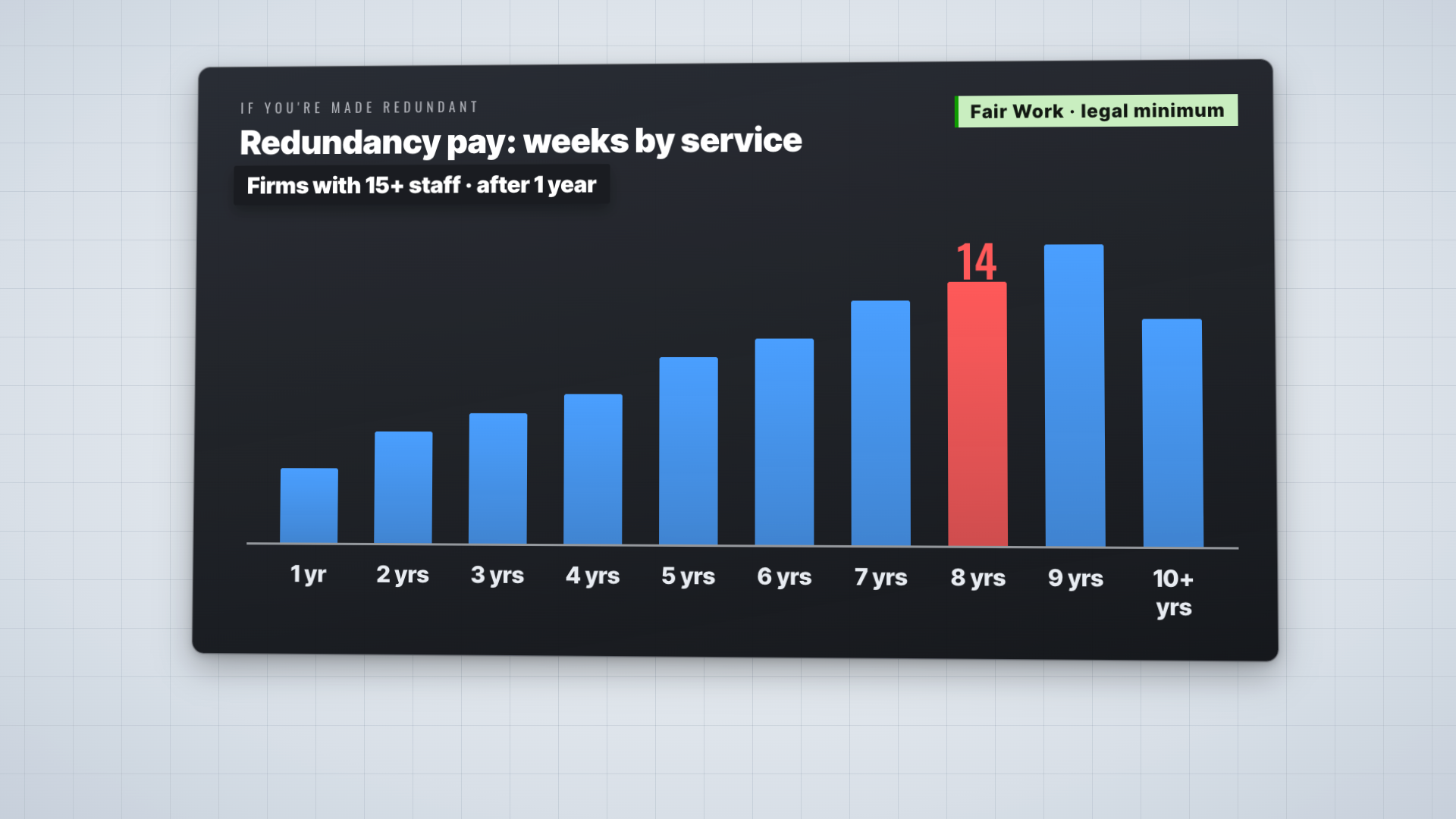
Redundancy pay kicks in at businesses with 15 or more employees once you've worked there a year. Pay in lieu of notice is the wages for a notice period you're not asked to work. He's under 45 with more than five years of service, so his notice period is four weeks.
If it's a genuine redundancy, where the job itself is abolished, that money is tax-free up to a limit set by the ATO, our tax office. In 2026-27, the limit is $13,600, plus $6,800 for each full year of service, or about $68,000 for eight years. His $52,000 is under that, so he pays no tax on it.
The household spends $4,000 a month apart from the mortgage. With the $5,300 repayment on top and his wife's pay coming in, the $52,000 lasts about 17 months.
Item | Sydney couple | Melbourne family |
Mortgage and repayment | $800,000; $5,300 a month | $1 million; $6,600 a month |
Income after the job loss | Wife takes home $6,250 a month | None (one income) |
Other spending | $4,000 a month | $3,500 a month |
Redundancy pay plus notice | 14 weeks plus 4 weeks, about $52,000 | 7 weeks plus 3 weeks, about $23,000 |
How long it lasts | About 17 months | Just over two months |
What Happens to a Family on One Income?
The money runs out in just over two months. Our second example is in Melbourne, with a $1 million mortgage, one income, three years of service and a $120,000 salary. The same rules give seven weeks of redundancy pay plus three weeks' notice, about $23,000, also tax-free.
But the repayment alone is $6,600 a month, and with $3,500 of other spending, the family needs more than $10,000 a month. Neither example counts savings or government payments, and the only difference between the two households is a second income.
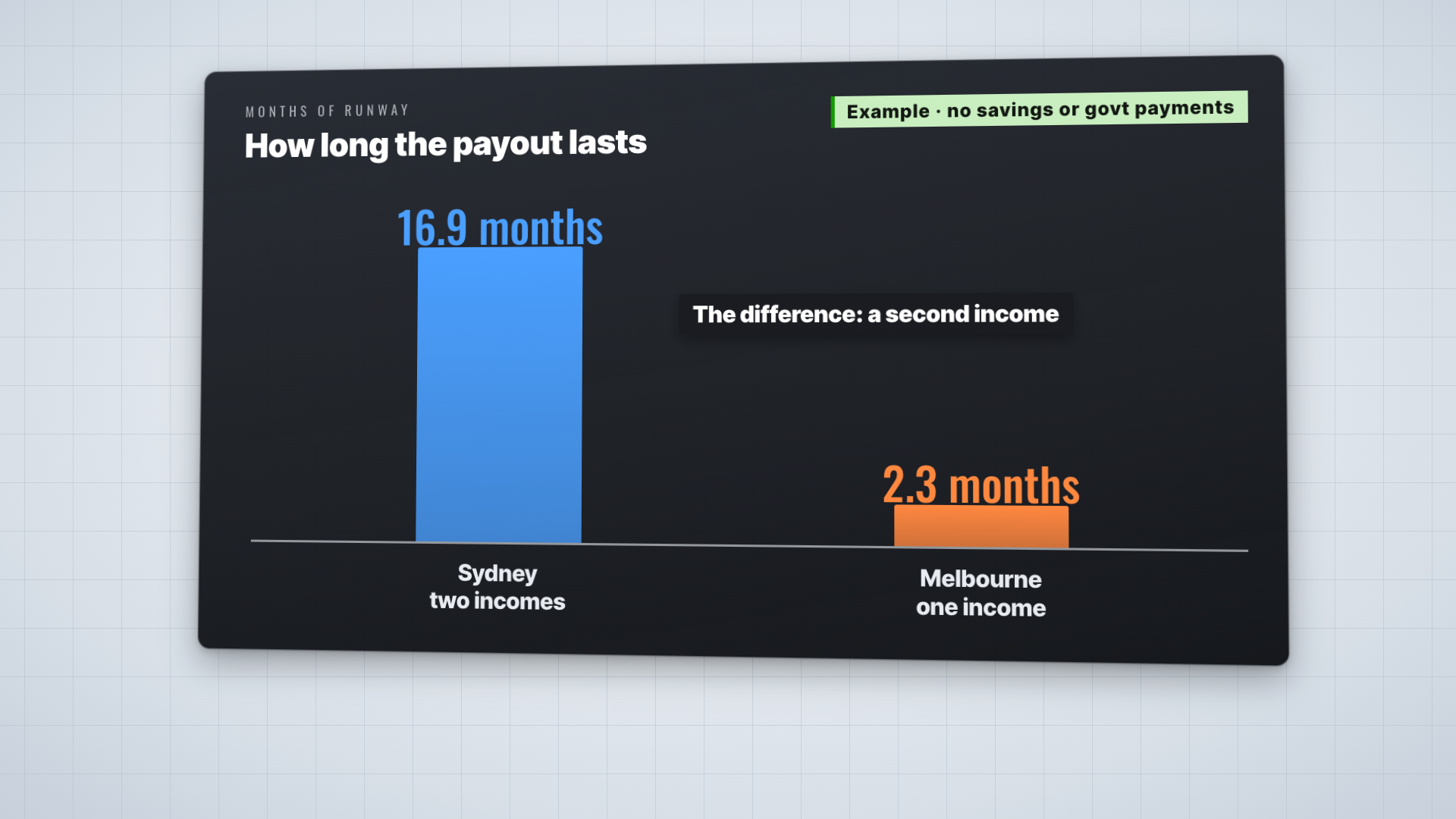
So when these cuts hit a family with a mortgage and one income, the blow is devastating. That's why I look at the whole household, not just the job, when I work out how exposed a family is to this wave.
If you still have a job, my advice is to stay put for now, and not to stretch your borrowing to buy property. The RBA and several big banks expect unemployment to keep rising into 2027. That means changing jobs or taking on a bigger loan carries more risk than usual.
Many of the job cuts announced in this wave won't take effect until 2027. The next few months of jobs data will probably look worse, so a household on one income has less time to prepare than the headline rate suggests.
Is the RBA Done Raising Interest Rates?
Probably, but it isn't certain. The RBA's nine-member rate-setting board voted 6 to 3 for the 3 November hike, and its statement said house prices have fallen significantly. After September's hike, the statement said the RBA would hike again if needed, but in November, that line was gone.
The minutes show the three who voted against wanted to hold rates. They were worried about a much sharper downturn, rising unemployment and a falling property market dragging down the economy. After the October jobs figure, financial markets stopped betting on a hike on 8 December.
CBA's economists say a December hold is all but locked in. CBA and NAB expect rate cuts to start around August 2027, and ANZ in November 2027. Westpac and NAB both say this hiking cycle is over.
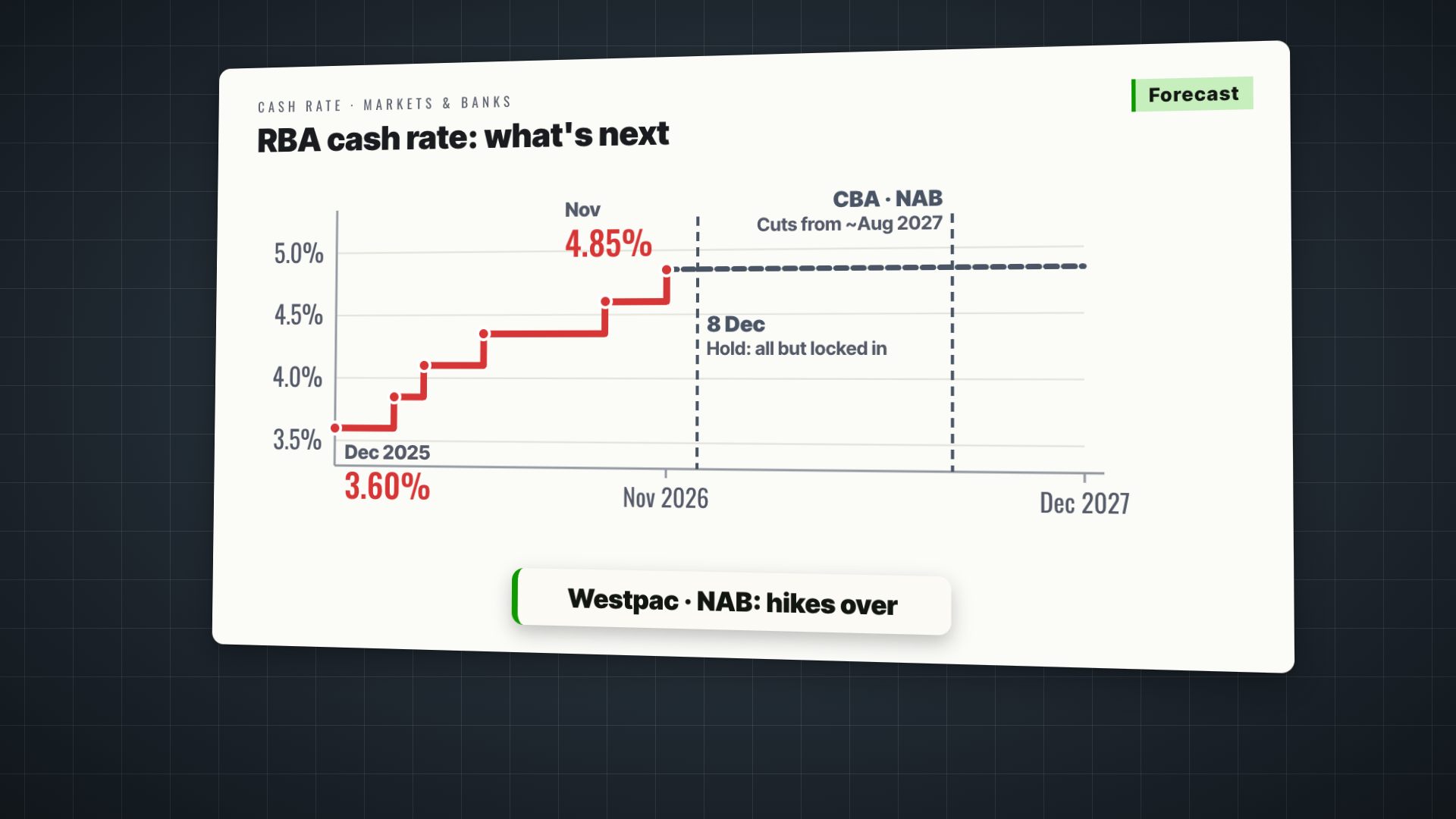
On 20 November, NAB cut its two- and three-year fixed rates by up to 0.28%. Fixed rates reflect where banks think interest rates are heading. In a month when more than 20 lenders raised theirs, NAB was the only big four bank cutting. It's most likely betting that rates will come down.
The hikes may not be over, though. The ABS's latest inflation figure is 4.3% for September, still above the RBA's 2% to 3% target. Westpac says a February 2027 hike can't be completely ruled out.
With the Unemployment Rate at 4.9%, Has Property Seen the Worst?
I think we may be seeing the worst of the bad news for the current cycle, but I'm not saying prices have bottomed. Confidence is still very weak. In November's Westpac-Melbourne Institute survey, confidence among people with a mortgage hit its lowest since records began in 1994.
Auction clearance rates on the weekend of 14 and 15 November were the lowest since April 2020, and the preliminary rate on 21 November was 46.9%, still below 50%. The property data firm Cotality says capital city home values have fallen 8.1% in the seven months since their March 2026 peak.
That's the fastest pace in 40 years. The record fall was 8.2%, from 2017 to 2019, and this one has nearly matched it in just seven months. So my view is that, from here, the market is more likely to get better than worse. It may still need a bit more time to recover, but I already see some signs of hope further ahead.
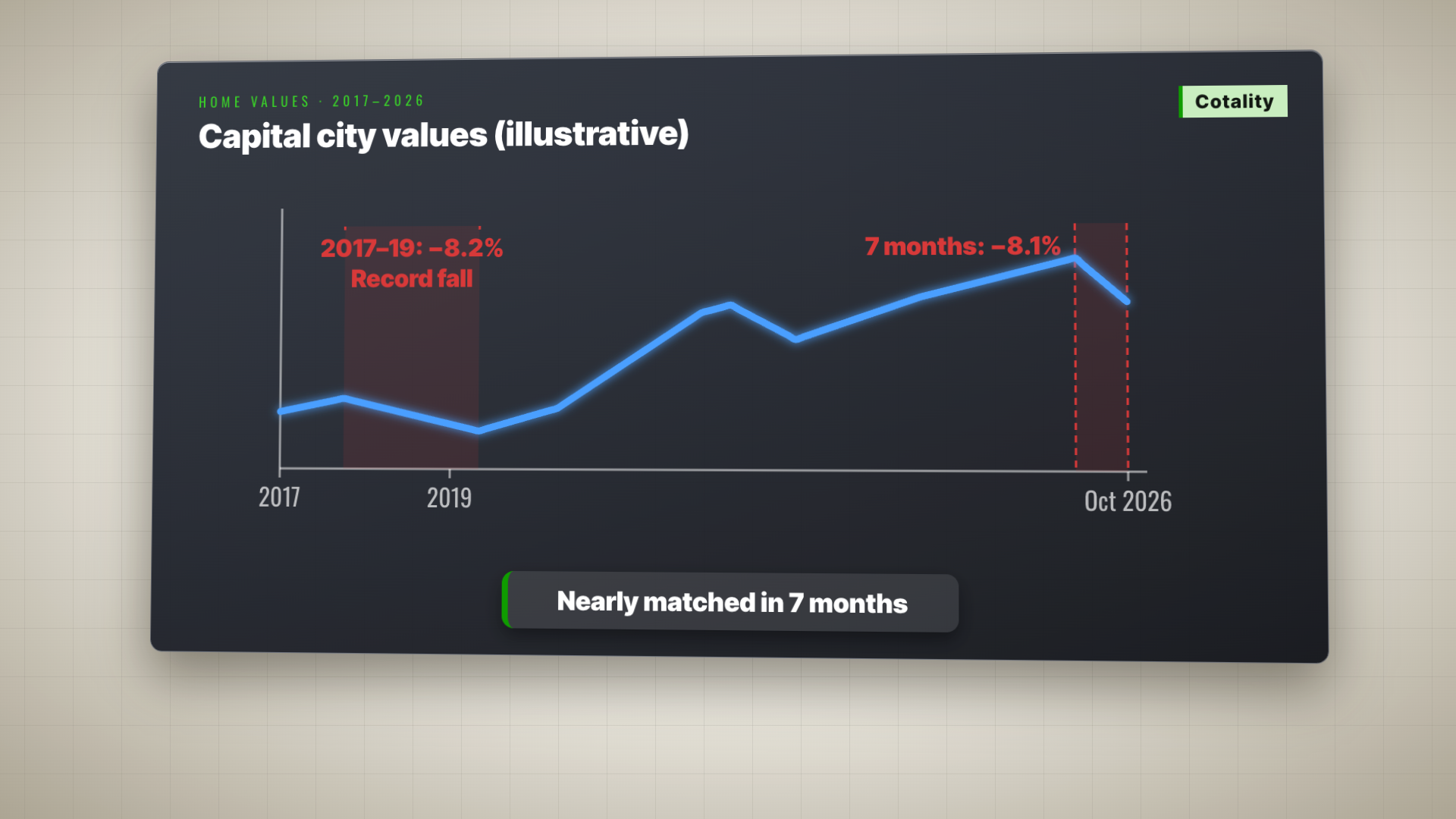
With unemployment this high, the rate hikes have probably run their course. However, many of the job cuts announced in this wave won't take effect until 2027, so the bad news on the jobs front is only just beginning. Consumer confidence will also take time to rebuild.
Indicator | Latest reading | For comparison |
Confidence among people with a mortgage (November) | Lowest on record | Records began in 1994 |
Auction clearance rates, weekend of 14 and 15 November | Lowest since April 2020 | Preliminary rate on 21 November: 46.9% |
Capital city home values (Cotality) | Down 8.1% in seven months since the March 2026 peak | Record fall: 8.2%, from 2017 to 2019 |
Frequently Asked Questions
What is the Australian unemployment rate now?
The ABS said on 19 November that unemployment rose to 4.9% in October 2026, the highest since October 2021. Employment fell by 43,500 when the market expected a rise of more than 20,000. The survey ran before several big job cut announcements, so the next few months will probably look worse.
Which Australian companies announced job cuts in late 2026?
Between 20 October and 18 November, NAB, Westpac, Canva, Woodside, David Jones, Qantas, Bunnings and KPMG announced cuts or restructures, adding up to more than 7,000 jobs. Some figures are global, some count affected roles including redeployments, and NAB's cuts run until September 2027.
Why are Australian jobs moving offshore?
Mainly because of cost. Back-office work in finance, HR, procurement and technology doesn't involve customers, so it's the easiest to move. Qantas is sending some of this work mainly to Accenture's team in India, and CBA, ANZ and NAB have more than 20,000 staff between them in India, Manila and Vietnam.
How much redundancy pay do you get in Australia?
It depends on your years of service. At businesses with 15 or more employees, eight years but not nine gives 14 weeks' pay, and three years gives seven weeks. A genuine redundancy is tax-free up to $13,600 plus $6,800 for each full year of service in 2026-27.
Will the RBA raise interest rates again?
Probably not, but it isn't certain. The board voted 6 to 3 for the November hike and dropped its line about hiking again if needed. Westpac and NAB say this hiking cycle is over, but September inflation was 4.3%, and Westpac says a February 2027 hike can't be completely ruled out.
Have Australian house prices hit the bottom?
Not necessarily. Cotality says capital city home values have fallen 8.1% in the seven months since the March 2026 peak, nearly matching the record 8.2% fall from 2017 to 2019. My view is that we may be seeing the worst of the bad news for this cycle, but prices haven't necessarily bottomed.
What Should Families With a Mortgage Do Now?
My view is that, with the unemployment rate at 4.9%, the rate hikes have probably run their course. The bad news on the jobs front, though, is only just beginning, because many of the cuts announced in this wave won't take effect until 2027. I'm not saying prices have bottomed, but I do think we may be seeing the worst of the bad news for the current cycle. Consumer confidence will take time to rebuild. If your household depends on one income, work out now how long your money would last if that job went.
Stay put in your job for now
Avoid taking on a bigger loan
Work out how long redundancy pay would last
Check how your household copes on one income
Expect more job cuts to land in 2027
Watch the next few months of jobs data
Book your free strategy call today.
Prefer to watch? See the full APS186 video on YouTube →
About the author
Alex is the founder of AusPropertyStrategy, a Sydney-based licensed buyer's agent and property investment strategist with dual master's degrees in accounting and an MBA, and a former general manager of a listed company. For APS186, he went through the ABS October 2026 labour force figures, the job cut announcements from eight big companies, redundancy and ATO tax rules, the RBA's November decision, forecasts and minutes, and the latest Cotality and Westpac-Melbourne Institute figures.
What we tested: how far the 7,000-plus job cut total holds up once global, "affected" and future roles are separated; where the offshored work is going; redundancy pay, notice and the ATO tax-free limit for a Sydney couple and a one-income Melbourne family; and what the RBA's vote, the banks' rate forecasts and the latest property data say about whether this is peak bad news.
About the figures: unemployment and employment figures are from the ABS October 2026 labour force release (19 November 2026). The job cut figures come from company announcements and media reports between 20 October and 18 November 2026, and some are global figures or count "affected" roles. The RBA figures are from its 3 November 2026 decision, statement, forecasts and minutes, and the property figures are from Cotality, the Westpac-Melbourne Institute survey and preliminary auction clearance rates. The household examples are simplified and ignore savings and government payments. This is general information, not financial advice.


